• About
  • Buy Bankruptcy Adversary Package
  • Buy Foreclosure Defense Package
  • Contact Us
  • Donation
  • FAQ
  • Services

FightForeclosure.net

~ Your "Pro Se" Foreclosure Fight Solution!

FightForeclosure.net

Category Archives: Appeal

Why Homeowners Need to Shift the Burden of Proof To Foreclosure Mills

05 Thursday Dec 2013

Posted by BNG in Affirmative Defenses, Appeal, Case Laws, Case Study, Federal Court, Foreclosure Defense, Fraud, Judicial States, Non-Judicial States, Pleadings, Pro Se Litigation, State Court, Trial Strategies, Your Legal Rights

≈ Leave a comment

Tags

Bank of America, Borrower, Foreclosure, MERS, Mortgage Electronic Registration System, Ohio, U.S. Bancorp, US Bank

CASE STUDY:

This case brings to mind why homeowner MUST shift the burden of proof to foreclosure mills in order to save their homes or the courts will ‘assume’ that the burden rests on the homeowner. (Which it does not). Borrower has no burden of proof as the burden of proof is squarely shouldered by the illegal entity bringing a judicial or non judicial foreclosure proceeding against the homeowner, in order for them to show that either they owns the Note or had the rights of enforcement on the Note. Even if they “own the Note,” they might not have the “right to enforce it”, even if they are “holder of the note, and does not own it“, they might not have “standing to bring the action“, per UCC. (That is the law of negotiable instruments – and your “Note” is a negotiable instrument just like a “Check”.

SO FOLKS! DO YOUR HOMEWORK AND MAKE THEM PROVE IT! DO NOT LOSE YOUR DREAM HOME BASED ON MERE IGNORANCE!

U.S. BANK NATL. ASSN. v. SPICERNo. 9-11-01

2011 Ohio 3128 U.S. Bank National Association, As Trustee On Behalf of the Home Equity Asset Trust 2007-3 Home Equity Pass-Through Certificates, Series 2007-3, Plaintiff-Appellee,
v.
Gregory M. Spicer, Defendant-Appellant, and
Mortgage Electronic Registration Systems, Inc., et al., Defendants-Appellees.
Court of Appeals of Ohio, Third District, Marion County.
Date of Decision: June 27, 2011.

OPINION

SHAW, J.

{¶1} Appellant, Gregory M. Spicer (“Spicer”) appeals the December 9, 2010 judgment of the Marion County Court of Common Pleas overruling his “Motion for Rule 60(B) to Vacate Judgment and Motion to Stay Sheriff’s Sale.”

{¶2} On November 22, 2006, Spicer executed a promissory note with Intervale Mortgage Corporation (“Intervale”) for a mortgage loan in the amount of $212,000.00 to purchase a residence located at 1517 Eagle Links Drive in Marion, Ohio. The loan documents identified Decision One LLC (“Decision One”) as Intervale’s servicing agent and Mortgage Electronic Registration Systems, Inc. (“MERS”) as Intervale’s nominee for matters related to Spicer’s loan. The mortgage was recorded in the Marion County Recorder’s office on December 1, 2006.

{¶3} In February of 2007, Spicer received a letter from Select Portfolio Servicing (“SPS”) notifying him that the servicing of his mortgage loan had been transferred from Decision One to SPS and that, as of March 1, 2007, SPS would be the entity receiving his mortgage payments.

{¶4} On September 22, 2008, Bill Koch, an assistant secretary for MERS, issued a “corporate assignment of mortgage,” which evidenced that MERS, as nominee for Intervale, assigned Spicer’s mortgage to Appellee, U.S. Bank National Association, as trustee, on behalf of the holders of the Home Equity Asset Trust 2007-3 Home Equity Pass-Through Certificates, Series 2007-3 (“U.S. Bank”). This assignment of Spicer’s mortgage was subsequently recorded in the Marion County Recorder’s office.

{¶5} On September 25, 2008, U.S. Bank filed a complaint for foreclosure against Spicer alleging the note to be in default because Spicer failed to make the monthly payments on the note since April 28, 2008, and the default had not been cured. The complaint alleged that a balance of $208,865.11, plus interest remained outstanding on the promissory note. U.S. Bank requested judgment against Spicer for this amount, plus late charges, advances made for the payment of taxes, assessments, insurance premiums, or cost incurred for the protection of the mortgaged premises. U.S. Bank also requested the trial court to order a foreclosure and sale of the property. The record demonstrates that Spicer was properly served with the complaint on October 21, 2008.

{¶6} Spicer failed to appear or otherwise enter into the action and on January 5, 2009, U.S. Bank filed a motion for default judgment which was subsequently granted by the trial court. On January 12, 2009, the trial court entered a decree in foreclosure and ordered the property to be sold. The property was scheduled for a Sheriff’s sale on April 17, 2009.

{¶7} On April 13, 2009, Spicer sent an ex parte letter to the trial court requesting a stay in the sale proceedings. Spicer’s letter was placed in the record with a “received” stamp, but was not “file-stamped” by the clerk of courts. Moreover, there is no evidence that Spicer served this letter on counsel for U.S. Bank or that U.S. Bank was otherwise made aware of the existence of this letter.

{¶8} On April 23, 2009, U.S. Bank filed a “Motion to Vacate Order for Sale and Withdraw Property from Sale” with the trial court. In this motion, U.S. Bank informed the court that “Plaintiff and the borrower have entered into a loss mitigation agreement.” On April 24, 2009, the trial court granted U.S. Bank’s motion to withdraw the property from the scheduled Sheriff’s sale.

{¶9} On June 23, 2009, U.S. Bank filed an “Alias Praecipe for Order for Sale” requesting an order of sale and for the Sheriff to appraise, advertise, and sell the property.

{¶10} On August 10, 2009, a notice of sale was filed. The sale was scheduled to take place on September 18, 2009. U.S. Bank subsequently filed another “Motion to Vacate Order for Sale and Withdraw Property from Sale” stating that the parties “have entered into a forbearance agreement.” The trial court subsequently granted U.S. Bank’s motion to vacate the order of sale.

{¶11} On March 31, 2010, U.S. Bank filed a second “Alias Praecipe for Order for Sale” requesting an order of sale on the property and notice of sale was subsequently filed, scheduling the sale of the property. On June 22, 2010, U.S. Bank then filed a third “Motion to Vacate Order for Sale and Withdraw Property from Sale.” The reason cited for this motion was that the parties “are in the process of negotiating a loss mitigation agreement.”

{¶12} On July 12, 2010, the trial court granted U.S. Bank’s motion to withdraw the property from the Sheriff’s sale; however, the court also noted in its order that “No further withdrawals of sale will be allowed.”

{¶13} On July 15, 2010, U.S. Bank filed a “Pluries Praecipe for Order for Sale without Reappraisal” requesting that another order of sale be issued on the property. Sale of the property was scheduled for November 19, 2010.

{¶14} On October 21, 2010, nineteen months after the trial court issued its decree in foreclosure on the property, Spicer filed a “Motion for Rule 60(B) to Vacate Judgment and Motion to Stay Sheriff’s Sale.” Notably, this is the first formal appearance entered by Spicer in this action. In this motion, Spicer argued that he was never given the original loan documents evidencing his loan with Intervale, and that his original loan had been “shuffled around and assigned to various parties.” Spicer further alleged that there is no proof U.S. Bank was properly assigned the promissory note and mortgage. Spicer also claimed that he is a victim of “robo-signing”1 by SPS, the servicing agent for his mortgage loan. In support of his motion, Spicer attached several internet articles and blogs, which generally discussed the alleged misconduct of some mortgage companies.

{¶15} In this motion, Spicer also requested that the trial court stay the Sheriff’s sale until it can be proven “who has actual position [sic] and ownership of the original mortgage and standing to foreclose on the mortgage.” However, he failed to specifically claim in this motion that he is entitled to relief pursuant to any of the enumerated grounds listed in Civ.R. 60(B) with respect to his instant case, or otherwise attempt to satisfy any the requirements a movant must prove in order to be entitled to Civ.R. 60(B) relief from judgment.

{¶16} On October 25, 2010, Spicer filed a supplement to his “Motion for Rule 60(B) to Vacate Judgment and Motion to Stay Sheriff’s Sale” and attached several more unauthenticated articles and documents about MERS and Intervale, which were not of direct relevance to his case.

{¶17} On October 28, 2010, Spicer filed another supplement to his “Motion for Rule 60(B) to Vacate Judgment and Motion to Stay Sheriff’s Sale,” attaching an amicus brief written by the Ohio Attorney General, which was filed in relation to a Cuyahoga County case, a separate and distinct case from Spicer’s case. Spicer argued that this other case was of particular relevance to his case because it involved U.S. Bank and its counsel of record in the case sub judice. Spicer urged the trial court to impute to his case any misconduct alleged against U.S. Bank in the Cuyahoga County case. Spicer also filed more internet articles generally examining the causes of the mortgage crisis, specifically the role of “robo-signing” by lenders in foreclosure actions.

{¶18} On November 4, 2010, Spicer filed a third supplement to his “Motion for Rule 60(B) to Vacate Judgment and Motion to Stay Sheriff’s Sale,” now arguing that U.S. Bank had no standing to bring the underlying foreclosure action because the original mortgage lender, Intervale, did not have authority to execute mortgages in Ohio. Spicer further argued that U.S. Bank did not sign the original promissory note and does not have the original “wet ink” promissory note in its possession. Spicer also identified, for the first time, the two individuals who signed affidavits in support of the foreclosure proceedings from MERS and SPS,2 and accused them of being “robo-signers” who “lack personal knowledge of the facts herein.” (Supp. Mot. Nov. 4, 2010 at 2).

{¶19} Notably, in each of his supplements to his “Motion for Rule 60(B) to Vacate Judgment and Motion to Stay Sheriff’s Sale,” Spicer again failed to identify any grounds on which he is entitled to relief pursuant to Civ.R. 60(B).

{¶20} On November 8, 2010, U.S. Bank filed its memorandum in opposition to Spicer’s “Motion for Rule 60(B) to Vacate Judgment and Motion to Stay Sheriff’s Sale.” U.S. Bank argued that Spicer failed to satisfy the burden required to be shown by a movant that he or she is entitled to relief from judgment under Civ.R. 60(B). Specifically, U.S. Bank asserted that Spicer failed to identify what grounds, if any, exist for vacating the judgment, provide any operative facts or admissible evidence in support of such grounds, failed to identify a meritorious defense to the foreclosure proceedings—i.e. why the loan is not in default for Spicer’s non-payment, and that his Civ.R. 60(B) motion was not timely.

{¶21} U.S. Bank further asserted that it is the real party in interest to bring the foreclosure proceedings and argued that Spicer had waived this issue by failing to raise it until nineteen months after the decree in foreclosure was entered by the trial court.

{¶22} On November 15, 2010, Spicer filed a “Reply Brief” to U.S. Bank’s memorandum in opposition to his “Motion for Rule 60(B) to Vacate Judgment and Motion for Stay of Sheriff’s Sale.” In his response, Spicer urged the trial court to follow a procedural rule adopted by the Cuyahoga Court of Common Pleas requiring plaintiffs to follow certain directives in filing complaints for foreclosure in that court. Spicer also, for the first time, alleged that he is entitled to relief on one of the grounds listed in Civ.R. 60(B), specifically Civ.R. 60(B)(5), which is the “catch-all” provision under the rule, permitting the court to vacate a judgment “for any other reason justifying relief from the judgment.” Civ.R. 60(B)(5). Spicer argued that U.S. Bank “is perpetrating a fraud upon this court” and asserted several unsubstantiated allegations to support his position. Spicer also maintained that his motion is timely because Civ.R. 60(B)(5) does not state a specific timeframe to bring the motion, but rather requires the motion to be filed within a “reasonable time.”

{¶23} U.S. Bank filed a response to Spicer’s “Reply Brief” on November 19, 2010, and attached several documents refuting Spicer’s various allegations, including that it was not the real party in interest under Civ.R. 17(A) to file the foreclosure action.

{¶24} On November 22, 2010, U.S. Bank filed a fourth “Motion to Vacate Order for Sale and Withdraw Property from Sale” requesting the trial court to temporarily refrain from executing the sale in order for U.S. Bank to comply with recent directives issued by the U.S. Treasury Department.

{¶25} On December 9, 2010, the trial court issued its decision overruling Spicer’s “Motion for Rule 60(B) to Vacate Judgment and Motion for Stay of Sheriff’s Sale.” Specifically, the trial court determined that Spicer failed to timely raise the defense that U.S. Bank was not the real party in interest under Civ. R. 17(A). The trial court also concluded that Spicer failed to satisfy his burden demonstrating he is entitled to relief under Civ.R. 60(B)(5). Furthermore, the trial court found the following with respect to Spicer’s allegations of misconduct by SPS:

As no misconduct has been alleged against [SPS], Defendant Gregory Spicer has not shown sufficient grounds [for] the granting of relief from judgment in this action. This is particularly true since said Defendant did nothing to object to the original judgment being rendered in this action, and did nothing to attempt to obtain relief from judgment until 21 [sic] months after the Judgment was rendered in this action. Said Defendant has made absolutely no showing that he had not failed to make his mortgage payments as agreed under the promissory note.

(JE, Dec. 9, 2010 at 4).

{¶26} Spicer subsequently filed this appeal, asserting the following assignments of error.

ASSIGNMENT OF ERROR NO. I THE TRIAL COURT ERRED IN THAT FORECLOSURE IN THIS ACTION WAS FILED ON JANUARY 12, 2009, AND THAT DEFENDANT GREGORY SPICER DID NOT FILE HIS MOTION FOR RELIEF FROM JUDGMENT UNTIL OCTOBER 21, 2010. THIS 21-MONTH DELAY IS WELL BEYOND THE ONE YEAR TIME LIMIT. ASSIGNMENT OF ERROR NO. II THE TRIAL COURT ERRED IN CONCLUDING THAT NOTHING IN THE RECORD OF THIS ACTION SHOWING THAT THE SERVICER OF THE MORTGAGE QUESTIONED, SELECT PORTFOLIO SERVICING, INC., OR THAT BILL KOCH HAS ENGAGED IN ANY OF THE MISCONDUCT.

{¶27} For ease of discussion, we elect to address Spicer’s assignments of error together.

{¶28} In his first assignment of error, Spicer claims that the trial court erred when it found that he did not file his Civ.R. 60(B) motion for relief from judgment until twenty-one months after the trial court rendered judgment on the foreclosure action.3 Spicer appears to argue that his April 13, 2009 ex parte letter to the trial court served as a functional equivalent for a Civ.R. 60(B) motion for relief from judgment and, therefore, his motion should be considered timely because it was sent to the court only three months after it rendered its foreclosure judgment.

{¶29} First, we observe that in his April 13, 2009 letter, Spicer simply requests the trial court to stay the Sheriff’s sale. In reviewing this letter, we note that Spicer fails to mention Civ.R. 60(B), let alone make any statement that can be construed as a request for relief from judgment under Civ.R. 60(B). In addition, Spicer neglects to cite any legal authority which supports his position that his ex parte letter, which does not contain the contents required by Civ.R. 60(B) in substance or in form, should be construed by the trial court as a timely filed motion for relief from judgment.

{¶30} Moreover, pursuant to App.R. 16(A)(7) we are not required to address arguments that have not been sufficiently presented for review or supported by proper authority. Therefore, it is well within our purview to disregard this assignment of error. See App.R. 12(A)(2). Nevertheless, in reviewing this issue we find no authority supporting Spicer’s contention that the trial court erred when it determined that he failed to file his Civ.R. 60(B) motion until twenty-one months after the foreclosure judgment was entered.

{¶31} Spicer also argues under this assignment of error that the trial court erred in determining that he is not entitled to relief from judgment under Civ.R. 60(B)(5). Initially, we note that in order to prevail on a Civ.R. 60(B) motion, a party must show 1) a meritorious defense or claim to present if relief is granted; 2) the party is entitled to relief under one of the five enumerated grounds stated in Civ.R. 60(B)(1) through (5); and 3) the motion is made within the required timeframe. In re Whitman, 81 Ohio St.3d 239, 242, 690 N.E.2d 535, 1998-Ohio-466; Douglas v. Boykin (1997), 121 Ohio App.3d 140, 145, 699 N.E.2d 123.

{¶32} The elements entitling a movant to Civ.R. 60(B) relief “are independent and in the conjunctive; thus, the test is not fulfilled if any one of the requirements is not met.” Strack v. Pelton, 70 Ohio St.3d. 172, 174, 637 N.E.2d 914, 1994-Ohio-107. “The decision to grant or deny a motion to vacate judgment pursuant to Civ.R. 60(B) lies in the sound discretion of the trial court and will not be disturbed absent an abuse of discretion.” Id. An abuse of discretion means that the trial court was unreasonable, arbitrary, or unconscionable in its ruling. Blakemore v. Blakemore (1983), 5 Ohio St.3d 217, 219, 450 N.E.2d 1140.

{¶33} On appeal, Spicer argues that he is entitled to relief from judgment under Civ.R. 60(B)(5), which is the “catch-all” provision of the rule permitting a court to relieve a party from a final judgment for “any other reason justifying relief from the judgment.” This provision of the rule is not subject to the one-year limitation in filing as motions filed under Civ.R. 60(B)(1), (2), and (3).4 Rather, motions filed on the grounds of Civ.R. 60(B)(5) are required to be filed in a reasonable time.

{¶34} In support of his position, Spicer argues that U.S. Bank is not the real party in interest to bring these foreclosure proceedings and that U.S. Bank and its servicing agent SPS had committed a “fraud upon the court.” The trial court addressed both of these issues in its judgment entry overruling his “Motion for Rule 60(B) to Vacate Judgment and Motion to Stay Sheriff’s Sale.”

{¶35} First, with respect to Spicer’s argument that U.S. Bank is not the real party in interest to bring these foreclosure proceedings, we note that the trial court concluded that Spicer waived this argument because he failed to timely assert it. Civil Rule 17(A) provides, in pertinent part:

Every action shall be prosecuted in the name of the real party in interest. * * * No action shall be dismissed on the ground that it is not prosecuted in the name of the real party in interest until a reasonable time has been allowed after objection for ratification of commencement of the action by, or joinder or substitution of, the real party in interest.

{¶36} The Supreme Court of Ohio has stated that “[t]he purpose behind the real party in interest rule is to enable the defendant to avail himself of evidence and defenses that the defendant has against the real party in interest, and to assure him finality of the judgment, and that he will be protected against another suit brought by the real party at interest on the same matter.” Shealy v. Campbell (1985), 20 Ohio St.3d 23, 24, 485 N.E.2d 701.

{¶37} As previously noted by this Court, a majority of appellate courts infer that the defense that a party is not the real party in interest can be raised after an initial responsive pleading, and if it is not raised in a timeframe relative to that initial pleading stage in the proceedings, then the defense is waived. First Union Natl. Bank v. Hufford, 146 Ohio App.3d 673, 677, 2001-Ohio-2271, ¶13, 767 N.E.2d 1206 citing Travelers Indemn. Co. v. R.L. Smith Co. (Apr. 13, 2001), 11th Dist. No. 2000-L-014, Hang-Fu v. Halle Homes, Inc. (Aug. 10, 2000), 8th Dist. No. 76589, Robbins v. Warren (May 6, 1996), 12th Dist. No. CA95-11-200; see also Mid-State Trust IX v. Davis, 2nd Dist. No. 07-CA-31, ¶58 (affirming this principle on similar facts and concluding that the issue of standing for the real party in interest defense is waived if not timely asserted).

{¶38} Here, the record demonstrates that Spicer failed to enter a formal appearance in this action until more than nineteen months after the trial court entered its decree in foreclosure on the property. Spicer provides neither the trial court nor this Court with any explanation why he was unable to make any appearance in the underlying foreclosure proceedings, let alone timely raise this issue during the initial pleading phase. Rather, Spicer simply makes blanket assertions that U.S. Bank is not the real party in interest without submitting any evidence to substantiate his claim. Moreover, Spicer cites no legal authority to support his position. Accordingly, we do not find the trial court’s determination that Spicer failed to timely assert a real-party-in-interest defense to be an abuse of discretion.

{¶39} Spicer’s second basis that he is entitled to relief under Civ.R. 60(B)(5) is his assertion that U.S. Bank and SPS have committed a “fraud on the court.” In making this argument Spicer relies solely on Coulson v. Coulson, (1983), 5 Ohio St.3d 12, 448 N.E.2d 809. In Coulson, an attorney represented to the court that he was counsel for the Plaintiff in a divorce action at the same time he was colluding with the Defendant in the action, by drafting a separation agreement on the behalf of the Plaintiff at the direction and upon the terms dictated by the Defendant. Id. at 13. The domestic relations court relied on the attorney’s representation and approved the separation agreement and incorporated it into its judgment, unaware of the attorney’s prior arrangement with the Defendant. Id. The Supreme Court of Ohio determined that the attorney’s actions in this instance constituted a “fraud upon the court.” Id. at 16-17.

{¶40} As explained by the Supreme Court, fraud upon the court embraces the “`species of fraud which does or attempts to, defile the court itself, or is a fraud perpetrated by the officers of the court so that the judicial machinery cannot perform in the usual manner its impartial task of adjudging cases that are presented for adjudication.'” Coulson, 5 Ohio St.3d at 15 quoting MOORE’S FEDERAL PRACTICE (2 Ed.1971) 515, paragraph 60.33.

{¶41} As the basis for his claim that U.S. Bank and SPS committed a fraud upon the trial court, Spicer alleges that Bill Koch, the individual who effectuated the assignment of Spicer’s mortgage between Intervale and U.S. Bank, is a “robo-signer.” However, Spicer provided the trial court with no evidence to substantiate this claim other than unauthenticated internet articles discussing the alleged misconduct of mortgage lenders in the industry. There is nothing in these articles or Spicer’s unsupported allegations that can be construed as a “fraud upon the court.” Spicer simply failed to provide any relevant evidence to demonstrate misconduct on the part of U.S. Bank or its servicing agent, SPS in this matter.

{¶42} In addition, we note that Civ.R. 60(B)(5) applies only when a more specific provision of the rule does not apply. Strack v. Pelton (1994), 70 Ohio St.3d 172, 174, 637 N.E.2d 914, 1994-Ohio-107. Moreover, Civ.R. 60(B)(5) is not intended to be used as a substitute for any of the other more specific provisions of Civ.R. 60(B). Caruso-Ciresi, Inc. v. Lohman (1983), 5 Ohio St.3d 64, 448 N.E.2d 1365. Here Spicer’s allegations of misconduct against U.S. Bank and SPS are more akin to the traditional legal concept of fraud, which is specifically addressed by Civ.R. 60(B)(3). However, as previously mentioned, a motion filed pursuant to Civ.R. 60(B)(3) must be filed within one year from the entry of the judgment the movant seeks to vacate. Spicer’s “Motion for Rule 60(B) to Vacate Judgment” was filed several months after the expiration of this timeframe. Accordingly, for all these reasons we find that the trial court did not abuse its discretion when it concluded that Spicer is not entitled to relief under Civ.R. 60(B) and overruled his “Motion for Rule 60(B) to Vacate Judgment and Motion for Stay of Sheriff’s Sale.”

{¶43} Based on the foregoing, Spicer’s first and second assignments of error are overruled and the judgment of the Marion County Court of Common Pleas is affirmed.

Judgment Affirmed

ROGERS, P.J. and PRESTON, J., concur.

FootNotes

1. Here, Spicer is referring to media reports covering the alleged widespread misconduct by mortgage servicers and banks during foreclosing procedures. Such alleged misconduct includes employees of these entities signing affidavits purporting to have knowledge of the contents of foreclosure files that the employees never actually reviewed and, therefore, have no personal knowledge of relative to the foreclosure proceedings.2. SPS is also the servicer for U.S. Bank on Spicer’s mortgage.3. As a point of clarification, Spicer filed his “Motion for Rule 60(B) to Vacate Judgment and Motion for Stay of Sheriff’s Sale” nineteen months after the trial court entered its judgment of foreclosure. However, Spicer’s initial filing of his motion was captioned as a Civ.R. 60(B) motion, but contained none of the required substance of such a motion. It was not until two months later, twenty-one months after the trial court’s foreclosure judgment, that Spicer actually included Civ.R. 60(B) elements in his “Reply Brief.”4. Civil Rule 60(B) specifically provides, “On motion and upon such terms as are just, the court may relieve a party or his legal representative from a final judgment, order or proceeding for the following reasons: (1) mistake, inadvertence, surprise or excusable neglect; (2) newly discovered evidence which by due diligence could not have been discovered in time to move for a new trial under Rule 59(B); (3) fraud (whether heretofore denominated intrinsic or extrinsic), misrepresentation or other misconduct of an adverse party; (4) the judgment has been satisfied, released or discharged, or a prior judgment upon which it is based has been reversed or otherwise vacated, or it is no longer equitable that the judgment should have prospective application; or (5) any other reason justifying relief from the judgment. The motion shall be made within a reasonable time, and for reasons (1), (2) and (3) not more than one year after the judgment, order or proceeding was entered or taken. A motion under this subdivision (B) does not affect the finality of a judgment or suspend its operation.”

If you find yourself in an unfortunate situation of losing or about to your home to wrongful fraudulent foreclosure, visit: http://www.fightforeclosure.net

0.000000 0.000000

Share this:

  • Share on X (Opens in new window) X
  • Share on Facebook (Opens in new window) Facebook
Like Loading...

Why Homeowners Lose on Appeal – A Review of Wrongful Foreclosure Appeal Case

02 Monday Dec 2013

Posted by BNG in Appeal, Case Laws, Case Study, Federal Court, Foreclosure Defense, Fraud, MERS, Pleadings, Pro Se Litigation

≈ Leave a comment

Tags

Arizona, Bank of America, Florida, MERS, Mortgage Electronic Registration System, New York, Washington, Wells Fargo

A CASE IN REVIEW (1)

UNITED STATES COURT OF APPEALS FOR THE NINTH CIRCUIT

No. 09-17364    D.C. No. 2:09-cv-00517-JAT

OLGA CERVANTES, an unmarried
woman; CARLOS ALMENDAREZ, a
married man; ARTURO MAXIMO, a
married man, individually and on
behalf of a class of similarly
situated individuals,
Plaintiffs-Appellants,
v.

OPINION
COUNTRYWIDE HOME LOANS, INC., a
New York corporation; MORTGAGE
ELECTRONIC REGISTRATION SYSTEMS,
INC., a subsidiary of MERSCORP,
INC., a Delaware corporation; ý MERSCORP, INC.; FEDERAL HOME
LOAN MORTGAGE CORPORATION, a
foreign corporation, AKA Freddie
Mac; FEDERAL NATIONAL
MORTGAGE ASSOCIATION, a foreign
corporation; GMAC MORTGAGE,
LLC, a Delaware corporation;
NATIONAL CITY MORTGAGE, a
foreign company and a division of
National City Bank, a foreign
company; J.P. MORGAN CHASE
BANK, N.A., a New York
corporation; CITIMORTGAGE, INC., a
New York corporation;

HSBC MORTGAGE CORPORATION,
U.S.A., a Delaware corporation;
AIG UNITED GUARANTY
CORPORATION, a foreign
corporation; WELLS FARGO BANK,
N.A., a California corporation,
DBA Wells Fargo Home Equity;
BANK OF AMERICA, N.A., a foreign
corporation; GE MONEY BANK, a
foreign company; PNC FINANCIAL
SERVICES GROUP, INC., a
Pennsylvania corporation; No. 09-17364
NATIONAL CITY CORPORATION, a D.C. No. subsidiary of PNC Financial  Services Group; N 2:09-cv-00517-JAT ATIONAL CITY
BANK, a subsidiary of National OPINION
City Corporation; MERRILL LYNCH
& COMPANY, INC., a subsidiary of
Bank of America Corporation;
FIRST FRANKLIN FINANCIAL
CORPORATION, a subsidiary of
Merrill Lynch & Company, Inc.;
LASALLE BANK, N.A., a subsidiary
of Bank of America; TIFFANY &
BOSCO P.A., an Arizona
professional association,
Defendants-Appellees.

Appeal from the United States District Court
for the District of Arizona
James A. Teilborg, District Judge, Presiding
Argued and Submitted
February 16, 2011—San Francisco, California
Filed September 7, 2011

Before: Richard C. Tallman, Johnnie B. Rawlinson,* and
Consuelo M. Callahan, Circuit Judges.
Opinion by Judge Callahan

*Due to the death of the Honorable David R. Thompson, the Honorable
Johnnie B. Rawlinson, United States Circuit Judge for the Ninth Circuit,
has been drawn to replace him on this panel. Judge Rawlinson has read
the briefs, reviewed the record, and listened to the audio recording of oral
argument held on February 16, 2011.

COUNSEL
William A. Nebeker and Valerie R. Edwards, Koeller
Nebeker Carlson & Haluck, LLP, Phoenix, Arizona, and Robert
Hager and Treva Hearne, Hager & Hearne, Reno, Nevada,
for the appellants.
Timothy J. Thomason, Mariscal Weeks McIntyre & Friedlander,
P.A., Phoenix, Arizona, Thomas M. Hefferon, Goodwin
Procter, LLP, Washington, DC, Howard N. Cayne,
Arnold & Porter, LLP, Washington, DC, Stephen E. Hart,
Federal Housing Finance Agency, Washington, DC, Mark S.
Landman, Landman Corsini Ballaine & Ford P.C., New York,
New York, and Robert M. Brochin, Morgan, Lewis & Bockius,
LLP, Miami, Florida, for the appellees.

OPINION

CALLAHAN, Circuit Judge:
This is a putative class action challenging origination and
foreclosure procedures for home loans maintained within the
Mortgage Electronic Registration System (MERS). The plaintiffs
appeal from the dismissal of their First Amended Complaint
for failure to state a claim. In their complaint, the
plaintiffs allege conspiracies by their lenders and others to use
MERS to commit fraud. They also allege that their lenders
violated the Truth in Lending Act (TILA), 15 U.S.C. § 1601
et seq., and the Arizona Consumer Fraud Act, Ariz. Rev. Stat.
§ 44-1522, and committed the tort of intentional infliction of
emotional distress by targeting the plaintiffs for loans they
could not repay. The plaintiffs were denied leave to file their
proposed Second Amended Complaint, and to add a new
claim for wrongful foreclosure based upon the operation of
the MERS system.

On appeal, the plaintiffs stand by the sufficiency of some
of their claims, but primarily contend that they could cure any
pleading deficiencies with a newly amended complaint, which
would include a claim for wrongful foreclosure. We are
unpersuaded that the plaintiffs’ allegations are sufficient to
support their claims. Although the plaintiffs allege that
aspects of the MERS system are fraudulent, they cannot
establish that they were misinformed about the MERS system,
relied on any misinformation in entering into their home
loans, or were injured as a result of the misinformation. If
anything, the allegations suggest that the plaintiffs were
informed of the exact aspects of the MERS system that they
now complain about when they agreed to enter into their
home loans. Further, although the plaintiffs contend that they
can state a claim for wrongful foreclosure, Arizona state law
does not currently recognize this cause of action, and their
claim is, in any case, without a basis. The plaintiffs’ claim
depends upon the conclusion that any home loan within the MERS system is unenforceable through a foreclosure sale, but
that conclusion is unsupported by the facts and law on which
they rely. Because the plaintiffs fail to establish a plausible
basis for relief on these and their other claims raised on
appeal, we affirm the district court’s dismissal of the complaint
without leave to amend.

     I.
The focus of this lawsuit—and many others around the
country—is the MERS system.

1. How MERS works
MERS is a private electronic database, operated by MERSCORP,
Inc., that tracks the transfer of the “beneficial interest”
in home loans, as well as any changes in loan servicers. After
a borrower takes out a home loan, the original lender may sell
all or a portion of its beneficial interest in the loan and change
loan servicers. The owner of the beneficial interest is entitled
to repayment of the loan. For simplicity, we will refer to the
owner of the beneficial interest as the “lender.” The servicer
of the loan collects payments from the borrower, sends payments
to the lender, and handles administrative aspects of the
loan. Many of the companies that participate in the mortgage
industry—by originating loans, buying or investing in the
beneficial interest in loans, or servicing loans—are members
of MERS and pay a fee to use the tracking system. See Jackson
v. Mortg. Elec. Registration Sys., Inc., 770 N.W.2d 487,
490 (Minn. 2009).

When a borrower takes out a home loan, the borrower executes
two documents in favor of the lender: (1) a promissory
note to repay the loan, and (2) a deed of trust, or mortgage,
that transfers legal title in the property as collateral to secure
the loan in the event of default. State laws require the lender
to record the deed in the county in which the property is located. Any subsequent sale or assignment of the deed must
be recorded in the county records, as well.

This recording process became cumbersome to the mortgage
industry, particularly as the trading of loans increased.
See Robert E. Dordan, Mortgage Electronic Registration Systems
(MERS), Its Recent Legal Battles, and the Chance for a
Peaceful Existence, 12 Loy. J. Pub. Int. L. 177, 178 (2010).
It has become common for original lenders to bundle the beneficial
interest in individual loans and sell them to investors
as mortgage-backed securities, which may themselves be
traded. See id. at 180; Jackson, 770 N.W.2d at 490. MERS
was designed to avoid the need to record multiple transfers of
the deed by serving as the nominal record holder of the deed
on behalf of the original lender and any subsequent lender.
Jackson, 770 N.W.2d at 490.

At the origination of the loan, MERS is designated in the
deed of trust as a nominee for the lender and the lender’s
“successors and assigns,” and as the deed’s “beneficiary”
which holds legal title to the security interest conveyed. If the
lender sells or assigns the beneficial interest in the loan to
another MERS member, the change is recorded only in the
MERS database, not in county records, because MERS continues
to hold the deed on the new lender’s behalf. If the beneficial
interest in the loan is sold to a non-MERS member, the
transfer of the deed from MERS to the new lender is recorded
in county records and the loan is no longer tracked in the
MERS system.
In the event of a default on the loan, the lender may initiate
foreclosure in its own name, or may appoint a trustee to initiate
foreclosure on the lender’s behalf. However, to have the
legal power to foreclose, the trustee must have authority to act
as the holder, or agent of the holder, of both the deed and the
note together. See Landmark Nat’l Bank v. Kesler, 216 P.3d
158, 167 (Kan. 2009). The deed and note must be held
together because the holder of the note is only entitled to repayment, and does not have the right under the deed to use
the property as a means of satisfying repayment. Id. Conversely,
the holder of the deed alone does not have a right to
repayment and, thus, does not have an interest in foreclosing
on the property to satisfy repayment. Id. One of the main
premises of the plaintiffs’ lawsuit here is that the MERS system
impermissibly “splits” the note and deed by facilitating
the transfer of the beneficial interest in the loan among lenders
while maintaining MERS as the nominal holder of the
deed.
The plaintiffs’ lawsuit is also premised on the fact that
MERS does not have a financial interest in the loans, which,
according to the plaintiffs, renders MERS’s status as a beneficiary
a sham. MERS is not involved in originating the loan,
does not have any right to payments on the loan, and does not
service the loan. MERS relies on its members to have someone
on their own staff become a MERS officer with the
authority to sign documents on behalf of MERS. See Dordan,
12 Loy. J. Pub. Int. L. at 182; Jackson, 770 N.W.2d at 491.
As a result, most of the actions taken in MERS’s own name
are carried out by staff at the companies that sell and buy the
beneficial interest in the loans. Id.

2. The named plaintiffs
The three named plaintiffs in this case, Olga Cervantes,
Carlos Almendarez, and Arturo Maximo, obtained home
loans or refinanced existing loans in 2006. All three signed
promissory notes with their lenders—Cervantes with Countrywide
Home Loans, and Almendarez and Maximo with First
Franklin. Each executed a deed of trust in favor of his or her
lender, naming MERS as the “beneficiary” and as the “nominee”
for the lender and lender’s “successors and assigns.”
All three plaintiffs are Hispanic, and Almendarez and Maximo
do not speak or read English. Almendarez and Maximo
negotiated the mortgage loans with their lenders in Spanish, but were provided with, and signed, copies of their loan documents
written in English.
The plaintiffs subsequently defaulted on their loans. Following
Cervantes’s default, trustee Recontrust Company initiated
non-judicial foreclosure proceedings by recording a
notice of a trustee’s sale in the county records. The parties
have not addressed the status of the noticed sale. Following
defaults by Almendarez and Maximo, their lender, First
Franklin, appointed LaSalle Bank as its trustee to initiate nonjudicial
foreclosure proceedings. MERS recorded documents
with the county assigning its beneficial interest in the deeds
of trust to La Salle Bank. Later, Michael Bosco of Tiffany &
Bosco was substituted in as First Franklin’s trustee. Michael
Bosco sold Almendarez’s house at public auction in February
2009. The sale of Maximo’s property was cancelled in April
2009.

3. Procedural history
Cervantes filed suit in March 2009. Almendarez and Maximo
joined the lawsuit, and the plaintiffs filed their First
Amended Complaint a few days later. The First Amended
Complaint names several defendants, including the plaintiffs’
lenders, the trustees for the lenders, MERS, and MERS members
who are named only as co-conspirators based on their
role in using the MERS system. The defendants filed several
motions to dismiss, prompting the plaintiffs to file a motion
for leave to amend, along with a proposed Second Amended
Complaint. The district court held a hearing on the various
motions, at which the plaintiffs orally proposed to amend their
complaint with a wrongful foreclosure claim. The district
court granted the motions to dismiss the First Amended Complaint,
and denied the motion for leave to amend on the
ground that amendment would be futile. The plaintiffs appeal.

    II.
We have jurisdiction under 28 U.S.C. § 1291. We review
de novo the district court’s dismissal for failure to state a claim pursuant to Federal Rule of Civil Procedure 12(b)(6).
Mendiondo v. Centinela Hosp. Med. Ctr., 521 F.3d 1097,
1102 (9th Cir. 2008). “To survive a motion to dismiss, a complaint
must contain sufficient factual matter, accepted as true,
to state a claim to relief that is plausible on its face.” Ashcroft
v. Iqbal, 129 S. Ct. 1937, 1949 (2009) (internal quotation
marks omitted). Dismissal is proper when the complaint does
not make out a cognizable legal theory or does not allege sufficient
facts to support a cognizable legal theory. Mendiondo,
521 F.3d at 1104. A complaint that alleges only “labels and
conclusions” or a “formulaic recitation of the elements of the
cause of action” will not survive dismissal. Bell Atl. Corp. v.
Twombly, 550 U.S. 544, 555 (2007).

The district court’s denial of leave to amend the complaint
is reviewed for an abuse of discretion. Gompper v. VISX, Inc.,
298 F.3d 893, 898 (9th Cir. 2002). Although leave to amend
should be given freely, a district court may dismiss without
leave where a plaintiff ’s proposed amendments would fail to
cure the pleading deficiencies and amendment would be
futile. See Cook, Perkiss & Liehe, Inc. v. N. Cal. Collection
Serv. Inc., 911 F.2d 242, 247 (9th Cir. 1990) (per curiam).1

1The plaintiffs have requested that we take judicial notice of orders of
the United States District Court for the District of Arizona dismissing
complaints without prejudice in pending multidistrict litigation concerning
MERS. The plaintiffs imply that it was inconsistent for the same district
court to deny leave to amend here. We deny the requests because the
orders are not relevant.

                               III.
The plaintiffs challenge the dismissal of their complaint
without leave to amend but, on appeal, only address the district
court’s: (1) dismissal of their claim for conspiracy to
commit fraud through the MERS system; (2) failure to
address their oral request for leave to add a wrongful foreclosure
claim; (3) dismissal of trustee Tiffany & Bosco from the suit; (4) denial of leave to amend their pleadings regarding equitable tolling of their TILA and Arizona Consumer Fraud Act claims; and (5) dismissal of their claim for intentional infliction of emotional distress. We address these claims in
turn, and do not consider the dismissed claims that are not
raised on appeal. Entm’t Research Group v. Genesis Creative
Group, 122 F.3d 1211, 1217 (9th Cir. 1997) (“We will not
consider any claims that were not actually argued in [appellant’s]
opening brief.”).

1. Conspiracy to commit fraud through the MERS
system
On appeal, the plaintiffs contend that they sufficiently
alleged a conspiracy among MERS members to commit fraud.
In count seven of the First Amended Complaint, they allege
that MERS members conspired to commit fraud by using
MERS as a sham beneficiary, promoting and facilitating predatory
lending practices through the use of MERS, and making
it impossible for borrowers or regulators to track the changes
in lenders.

[1] Under Arizona law, a claim of civil conspiracy must be
based on an underlying tort, such as fraud in this instance.
Baker ex rel. Hall Brake Supply, Inc. v. Stewart Title & Trust
of Phoenix, Inc., 5 P.3d 249, 256 (Ariz. Ct. App. 2000). To
show fraud, a plaintiff must identify “(1) a representation; (2)
its falsity; (3) its materiality; (4) the speaker’s knowledge of
its falsity or ignorance of its truth; (5) the speaker’s intent that
it be acted upon by the recipient in the manner reasonably
contemplated; (6) the hearer’s ignorance of its falsity; (7) the
hearer’s reliance on its truth; (8) the right to rely on it; [and]
(9) his consequent and proximate injury.” Echols v. Beauty
Built Homes, Inc., 647 P.2d 629, 631 (Ariz. 1982).

[2] The plaintiffs’ allegations fail to address several of
these necessary elements for a fraud claim. The plaintiffs have
not identified any representations made to them about the MERS system and its role in their home loans that were false
and material. None of their allegations indicate that the plaintiffs
were misinformed about MERS’s role as a beneficiary,
or the possibility that their loans would be resold and tracked
through the MERS system. Similarly, the plaintiffs have not
alleged that they relied on any misrepresentations about
MERS in deciding to enter into their home loans, or that they
would not have entered into the loans if they had more information
about how MERS worked. Finally, the plaintiffs have
failed to show that the designation of MERS as a beneficiary
caused them any injury by, for example, affecting the terms
of their loans, their ability to repay the loans, or their obligations
as borrowers. Although the plaintiffs allege that they
were “deprived of the right to attempt to modify their toxic
loans, as the true identity of the actual beneficial owner was
intentionally hidden” from them, they do not support this bare
assertion with any explanation as to how the operation of the
MERS system actually stymied their efforts to identify and
contact the relevant party to modify their loans. Thus, the
plaintiffs fail to state a claim for conspiracy to commit fraud
through the MERS system, and dismissal of the claim was
proper.

[3] While the plaintiffs’ allegations alone fail to raise a
plausible fraud claim, we also note that their claim is undercut
by the terms in Cervantes’s standard deed of trust, which
describe MERS’s role in the home loan.2 For example, the
plaintiffs allege they were defrauded because MERS is a
“sham” beneficiary without a financial interest in the loan, yet
the disclosures in the deed indicate that MERS is acting
“solely as a nominee for Lender and Lender’s successors and
assigns” and holds “only legal title to the interest granted by Borrower in this Security Instrument.” Further, while the
plaintiffs indicate that MERS was used to hide who owned the
loan, the deed states that the loan or a partial interest in it “can
be sold one or more times without prior notice to Borrower,”
but that “[i]f there is a change in Loan Servicer, Borrower will
be given written notice of the change” as required by consumer
protection laws. Finally, the deed indicates that MERS
has “the right to foreclose and sell the property.” By signing
the deeds of trust, the plaintiffs agreed to the terms and were
on notice of the contents. See Kenly v. Miracle Props., 412 F.
Supp. 1072, 1075 (D. Ariz. 1976) (explaining that a deed of
trust is “an essentially private contractual arrangement”). In
light of the explicit terms of the standard deed signed by Cervantes,
it does not appear that the plaintiffs were misinformed
about MERS’s role in their home loans.

2Cervantes’s deed of trust, attached to MERSCORP’s reply in support
of its motion to dismiss, may be considered at the pleadings stage because the complaint references and relies on the deed, and its authenticity is unquestioned. See Swartz v. KPMG LLP, 476 F.3d 756, 763 (9th Cir. 2007) (per curiam).

[4] Moreover, amendment would be futile. In their proposed
Second Amended Complaint, the plaintiffs seek to add
further detail concerning how MERS works in general and
how it has facilitated the trade in mortgage-backed securities.
But none of the new allegations cure the First Amended Complaint’s
deficiencies: the plaintiffs have not shown that they
received material misrepresentations about MERS that they
detrimentally relied upon. Accordingly, we affirm the district
court’s dismissal, without leave to amend, of the claim for
conspiracy to commit fraud through the MERS system.

2. Wrongful foreclosure
The plaintiffs contend that the district court abused its discretion
by dismissing their complaint without leave to add a
wrongful foreclosure claim. The only mention of a wrongful
foreclosure claim was during the hearing on the plaintiffs’
motion for leave to amend and the defendants’ motions to dismiss.
Although the plaintiffs expressed their intention to add
a wrongful foreclosure claim, they failed to include it in their
proposed Second Amended Complaint. Moreover, during the
hearing, the plaintiffs stated only a general theory of the claim: they posited that any foreclosure on a home loan tracked in the MERS system is “wrongful” because MERS is not a true beneficiary. As the plaintiffs describe it on appeal, their claim is that “the MERS system was used to facilitate wrongful foreclosure based on the naming of MERS as the
beneficiary on the deed of trust, which results in the note and
deed of trust being split and unenforceable.”

[5] The plaintiffs’ oral request to add a wrongful foreclosure
claim was procedurally improper and substantively
unsupported. The district court’s local rules require the plaintiffs
to submit a copy of the proposed amended pleadings
along with a motion for leave to amend. See D. Ariz. Civ. L.
R. 15.1. The plaintiffs failed to do so. Further, they failed to
provide the district court with an explanation of the legal and
factual grounds for adding the claim. It is particularly notable
here that Arizona state courts have not yet recognized a
wrongful foreclosure cause of action. Although a federal court
exercising diversity jurisdiction is “at liberty to predict the
future course of [a state’s] law,” plaintiffs choosing “the federal
forum . . . [are] not entitled to trailblazing initiatives
under [state law].” Ed Peters Jewelry Co. v. C & J Jewelry
Co., Inc., 124 F.3d 252, 262- 63 (1st Cir. 1997) (affirming
dismissal of a wrongful foreclosure claim when no such
action existed under state law). Under the circumstances, we
conclude that it was not an abuse of discretion for the district
court to deny leave to amend without addressing the plaintiffs’
proposed claim for wrongful foreclosure. See Gardner
v. Martino (In re Gardner), 563 F.3d 981, 991 (9th Cir. 2009)
(concluding that the district court did not abuse its discretion
by denying leave to amend where the party seeking leave
failed to attach a proposed amended complaint in violation of
local rules and failed to articulate a factual and legal basis for
amendment).

[6] In any event, leave to amend would be futile because
the plaintiffs cannot state a plausible basis for relief. Looking
to states that have recognized substantive wrongful foreclosure claims, we note that such claims typically are available
after foreclosure and are premised on allegations that the borrower
was not in default, or on procedural issues that resulted
in damages to the borrower. See, e.g., Ed Peters Jewelry Co.,
124 F.3d at 263 n.8 (noting that the Massachusetts Supreme
Court recognized a claim for wrongful foreclosure where no
default had occurred in Mechanics Nat’l Bank of Worcester v.
Killeen, 384 N.E.2d 1231, 1236 (Mass. 1979)); Fields v. Millsap
& Singer, P.C., 295 S.W.3d 567, 571 (Mo. Ct. App.
2009) (stating that “a plaintiff seeking damages in a wrongful
foreclosure action must plead and prove that when the foreclosure
proceeding was begun, there was no default on its part
that would give rise to a right to foreclose” (internal alteration
and citation omitted)); Gregorakos v. Wells Fargo Nat’l
Ass’n, 647 S.E.2d 289, 292 (Ga. App. 2007) (“In Georgia, a
plaintiff asserting a claim of wrongful foreclosure must establish
a legal duty owed to it by the foreclosing party, a breach
of that duty, a causal connection between the breach of that
duty and the injury it sustained, and damages.” (internal quotation
marks and alteration omitted)); Collins v. Union Fed.
Sav. & Loan Ass’n, 662 P.2d 610, 623 (Nev. 1983) (“[T]he
material issue of fact in a wrongful foreclosure claim is
whether the trustor was in default when the power of sale was
exercised.”). Similarly, the case that the plaintiffs cite for the
availability of a wrongful foreclosure claim under Arizona
law, Herring v. Countrywide Home Loans, Inc., No. 06-2622,
2007 WL 2051394, at *6 (D. Ariz. July 13, 2007), recognized
such a claim where the borrower was not in default at the time
of foreclosure. The plaintiffs have not alleged that Cervantes’s
or Maximo’s homes were sold and, in any event, all are
in default and have not identified damages. Thus, under the
established theories of wrongful foreclosure, the plaintiffs
have failed to state a claim.

Instead, the plaintiffs advance a novel theory of wrongful
foreclosure. They contend that all transfers of the interests in
the home loans within the MERS system are invalid because
the designation of MERS as a beneficiary is a sham and the system splits the deed from the note, and, thus, no party is in
a position to foreclose.

[7] Even if we were to accept the plaintiffs’ premises that
MERS is a sham beneficiary and the note is split from the
deed, we would reject the plaintiffs’ conclusion that, as a necessary
consequence, no party has the power to foreclose. The
legality of MERS’s role as a beneficiary may be at issue
where MERS initiates foreclosure in its own name, or where
the plaintiffs allege a violation of state recording and foreclosure
statutes based on the designation. See, e.g., Mortgage
Elec. Registration Sys. v. Saunders, 2 A.3d 289, 294-97 (Me.
2010) (concluding that MERS cannot foreclose because it
does not have an independent interest in the loan because it
functions solely as a nominee); Landmark Nat’l Bank, 216
P.3d at 165-69 (same); Hooker v. Northwest Tr. Servs., No.
10-3111, 2011 WL 2119103, at *4 (D. Or. May 25, 2011)
(concluding that the defendants’ failure to register all assignments
of the deed of trust violated the Oregon recording laws
so as to prevent non-judicial foreclosure). But see Jackson,
770 N.W.2d at 501 (concluding that defendants’ failure to
register assignments of the beneficial interest in the mortgage
loan did not violate Minnesota recording laws so as to prevent
non-judicial foreclosure). This case does not present either of
these circumstances and, thus, we do not consider them.

[8] Here, MERS did not initiate foreclosure: the trustees
initiated foreclosure in the name of the lenders. Even if
MERS were a sham beneficiary, the lenders would still be
entitled to repayment of the loans and would be the proper
parties to initiate foreclosure after the plaintiffs defaulted on
their loans. The plaintiffs’ allegations do not call into question
whether the trustees were agents of the lenders. Rather, the
foreclosures against Almendarez and Maximo were initiated
by the trustee Tiffany & Bosco on behalf of First Franklin,
who is the original lender and holder of Almendarez’s and
Maximo’s promissory notes. Although it is unclear from the
pleadings who the current lender is on plaintiff Cervantes’s loan, the allegations do not raise any inference that the trustee
Recontrust Company lacks the authority to act on behalf of
the lender.

Further, the notes and deeds are not irreparably split: the
split only renders the mortgage unenforceable if MERS or the
trustee, as nominal holders of the deeds, are not agents of the
lenders. See Landmark Nat’l Bank, 216 P.3d at 167. Moreover,
the plaintiffs have not alleged violations of Arizona
recording and foreclosure statutes related to the purported
splitting of the notes and deeds.

[9] Accordingly, the plaintiffs have not raised a plausible
claim for wrongful foreclosure, and we conclude that dismissal
of the complaint without leave to add such a claim was
not an abuse of discretion.

3. Injunctive relief against Tiffany & Bosco
[10] The plaintiffs contend that the district court improperly
dismissed the trustee Tiffany & Bosco from this suit
under Arizona Revised Statute 33-807(E). Section 33-807(E)
provides that a “trustee is entitled to be immediately dismissed”
from any action other than one “pertaining to a
breach of the trustee’s obligations,” because the trustee is otherwise
bound by an order entered against a beneficiary for
actions that the trustee took on its behalf. The only breach that
the plaintiffs allege against Tiffany & Bosco is that it failed
to recognize that its appointment was invalid. According to
the plaintiffs, the appointment was invalid because MERS is
a sham beneficiary and lacks power to “appoint” a trustee.
However, a trustee such as Tiffany & Bosco has the “absolute
right” under Arizona law “to rely upon any written direction
or information furnished to him by the beneficiary.” Ariz.
Rev. Stat. § 33-820(A). Thus, Tiffany & Bosco did not have
an obligation to consider whether its presumptively legal
appointment as trustee, which was recorded in the county
records, was invalid based on the original designation of MERS as a beneficiary. Accordingly, Tiffany & Bosco was
properly dismissed.

4. Equitable Tolling and Estoppel
The plaintiffs contend that the district court failed to
address the equitable tolling of their claims under TILA and
the Arizona Consumer Fraud Act and, in any event, abused its
discretion by denying the plaintiffs leave to amend their allegations
in support of equitable tolling and estoppel. A district
court may dismiss a claim “[i]f the running of the statute is
apparent on the face of the complaint.” Jablon v. Dean Witter
& Co., 614 F.2d 677, 682 (9th Cir. 1980). However, a district
court may do so “only if the assertions of the complaint, read
with the required liberality, would not permit the plaintiff to
prove that the statute was tolled.” Id.

[11] The plaintiffs’ claims under TILA and the Arizona
Consumer Fraud Act are subject to one-year statutes of limitations.
15 U.S.C. § 1640(e); Ariz. Rev. Stat. § 12-541(5). Both
limitations periods began to run when the plaintiffs executed
their loan documents, because they could have discovered the
alleged disclosure violations and discrepancies at that time.
See 15 U.S.C. § 1640(e) (the one-year limitations period for
a TILA claim begins when the violation occurred); Alaface v.
Nat’l Inv. Co., 892 P.2d 1375, 1379 (Ariz. Ct. App. 1994) (a
cause of action for consumer fraud under Arizona law accrues
“ ‘when the defrauded party discovers or with reasonable diligence
could have discovered the fraud’ ”). The running of the
limitations periods on both claims is apparent on the face of
the complaint because the plaintiffs obtained their loans in
2006, but commenced their action in 2009.

[12] The plaintiffs have not demonstrated a basis for equitable
tolling of their claims. “We will apply equitable tolling
in situations where, despite all due diligence, the party invoking
equitable tolling is unable to obtain vital information bearing
on the existence of the claim.” Socop-Gonzalez v. I.N.S., 272 F.3d 1176, 1193 (9th Cir. 2001) (internal quotation marks
and alterations omitted). The plaintiffs suggest that their
TILA claim should have been tolled because Almendarez and
Maximo speak only Spanish, but received loan documents
written in English. However, the plaintiffs have not alleged
circumstances beyond their control that prevented them from
seeking a translation of the loan documents that they signed
and received. Thus, the plaintiffs have not stated a basis for
equitable tolling. See Hubbard v. Fidelity Fed. Bank, 91 F.3d
75, 79 (9th Cir. 1996) (per curiam) (declining to toll TILA’s
statute of limitations when “nothing prevented [the mortgagor]
from comparing the loan contract, [the lender’s] initial
disclosures, and TILA’s statutory and regulatory requirements”).

[13] In addition, the plaintiffs have not demonstrated a
basis for equitable estoppel. Equitable estoppel “halts the statute
of limitations when there is active conduct by a defendant,
above and beyond the wrongdoing upon which the plaintiff ’s
claim is filed, to prevent the plaintiff from suing in time.” See
Guerrero v. Gates, 442 F.3d 697, 706 (9th Cir. 2006) (internal
quotation marks omitted). The First Amended Complaint
alleges only that the defendants “fraudulently misrepresented
and concealed the true facts related to the items subject to disclosure.”
The plaintiffs, however, have failed to specify what
true facts are at issue, or to establish that the alleged misrepresentation
and concealment of facts is “above and beyond the
wrongdoing” that forms the basis for their TILA and Arizona
Consumer Fraud Act claims. Guerrero, 442 F.3d at 706.

[14] The district court therefore properly dismissed the
plaintiffs’ claims under both TILA and the Arizona Consumer
Fraud Act as barred by a one-year statute of limitations. The
plaintiffs did not add any new facts to the proposed Second
Amended Complaint, and do not suggest any on appeal, that
would support applying either equitable tolling or equitable
estoppel to their claims. Thus, the district court also did not
abuse its discretion by denying leave to amend.

5. Intentional Infliction of Emotional Distress
The plaintiffs contend that they sufficiently stated a claim
for intentional infliction of emotional distress. When ruling on
a motion to dismiss such a claim under Arizona law, a district
court may determine whether the alleged conduct rises to the
level of “extreme and outrageous.” See Cluff v. Farmers Ins.
Exch., 460 P.2d 666, 668 (Ariz. Ct. App. 1969), overruled on
other grounds by Godbehere v. Phoenix Newspapers, Inc.,
783 P.2d 781 (Ariz. 1989).

[15] Here, the plaintiffs fail to meet that threshold. They
allege that the lenders’ “actions in targeting Plaintiffs for a
loan, misrepresenting the terms and conditions of the loan,
negotiating the loan, and closing the loan” were “extreme and
outrageous because of the Plaintiffs’ vulnerability” and “because
the subject of the loan was each Plaintiff ’s primary residence.”
This conduct, though arguably offensive if true, is
not so outrageous as to go “beyond all possible bounds of
decency.” Lucchesi v. Frederic N. Stimmell, M.D., Ltd., 716
P.2d 1013, 1015 (Ariz. 1986) (en banc). The plaintiffs essentially
allege that the lenders offered them loans that the lenders
knew they could not repay; this is not inherently “extreme
and outrageous.” Moreover, the plaintiffs do not allege any
additional support for their claim in their proposed Second
Amended Complaint. Accordingly, the district court properly
dismissed, without leave to amend, the plaintiffs’ claim for
intentional infliction of emotional distress.

IV.
The district court properly dismissed the plaintiffs’ First
Amended Complaint without leave to amend. The plaintiffs’
claims that focus on the operation of the MERS system ultimately
fail because the plaintiffs have not shown that the
alleged illegalities associated with the MERS system injured
them or violated state law. As part of their fraud claim, the
plaintiffs have not shown that they detrimentally relied upon any misrepresentations about MERS’s role in their loans. Further,
even if we were to accept the plaintiffs’ contention that
MERS is a sham beneficiary and the note is split from the
deed in the MERS system, it does not follow that any attempt
to foreclose after the plaintiffs defaulted on their loans is necessarily
“wrongful.” The plaintiffs’ claims against their original
lenders fail because they have not stated a basis for
equitable tolling or estoppel of the statutes of limitations on
their TILA and Arizona Consumer Fraud Act claims, and
have not identified extreme and outrageous conduct in support
of their claim for intentional infliction of emotional distress.

Thus, we AFFIRM the decision of the district court.

If you have been a victim of wrongful foreclosure and need help in saving your home from fraudulent foreclosure, you need to know the Foreclosure Fundamentals that will ensure that you stick it to these illegal entities rather than having your case thrown out by the courts that favors the deep pockets. To get the real arsenals that will blow the lids off of these crime pots – visit: http://www.fightforeclosure.net

0.000000 0.000000

Share this:

  • Share on X (Opens in new window) X
  • Share on Facebook (Opens in new window) Facebook
Like Loading...

Florida Homeowner’s Guide to a Civil Lawsuit

02 Saturday Nov 2013

Posted by BNG in Affirmative Defenses, Appeal, Discovery Strategies, Federal Court, Foreclosure Defense, Judicial States, Litigation Strategies, Non-Judicial States, Pleadings, Pro Se Litigation, State Court, Trial Strategies, Your Legal Rights

≈ Leave a comment

Tags

Chinese style name, Directed Verdict, Florida, Lawsuit, Times New Roman, Typeface, United States, Warehouseman

This post is intended to offer a general introduction to, and overview of, the course of a “typical” civil lawsuit for homeowners wishing to fight their foreclosure in other to save their homes. Because of the vast array of actions that may be pursued in Florida courts, an exhaustive discussion of the rights, remedies, and procedures available is beyond the scope of this post.

Moreover, this post will focus mainly on the pretrial proceedings, which tend to be more “mysterious” and less publicized than the actual trial. Indeed, pretrial proceedings can be a valuable way of savings your home as many banks and lenders who were in the business of illegal wrongful foreclosure with fraudulently manufactured sets of mortgage documents never take homeowners serious until it gets to that stage. The reason why they take a homeowner serious from that point on is that Banks and lenders will then start making major expenses on legal fees to attorneys retained to respond to the wrongful foreclosure complaints filed by homeowners. With an average wrongful foreclosure litigation lasting between 2 to 5 years, and many homeowners living in their homes mortgage free throughout the litigation period without making a dime in mortgage payments, most smart Lenders and Banks try to cut their loses by quickly modifying mortgage loans with terms most favorable to homeowners in order for homeowners to remain in their rightfully owned dream homes. This fit would not have been accomplished by simply asking the banks to modify a mortgage loan as most loans have been securitized to investors. Lenders and banks from that point on serves only as “servicers” (Not Owners) to the securitized investment trusts From that point after the securitization, they are no longer owners of the mortgage loans, but simply servicers of the trust, unless they later repurchase it after default. They may try to trick homeowners into thinking that they still own their mortgage loans, absolutely not! That’s why they are giving homeowners run around in order to foreclose and steal the home right behind your nose. Folks! they can’t modify mortgage loans for the simple fact that “they cannot modify what they don’t own” period! There are thousands of investors that own the mortgage pools.  Mortgage pools are controlled by PSA (Pooling and Servicing Agreement) and they must obtain consent authorizations from all investors (Real Owners), in order to modify any loans in the securitized pools that is why it is nearly impossible to modify most loans unless you take them to Court to prove their ownership, which they cannot do. Then and only then will the Lenders and Banks get those consent from investors as investors do not want to lose assets and in most times the loans will simply be repurchased from the trust by your lender after default before modification. Once repurchased, your loan is ‘get this’, “no longer a secured debt” but an unsecured debt and your “home” is no longer used as a collateral to your mortgage loan debt. Your mortgage loan may also have been paid off by forced place insurance your lender placed on your loan when you took out your loan, as that is taken out to cover their loses in the event of your default on the mortgage loan. That this why they are charging you the forced placed insurance premium when you took out your mortgage loan, in order to collect large sums of money that reduces your mortgage debt and in most cases, “pays off your entire mortgage loan” when you default. But they will still try to foreclose on you as if your loan is still a secured debt which it is not. They perpetrate those fraud due to your ignorance. That’s of course if you keep quite and let them steal your home right under your nose.

While many homeowners are familiar with the general procedures applicable in criminal cases, they may be less familiar with civil proceedings. For example, unlike criminal defendants, civil litigants enjoy no constitutional speedy trial rights. As a result, civil proceedings may seem unduly lengthy, particularly in counties where the court dockets are especially congested. Courts try to speed up the process and encourage extra-judicial resolution of disputed claims, for example, through court-annexed mediation or arbitration.

I. The Pleadings

A. The Complaint
B. Answer
C. Responsive Motions
D. Counterclaims
E. Crossclaims and Third-Party Claims
F. Amendment

II. Pretrial Procedure

A. Discovery
B. Discovery Methods
C. Protective Orders
D. Sanctions

III. Dismissal

A. Voluntary Dismissal
B. Involuntary Dismissal
C. Summary Judgment

IV. Non-Judicial Methods of Resolution

A. Mediation
B. Arbitration
C. Offers of Judgment

V. Trial

A. Demand for Jury
B. Jury Selection
C. Opening Statements
D. Motion for Directed Verdict
E. Closing Argument
F. Jury Instructions
G. Verdict

VI. Conclusion
————————–

I. The Pleadings.

The term “pleadings” often is used synonymously (and incorrectly) to refer to any documents filed with the court. However, this term has a more limited and technical meaning. The “pleadings” in a lawsuit are simply those filings that set forth either (a) the complaining party’s allegations and causes of action; or (b) the defending party’s responses to those allegations along with any defenses or causes of action the defending party may assert. This becomes significant only when the Florida Rules of Civil Procedure distinguish between “pleadings” and other documents. For example, a motion to dismiss for failure to state a cause of action is directed solely to the “pleadings” and the court may not consider any other filings, such as exhibits, deposition testimony, interrogatory answers, etc.

A. The Complaint.

A civil action is commenced by filing a complaint or petition. Fla. R. Civ. P. 1.050. This initial pleading filed by the complaining party generally consists of factual allegations, a description of the legal claims based on those allegations, and a request for relief. Fla. R. Civ. P. 1.110(b). Some pleadings are subject to special rules. For example, in actions alleging injury or death arising out of medical malpractice, the pleadings are required to include a certificate that counsel has conducted “a reasonable investigation as permitted by the circumstances to determine that there are grounds for a good faith belief that there has been negligence in the care or treatment of the claimant.” Fla. Stat. Sec. 766.104(1) (2003). “Good faith” may be demonstrated by a written expert opinion that there is evidence of medical negligence. Id. Failure to comply with this section may subject the party to an award of fees and costs. Id. These special pleading rules are in addition to the pre-suit notice requirements applicable to medical malpractice claims. See Fla. Stat. Sec. 766.106 (2003). A lawsuit may involve one defendant, multiple defendants, or even a class of defendants. The procedures and requirements for certifying a class of plaintiffs or defendants are found in Fla. R. Civ. P. 1.220. Similarly, the lawsuit may involve multiple plaintiffs or a class of plaintiffs.

A complaint may assert more than one count. It may state different causes of action, even if they are inconsistent. This common practice is called pleading “in the alternative.” Sometimes the conduct complained about may support more than one cause of action, depending on what discovery reveals. For example, Adam contracts to sell a piece of commercial real estate to Bob. Adam decides to accept a better offer from Charles. Bob brings a lawsuit against Adam after Adam reneges on their agreement. Bob may seek monetary damages because he will have to incur additional expenses in finding another suitable property. However, Bob also may sue in the alternative, for “specific performance,” which simply means that the original contract between Bob and Adam would be enforced and Adam would be required to sell the property to Bob, instead of paying Bob money damages.

Therefore, a party often does not have to choose initially which theory it will proceed on; however, the party ultimately can recover only once. Therefore, Bob cannot have both remedies and will have to choose which one he wants.

A party also may plead claims that are inconsistent with each other. As one court has noted, this is because “the pleadings in a cause are merely a tentative outline of the position which the pleader takes before the case is fully developed on the facts.” Hines v. Trager Constr. Co., 188 So. 2d 826, 831 (Fla. 1st DCA), cert. denied, 194 So. 2d 618 (Fla. 1966). This rule applies equally to defendants. Therefore, a defendant may raise defenses that are inconsistent with each other.

The relief most commonly sought is money damages. Compensatory damages are intended to compensate the injured party for its loss. Punitive or exemplary damages are awarded beyond the actual loss and are intended to punish the wrongdoer and to deter similar conduct by others. The availability of punitive damages is limited by statute and court rule. See Fla. Stat. Sec. 768.72 (2003). This statute prevents a party from even including a claim for punitive damages in the complaint until that party has presented record evidence sufficient to support a jury verdict for punitive damages. This is important because the party seeking punitive damage is not entitled to the discovery of information concerning the other party’s financial net worth until the court is satisfied that a triable claim for punitive damages has been established. Id. In 2003, these requirements were incorporated into Fla. R. Civ. P. 1.190(f).

A party also may seek injunctive relief, i.e., an order by the court directing a party to do some act (positive) or to refrain from doing some act (negative). Once such an order is entered by a court, noncompliance with that order may be punishable as contempt of court.

One form of injunctive relief frequently requested is “specific performance,” which is essentially a direction to a party to perform its contract. Specific performance may be requested in land sales contracts and non-compete agreements. However, this remedy is not available to enforce certain types of contracts, such as personal service contracts.

A party also may seek declaratory relief. The trial courts have jurisdiction “to declare rights, status, and other equitable or legal relations whether or not further relief is or could be claimed.” Fla. Stat. Sec. 86.011 (2003). This may include the interpretation and declaration of rights under “a statute, regulation, municipal ordinance, contract, deed, will, franchise, or other article, memorandum, or instrument in writing.” Fla. Stat. Sec. 86.021 (2003). The declaration may be affirmative or negative and “has the force and effect of a final judgment.” Fla. Stat. Sec. 86.011 (2003). For example, declaratory judgment proceedings frequently are initiated by insurance companies seeking a determination of their obligation to defend against another action.

B. Answer.

After being served with the initial pleading, the defendant (or respondent) must respond to it. A defendant has a couple of options at this stage.

Typically the defendant files an answer, which responds to each allegation of the complaint and which may set forth one or more defenses. Fla. R. Civ. P. 1.110(c). Under the rules of civil procedure, “affirmative defenses” must be asserted in a responsive pleading or motion to dismiss or they will be waived. Fla. R. Civ. P. 1.110(d). Affirmative defenses are those defenses that “avoid” rather than deny. For example, the statute of limitations is an affirmative defense. By raising this defense, the defendant asserts that even if the defendant committed all of the horrible acts alleged by the plaintiff, the plaintiff has no cause of action because the action was not filed in a timely fashion. In that respect the claim is “avoided,” rather than denied.

C. Responsive Motions.

In lieu of, or in addition to, filing an answer, the defendant may move to challenge the legal sufficiency of the claims raised by the plaintiff. Fla. R. Civ. P. 1.140. These rules apply equally to counterclaims, crossclaims, and third-party claims. This motion is not a “pleading.” The defendant may argue that the complaint “fails to state a claim,” that is, even assuming that the facts alleged in the complaint are true, the law does not recognize a cause of action. Fla. R. Civ. P. 1.140(b)(6). For example, a store patron sues the grocery store for damages after he is assaulted by a third person in the vacant lot next door. The grocery store will move to dismiss, claiming that the store patron has failed to state a cause of action because it has no duty to protect customers off the premises. An out-of-state defendant might argue that the court lacks “personal jurisdiction” over him or her Fla. R. Civ. P. 1.140(b)(2). because he or she lacks sufficient “contacts” with the state, such as an office or business transactions in the state. This is based on the federal due process clause. Before a court may exercise personal jurisdiction over a nonresident defendant, that defendant must possess “certain minimum contacts with the state” so that “maintenance of the suit does not offend ‘traditional notions of fair play and substantial justice’.” Walt Disney Co. v. Nelson, 677 So. 2d 400, 402 (Fla. 5th DCA 1996) (quoting International Shoe Co. v. Washington, 326 U.S. 310, 316 (1945)).

Other defenses that might be raised at this stage include failure to join an indispensable party, Fla. R. Civ. P. 1.140(b)(7). lack of subject matter jurisdiction, Fla. R. Civ. P. 1.140(b)(1). Subject matter jurisdiction refers to the court’s authority or competence to preside over certain matters. For example, by statute, circuit courts lack subject matter jurisdiction to hear matters involving amounts less than $15,000.00. The subject matter for such actions is vested in the county courts. See Fla. Stat. Sec. 34.01(1)(c) (2003). improper venue, Fla. R. Civ. P. 1.140(b)(3). Venue is governed by Fla. Stat. Ch. 47 (2003), except where the Legislature has provided for special venue rules. See, e.g., Fla. Stat. Sec. 770.05 (2003) (limiting choice of venue in actions involving “libel or slander, invasion of privacy, or any other tort founded upon any single publication, exhibition, or utterance”). and insufficiency of process Fla. R. Civ. P. 1.140(b)(4). “Insufficiency of process” refers to the actual document which is served. To determine if the process is adequate, one should examine it to determine that it is signed by a clerk of court or the clerk’s deputy, it bears the clerk’s seal, a correct caption, the defendant’s correct name, the name of the appropriate state, the return date, the name and address of the party or lawyer causing process to be issued, and the name of any defendant organization. If it is not a summons, it should comply with the statute or rule that authorizes its issuance. See H.

Trawick, Florida Practice & Procedure Sec. 8-22, at 170-72 (1999). or service of process. Fla. R. Civ. P. 1.140(b)(5). A defect in the “service of process” claims that the defendant was not served appropriately: for example, he or she was not served personally, when required. Service of process is governed by Fla. R. Civ. P. 1.070 and by Fla. Stat. Chs. 48, 49 (2003). Certain defenses are waived if not raised either by an answer (or other responsive pleading) or by motion to dismiss, such as personal jurisdiction, improper venue, and insufficiency of process or service of process. Fla. R. Civ. P. 1.140(h)(1).

A defendant also may move for “a more definite statement” if the pleading is so vague or ambiguous that the defendant cannot frame a sufficient response to it Fla. R. Civ. P. 1.140(e). or it may move to “strike” portions as “redundant, immaterial, impertinent or scandalous.” Fla. R. Civ. P. 1.140(f).

D. Counterclaims.

In addition to its responsive pleading, a defendant may file a counterclaim, which operates like a complaint, except that the defendant is now the counterclaim plaintiff. Fla. R. Civ. P. 1.170. Thus, a counterclaim sets out factual allegations, legal claims, and a request for relief, just like a complaint. Id. A counterclaim requires a response by the “counterclaim defendant,” who was the plaintiff in the initial complaint. See Fla. R. Civ. P. 1.100(a) and 1.110(c).

Counterclaims may be “permissive” or “compulsory.” Fla. R. Civ. P. 1.170(a), (b). A counterclaim is “compulsory” and, therefore, must be raised in he current action if it “arises out of the transaction or occurrence that is the subject matter of the opposing party’s claim and does not require for its adjudication the presence of third parties over whom the court cannot acquire jurisdiction.” Fla. R. Civ. P. 1.170(a). On the other hand, a counterclaim is “permissive” if it does not arise out of the transaction or occurrence that is the subject matter of the opposing party’s claim. Fla. R. Civ. P. 1.170(b). This designation determines whether the counterclaim must be raised at this time or whether the defendant/counterclaim plaintiff can bring a separate action on the counterclaim. Fla. R. Civ. P. 1.170(a), (b).

E. Crossclaims and Third-Party Claims.

A defendant may file a crossclaim against another defendant Fla. R. Civ. P. 1.170(g). or may file a third-party complaint against a nonparty. Fla. R. Civ. P. 1.170(h). Crossclaims and third-party claims include factual allegations, legal claims, and requests for relief. They also require a response by the crossclaim or third-party defendants. Fla. R. Civ. P. 1.100(a). In practice, the pleadings can become quite complicated because of the number of possible claims which may be asserted. For example, a crossclaim defendant can assert a counterclaim against the crossclaim plaintiff and can assert a third-party claim against other nonparties. Multiple plaintiffs who are subject to a counterclaim can assert cross-claims against each other or third-party claims against other nonparties. There may be fourth party complaints. Understanding the availability of crossclaims, counterclaims and third-party claims by various parties aids in comprehension when one is faced with a lengthy caption identifying one party as a defendant, a counterclaim plaintiff, a crossclaim defendant, and a third-party plaintiff, all at the same time.

F. Amendment.

A party may amend the pleading once as a matter of right if there has been no responsive pleading. Otherwise, leave of court or written consent of the other side is required. Fla. R. Civ. P. 1.190(a). Leave of court is “given freely when justice so requires.” Id. Frequently a party will amend the pleading to cure any deficiencies addressed by a motion to dismiss. Amendments may be allowed even after trial under certain circumstances. Fla. R. Civ. P. 1.190(b).

II. Pretrial Procedure.

After responsive pleadings or motions are due, the court may schedule a case management conference to try to expedite and streamline litigation, for example, by scheduling service of papers, coordinating complex litigation, addressing discovery issues, pretrial motions and settlement issues, requiring the parties to file stipulations, etc. Fla. R. Civ. P. 1.200(a).
Later, the court may schedule a pretrial conference to address simplification of issues, amendments, admissions by one party, experts, etc. The failure of a party or its attorney to cooperate in these conferences may result in sanctions. Fla. R. Civ. P. 1.200(b), (c); Fla. Stat. Sec. 768.75(1) (2003).

A. Discovery.

Discovery occupies a large part of most civil lawsuits because Florida courts do not favor trial “by ambush.” Therefore, the rules of civil procedure encourage, indeed mandate, complete discovery. In practice, however, discovery disputes occupy a large amount of attorney and judge time.

Generally, discovery is allowed of “any matter, not privileged, that is relevant to the subject matter of the pending action.” Fla. R. Civ. P. 1.280(b)(1). In this context, “relevance” has a very broad meaning. Information is discoverable if it “appears reasonably calculated to lead to the discovery of admissible evidence.” Id.

The goals of discovery are several. Each party desires to know what the other party intends to present at trial so as to avoid any nasty surprises. Each party also seeks to obtain evidence either to support its claims and/or defenses or rebut the opposing party’s claims and/or defenses, whether directly or through impeachment. Discovery permits a party to obtain information concerning what documents the other side intends to introduce, what that party’s experts and other witnesses will say and how that party intends to prove its claims and/or defenses. In cases in which punitive damages legitimately have been sought, the plaintiff may obtain financial worth information from the alleged wrongdoer. However, keep in mind that punitive damages only may be requested with prior permission of the court. See Fla. Stat. Sec. 768.72 (2003).

While discovery is very broad, it is not without limitation. For example, the other side generally cannot discover privileged information. Fla. R. Civ. P. 1.280(b)(1). Examples of evidentiary privileges recognized by statute are: journalist’s privilege, Fla. Stat. Sec. 90.5015 (2003); attorney-client communications, Fla. Stat. Sec. 90.502 (2003); psychotherapist-patient communications, Fla. Stat. Sec. 90.503 (2003); sexual assault counselor-victim communications, Fla. Stat. Sec. 90.5035 (2003); domestic violence advocate-victim communications, Fla. Stat. Sec. 90.5036 (2003); husband-wife communications, Fla. Stat. Sec. 90.504 (2003); communications to clergy, Fla. Stat. Sec. 90.505 (2003); accountant-client communications, Fla. Stat. Sec. 90.5055 (2003); and trade secrets, Fla. Stat. Sec. 90.506 (2003). The rules also restrict a party’s ability to obtain documents and tangible things prepared “in anticipation of litigation” by the other side. Fla. R. Civ. P. 1.280(b)(3). This is also known as the “work-product” privilege. The rules severely limit a party’s ability to discover information concerning experts who have been retained by the other side in anticipation of litigation but who are not expected to testify at trial. Fla. R. Civ. P. 1.280(b)(4)(B).

B. Discovery Methods.

There are several mechanisms for obtaining discovery. To a large extent, the type of discovery method employed and its timing depend on the information desired and the particular style of the legal practitioner.

1. Depositions.

A “deposition” is an oral examination of a person under oath that is recorded by a stenographer and may be videotaped or audiotaped. Fla. R. Civ. P. 1.310. A party deponent may be required to produce documents during the examination. Fla. R. Civ. P. 1.310(b)(5). Depositions of parties may be used by the other side for any purpose. Fla. R. Civ. P. 1.330(a)(2). Depositions may be taken by telephone. Fla. R. Civ. P. 1.310(b)(7). Depositions frequently are used to impeach subsequent testimony. Sometimes, depositions may be taken prior to the filing of a civil action or during appeal to preserve testimony. Fla. R. Civ. P. 1.290. Depositions may or may not be transcribed, depending upon the wishes of the parties. Depositions also may be conducted on written questions. See Fla. R. Civ. P. 1.320. This method is not used frequently.

2. Interrogatories.

“Interrogatories,” another common discovery method, are written questions that are served on a party Although the rules allow for any person to be deposed, interrogatories and requests for admission may be directed only to parties. See Fla. R. Civ. P. 1.340(a) (“a party may serve upon any other party written interrogatories”) and 1.370(a) (“[A] party may serve upon any other party a written request for the admission of the truth of any matters within the scope of rule 1.280(b)”). and that require written responses within thirty (30) days. Fla. R. Civ. P. 1.340(a). The rules limit the number of questions to thirty (30) without court approval. Id. Form interrogatories pre-approved by the Florida Supreme Court must be used if applicable. Id. Interrogatories must be answered separately, fully, in writing, and under oath unless objections are made. Id. Like deposition testimony, interrogatory answers frequently are used to impeach subsequent testimony.

A party may produce records in lieu of answering an interrogatory if the answer may be derived from those records and if it is equally burdensome for the party to determine the answer as it is for the party seeking the information. Fla. R. Civ. P. 1.340(c).

3. Production of Documents and Things by Parties.

A party may be required to produce documents or other tangible things for inspection and/or copying by the other side. Fla. R. Civ. P. 1.350(a). “Documents” are defined broadly to include writings, drawings, graphs, charts, photographs, phono-records and other “data compilations” from which information may be obtained or translated. See Fla. R. Civ. P. 1.350. The party seeking the information may test and sample the tangible items. Fla. R. Civ. P. 1.350(a)(2). A party may request to enter upon designated land or property to inspect some object or operation. Fla. R. Civ. P. 1.350(a)(3).

4. Production of Documents and Things by Nonparties.

A party also may obtain documents from nonparties by issuing a subpoena directing production of documents or things without deposition. See Fla. R. Civ. P. 1.351(a). Other parties must be notified at least ten (10) days before the subpoena issues so that they may object. Fla. R. Civ. P. 1.351(b). If another party objects, this method of nonparty discovery becomes unavailable. Fla. R. Civ. P. 1.351(c). If there is no objection, the nonparty may comply with the subpoena by providing copies of the documents or things sought. Fla. R. Civ. P. 1.351(e).

5. Mental and Physical Examinations.

In certain circumstances, a party may request that a qualified expert conduct a physical or mental examination of a party, or a person in that party’s control or custody. Fla. R. Civ. P. 1.360(a). This discovery method is utilized most often in personal injury cases and otherwise when a person’s physical or mental condition is in controversy. The party requesting the examination must demonstrate good cause. Fla. R. Civ. P. 1.360(a)(2).

6. Request for Admissions.

An important, but often under-utilized, form of discovery is the “request for admissions.” Fla. R. Civ. P. 1.370. One party serves upon another party a written request that the party admit to the truth of certain matters, including statements or opinions of fact or the application of law to fact, or the genuineness of documents. Fla. R. Civ. P. 1.370(a). If the other side fails to respond or object within thirty (30) days, the facts are considered admitted, which means that they are conclusively established. Fla. R. Civ. P. 1.370(b). The requesting party also may move to determine the sufficiency of the responses. Fla. R. Civ. P. 1.370(a). If the court decides that a response does not comply with the rule, the matter may be deemed admitted or an amended answer required. Id. If a party fails to admit a matter and the other side later proves that matter, the party may have to pay the costs incurred by the other side in making that proof. Id. Recently, the Florida Supreme Court revised the rules of civil procedure to limit the number of requests for admissions to thirty (30).Fla. R. Civ. P. 1.370(a).

C. Protective Orders.

At any time, a party or nonparty from whom discovery is sought may ask the court to enter a protective order to protect that person from “annoyance, embarrassment, oppression, or undue burden or expense.” Fla. R. Civ. P. 1.280(c). Such a protective order may prohibit discovery, limit its scope, or effectuate other protective measures. Id.

D. Sanctions.

A party who is dissatisfied with the other side’s cooperation in discovery may seek an order compelling discovery. Fla. R. Civ. P. 1.380(a). If a motion to compel is granted, the opposing party shall pay the moving party’s expenses incurred in obtaining the order, which may include attorney’s fees, unless the opposition to the motion was justified or other circumstances make an award of expenses unjust. Fla. R. Civ. P. 1.380(a)(4). Similarly, if the motion is denied, the moving party shall pay the nonmoving party’s expenses unless the motion was substantially justified or other circumstances make an award of expenses unjust. Id.

If the court orders discovery, failure to obey that order may be punishable as contempt. Fla. R. Civ. P. 1.380(b). The court has many available sanctions for discovery violations, particularly when the recalcitrant person is a party. Certain matters may be deemed established or a party may be prevented from opposing or supporting claims or defenses or from introducing evidence. Fla. R. Civ. P. 1.380(b)(2). The court may strike pleadings, dismiss the action, or enter a default judgment. Id. However, the failure to submit to a physical or mental examination is not punishable by contempt. Fla. R. Civ. P. 1.380(b)(2)(E).

III. Dismissal.

Frequently, civil actions are dismissed before a trial on the merits of the underlying claims. In addition to settlement, dismissal of a civil action may come about under a number of circumstances.

A. Voluntary Dismissal.

A party’s ability to dismiss its own action is limited by the rules of civil procedure. Fla. R. Civ. P. 1.420. The dismissal rules also apply to counterclaims, crossclaims, and third-party claims. A party may dismiss its lawsuit voluntarily without a court order prior to trial, as long as no motion for summary judgment has been heard or one has been denied and the case has not been submitted to the fact-finder. Fla. R. Civ. P. 1.420(a)(1)(A). An action may be dismissed by stipulation of the parties. Fla. R. Civ. P. 1.420(a)(1)(B). If the plaintiff previously has dismissed a similar case, this second dismissal will operate as an adjudication on the merits and the plaintiff will not be permitted to refile the action. Fla. R. Civ. P. 1.420(a)(1). Otherwise, the plaintiff may be able to refile the action. However, the plaintiff may be required to pay costs before bringing a similar action against the same party. Fla. R. Civ. P. 1.420(d).

B. Involuntary Dismissal.

The court may enter an order of dismissal as a sanction for failure to comply with court rules or orders. Fla. R. Civ. P. 1.420(b). In evaluating whether the compliance merits this drastic sanction, the court considers the intent of the noncompliant party, the existence of previous sanctions, the involvement of the client, the degree of prejudice to the other side, and any justification for noncompliance. See H. Trawick, Florida Practice & Procedure Sec. 21-5, at 335-37 (1999).

If a case is tried to the court (i.e., without a jury), a party may seek involuntary dismissal if the other side, after completing its presentation of evidence, has failed to show a right to relief. Fla. R. Civ. P. 1.420(b).
Unless the order states that the dismissal is without prejudice, an involuntary dismissal under this rule is an adjudication on the merits and precludes the plaintiff from refiling the action. See, e.g., Drady v. Hillsborough County Aviation Auth., 193 So. 2d 201 (Fla. 2d DCA 1967), cert. denied, 210 So. 2d 223 (Fla. 1968).

An action shall be dismissed by the court for failure to prosecute if there has been no record activity for one year unless the court has stayed the action or a party shows good cause prior to the hearing. Fla. R. Civ. P. 1.420(e). In practice, this rule is strictly enforced.

C. Summary Judgment.

After the lawsuit has been filed, either party may move for summary judgment, subject to certain time restrictions. Fla. R. Civ. P. 1.510. Unlike a motion to dismiss, a motion for summary judgment does more than challenge the legal sufficiency of the complaint. Of course, a summary judgment motion may be directed to a counterclaim, crossclaim, or third-party claim in the same manner. In moving for a summary judgment, one argues that the opposing party cannot present evidence that would be sufficient to demonstrate a “genuine issue as to any material fact” and that the moving party is entitled to judgment as a matter of law. Fla. R. Civ. P. 1.510(c). Orders granting summary judgment are scrutinized closely on appeal.

The motion for summary judgment may be supported or opposed by competent affidavits made on personal knowledge that set forth admissible facts. Fla. R. Civ. P. 1.510(a), (b), (e). The parties also may rely upon depositions and answers to interrogatories. Fla. R. Civ. P. 1.510(e). However, in evaluating a motion for summary judgment, a trial judge may not weigh evidence or assess credibility. If the material facts are in dispute, summary judgment may not be entered and the litigation continues.

IV. Non-Judicial Methods of Resolution.

There are several ways in which a case may be resolved by the parties before trial, with the assistance of “alternative dispute resolution” techniques.

A. Mediation.

Mediation is “a process whereby a neutral third person called a mediator acts to encourage and facilitate the resolution of a dispute between two or more parties. It is an informal and nonadversarial process with the objective of helping the disputing parties reach a mutually acceptable and voluntary agreement.” Fla. Stat. Sec. 44.1011(2) (2003). The parties also may stipulate to mediation. Fla. R. Civ. P. 1.710(b). Mediation does not suspend the discovery process. Fla. R. Civ. P. 1.710(c).

Some civil actions are never ordered to mediation, including bond estreatures, habeas corpus and extraordinary writs, bond validations, criminal or civil contempt proceedings, or any other matters specified by the chief judge of that court. Fla. R. Civ. P. 1.710(b).

The mediator may be chosen by the parties or may be appointed by the court. The chief judge maintains a list of mediators who have been certified by the Florida Supreme Court. Fla. Stat. Sec. 44.102(5) (2003). When possible, qualified individuals who have volunteered their time to serve as mediators shall be appointed. Fla. Stat. Sec. 44.102(5)(a) (2003). Often parties agree on a particular mediator in order to select someone with specialized knowledge or expertise in the area under consideration.

Parties who fail to appear at mediation without good cause are subject to sanctions. Fla. R. Civ. P. 1.720(b). The mediator controls the mediation process. Fla. R. Civ. P. 1.720(d). Counsel are permitted to communicate privately with their clients. Id. If the parties and mediator agree, mediation can proceed without counsel. Id. The mediator can meet privately with the parties or their counsel. Fla. R. Civ. P. 1.720(e).

If the mediation results in no agreement, the mediator reports this to the court without comment or recommendation. Fla. R. Civ. P. 1.730(a). The mediator also may identify pending motions or outstanding legal issues, discovery process or other actions whose resolution could facilitate the possibility of a settlement. Id. If an agreement is reached, it is reduced to writing and signed by the parties and their counsel. Fla. R. Civ. P. 1.730(b). Mediation proceedings are privileged, subject to limited exceptions. Fla. Stat. Sec. 44.102(3) (2003). Written communications in mediation are also exempt from Florida’s Public Records Act.Fla. Stat. Sec. 44.102(3) (2003).

B. Arbitration.

There are generally two types of court-ordered arbitration: mandatory non-binding arbitration and voluntary binding arbitration. In addition, arbitration often is ordered when the parties previously have agreed contractually to submit their claims to arbitration. See Fla. Stat. Sec. 682.02 (2003).

1. Mandatory (Non-Binding) Arbitration.

The court may direct the parties to participate in mandatory, non-binding arbitration. See Fla. Stat. Sec. 44.103(2) (2003). Unlike mediation, which is relatively informal, arbitration is similar to a mini-trial because arbitrators may administer oaths, take testimony, issue subpoenas and apply to the court for orders compelling attendance and production. Fla. Stat. Sec. 44.103(4) (2003). The arbitrator (or arbitration panel) renders a written decision that will become final if the parties do not submit a timely request for a trial de novo. Fla. Stat. Sec. 44.103(5) (2003). If a party requests a trial de novo and does not achieve a result that is more favorable than the arbitration award, that party may be assessed costs, including fees. Fla. Stat. Sec. 44.103(6) (2003).

2. Voluntary (Binding) Arbitration.

The parties also may agree in writing to submit their action to binding arbitration, except when constitutional issues are involved. Fla. Stat. Sec. 44.104(1) (2003). The parties may agree on the selection of one or more arbitrators; otherwise, they will be appointed by the court. Fla. Stat. Sec. 44.104(2) (2003). As in mandatory non-binding arbitration, the arbitrator has the power to administer oaths, issue subpoenas, etc. Fla. Stat. Sec. 44.104(7) (2003). A majority of the arbitrators may render a decision. Fla. Stat. Sec. 44.104(8) (2003). The Florida Rules of Evidence apply to voluntary binding arbitration proceedings. Fla. Stat. Sec. 44.104(9) (2003). Appeals to the circuit court are limited to statutorily defined issues, such as failure of the arbitrators to comply with procedural or evidentiary rules, misconduct, etc. Fla. Stat. Sec. 44.104(10) (2003). Disputes involving child custody, visitation, or child support, or the rights of a nonparty to the arbitration are non-arbitrable. Fla. Stat. Sec. 44.104(14) (2003). In addition, the court may require the parties in a medical malpractice action to submit to non-binding arbitration before a panel of arbitrators consisting of a plaintiff’s attorney, a health care practitioner or defense attorney, and a trial attorney. See Fla. Stat. Sec. 766.107(1) (2003). The panel considers the evidence and decides the issues of liability, amount of damages, and apportionment of responsibility among the parties, but may not award punitive damages. Fla. Stat. Sec. 766.107(3)(b) (2003). Voluntary binding arbitration is also available in medical malpractice actions. See Fla Stat. Sec. 766.207 (2003).

C. Offers of Judgment.

Before trial, a party may submit a written “offer of judgment” that offers to settle a claim on specified terms, e.g., for a specified amount, etc. Fla. Stat. Sec. 768.79(1) (2003). The other side has thirty (30) days to accept the offer in writing. If the plaintiff rejects an offer by a defendant under this section and ultimately obtains a judgment of no liability or at least twenty-five percent (25%) less than the offer, the plaintiff will be responsible for costs and fees from the date of the filing of the offer. Id. Likewise, if the defendant rejects a demand for judgment by the plaintiff under this section, and the plaintiff subsequently obtains a judgment that is at least twenty-five percent (25%) greater than the offer, the defendant will be responsible for plaintiff’s fees and costs incurred after the date of the filing of the demand. Id. An offer or demand may be withdrawn in writing at any time prior to its acceptance. Fla. Stat. Sec. 768.79(5) (2003). Another statute provides for the assessment of costs and fees against a party whose rejection of an offer of settlement subsequently is determined by the court to have been “unreasonable.” Unlike Fla. Stat. Sec. 768.79 an award of fees and costs under this section is not mandatory. However, this section does not apply to causes of action which accrue after October 1, 1990 and, therefore, the statute is all but obsolete. See Fla. Stat. Sec. 45.061 (2003). Given the availability of fees and costs under this section, it is a powerful mechanism for encouraging parties to consider settlement offers seriously.

V. Trial.

Although the majority of civil cases are resolved without a trial, many still proceed to trial. Once all motions directed to the last “pleading” Recall that “pleading” has a specialized meaning and refers to complaint and answer, counterclaim and response to counterclaim, crossclaim and response to crossclaim, etc.have been resolved of or, if no such motions were served, within twenty (20) days of the service of the last pleading, an action is “at issue,” and a party may notify the court that it is ready to be set for trial. Fla. R. Civ. P. 1.440(b). Typically, the court directs the parties to mediation if mediation already has not occurred. Otherwise, a trial date may be scheduled.

A. Demand for Jury.

The right to a jury trial in a civil case is not absolute and, in fact, may be waived if it is not demanded in a timely fashion. Fla. R. Civ. P. 1.430(d).

Typically, the demand for a jury trial is appended to the plaintiff’s complaint. A plaintiff may choose, however, for strategic purposes or otherwise, not to assert its jury trial right. However, both parties enjoy the right to a jury trial Fla. R. Civ. P. 1.430(a); Art. I, Sec. 22, Fla. Const. and a defendant who desires a jury trial typically will demand one in its answer or other responsive pleading. If a jury trial is not demanded within the time limits imposed by the rules of civil procedure, it is deemed waived. Fla. R. Civ. P. 1.430(d). If a jury trial is demanded, the demand thereafter may not be withdrawn without consent of the parties. Id.

A matter may be tried completely or partially to a jury. Fla. R. Civ. P. 1.430(c). However, parties are not entitled automatically to a jury trial in all cases because some matters, such as injunction proceedings, are not triable to a jury.

B. Jury Selection.

Assuming that a jury trial has been demanded, the first step in the trial process is jury selection. Prospective jurors may be provided with a questionnaire to determine any legal disqualifications (e.g., felony conviction). Fla. R. Civ. P. 1.431(a)(1). Fla. Stat. Sec. 40.013 (2003), disqualifies from jury service (1) those individuals who have been convicted of a felony and (2) the Governor, Lieutenant Governor, Cabinet officers, clerk of court, and judges. Fla. Stat. Sec. 40.013(1), (2)(a) (2003). This chapter also permits other individuals to be excused upon request, including law enforcement officers and their investigative personnel, expectant mothers and non-full-time employed single parents of children under six years old, practicing attorneys and physicians, the physically infirm, individuals over seventy (70) years old, individuals who demonstrate hardship, extreme inconvenience, or public necessity, and persons who care for certain incapacitated individuals. Id. Jurors also may be provided with questionnaires to assist in voir dire, or the oral examination of prospective jurors. Fla. R. Civ. P. 1.431(a)(2). The parties have the right to examine jurors orally on voir dire. Fla. R. Civ. P. 1.431(b). The court also may question prospective jurors. Id.

The parties may challenge any prospective juror “for cause,” i.e., if the juror is biased, incompetent, or related to a party or attorney for a party or has some interest in the action. Fla. R. Civ. P. 1.431(c)(1). There is no limit to the number of “for cause” challenges that may be raised. On the other hand, a party generally is limited to three (3) “peremptory” challenges, which do not require that the party establish cause, or any other reason for that matter. Fla. R. Civ. P. 1.431(d). However, there are constitutional limitations on peremptory challenges. For example, a party may not utilize its peremptory challenges to exclude prospective jurors in a racially discriminatory manner. See, e.g., State v. Johans, 613 So. 2d 1319, 1321 (Fla. 1993); State v. Neil, 457 So. 2d 481 (Fla. 1984); Laidler v. State, 627 So. 2d 1263 (Fla. 4th DCA 1993).

After the trial jury is selected, the court may provide for the selection of alternate jurors, and the parties generally are allowed one peremptory challenge for this process. Fla. R. Civ. P. 1.431(g). Alternate jurors are selected in the same manner as trial jurors, and are in all respects identical except that they are discharged if they are not needed when the jury retires to deliberate. Fla. R. Civ. P. 1.431(g)(1).

C. Opening Statements.

After a jury is selected, the parties present opening statements. Opening statements are not supposed to be arguments; rather, the parties should advise the jury of what the evidence will prove. After opening statements, the parties or the court may “invoke the rule,” which simply means that nonparty witnesses are excluded from the courtroom while others are testifying. Fla. Stat. Sec. 90.616 (2003). In addition, the witnesses are directed not to discuss the case with anyone other than the attorneys. H. Trawick, Florida Practice & Procedure Sec. 22-7, at 356 (1999).

D. Motion for Directed Verdict.

After the plaintiff presents its case-in-chief, the defendant may move for a directed verdict on the grounds that the plaintiff has failed to present sufficient evidence to justify submission of the case to the jury. Fla. R. Civ. P. 1.480(a). If the action is being tried to the court without a jury, the proper motion is a motion for involuntary dismissal under Fla. R. Civ. P. 1.420(b), as discussed earlier. If the motion is denied or reserved, the case proceeds, subject to the defendant’s ability to renew the motion at the close of the evidence. However, in a nonjury trial, renewal of the motion for involuntary dismissal at the close of the evidence is not authorized.

Orders granting directed verdict are unusual and scrutinized closely on appeal. Courts commonly “reserve ruling” on a motion for directed verdict and allow the case to proceed to the jury. This is a preferred approach because if the trial court grants a directed verdict and does not submit the case to the jury, and the directed verdict is overturned on appeal, the entire case must be retried. On the other hand, if the judge reserves ruling on the motion for directed verdict, the judge may override a subsequent plaintiff’s verdict and if that decision is overturned on appeal, the verdict may simply be reinstated without the necessity of a new trial.

After the plaintiff presents its case and any motions for directed verdict by either side are addressed, the defendant presents its case-in-chief. At the close of the defendant’s case, either party may move for a directed verdict. The plaintiff may present rebuttal evidence.

E. Closing Argument.

After the close of all the evidence, each side has an opportunity to present closing arguments. Because the plaintiff bears the burden of proof, the plaintiff is permitted to argue first and last (i.e., in rebuttal to defendant’s argument). The attorneys are required to confine their closing arguments to the evidence presented, along with its reasonable inferences. Alford v. Barnett Nat’l Bank, 137 Fla. 564, 188 So. 322 (1939). Case law restricts the types of arguments that may be presented in closing argument. For example, an attorney may not express a personal belief in his client or his client’s case. Miami Coin-O-Wash, Inc. v. McGough, 195 So. 2d 227 (Fla. 3d DCA 1967). He may not request that the jury place itself in his client’s shoes, i.e., the so-called “Golden Rule” argument. Bullock v. Branch, 130 So. 2d 74 (Fla. 1st DCA 1961).

F. Jury Instructions.

If the judge does not direct a verdict following the parties’ respective presentations, the case is submitted to a jury. Prior to the close of evidence, the parties must submit requested jury instructions. Fla. R. Civ. P. 1.470(b). These may include numerous form instructions pre-approved by the Florida Supreme Court. Additional instructions may need to be drafted and often there will be great debate between the parties on their wording.

The judge instructs the jurors on the manner in which they are expected to deliberate and the law that they must follow. Finally, the jurors retire to deliberate. Id. Frequently, the jury has questions during the deliberation process. The parties and their attorneys are notified of such questions. There may be some discussion or debate on how such questions are to be answered and the attorneys may object on the record to the answers ultimately provided to the jury.

G. Verdict.

Once the jury’s deliberations are complete, the verdict is announced in open court. A verdict may be either a “general” verdict or a “special” verdict. A general verdict “finds for a party in general terms on all issues within the province of the jury to determine.” H. Trawick, Florida Practice & Procedure Sec. 24-2, at 399 (1999). On the other hand, the court might employ a “special verdict,” which asks the jury to answer specific questions that determine the disputed facts. H. Trawick, Florida Practice & Procedure Sec. 24-3, at 400 (1999). For example, a special verdict form in a negligence action might require the jury to determine whether the defendant owed a duty to the plaintiff. If the answer to this question were negative, the court would enter judgment for the defendant because duty is an essential element of a negligence claim. A general verdict, on the other hand, might simply ask whether the jury’s verdict was for the plaintiff and, if so, for how much. Regardless of the form of verdict that is used, a separate verdict on each count must be required if requested by either party. H. Trawick, Florida Practice & Procedure Sec. 24-2, at 399 (1999). The verdict form is written and signed by the foreperson.

In negligence actions, the verdict is required to be itemized according to economic loss, noneconomic loss, and punitive damages (if awarded). Fla. Stat. Sec. 768.77(1) (2003). “Economic damages” refers to “past lost income and future lost income reduced to present value; medical and funeral expenses; lost support and services; replacement value of lost personal property; loss of appraised fair market value of real property; costs of construction repairs, including labor, overhead, and profit; and any other economic loss which would not have occurred but for the injury giving rise to the cause of action.” Fla. Stat. Sec. 768.81(1) (2003). In addition, damages must be itemized further into past and future damages. Fla. Stat. Sec. 768.77(2) (2003). Economic damages are computed before and after reduction to present value, but no other damages are reduced to present value. Id. After the verdict is read, either party may request that the individual jurors be polled. Each juror is asked then to confirm that the verdict read is his or her verdict. Once the requested polling is complete, the jury is discharged.

VI. Conclusion.

This post provides a general overview of the route of a civil lawsuit. Every lawsuit is different and the steps often vary dramatically. Pretrial proceedings frequently are overlooked as a valuable source of information. Although access to various components of the pretrial process is beyond the scope of this post, homeowners should view this post as a guide for successful wrongful foreclosure defense. Hopefully, this post will serve to “demystify” the pretrial process and assist homeowners gearing up to fight the wrongful foreclosure shops that are illegally snatching away their dream homes.

If you find yourself in an unfortunate situation of losing or about to lose your home to wrongful fraudulent foreclosure, and needed solutions to defend or reclaim your home please visit: http://www.fightforeclosure.net

27.664827 -81.515754

Share this:

  • Share on X (Opens in new window) X
  • Share on Facebook (Opens in new window) Facebook
Like Loading...

Why Homeowners In Foreclosure Proceedings May Need To Remove Their Cases To Federal Courts

15 Thursday Aug 2013

Posted by BNG in Affirmative Defenses, Appeal, Federal Court, Foreclosure Defense, Judicial States, Litigation Strategies, Non-Judicial States, Pro Se Litigation, Trial Strategies

≈ Leave a comment

Tags

California, Federal Rules of Civil Procedure, Lawsuit, State Courts, Supreme Court of United States, United States, United States district court, United States federal courts

A Guide To Removing Cases To Federal Courts

REMOVING CASES TO FEDERAL COURT – A CHECKLIST

Defendants in consumer foreclosure or finance cases regularly “remove” cases filed against them in state court to federal court. This post discusses the process of removal, including the factors defendants should consider before deciding to remove a case to federal court. It sets forth a step by step “checklist” for defendants who decide they would prefer federal court to state court.

What is removal?
Removal is the process of transferring a case from state court to federal court. It is provided for by federal statute. 28 U.S.C. §§ 1441-1453; Fed. R. Civ. Pro. 81(c). State courts have no role to play in determining whether a case is removed or not – a defendant can remove a case if it elects to do so and the case could have been filed in federal court in the first place (with
some exceptions).

Once a case has been removed from state to federal court, the state court no longer has jurisdiction over the matter, though a federal court can remand a case to state court. A federal judge can remand a case without any request by the plaintiff if the judge does not believe federal
jurisdiction has been properly established by the defendant. A plaintiff can also move to have the case remanded to state court if the plaintiff does not believe federal jurisdiction exists. In some cases, where the basis for removal is “federal question” jurisdiction (where a claim is based
on federal law) and that claim is later dismissed, leaving only state law claims, a judge may decline to exercise jurisdiction over the remaining state law claims, and they can be re-filed in state court. However, in general once case has been removed to federal court it stays there until fully resolved.
Note that only a defendant can remove a case to federal court. The theory is that if a plaintiff files a case in state court, he, she, or it selected that forum and cannot change to federal court. In the context of mortgage servicing litigation, this can prevent removal of a borrower’s claims raised as counterclaims in a foreclosure initiated by the servicer in state court.

Why remove cases to federal court?

There are a number of reasons mortgage servicers frequently remove cases to federal court.
• Federal judges are generally more experienced with the types of cases servicers typically face (i.e., consumer finance-related matters)

• Better developed case law (a federal district court is bound by the decisions of the circuit court of appeals in which the district court is located, and the opinions of other district court judges are published – state court judges are not bound by federal court decisions and state trial court opinions are generally not published)

• More consistent – and thus predictable – treatment in federal court

• Generally better judges in federal court. This is highly variable, however. There are many, many very fine judges in state court, and there are some terrible judges in federal court. Every situation must be evaluated based on the particular judge assigned to the case in state court and the possible judge assignments in federal court.

• Usually cases move faster in federal court than in state court. The amount of time that passes between the initiation of a case and its resolution is one of the biggest factors in the overall cost of litigation – both in terms of the direct expenses of litigation and the cost of business interruption – so resolving cases quicker will generally result in lower overall litigation cost.

• Familiarity with the Federal Rules of Civil Procedure and certainty regarding expectations and obligations, which can vary in state court

• In cases that may go to trial, the jury pool may be more favorable in federal court than in state court. Usually a federal district is broader and covers a wider demographic than a state court jury pool. This can be beneficial or detrimental depending on the particular circumstances.

• In class action litigation, the availability of interlocutory review of class
certification orders.

Step 1:
Do you really want to remove?

Although we typically advise clients to remove cases from state to federal court whenever possible, the particular circumstances of each case must be considered before making a final decision. There are situations in which a defendant will be better off in state court than federal court.

For example, your case may be assigned to a particularly favorable state court judge. If you or your counsel know that judge to be fair or to have rendered favorable decisions on key issues in the past, you will likely want to remain in that forum rather than taking your chances with an unknown federal judge. If you do not have prior experience with the judge to whom the case has been assigned in state court, obtain input from attorneys who have experience with that judge. You or your counsel should also research the state court judge’s track record. Are there published appellate opinions related to that judge’s decisions? Does that judge have any experience with the type of case you have assigned to the judge, and if so, how has he or she handled those kinds of cases in the past?

You should always get basic biographical information for the state court judge to whom you have been assigned before making a decision to remove a case from that judge’s courtroom.
There are many sources for such information, including bar association surveys, local legal newspaper guides (for example, the California Daily Journal volume of “Judicial Profiles” is an excellent resource for information about California judges) and third-party websites such as “The
Robing Room” (www.therobingroom.com).

When a case is removed to federal court, it is randomly assigned to a federal district court judge and/or magistrate judge. There is no way to know in advance what judge the case will be assigned to upon removal. Therefore, a removing defendant is always taking a risk that the
federal judge assigned to the case will be less favorable than the state court judge it was assigned to. However, the risk can be calculated to a degree. Certain federal judicial districts have judges with better reputations than others. If you are in a district that only has a couple of judges and
they have poor reputations in the kind of case you are facing, you are less likely to remove. If you are in a jurisdiction with more judges, or a very high ratio of favorable to unfavorable federal judges, you are more likely to remove. There are no jurisdictions, however, in which the federal judges are all excellent nor are there any where the judges are all poor. Every jurisdiction has some judges that are very good and every jurisdiction has judges that are not so good.

Ultimately, whether you should remove the case to federal court requires the exercise of judgment and a balancing of the risks, but ultimately whether you get a “better” judge in federal court than state court will come down to a certain degree of luck.

If the case you are considering removing arguably relates to another case or cases pending in the same jurisdiction you are removing to, you may be able to seek to have the case you are removing transferred to that judge or consolidated with those cases. Similarly, if the case is a re-filed action (or an action that is related in some way to an earlier case), you may be
able to have the case assigned to the judge who heard the earlier case. Forum or “judge” shopping is frowned upon, but if there are efficiencies to be gained by having a particular case assigned to a particular judge, judges are amenable to such transfers.

Finally, you need to take into account the published decisions involving the issues you are facing in the case. If the federal court has a number of negative opinions, or there is negative authority from the U.S. Court of Appeals that includes the district court you would remove your case to, you will probably prefer to stay in state court. Conversely, if the state court authority is negative (or non-existent) and the federal court authority is more positive, you will likely want to get your case into the federal court if you can.

Step 2:
Determine whether there is federal jurisdiction.

In order to remove a case to federal court, the federal court must have subject matter jurisdiction over the matter. If there is no federal jurisdiction, the case cannot be removed.

Generally speaking, a case can be removed to federal court if it could have been filed in federal court by the plaintiff. In many cases both state and federal courts may have subject matter jurisdiction over a particular matter, and the plaintiff has his or her choice of which court to present the claim to. Plaintiffs generally prefer state courts for all the same reasons defendants
generally prefer federal courts. They believe the state court forum offers them leverage in settlement discussions and a more favorable forum for resolution of their claims.

Federal subject matter jurisdiction generally comes in two different varieties: Federal Question Jurisdiction and Diversity Jurisdiction. Diversity jurisdiction is now broken into two subsets – “standard” diversity jurisdiction and “CAFA” jurisdiction in putative class action
cases.

                                Federal Question Jurisdiction

Federal question jurisdiction exists when a claim arises pursuant to a federal law. For example, if a plaintiff alleges a claim pursuant to the Truth in Lending Act, the Real Estate Settlement Procedures Act, the Fair Credit Reporting Act, the Fair Debt Collection Practices Act, etc., the case presents a “federal question” and can be removed to federal court. In addition,
certain state claims that present a “substantial federal question” can also be removed on the basis of federal question jurisdiction. For example, a state consumer fraud claim that contends that a defendant violated the state statute by acting “unlawfully,” where the “unlawful” conduct is
alleged to be a violation of a federal statute, may present a federal question even though the claim is actually brought pursuant to state law. Also, certain state court claims are pre-empted by federal law, and thus present federal questions.

                                             28 U.S.C. § 1331
The district courts shall have original jurisdiction of all civil actions arising under the Constitution, laws, or treaties of the United States.

Supplemental Jurisdiction

When a case containing claims that present federal questions and claims that do not present federal questions, the federal court has what is called “supplemental jurisdiction” to hear the non-federal claims. However, if the court dismisses the federal claims, it has discretion to either retain the state claims or remand them to state court. You should beware that in some
courts, judges regularly refuse to exercise supplemental jurisdiction over state claims if the federal claims are dismissed. This results in the state claims being dismissed without prejudice – i.e., the plaintiff can simply re-file them in state court. Thus, in cases where there is a significant likelihood that the claims presenting federal questions will be dismissed but it is less certain whether the state claims will be dismissed, you should anticipate that the state claims may wind up back in state court notwithstanding the removal. Your overall goals for the litigation should be considered when deciding whether to remove if there are both federal and non-federal claims
presented. If you believe the case will be settled quickly or your goal is to resolve the litigation by way of a motion as quickly as possible, you may elect not to remove a case if there is a chance that the federal court will refuse to consider the state claims.

This is also a good reason to raise both federal question and diversity jurisdiction as the basis for removal if there is a good faith basis to assert both in the notice of removal. While a federal court has discretion to decline to exercise supplemental jurisdiction to consider the state claims if it dismisses the federal claims, the same is not true if diversity jurisdiction exists. For this reason, you should always include diversity jurisdiction as a basis for removal if possible.

                                         28 U.S.C. § 1367

(a) Except as provided in subsections (b) and (c) or as expressly provided otherwise by Federal statute, in any civil action of which the district courts have original jurisdiction, the district courts shall have supplemental jurisdiction over all other claims that are so related to claims in the action within such original jurisdiction that they form part of the same case or controversy under Article III of the United States Constitution. Such supplemental jurisdiction shall include claims that involve the joinder or intervention of additional parties.

(b) In any civil action of which the district courts have original jurisdiction founded solely on section 1332 of this title, the district courts shall not have supplemental jurisdiction under subsection (a) over claims by plaintiffs against persons made parties under Rule 14, 19, 20, or 24 of the Federal Rules of Civil Procedure, or over claims by persons proposed to be joined as plaintiffs under Rule 19 of such rules, or seeking to intervene as plaintiffs under Rule 24 of such rules, when exercising supplemental jurisdiction over such claims would be inconsistent with the jurisdictional requirements of section 1332.
(c) The district courts may decline to exercise supplemental jurisdiction over a claim under subsection (a) if—

(1) the claim raises a novel or complex issue of State law,

(2) the claim substantially predominates over the claim or claims over which the district court has original jurisdiction,

(3) the district court has dismissed all claims over which it has original jurisdiction, or

(4) in exceptional circumstances, there are other compelling reasons for declining jurisdiction.

(d) The period of limitations for any claim asserted under subsection (a), and for any other claim in the same action that is voluntarily dismissed at the same time as or after the dismissal of the claim under subsection (a), shall be tolled while the claim is pending and for a period of 30 days after it is dismissed unless State law provides for a longer tolling period.

(e) As used in this section, the term “State” includes the District of Columbia, the Commonwealth of Puerto Rico, and any territory or possession of the United States

The Two Flavors of Diversity Jurisdiction

In order to avoid bias in state courts against a state’s own citizens and against citizens of other states, Congress enacted a statute that provides for federal court jurisdiction over disputes between citizens of different states. However, the rule is subject to certain conditions and limitations. Recently Congress passed the Class Action Fairness Act, or “CAFA”, which makes it easier for defendants in class action cases to remove such cases to federal court on the basis of diversity jurisdiction.

As pointed out in the previous section, diversity jurisdiction offers a defendant more certainty that the case will be fully adjudicated in federal court, as a court has discretion to refuse to exercise supplemental jurisdiction over state law claims if it dismisses claims presenting federal questions. However, if diversity jurisdiction exists, it will cover all of the claims.

                              “Standard” Diversity Jurisdiction

Diversity jurisdiction exists when there is complete diversity of citizenship among the parties and the amount in controversy exceeds $75,000.00 exclusive of interest and costs.

For “complete diversity” to exist, no plaintiff can be a citizen of the same state of any defendant. So if there are five plaintiffs, only one of whom is a citizen of California, and there are five defendants, and one of them is also a citizen of California, complete diversity is lacking and the case cannot be removed on the basis of diversity jurisdiction (though it still might be
removed if a federal question is presented in one or more claim). If all five plaintiffs are citizens of California but none of the defendants are California citizens, then complete diversity exists.

Individual Citizenship
An individual is typically a citizen of the state in which he or she resides.

Corporate Citizenship

Corporations are citizens of the state where it was incorporated as well as the state in which it maintains its principal place of business. Often this will be the same state, but a corporation may also often be a citizen of two states. A corporation organized pursuant to the laws of the State of Delaware whose principal place of business is located in New York is a
citizen of both Delaware and New York. Determining where a corporation’s principal place of business is located can be tricky. Different courts apply different tests, so it is possible that in some courts a corporation is considered a citizen of state A and state B where another court will
consider it to be a citizen of state A and state C.

National Bank Citizenship
National banks – banks organized pursuant to the laws of the United States rather than the laws of any particular state – are citizens of the state of their “main office” as specified in their articles of association. There are some wrongly decided district court opinions that hold that a national bank is a citizen of both the state specified as the location of its main office in its
articles of association and the state of its principal place of business. The majority of decisions, however, hold that a national bank is a citizen of only one state – the state specified in its articles of association as the location of its main office.

LLC/Partnership Citizenship
Limited liability companies and partnerships are problematic because they are considered citizens of the states in which their members or partners are citizens. In larger LLCs or partnerships, this can be a large number of states, which often precludes removal on the basis of diversity jurisdiction. Fortunately, few mortgage servicers are organized as LLCs or partnerships.

Trust/Trustee Citizenship
Unfortunately, trusts and trustees are frequently defendants in mortgage servicing litigation, and the analysis of the citizenship of a trust is problematic. If a trustee is a “real party in interest,” then only the trustee’s citizenship is considered for purposes of diversity jurisdiction.
However, it would be a rare case in which the servicer would want to take the position that the trustee of the typical RMBS trust is the “real party in interest.” In most cases, the plaintiff is seeking relief against the trust, not the trustee individually. The trustee will want to avoid
individual liability and limit liability to the trust for which the trustee serves as trustee. For example, if the plaintiff is suing for consumer fraud and includes “XYZ Mortgage Servicing, Inc., a Delaware corporation and ABC Bank, N.A., as Trustee for the 2006-1 Series 6 Certificates” as defendants, ABC Bank, N.A. will want to avoid individual liability – in other words, if plaintiff successfully obtains a $1,000,000 judgment, the ABC Bank will want
satisfaction of that judgment to come exclusively from the Trust, not from the Bank’s assets.

Note that state law can vary on the ability of a trustee to avoid individual liability in this way – a topic beyond the scope of this pamphlet. For purposes of citizenship, the salient point is that if the servicer plans to take the position that the trustee is not the “real party in interest” and that
the trust itself is the “real party in interest,” then the citizenship of the beneficiaries of the trust must be considered. That is, the servicer will need to know who all the investors in the trust are (as well as their citizenship) in order to use diversity as a basis for removal.

Beware of cutting corners here. If the servicer takes the position that only the citizenship of the trustee matters, the trustee could be estopped from later contending that it is not the real party in interest. Since it is very unlikely that a servicer would ever take the position that the trustee is the real party in interest, if you are removing a case in which a trust or trustee is a defendant, you will need to determine who the beneficiaries are and their citizenship, and lay those facts out in the notice of removal.

Nominal or “Fraudulently Joined” Defendants In determining whether diversity of citizenship exists, you do not consider the citizenship
of “nominal” or “fraudulently joined” defendants. “Nominal” or “fraudulently joined” defendants are defendants who do not have any real interest in the outcome of the litigation and are added simply to avoid diversity jurisdiction. For example, a mortgage servicing company organized in Delaware with its principal place of business in California may have an office and
operations in Texas. If it is sued in Texas state court by a Texas citizen, diversity of citizenship would exist unless the plaintiff names a co-defendant that is a Texas citizen. If the plaintiff adds one of the mortgage servicing company’s employees who happens to live in Texas, the presence
of that individual defendant would break the diversity unless the employee is a “nominal” or “fraudulently joined” defendant. In other words, if the claim is for rescission pursuant to TILA, there is no way the individual defendant could possibly have liability and thus the individual defendant’s citizenship would not be considered by the court in determining whether diversity jurisdiction exists.

You should also beware of improperly joined claims. Often a plaintiff’s lawyer will join dozens of individual claims against dozens of unrelated mortgage servicers in a single action.

The loans have no relationship to each other, and other than a common issue of law, the claims are completely unrelated. Sometimes these claims are joined by a common argument that MERS is the beneficiary of the mortgages involved, and that MERS is somehow unlawful or mortgages
for which MERS serves as beneficiary are unenforceable. These cases can result in loss of diversity if one of the unrelated defendants is a citizen of the same state as one of the plaintiffs.

In this case, you should seek to sever the claims and remove. In order to avoid the removal deadline, this may need to be done on an expedited basis, or you may need to remove first and seek severance in the federal court. Which course to take in a case like this is highly dependent
upon the particular circumstances presented.

Amount in Controversy
When asserting “standard” diversity as the basis for federal jurisdiction, the removing party must allege and be prepared to support an argument that the “amount in controversy” is in excess of $75,000 exclusive of interest and costs. Note that “amount in controversy” is not necessarily the same thing as “damages.” Consequential expenses – such as the expenses
incurred as a result of complying with an injunction – can be considered when determining whether more than $75,000 is “in controversy.” Also, in any case where the borrower is contending that the loan is null and void or unenforceable, so long as the principal balance due exceeds $75,000 the amount in controversy standard will be satisfied.

Cases where the amount in controversy standard is hard to satisfy typically involve challenges to various fees or charges imposed by a mortgage servicer. Typically these cases are pled as class actions and may be removable pursuant to CAFA (see discussion infra). However, if a number of plaintiffs join together to seek recovery of relatively small amounts, it can be difficult or impossible to meet the amount in controversy threshold. Defendants cannot “aggregate” damages of multiple plaintiffs to meet the amount in controversy standard.

                                       28 U.S.C. § 1332(a)

(a) The district courts shall have original jurisdiction of all civil actions where the matter in controversy exceeds the sum or value of $75,000, exclusive of interest and costs, and is between—

(1) citizens of different States;

(2) citizens of a State and citizens or subjects of a foreign state;

(3) citizens of different States and in which citizens or subjects of a foreign state are additional parties; and

(4) a foreign state, defined in section 1603 (a) of this title, as plaintiff and citizens of a State or of different States.

For the purposes of this section, section 1335, and
section 1441, an alien admitted to the United States
for permanent residence shall be deemed a citizen of
the State in which such alien is domiciled.

CAFA Jurisdiction

In 2005, Congress enacted the Class Action Fairness Act, which, among other things, made it easier for defendants to remove putative class action cases to federal court. CAFA can be a complicated statute to apply, but for purposes of this discussion, you need to be aware of two key differences between “standard” diversity jurisdiction and removal pursuant to CAFA.

First, only “minimal” diversity is required (not “complete” diversity). That is, only one plaintiff and one defendant need be citizens of different states – the presence of a defendant who is a citizen of the same state as one of the plaintiffs will not necessarily destroy diversity.

Second, the amount in controversy standard is raised to $5,000,000, but the claims of prospective class members can be aggregated (unlike “standard” diversity). Thus, if there are over 1,000,000 people in the class, the “amount in controversy” standard is satisfied even if each of them suffered damages of only $5.

There are several exceptions to these rules. For example, if more than 2/3 of the prospective class are citizens of the state in which the case was filed and at least one defendant is also a citizen of that state, the court will not take the case pursuant to CAFA. In other situations the court may have discretion to exercise jurisdiction depending on how many prospective class
members are citizens of the forum state.

   28 U.S.C. § 1332(d)
(d)

(1) In this subsection—

(A) the term “class” means all of the class members in a class action;

(B) the term “class action” means any civil action filed under rule 23 of the Federal Rules of Civil Procedure or similar State statute or rule of judicial procedure authorizing an action to be brought by 1 or more representative persons as a class action;

(C) the term “class certification order” means an order issued by a court approving the treatment of some or all aspects of a civil action as a class action; and

(D) the term “class members” means the persons (named or unnamed) who fall within the definition of the proposed or certified class in a class action.

(2) The district courts shall have original jurisdiction of any civil action in which the matter in controversy exceeds the sum or value of $5,000,000, exclusive of interest and costs, and is a class action in which—

(A) any member of a class of plaintiffs is a citizen of a State different from any defendant;

(B) any member of a class of plaintiffs is a foreign state or a citizen or subject of a foreign state and any defendant is a citizen of a State; or

(C) any member of a class of plaintiffs is a citizen of a State and any defendant is a foreign state or a citizen or subject of a foreign state.

(3) A district court may, in the interests of justice and looking at the totality of the circumstances, decline to exercise jurisdiction under paragraph (2) over a class action in which greater than one-third but less than two thirds of the members of all proposed plaintiff classes in the aggregate and the primary defendants are citizens of the State in which the action was originally filed based on consideration of—

(A) whether the claims asserted involve matters of national or interstate interest;

(B) whether the claims asserted will be governed by laws of the State in which the action was originally filed or by the laws of other States;

(C) whether the class action has been pleaded in a manner that seeks to avoid Federal jurisdiction;

(D) whether the action was brought in a forum with a distinct nexus with the class members, the alleged harm, or the defendants;

(E) whether the number of citizens of the State in which the action was originally filed in all proposed plaintiff classes in the aggregate is substantially larger than the number of citizens from any other State, and the citizenship of the other members of the proposed class is dispersed among a substantial number of States; and

(F) whether, during the 3-year period preceding the filing
of that class action, 1 or more other class actions asserting
the same or similar claims on behalf of the same or other
persons have been filed.

(4) A district court shall decline to exercise jurisdiction under paragraph (2)—

(A)
(i) over a class action in which—

(I) greater than two-thirds of the members of all proposed plaintiff classes in the aggregate are citizens of the State in which the action was originally filed;

(II) at least 1 defendant is a defendant—

(aa) from whom significant relief is sought by members of
the plaintiff class;

(bb) whose alleged conduct forms a significant basis for the claims asserted by the proposed plaintiff class; and

(cc) who is a citizen of the State in which the action was originally filed; and

(III) principal injuries resulting from the alleged conduct or any related conduct of each defendant were incurred in the
State in which the action was originally filed; and

(ii) during the 3-year period preceding the filing of that class action, no other class action has been filed asserting the same or similar factual allegations against any of the defendants on behalf of the same or other persons; or

(B) two-thirds or more of the members of all proposed plaintiff classes in the aggregate, and the primary defendants, are citizens of the State in which the action was originally filed.

(5) Paragraphs (2) through (4) shall not apply to any class action in which—

(A) the primary defendants are States, State officials, or other governmental entities against whom the district court may be foreclosed from ordering relief; or

(B) the number of members of all proposed plaintiff classes
in the aggregate is less than 100.

(6) In any class action, the claims of the individual
class members shall be aggregated to determine whether
the matter in controversy exceeds the sum or value of
$5,000,000, exclusive of interest and costs.

(7) Citizenship of the members of the proposed plaintiff classes shall be determined for purposes of paragraphs (2) through (6) as of the date of filing of the complaint or amended complaint, or, if the case stated by the initial pleading is not subject to Federal jurisdiction, as of the date of service by plaintiffs of an amended pleading, motion, or other paper, indicating the existence of Federal jurisdiction.

(8) This subsection shall apply to any class action before or after the entry of a class certification order by the court with respect to that action.

(9) Paragraph (2) shall not apply to any class action that solely involves a claim—

(A) concerning a covered security as defined under 16(f)(3) [1] of the Securities Act of 1933 (15 U.S.C. 78p (f)(3) [2]) and section 28(f)(5)(E) of the Securities Exchange Act of 1934 (15 U.S.C. 78bb (f)(5)(E));

(B) that relates to the internal affairs or governance of a
corporation or other form of business enterprise and that
arises under or by virtue of the laws of the State in which
such corporation or business enterprise is incorporated or
organized; or

(C) that relates to the rights, duties (including fiduciary
duties), and obligations relating to or created by or
pursuant to any security (as defined under section 2(a)(1)
of the Securities Act of 1933 (15 U.S.C. 77b (a)(1)) and
the regulations issued thereunder).

(10) For purposes of this subsection and section 1453, an unincorporated association shall be deemed to be a citizen of the State where it has its principal place of business and the State under whose laws it is organized. (11)

(A) For purposes of this subsection and section 1453, a
mass action shall be deemed to be a class action
removable under paragraphs (2) through (10) if it
otherwise meets the provisions of those paragraphs.

(B)

(i) As used in subparagraph (A), the term “mass action”
means any civil action (except a civil action within the
scope of section 1711 (2)) in which monetary relief claims
of 100 or more persons are proposed to be tried jointly on
the ground that the plaintiffs’ claims involve common
questions of law or fact, except that jurisdiction shall exist
only over those plaintiffs whose claims in a mass action
satisfy the jurisdictional amount requirements under
subsection (a).

(ii) As used in subparagraph (A), the term “mass action”
shall not include any civil action in which—

(I) all of the claims in the action arise from an event or
occurrence in the State in which the action was filed, and
that allegedly resulted in injuries in that State or in States
contiguous to that State;

(II) the claims are joined upon motion of a defendant;

(III) all of the claims in the action are asserted on behalf
of the general public (and not on behalf of individual
claimants or members of a purported class) pursuant to a
State statute specifically authorizing such action; or

(IV) the claims have been consolidated or coordinated
solely for pretrial proceedings.

(C)

(i) Any action(s) removed to Federal court pursuant to this
subsection shall not thereafter be transferred to any other
court pursuant to section 1407, or the rules promulgated
thereunder, unless a majority of the plaintiffs in the action
request transfer pursuant to section 1407.

(ii) This sub-paragraph will not apply—

(I) to cases certified pursuant to rule 23 of the Federal
Rules of Civil Procedure; or

(II) if plaintiffs propose that the action proceed as a class
action pursuant to rule 23 of the Federal Rules of Civil
Procedure.

(D) The limitations periods on any claims asserted in a
mass action that is removed to Federal court pursuant to
this subsection shall be deemed tolled during the period
that the action is pending in Federal court.

Step 3:
Is removal timely?
Watch the deadline carefully!

A defendant must remove within 30 days of receiving summons and complaint. There is a split of authority regarding the impact of an “earlier served” defendant on a “later served” defendant’s ability to remove. In jurisdictions known as “first served” jurisdictions, the deadline runs from the date of service on the first defendant served. It is important to know whether you are in such a jurisdiction. If a co-defendant was served 29 days ago and you were just served today, your removal may be due tomorrow! Other jurisdictions follow a “last served” defendant
rule, meaning each defendant gets a full 30 days to decide whether to remove the case. While an earlier served defendant may be time-barred from removing a case, a later served defendant could still remove in such a jurisdiction.

If a case cannot be removed immediately but becomes removable later, the defendant has 30 days from the receipt of the amended complaint or pleading that makes the case removable. For example, a complaint may be amended and add a federal claim or a claim that increases the amount in controversy, or a plaintiff may settle with a non-diverse defendant, removing that party from the case. In no event can a case be removed more than one year after filing, however, unless it is a class action removable pursuant to CAFA.

Deadlines for removal cannot be extended by agreement of the parties or even by order of court. The deadlines are jurisdictional. That is, if they are not satisfied, the court does not have jurisdiction to hear the case.

Step 4:
Obtain Consent of Co-Defendants

All co-defendants who have been served with summons and complaint must consent to removal of a case before it can be removed. This can impose a significant hurdle, particularly if you are under significant time pressure to get a case removed. For one thing, you may not know for sure whether the co-defendants have been served or not. If there is no evidence of service of
process on the docket and you have no reason to believe the co-defendants have been served, we typically allege in our notice of removal that “on information and belief” no other co-defendants
have been served, and that on further “information and belief” any other co-defendants would consent to removal. However, the best practice is to contact the co-defendants and obtain their consent. If a co-defendant is a frequent defendant in litigation, it may be possible to identify its
usual outside counsel and contact that attorney to obtain the consent. Otherwise, a call to a General Counsel or a law department might yield results. However, if you know that a co-defendant has been served (for example, there is a proof of service on the docket indicating
service) you must have consent from that co-defendant before you can remove the case. Consenting co-defendants should file written consents with the court to ensure that the court does not remand the case to state court on a sua sponte basis due to lack of proof of consent.

We generally counsel clients to remove cases within 30 days of the date they are filed even if they have not yet been served. This avoids any issues over timeliness of the removal (a case removed within 30 days of filing is per se timely). It also helps avoid the need to obtain consent of co-defendants since there is not likely going to be any evidence of service of process on the docket this early in a case.

If a co-defendant has already removed a case, you should file a written consent to that removal (assuming you consent) and you should also file your own notice of removal if there are any additional grounds that support federal jurisdiction and/or the removal that were not stated in the co-defendant’s notice of removal. You need to do this within the same 30 day deadline for filing the notice of removal itself.

Step 5:
Prepare & File Documents in Federal Court
Several documents need to be prepared and filed in both federal and state court in order to effectuate the removal, including a notice of removal, a certificate of interested parties, a civil cover sheet, appearance forms and a notice of filing of notice of removal.

Document No. 1:

Notice of Removal

The key document is the notice of removal itself. This document should be prepared as if it were a motion seeking to establish federal jurisdiction. It consists of numbered paragraphs in which the removing defendant alleges all of the facts pertinent to a determination that federal jurisdiction exists. The notice of removal should be supported by evidence. Some federal judges review cases that have been removed from state court and assigned to them even without any motion to remand being filed. These judges will sua sponte remand a case to state court if they are not convinced that federal jurisdiction exists. Because you don’t know how active the judge assigned to your case will be, best practices call for the submission of the evidence necessary to support your allegations with the notice of removal. This can include an affidavit or affidavits of
knowledgeable witnesses about those facts, and will likely include documents supporting the factual allegations. The notice of removal should cite the complaint to the extent the complaint contains allegations that bear on federal jurisdiction. All of the pleadings filed in the state court
must be attached to the notice of removal.

This is another place where you may be tempted to cut corners – particularly given the time pressure you may be under to get the removal accomplished. Resist that temptation. A remand will mean that you have wasted your time and incurred expenses with nothing to show for them.

Document No. 2:
Certificate of Related Parties

Another document that must be filed when you remove a case is a certificate of related parties. The specific requirements vary from court to court, but most if not all federal courts require a statement to be filed identifying any affiliates of a corporate defendant. The certificate
may not need to be filed when the removal is filed, but it is a good practice to file it together with the other removal papers so that it has been taken care of and does not get overlooked later. The requirements are usually set forth in the court’s local rules and typically require disclosure of theidentity of any entity or person owning more than 5% of a corporation, the identities of the members of an LLC, the identities of the partners of a partnership, etc. as well as the affiliates of each of those (i.e., tracing ownership up the “corporate family tree”). As mentioned elsewhere,
you need to be careful of how you treat trustees of trusts who may be named defendants, and consider whether you need to disclose the identity of the beneficiaries of the trusts in order to avoid an argument later that the bank or entity serving as trustee has individual liability.

Document No. 3:
Civil Cover Sheet
This is a form most district courts require to be completed and filed when the notice of removal is filed. Although it is perfunctory, it contains information the court looks at in determining whether diversity or federal question jurisdiction has been properly invoked. An error here can result in greater scrutiny of the allegations of the notice of removal.

Document No. 4:
Appearance Forms
Many, but not all, district courts will also require the attorneys appearing for the removing defendant to file separate appearance forms.

                                            28 U.S.C. § 1446

(a) A defendant or defendants desiring to remove any civil action or criminal prosecution from a State court shall file in the district court of the United States for the district and division within which such action is pending a notice of removal signed pursuant to Rule 11 of the Federal Rules of Civil Procedure and containing a short and plain statement of the grounds for removal, together with a copy of all process, pleadings, and orders served upon such defendant or defendants in such action.

(b) The notice of removal of a civil action or proceeding shall be filed within thirty days after the receipt by the defendant, through service or otherwise, of a copy of the initial pleading setting forth the claim for relief upon which such action or proceeding is based, or within thirty days after the service of summons upon the defendant if such initial pleading has then been filed in court and is not required to be served on the defendant, whichever period is shorter.

(c) If the case stated by the initial pleading is not removable, a notice of removal may be filed within thirty days after receipt by the defendant, through service or otherwise, of a copy of an amended pleading, motion, order or other paper from which it may first be ascertained that the case is one which is or has become removable, except that a case may not be removed on the basis of jurisdiction conferred by section 1332 of this title more than 1 year after commencement of the action.

****

(d) Promptly after the filing of such notice of removal of a civil action the defendant or defendants shall give written notice thereof to all adverse parties and shall file a copy of the notice with the clerk of such State court, which shall effect the removal and the State court shall proceed no further unless and until the case is remanded

Step 6:
Prepare & File Documents for State Court

Once the notice of removal has been filed in federal court, you must apprise the state court of the fact that the case has been transferred. This is accomplished by filing a “Notice of Filing of Notice of Removal” in state court.

It is the filing of this document that officially divests the state court of jurisdiction. For this reason, timing can be important. Generally speaking orders entered in state court prior to removal remain in effect after the case has been removed unless vacated or modified by the federal court. Temporary restraining orders entered in the state court will remain in effect until they expire by their terms or applicable federal rules. Preliminary injunctions, however, will continue until they have been vacated, modified or expire by their own terms. Thus, if the Plaintiff is seeking a temporary restraining order or other relief in the state court and you would
prefer not to have the state court consider the issues raised in such a proceeding, you will want to not only file the notice of removal in the federal court prior to the hearing on any such matter, but also the notice of filing of notice of removal in the state court prior to that hearing. Once the
notice of filing of notice of removal is filed, the state court is deprived of jurisdiction to act unless and until the federal court remands the case to state court.

Copies of all of these documents must be promptly served upon the plaintiff’s counsel.

Step 7:
Defend Against Motion to Remand
A motion to remand is a plaintiff’s request that the federal court return the case to state court. A motion to remand can be based upon an argument that the federal court lacks jurisdiction (e.g., the amount in controversy is less than $75,000, the citizenship allegations are incorrect in the notice of removal and the parties are not diverse, the complaint does not state a
federal claim, etc.) or an argument that the removal procedure was flawed in some way (e.g., a served defendant does not consent, removal was untimely, etc.).

The plaintiff has 30 days to file a motion to remand based on a defect in the removal procedure.
A claim based on lack of subject matter jurisdiction can be raised at any time! One of the dangers of removal is a faulty assertion of subject matter jurisdiction. A plaintiff who does not believe that federal jurisdiction exists can “lie in the weeds” on that issue and see if he or she can settle the case or obtain a favorable result without seeking remand or arguing a lack of
jurisdiction. If the case does not go as the plaintiff hoped, he or she can claim that the court lacked subject matter jurisdiction and that he or she gets to start all over in state court. For this reason, you must be absolutely certain that subject matter jurisdiction exists before removing a case.

Federal courts are said to “jealously guard” their jurisdiction. This means they strictly construe the removal statute in favor of remand and against removal.

Beware that the statute contains a fee shifting provision. If the court finds that there was no “objectively reasonable basis” for the removal, it can award the plaintiff its fees and costs in seeking remand.
                                    28 U.S.C. § 1447(c)
(c) A motion to remand the case on the basis of any defect other than lack of subject matter jurisdiction must be made within 30 days after the filing of the notice of removal under section 1446 (a). If at any time before court lacks subject matter jurisdiction, the case shall
be remanded. An order remanding the case may require payment of just costs and any actual expenses, including attorney fees, incurred as a result of the removal. A certified copy of the order of remand shall be mailed by the clerk to the clerk of the State court. The State court may thereupon proceed with such case.

Step 8:
Consider Options if Remand is Ordered
Consider your options if remand is ordered, but in point of fact they are limited. An order remanding a case to state court is generally not reviewable on appeal.

There are exceptions to this rule, but they are so rare and unlikely to apply in the typical case against a mortgage loan servicer that they are not worth discussing here. Under certain circumstances you can seek a writ of mandamus from a court of appeals if remand is ordered, but this is also very rare and there is a high standard that must be satisfied to obtain it.
There is an exception for cases removed pursuant to CAFA. An order remanding a case removed pursuant to CAFA can be appealed. See 28 U.S.C. § 1453(c)(1) (notwithstanding 28 U.S.C. § 1447(d), court of appeals may review remand order where case was removed under CAFA).
Basically, if remand is ordered, you are going back to state court and will litigate there. Most state court judges will not hold your attempt to take the case away from them against you, but it is something to keep in mind.
      28 U.S.C. § 1447(d)
(d) An order remanding a case to the State court from which it was removed is not reviewable on appeal or otherwise, except that an order remanding a case to the State court from which it was removed pursuant to section 1443 of this title shall be reviewable by appeal or otherwise.

Step 9:
Impact of Removal on Deadline to Respond

Once the case is removed, you have the longer of:

i. 21 days from the date you receive the summons and complaint; or

ii. 5 days from the date of removal

to respond to the complaint with a motion to dismiss, answer and affirmative defenses, or some other pleading. Typically we take a conservative approach and contact the plaintiff’s counsel immediately upon removal to agree to a stipulated deadline for a response to the complaint.
Normally 5 days is insufficient, but in some cases if a motion to dismiss is ready to go there is no reason to delay further.

If the case is remanded to state court, the state court rules of procedure will apply. These can vary. The best practice is once again to seek a stipulation with the plaintiff’s lawyer for a deadline for the response in state court following remand

      Federal Rule of Civil Procedure 81(c)

(c) Removed Actions.

(1) Applicability.
These rules apply to a civil action after it is removed
from a state court.

(2) Further Pleading.

After removal, repleading is unnecessary unless the
court orders it. A defendant who did not answer
before removal must answer or present other
defenses or objections under these rules within the
longest of these periods:

(A) 21 days after receiving — through service or
otherwise — a copy of the initial pleading stating the
claim for relief;

(B) 21 days after being served with the summons for
an initial pleading on file at the time of service; or

(C) 7 days after the notice of removal is filed.

(3) Demand for a Jury Trial.

(A) As Affected by State Law. A party who, before
removal, expressly demanded a jury trial in
accordance with state law need not renew the
demand after removal. If the state law did not
require an express demand for a jury trial, a party
need not make one after removal unless the court
orders the parties to do so within a specified time.
The court must so order at a party’s request and
may so order on its own. A party who fails to make a
demand when so ordered waives a jury trial.

(B) Under Rule 38. If all necessary pleadings have
been served at the time of removal, a party entitled
to a jury trial under Rule 38 must be given one if the
party serves a demand within 14 days after:

(i) it files a notice of removal; or

(ii) it is served with a notice of removal filed by
another party.

Conclusion
In most cases you will prefer to have your cases proceed in federal court rather than state court. On the surface, removing a case from state court to federal court is not difficult. However, there are many contours to federal jurisdiction, and various issues that may not be apparent at first glance that can significantly impact the litigation that must all be accounted for.
Removal should not be taken lightly – it should be carefully considered, planned for and implemented.

For More Information Why Removal of Your Wrongful Foreclosure Case to the Federal Court Might Be the Best Option to Save Your Home Visit: http://www.fightforeclosure.net

Share this:

  • Share on X (Opens in new window) X
  • Share on Facebook (Opens in new window) Facebook
Like Loading...

Quiet Title Action ~ What Florida Home Owners Need to Know

14 Wednesday Aug 2013

Posted by BNG in Affirmative Defenses, Appeal, Banks and Lenders, Federal Court, Foreclosure Crisis, Foreclosure Defense, Fraud, Judicial States, Litigation Strategies, Loan Modification, MERS, Mortgage Laws, Non-Judicial States, Pleadings, Pro Se Litigation, State Court, Trial Strategies, Your Legal Rights

≈ 2 Comments

Tags

Center for Housing Policy, Florida, Foreclosure, MER, Mortgage Electronic Registration System, RealtyTrac, Securitization, United States

Quiet Title Actions: How to Force the Banks To Prove Up

The Foreclosure Crisis

I. THE FORECLOSURE CRISIS

• ISSUE ONE: Who Owns Your Note?

1. The Securitization Process:
– A. Originator Sells To Nominee (First Sale)
– B. The Nominee Sells To Depositor (Second Sale)
– C. The Depositor Sells to the REMIC Trust
• The REMIC Trust created to hold “pool” of mortgages and sell “shares” in
the REMIC Trust to investors.
• A Trustee is designated to operate the trust (typically a bank).
• The REMIC Trust operates through “Bylaws” and “Pooling and Servicing
Agreements”.
• The Pooling and Servicing Agreement outlines how the income from the
mortgages will be managed and the Servicing Agent who will collect income
and foreclose in the event of default.

The Foreclosure Crisis

• One in every 365 housing units in the United States was branded with a foreclosure notice recorded in December 2011, according to RealtyTrac.com. That means 850,000 Americans got a big lump of coal in their stocking from Uncle Scrooge.
• Over 2,076,764 American homes are now in foreclosure.
• One in every 165 housing units in California (more that twice the national average) received a foreclosure notice in December, for a total of 80,488 properties. In Nevada, the figure was one in every 93 houses.
• USA Today reports that almost 1 in 5 children in Nevada lived or live in owneroccupied homes that were lost to foreclosure or are at risk of being lost. The percentages are 15% in Florida, 14% for Arizona, and 12% for California. That’s about one in eight children in California. Five years into the foreclosure crisis, an estimated 2.3 million children have lived in homes lost to foreclosure.
• RealtyTrac reports that foreclosure and REO (real estate-owned) homes accounted for 24 percent of all residential sales during the fourth quarter of 2011.
• Here in relatively affluent Palm Beach County, homeowners are No. 1 in the state for the average number of loans in foreclosure that are delinquent. It has the fourth highest number of foreclosures, 45,829 with an average delinquency of 623 days.

Florida’s Foreclosure Statistics

• Florida is leading the country in foreclosure rates.
• Florida metro areas dominate the top 25 list for cities with the worst foreclosure rates — including the eight highest in the nation, according to a report released Tuesday.#
• In all, 17 of the top 25 cities with the highest foreclosure rates as of March are Florida cities, according to the Center for Housing Policy, the research arm of the Washington, D.C.-based National Housing Conference. #
• With a 10.9 percent foreclosure rate, Jacksonville is ranked 18th overall, but 14 other Florida cities had higher rates. Miami topped the list with the nation’s highest rate of 18.2 percent. #
• Miami’s conventional mortgage foreclosure rate in March was 14.2 percent, while its subprime rate was 39.1 percent. Jacksonville’s conventional foreclosure rate was 7.8 percent while its subprime rate was 29 percent.
• But given the fact that Florida cities made up 15 of the 25 cities with the highest “serious” mortgage delinquency rates — either behind by 90 days behind or more or now in foreclosure, there could be more foreclosures in the state’s future. And just like on the foreclosure list, Miami was also first, with a delinquency rate of 23.6 percent; and Jacksonville was 18th, with a rate of 15.6 percent.

Who Owns Your House?

• ISSUE ONE: WHO OWNS YOUR HOUSE?
– Promissory Note (the “Note”): Loan Agreement
– Mortgage/Deed of Trust: Power of Sale Document
– Grant Deed: You own until you breach the Promissory Note and
your Lender (or Others) use the Power of Sale Document to
Foreclose
– Before Securitization: Your Lender held your Note was always
the Foreclosing Entity.
– After Securitization: No One Knows Who Owns Your Note

Who Owns Your Note?

ISSUE TWO: Who Owns Your Note?
1. The Securitization Process:
– A. Originator Sells To Nominee (First Sale)
– B. The Nominee Sells To Depositor (Second Sale)
– C. The Depositor Sells to the REMIC Trust
• The REMIC Trust created to hold “pool” of mortgages and sell “shares” in
the REMIC Trust to investors.
• A Trustee is designated to operate the trust (typically a bank).
• The REMIC Trust operates through “Bylaws” and “Pooling and Servicing
Agreements”.
• The Pooling and Servicing Agreement outlines how the income from the
mortgages will be managed and the Servicing Agent who will collect income
and foreclose in the event of default.

• Why Is There a Question?
1. The Securitization Process: No One Knows Who Owns Your
Note
– The Original Lenders Failed to Properly Assign Your Note to
Subsequent Purchasers
– Incompetent Personnel
– No Training: No One Trained to Sell Notes Properly
– Never Occurred Before: Prior to Securitization Didn’t
Transfer or Sell Notes
– Thousands of Assignments Left Blank
– Remic Trusts Never Receive Assignments or Possession of
Notes: Current litigation

2. Mortgage Electronic Registration System, Inc
1. Created by over 44 Financial Institutions in 1998 to Avoid the
Registration of Securitized Mortgages : Saves Millions of
Dollars in Recordation fees;
2. Presently Being Sued in (5) States for Unlawfully failing to pay
Recording Fees on Securitized Mortgage Transactions
• WHAT IS MERS FUNCTION?
– TO CAMOUFLAGE THE SALE OF YOUR LOAN TO MULTIPLE
ENTITIES IN THE SECURITIZATION PROCESS;
– AVOID RECORDING FEES ON EVERY SALE OF YOUR LOAN
TO SUBSEQUENT PURCHASERS.
– ACT AS “BENEFICIARY” OF YOUR DEED OF TRUST OR
“NOMINEE” OF YOUR MORTGAGE

What is MERS?

• “MERS is a mortgage banking ‘utility’ that registers
mortgage loans in a book entry system so that … real
estate loans can be bought, sold and securitized (Similar
to Wall Street’s book entry utility for stocks and bonds is
the Depository Trust and Clearinghouse.”
• MERS is enormous. It originates thousands of loans
daily and is the mortgagee of record for at least 40
million mortgages and other security documents.
• MERS acts as agent for the owner of the note. Its
authority to act should be shown by an agency
agreement. Of course, if the owner is unknown, MERS
cannot show that it is an authorized agent of the owner.

Result: BANKS CAN’T PROVE THEY OWN YOUR LOAN

• The Wall Street Journal Picks Up the Scent
• An article by Nick Timiraos appeared in The Wall Street Journal on June 1, 2011 – “Banks Hit Hurdle to Foreclosures.”
• “Banks trying to foreclose on homeowners are hitting another roadblock,” Timiraos writes, “as some delinquent borrowers are successfully arguing that their mortgage companies can’t prove they own the loans and therefore don’t have the right to foreclose.”
• If you (or I) try to boot a homeowner into the street without any proof that we’re entitled to the property, the cops will lock us up. Stealing is stealing, whether it is somebody’s wallet or their 3-bedroom 2-bath in the suburbs with two dogs and a kid. When a bank tries to steal the bungalow without proof that they have a right to foreclose, it’s a “hurdle” or “another roadblock.”
• Semantics aside, this is good news for all people holding grant deeds. This year, the Journal reports, cases in California, North Carolina, Alabama, Florida, Maine, New York, New Jersey, Texas, Massachusetts and other states have raised questions about whether banks properly demonstrated ownership.
• In some cases, borrowers are showing courts that banks failed to properly assign ownership of mortgages after they were pooled into mortgage-backed securities. In other cases, borrowers say that lenders backdated or fabricated documents to fix those errors.
• “Flawed mortgage-banking processes have potentially infected millions of foreclosures, and the damages against these operations could be significant and take years to materialize,” said Sheila Bair, chairman of
the Federal Deposit Insurance Corp., in testimony to a Senate committee last month.
• In March, an Alabama court said J.P. Morgan Chase & Co. couldn’t foreclose on Phyllis Horace, a delinquent homeowner in Phenix City, Ala., because her loan hadn’t been properly assigned to its owners
– a trust that represents investors – when it was securitized by Bear Stearns Cos. The mortgage assignment showed that the loan hadn’t been transferred to the trust from the subprime lender that originated it.

The Problem With MERS

• Federal bankruptcy courts and state courts have found that MERS and its member banks often confused and misrepresented who owned mortgage notes. In thousands of cases, they apparently lost or mistakenly destroyed loan documents.
• The problems, at MERS and elsewhere, became so severe last fall that many banks temporarily suspended foreclosures.
• Not even the mortgage giant Fannie Mae, an investor in MERS, depends on it these days.
• “We would never rely on it to find ownership,” says Janis Smith, a Fannie Mae spokeswoman, noting it has its own records.
• Apparently with good reason. Alan M. White, a law professor at the Valparaiso University School of Law in Indiana, last year matched MERS’s ownership records against those in the public domain.
• The results were not encouraging. “Fewer than 30 percent of the mortgages had an accurate record in
MERS,” Mr. White says. “I kind of assumed that MERS at least kept an accurate list of current ownership.
They don’t. MERS is going to make solving the foreclosure problem vastly more expensive.”
• The Arkansas Supreme Court ruled last year that MERS could no longer file foreclosure proceedings there, because it does not actually make or service any loans. Last month in Utah, a local judge made the no-lessstriking decision to let a homeowner rip up his mortgage and walk away debt-free. MERS had claimed ownership of the mortgage, but the judge did not recognize its legal standing.
• And, on Long Island, a federal bankruptcy judge ruled in February that MERS could no longer act as an “agent” for the owners of mortgage notes. He acknowledged that his decision could erode the foundation of the mortgage business.
• But this, Judge Robert E Grossman said, was not his fault.
• “This court does not accept the argument that because MERS may be involved with 50 percent of all residential mortgages in the country,” he wrote, “that is reason enough for this court to turn a blind eye to
the fact that this process does not comply with the law.”

Legal Issues

1. SEPARATION OF THE NOTE AND THE DEED
• In the case of MERS, the Note and the Deed of Trust are held by separate entities. This can pose a unique problem dependent upon the court. The prevailing case law illustrates the issue:
• “The Deed of Trust is a mere incident of the debt it secures and an assignment of the debt carries with it the security instrument. Therefore, a Deed Of Trust is inseparable from the debt and always abides with the debt. It has no market or ascertainable value apart from the obligation it secures.
• A Deed of Trust has no assignable quality independent of the debt, it may not be assigned or transferred apart from the debt, and an attempt to assign the Deed Of Trust without a transfer of the debt is without effect. “
• This very “simple” statement poses major issues. To easily understand, if the Deed of Trust and the Note are not together with the same entity, then there can be no enforcement of the Note. The Deed of Trust enforces the Note. It provides the capability for the lender to foreclose on a property. If the Deed is separate from the Note, then enforcement, i.e. foreclosure cannot occur.
The following ruling summarizes this nicely.
• In Saxon vs Hillery, CA, Dec 2008, Contra Costa County Superior Court, an action by Saxon to foreclose on a property by lawsuit was dismissed due to lack of legal standing. This was because the Note and the Deed of Trust were “owned” by separate entities. The Court ruled that when the Note and Deed of Trust were separated, the enforceability of the Note was negated until rejoined.

2. MERS IS A NOMINEE AND NOT THE HOLDER OF THE NOTE
• The question now becomes as to whether a Note Endorsed in Blank and transferred to different entities does allow for foreclosure. If MERS is the foreclosing authority but has no entitlement to payment of the money, how could they foreclose? This is especially true if the true beneficiary
is not known. Why do I raise the question of who the true beneficiary is?
• THE MERS WEBSITE STATES…..
• “On MERS loans, MERS will show as the beneficiary of record. Foreclosures should be commenced in the name of MERS. To effectuate this process, MERS has allowed each servicer to choose a select number of its own employees to act as officers for MERS.
Through this process, appropriate documents may be executed at the servicer’s site on behalf of MERS by the same servicing employee that signs foreclosure documents for non-MERS loans. Until the time of sale, the foreclosure is handled in same manner as non-MERS foreclosures. At the time of sale, if the property reverts, the Trustee’s Deed Upon Sale will follow
a different procedure. Since MERS acts as nominee for the true beneficiary, it is important that the Trustee’s Deed Upon Sale be made in the name of the true beneficiary and not MERS. Your title company or MERS officer can easily determine the true beneficiary. Title companies have indicated that they will insure subsequent title when these procedures are followed.”

3. MERS IS THE NOMINEE AND NOT THE BENEFICIARY
• To further reinforce that MERS is not the true beneficiary of the loan, one need only look at the following Nevada Bankruptcy case, Hawkins, Case No. BK-S-07-13593-LBR (Bankr.Nev. 3/31/2009) (Bankr.Nev., 2009) – “A “beneficiary” is defined as “one designated to benefit from an appointment, disposition, or assignment . . . or to receive something as a result of
a legal arrangement or instrument.” BLACK’S LAW DICTIONARY 165 (8th ed. 2004). But it is obvious from the MERS’ “Terms and Conditions” that MERS is not a beneficiary as it has no rights whatsoever to any payments, to any servicing rights, or to any of the properties secured by the loans. To reverse an old adage, if it doesn’t walk like a duck, talk like a duck, and quack like a duck, then it’s not a duck.”
• When the initial Deed of Trust is made out in the name of MERS as Nominee for the Beneficiary and the Note is made to AB Lender, there should be no issues with MERS acting as an Agent for AB Lender. Hawkins even recognizes this as fact.
• The issue does arise when the Note transfers possession. Though the Deed of Trust states “beneficiary and/or successors”, the question can arise as to who the successor is, and whether Agency is any longer in effect. MERS makes the argument that the successor Trustee is a MERS
member and therefore Agency is still effective, and there does appear to be merit to the argument on the face of it.The original Note Holder, AB Lender, no longer holds the note, nor is entitled to payment. Therefore, that Agency relationship is terminated. However, the Note is endorsed in blank, and no Assignment has been made to any other entity, so who is the true
beneficiary? And without the Assignment of the Note, is the Agency relationship intact?

4. MERS FORECLOSURE PROCEDURES
• There, you have it. Direct from the MERS website. They admit that they
name people to sign documents in the name of MERS. Often, these are
Title Company employees or others that have no knowledge of the actual
loan and whether it is in default or not.
• Even worse, MERS admits that they are not the true beneficiary of the loan.
In fact, it is likely that MERS has no knowledge of the true beneficiary of the
loan for whom they are representing in an “Agency” relationship. They
admit to this when they say “Your title company or MERS officer can
easily determine the true beneficiary.
• Why are the Courts Accepting MERS as a Nominee or Agent of the
“Lenders”? The “beneficiary” term is erroneous. Even MERS states it
is not a “beneficiary”.
• If so, MERS cannot assign deeds of trust or mortgages to third parties
legally.

• ISSUE THREE: Does MERS have the Right to Participate in Your
Foreclosure?
– NO. According to the Majority of Federal Court Opinions and Every State Supreme Court decision which has addressed this Issue: Oregon and Washington Supreme Ct Decisions Pending
– Every Attorney General who has examined the legality of MERS has determined it is illegal business enterprise: New York; Delaware; Oregon, Washington, Idaho; with more to come.
_ Declared Unlawful Business Organization : ( In re: Agard, No. 10-77338, 2011 Bankr. LEXIS 488, at 58-59 (Bankr. E.D.N.Y. Feb 10, 2011)
_ In California, the federal court determined that MERS has to have a written contract with the new noteholder in order to have the authority to appoint or assign the beneficial interest in the note sufficient to foreclose (In re: Vargas: US Dist Ct, Central Dist of Calif; Case No LA 08-107036-SB).
– Judge Michael Simon of the Oregon Federal Court has found that MERS cannot assign its beneficiary status in a deed of trust to a third party for foreclosure purposes due to the fact that MERS does not under Oregon law have the legal authority to do so (James, et al v Reconstruct Trust, et al: US Dist Ct. Case No: 3:11-cv-00324-ST).

         Solutions

QUIET TITLE ACTIONS: Definition
• quiet title action n. a lawsuit to establish a party’s title to real property
against anyone and everyone, and thus “quiet” any challenges or claims to
the title. Such a suit usually arises when there is some question about clear
title, there exists some recorded problem (such as an old lease or failure to
clear title after payment of a mortgage), an error in description which casts
doubt on the amount of property owned, or an easement used for years
without a recorded description. An action for quiet title requires description
of the property to be “quieted,” naming as defendants anyone who might
have an interest (including descendants—known or unknown—of prior
owners), and the factual and legal basis for the claim of title. Notice
must be given to all potentially interested parties, including known and
unknown, by publication. If the court is convinced title is in the plaintiff (the
plaintiff owns the title), a quiet title judgment will be granted which can be
recorded and thus provide legal “good title.“

• QUIET TITLE ACTIONS:
– Purpose: Require All Adverse Claims to Title to Prove to the Court the
Worthiness of Their Claim:
– Mortgages/Deeds Of Trust:
• Who is the Owner of Your Note? Prove It
• Who is the Beneficiary of Your Deed of Trust/Mortgage? The Owner of the
Note
• Who has the Legal Right to Foreclose?
– ONLY THE OWNER OF THE NOTE IS A TRUE BENEFICIARY
– ONLY THE BENEFICIARY OF THE MORTGAGE OR DEED OF
TRUST OR ITS LEGAL REPRESENTATIVE CAN FORECLOSE
– MERS IS NOT A BENEFICIARY-According to its own Website
– MERS IS NOT A LEGAL REPRESENTATIVE OF ANY REMIC TRUST
» No Contract
» At Best MERS has a Contractual Relationship with Original Lender

• FLORIDA QUIET TITLE STATUTES-Civil Practice and Procedure
• 65.061 Quieting title; additional remedy.—
• (1) JURISDICTION.–Chancery courts have jurisdiction of actions by any person or corporation claiming legal or equitable title to any land…. and shall determine the title of plaintiff and may enter judgment quieting the title and awarding possession to the party entitled thereto….
• (2) GROUNDS.–When a person or corporation not the rightful owner of land has any conveyance or other evidence of title thereto, or asserts any claim, or pretends to have any right or title thereto, any person or corporation is the true and equitable owner of land the record title to which is not in the person or corporation because of the defective execution of any deed or mortgage because of the omission of a seal thereon, the lack of witnesses, or any defect or omission in the wording of the acknowledgment of a party or parties thereto, when the person or corporation claims title thereto by the defective instrument and the defective instrument was apparently made and delivered by the grantor to convey or mortgage the real estate and was recorded in the county where the land lies which may cast a cloud on the title of the real owner….
• (4) JUDGMENT.–If it appears that plaintiff has legal title to the land or is the equitable owner thereof based on one or more of the grounds mentioned in subsection (2), or if a default is entered against defendant (in which case no evidence need be taken), the court shall enter judgment removing the alleged cloud from the title to the land and forever quieting the title in plaintiff and those claiming under him or her since the commencement of the action and adjudging plaintiff to have a good fee simple title to said land or the interest thereby cleared of cloud.

DECLARATORY RELIEF
• WHO OWNS THE NOTE? WHO IS ENTITLED TO FORECLOSE?
• FEDERAL RULES OF CIVIL PROCEDURE: RULE 57. DECLARATORY JUDGMENT
• 28 U.S.C. §2201. Rules 38 and 39 govern a demand for a jury trial. The existence of another adequate remedy does not preclude a declaratory judgment that is otherwise appropriate. The court may order a speedy hearing of a declaratory-judgment action.
• The fact that a declaratory judgment may be granted “whether or not further relief is or could be prayed” indicates that declaratory relief is alternative or cumulative and not exclusive or extraordinary. A declaratory judgment is appropriate when it will “terminate the controversy” giving rise to the proceeding. Inasmuch as it often involves only an issue of law
on undisputed or relatively undisputed facts, it operates frequently as a summary proceeding, justifying docketing the case for early hearing as on a motion, as provided for in California (Code Civ.Proc. (Deering, 1937) §1062a), Michigan (3 Comp.Laws (1929) §13904), and Kentucky
(Codes (Carroll, 1932) Civ.Pract. §639a–3).
• The “controversy” must necessarily be “of a justiciable nature, thus excluding an advisory decree upon a hypothetical state of facts.” Ashwander v. Tennessee Valley Authority, 297 U.S. 288, 325, 56 S.Ct. 466, 473, 80 L.Ed. 688, 699 (1936). The existence or nonexistence of any right, duty, power, liability, privilege, disability, or immunity or of any fact upon which such legal relations depend, or of a status, may be declared.

• WRONGFUL FORECLOSURE:
• What is a Wrongful Foreclosure Action?
• A wrongful foreclosure action typically occurs when the lender starts a
judicial foreclosure action when it simply has no legal cause. Wrongful
foreclosure actions are also brought when the service providers accept
partial payments after initiation of the wrongful foreclosure process, and
then continue on w i t h the f o r e c l o s u r e process. These
predatory lending strategies, as well as other forms of misleading
homeowners, are illegal.
• The borrower is the one that files a wrongful disclosure action with the court against the service provider, the holder of the note and if it is a non-judicial foreclosure, against the trustee complaining that there was an illegal, fraudulent or willfully oppressive sale of property under a power of sale contained in a mortgage or deed or court judicial proceeding. The borrower can also allege emotional distress and ask for punitive damages in a wrongful foreclosure action.

• FRAUD CLAIMS
• Mortgage Payments: Have you been paying mortgage payments to the
wrong financial institution?
• JP Morgan Chase: Bought “Assets” of WAMU from FDIC in 2008
– All Mortgage Loans from 2003-2008 were already sold to REMIC Trusts
– What Did Chase Bank Buy? Servicing Contracts?
– Can Chase Bank Foreclose on Notes It Does Not Own?
• One West Bank: Bought “Assets” of IndyMac from FDIC in 2008
– All Mortgage Loans from 2003-2008 were already sold to REMIC Trusts
– What did One West Bank Buy? Servicing Contracts?
– Can One West Foreclose on Notes It Does Not Own?
• Bank of America: Bought “Servicing Contracts” from Countrywide in 2008
– All Mortgage Loans from 2003-2008 were already sold to REMIC Trusts
– What Did Bank of America Buy? Servicing Contracts
– Can Bank of America Foreclose on Notes It Does Not Own?

• QUIET TITLE LITIGATION:
– Potential Outcomes:
• Actual Quiet Title: Removal of All Liens, Encumbrances,
Mortgages:
• Principal Reduction: Mediation or Arbitration Resulting in
Substantial Reduction in Your Mortgage Balance
• Damage Claims against Financial Institutions: Punitive Damages?
• TROS and Injunctions: Stopping the Foreclosure Process
• Did Default Insurance Pay Off My Mortgage
• Declaratory Relief:
– Who Do I Pay My Mortgage To?
– Who Can Foreclose on My House?

Credit Rehabilitation
• Credit Rehabilitation
• The Fair Credit Reporting Act (FCRA) gives you the right to contact credit bureaus directly and dispute items on your credit reports. You can dispute any and all items that are inaccurate, untimely, misleading, biased, incomplete or unverifiable (questionable items). If the bureaus cannot verify that the information on their reports is indeed correct, then those items must be deleted.
• PeabodyLaw has created the “Mortgage Audit Plan”:
– Obtain a Securitization Audit from Audit Pros, Inc.
– Peabody Law will utilize the results of your Securitization Audit to file a
court action seeking a court order removing all negative credit reporting
items from your credit history based upon the findings of the audit.
– Upon receipt of Court Judgment rendering the nullification of unlawful
and erroneous credit references, Peabody Law will send a Demand
Letter with the Judgment attachment to each Credit Reporting Agency
demanding retraction and removal of all negative credit references
relating to mortgage payments, foreclosures, short sales, etc.

For a Complete Pro Se “Do It Yourself” Foreclosure Defense Kit With Well Drafted Pleadings and Step By Step Guide For Saving Your Home Visit: http://www.fightforeclosure.net

25.788969 -80.226439

Share this:

  • Share on X (Opens in new window) X
  • Share on Facebook (Opens in new window) Facebook
Like Loading...

What Homeowners Need to Know About Judicial Foreclosure Process

13 Tuesday Aug 2013

Posted by BNG in Appeal, Federal Court, Foreclosure Defense, Judicial States, Litigation Strategies, Pleadings, Pro Se Litigation, Trial Strategies, Your Legal Rights

≈ Leave a comment

Foreclosure is the process by which the lender takes control of the property and sells it to raise money to pay the debt. The process varies depending on if your state is a judicial or nonjudicial state.

This post is designed to guide homeowners in Judicial foreclosure States as to how foreclosure process works.

1. The Foreclosure Process

Foreclosure is the process by which the lender takes control of the property which was pledged as collateral for the mortgage debt and sells the property to raise money to pay on the debt created by the Note. The sale extinguishes the borrower’s interest in the property although some states have redemption period after the sale. Other interests are also extinguished if the foreclosure is done properly, including the rights of other owners, spouses, junior mortgages, lienholders, and some taxes. The foreclosure process is very different depending on whether it is judicial or non-judicial. In the US, approximately half of the states permit non-judicial foreclosure. The rest of the states require judicial foreclosure. A few states allow both. However, the process is different in each state; accordingly the material here is intended as a general guide. It is for educational purposes only, and is not legal advice.

2. Interested Parties

In order for the interests of all parties who may have a claim to the property be extinguished, the foreclosure must be done properly, and all interested parties must be given proper notice as detailed by state law. The typical interested parties are other owners of the property, spouses, junior mortgages, lienholders, and some taxes. If the borrower is deceased, his or her heirs and estate are interested parties.

3. Judicial Foreclosure

Judicial foreclosure is a lawsuit, similar to other kinds of lawsuits. It is formal and much more complex, and generally takes longer than non-judicial foreclosure, although this varies by jurisdiction. The point of a judicial foreclosure is for the lender to obtain from the court a judgment in foreclosure, and the right to hold a sale of the mortgaged property. The court is involved in the foreclosure process all the way through. So, if a borrower feels there is something wrong or improper occurring, he or she can raise those issues within the judicial foreclosure proceeding.

4. Notice of Default and Acceleration

Most mortgage and most states’ laws require the lender to give a borrower advance notice that a foreclosure is about to start, and an opportunity to cure the default. The cure period is typically between 20 and 60 days, depending on the mortgage document and state law.

5. Service of Process

Lawsuits are begun by service of process. All states have laws that govern exactly how this has to work to be valid. In most states, it means that the Summons and Complaint (see below) must be handed directly to you or to an adult member of your household. However, all states have laws to cover situations where you avoid service of process or cannot be served personally. Service of process must be done properly in accordance with the law of the state in question to be valid. These days we see many examples of improper service of process. If process is not served properly, this issue MUST be raised before any other defensive pleadings or it is waived.

6. Summons and Complaint

This is usually the first evidence that a borrower in a judicial state sees that his or her property is being subjected to foreclosure. A Complaint is filed by the lender or its agent, the loan servicer, with the Clerk of the court having jurisdiction over foreclosures in that county. The Clerk issues a Summons, and that, with the Complaint, is then delivered personally to the borrower and any other interested parties (other property owners, spouses, junior mortgages and liens, condominium and homeowners’ associations). Service of the Summons and Complaint starts the clock ticking for the party served to defend if he, she or it is going to do so. The party suing is the Plaintiff, the parties being sued are Defendants. The Complaint asks that the court accelerate the obligation to pay the entire mortgage debt in full, with all accrued costs, fees, advances and expenses.

7. Response

If a borrower or other interested party has any reason to contest a foreclosure, he she or it needs to file a Response to the Complaint unless there is a defective process service issue (see above). There are many different kinds of responses, and it is critical that the right one be utilized at the right time. Motions and other objections normally deal with preliminary matters of some kind, including technical defects in the Complaint, technical defects in service of process, etc. There are various kinds of preliminary motions. Most applicable usually to foreclosure, depending on the facts, are Motions to Quash Service, Motions to Dismiss, Motions to Strike, and often there are others, depending on the specific law and procedure of the state in question.

8. Response – Answer

Answers fully address the allegations of the Complaint. In most cases, if issues exist which can be raised by Motion or Objection, this is waived if an Answer is filed first. Answers raise legal issues which are defenses to foreclosure (See Guide – Defenses to Foreclosure). The amount of time allowed for a Response is governed by state law, usually 20 or 30 days. Many people try to file their own “Answer”. This is normally a very dangerous move. The filing of an Answer generally extinguishes the right to file preliminary motions, which can be critical to the correct handling of a defense case. The only things which should be contained in an Answer are legal defenses to foreclosure. These are rarely what you would expect. Typically, the sorts of things people file talk about their financial difficulties, about the fact that they are trying to get the mortgage company to work with them, or trying to get a better job, and that they need more time.

9. Default

If a Defendant does not file a response within the time allowed by law, the Plaintiff can cause default to be entered against that Defendant, which precludes his or her being able to raise defenses. In some states, it also allows the foreclosure to proceed without any further notice to defaulting defendants.

10. Counterclaim

If a borrower has been wronged by the mortgage lender or servicer, he or she may file a counterclaim. A counterclaim is just that – a suit within a suit, where the Borrower is suing the Lender or Servicer.

11. Discovery

Interrogatories, Requests for Production, Requests for Admission, Depositions – These are tools which can be used by any party to a lawsuit to obtain more information to prove or disprove his, her or its case. Interrogatories are written questions which one party serves on the other, demanding information. Requests for Production are requests for tangible things, such as documents, files, objects, etc. Requests for Admissions are used by attorneys to attempt to compel the other side to admit or deny issues. Depositions are in-person testimony, under oath, all of which is taken down by a court reporter. Cases may involve all or any combination of these, however each jurisdiction has specific rules as to when discovery can be propounded, how long the other side has to respond, and how to handle a failure to respond or to respond properly. Properly done discovery is usually the key to a successful outcome in a lawsuit.

12. Burden of Proof

Normally, whichever party raises an issue has the burden of proving it. This means that if I say you owe me money, I have to be able to prove it. If I say I own the mortgage on your home, I have to be able to prove it. As mentioned above, well-done discovery will allow your attorney to find out whether I can prove it or not. As an example, if you claim that the mortgage company did not apply payments correctly, you have to be able to prove it. You may be able to do this with your records, but it would also be of tremendous use to get the mortgage company’s records of what payments they applied to see if their records are right. So, in a Judicial Foreclosure, the Plaintiff has the burden of proving its right to foreclose, the amount of the debt and the existence and details of default. The defendant has the burden of proving any affirmative defenses he she or it raises.

13. Summary Judgment

Either party has the right to ask the court to grant summary judgment in its favor. Normally, the Motion for Summary Judgment is supported by affidavits from potential witnesses supporting their claims. If granted, that ends the case – it means the moving party wins. Summary judgment is the goal of foreclosure plaintiffs. Technically, it means that the court is convinced that there is no reason for a trial, that the pleadings and issues raised in the case by the parties demonstrate that the party requesting summary judgment does not have to do any more to prove its case. If a defendant does not raise issues which constitute defenses to foreclosure, and does not establish that there are issues that need to be sorted out at trial, the court is likely to grant summary judgment, since that removes one more case from the court’s swollen caseload.

14. Summary Judgement (Cont.)

If a defendant has been defaulted, the way to summary judgment for the Plaintiff is wide open. If a defendant has filed a homemade “answer” telling the court that he, she or it can’t pay right now, is trying to get a modification, is trying to get a better job, needs more time, likewise the way to summary judgment for the Plaintiff is wide open. If the defendant has properly raised legitimate issues, there is a chance of surviving summary judgment and if a summary judgment is improperly granted anyway, that may be a basis for appeal. The Order granting Summary Judgment normally itemizes the entire amount claimed to be due at that point – the entire mortgage debt in full, with all accrued costs, fees, advances and expenses. Once Summary Judgment is granted, the next step normally is the scheduling of a foreclosure sale.

15. Trial

If neither party is able to obtain Summary Judgment, and unless the dispute is settled by agreement, the next step is trial. Trial is a full scale proceeding. Some states allow for trial by jury, others do not, but most mortgage documents contain a jury trial waiver which the borrower consented to at closing. At trial a judge with or without a jury hears and rules on all the evidence presented, hears the arguments of counsel and makes a decision. If a Counterclaim has been filed and has not been disposed of via Summary Judgment, the counterclaim may allow for trial by jury. At the conclusion of the trial, if the Plaintiff wins, then it proceeds to set a sale (see below). If it loses, it will be unable to proceed any further with the foreclosure process. If it did lose, depending on the reason why, it may be possible for another Plaintiff to bring an action for foreclosure.

16. Foreclosure Sale

In order for a foreclosure sale to be held in a judicial foreclosure, the actual lawsuit must be over, either through Summary Judgment or after trial, and all that remains are the final details of getting the property sold. Again the process and details vary by state, but all entail setting a date for sale. Notice of the date is given to all interested parties and in many states also provided publicly in the newspaper and often now by posting on the web sites of Courts, Clerks of Court or other similar locations. The foreclosure sale is handled by a judicial officer – in some states it is the Sheriff, in some states it is the Clerk of Courts, in some states a referral is made to a court-appointed master. The date is set, notice is given, and then the actual sale occurs. It is generally in the form of an auction.

17. Foreclosure Sale (cont.)

The foreclosing lender sends a representative to bid. Its bid is usually the total amount due it, although sometimes if the property is underwater, the lender will reduce its bid in the hope that it will be outbid by a third party. If a junior lienholder or third party is the high bidder, it is the successful purchaser. However, in many places now, when the mortgage debt equals or exceeds the current value of the property, there are no other bidders, and so the mortgage company wind up as the high bidder. Normally the entire bid amount must be paid right away in full. There is some time period after the sale before the sale is confirmed. This varies by state. Once the sale is confirmed, a document is issued to the buyer conveying title. Depending on the state, it might be a Sheriff’s Deed, a Certificate of Title or some other instrument, but the practical effect is to convey title. Once the new buyer owns the property, they can do what they want, subject to right of redemption.

18. Deficiency Judgments

Many states provide a mechanism for a foreclosing Plaintiff to recover a deficiency judgment, usually consisting of the shortfall between the total owed by the borrower and the value of the property it recovers if it buys it at the foreclosure sale. In those states that permit this, a borrower is not done with the obligation simply because he she or it allows a foreclosure to be completed. It is very important to understand whether or not you may be exposed for a deficiency judgment before you decide whether to oppose foreclosure or to consider bankruptcy. For details of how deficiency judgments work in Florida, check my Legal Guide on deficiency judgments. While the guide is geared to Florida, the concept is similar in other states that permit it, although the details and time-frames vary. Some states do not allow deficiency judgments under some circumstances.

For Your Complete Judicial Foreclosure Kit With Well Structured Pleadings and Step by Step Guide For Your Wrongful Foreclosure Defense Visit:http://www.fightforeclosure.net

Share this:

  • Share on X (Opens in new window) X
  • Share on Facebook (Opens in new window) Facebook
Like Loading...

How Homeoweners Can Use Various Forms of Mortgage Fraud Schemes For Wrongful Foreclosure Defense

12 Monday Aug 2013

Posted by BNG in Affirmative Defenses, Appeal, Banks and Lenders, Federal Court, Foreclosure Defense, Fraud, Judicial States, Litigation Strategies, Loan Modification, Non-Judicial States, Notary, Note - Deed of Trust - Mortgage, Pleadings, Pro Se Litigation, Scam Artists, Title Companies, Your Legal Rights

≈ Leave a comment

Tags

Business, Finance, Financial Services, Loan origination, mortgage, Mortgage fraud, Mortgage loan, United States

Over the past few years, mortgage fraud continues to result in significant losses for both financial institutions and homeowners.

Mortgage fraud has continued to increase over the past few years. Declining economic conditions, liberal underwriting standards, and declining housing values contributed to the increased level of fraud. Market participants are perpetrating mortgage fraud by modifying old schemes, such as property flip, builder-bailout, and short sale fraud, as well as employing newer schemes, such as buy and bail, reverse mortgage fraud, loan modification and refinance fraud, and mortgage servicing fraud.

It is imperative that homeowners understand the nature of the various schemes involving mortgage frauds as this will help you to build rock solid defense when fighting your wrongful foreclosure to save your home.

Various individuals participate in mortgage fraud schemes. The following list consists of common participants in such schemes.

Appraiser                                    Processor
Borrower                                    Real Estate Agent
Buyer                                         Seller
Closing/Settlement Agent          Title Agent
Loan Servicer                             Underwriter
Originator                                  Warehouse Lender

BASIC MORTGAGE TRANSACTIONS

Basic mortgage transactions are generally the same whether the purpose of the loan is to purchase a property, refinance an existing loan, or obtain a loan against a property that is unencumbered and may be offered through one of the channels described below:

Retail

In retail transactions, the borrower makes an application directly with a financial institution loan officer. These mortgage transactions are the most basic and involve the fewest number of third parties, which may include appraisers and closing agents. Usually, the application package consisting of financial information, credit report, a collateral valuation report such as an appraisal or evaluation, title information, and various other credit-related documents, is compiled and forwarded to an underwriter for a credit decision. Upon approval, the financial institution then releases funds to a closing agent, who disburses funds to the various parties. The loan package is returned to the financial institution and reviewed for quality and accuracy. The loan is either held on the financial institution’s books or sold into the secondary market. Retail originations only include loans closed in the financial institution’s name.

Broker Origination

A broker-originated loan is similar to the retail transaction, except that the borrower makes an application with a mortgage broker. A broker is a firm or individual, acting on behalf of either the financial institution or the borrower, who matches a borrower’s financing needs with an institution’s mortgage origination programs. Brokers are compensated by receiving a commission expressed as a percentage of the total loan amount (e.g., 1 percent origination fee) from the borrower or through a yield-spread premium from the lender when the loan closes.

Brokers have played a critical role in the wholesale loan origination process and have significant influence on the total loan transaction. Brokers have served as the point of contact for the borrower and the lender, and coordinated the involvement of other parties to complete the transaction. A broker can perform some or most of the loan processing functions including, but not limited to, taking loan applications; ordering credit and title reports; verifying a borrower’s income and employment; etc.

Once the broker has gathered the necessary information, the application is submitted along with supporting documentation to one or more financial institutions for underwriting. The financial institution’s underwriter reviews the information and makes a credit decision. The financial institution also may perform pre-funding quality assurance activities, such as re-verification of income and employment.

A copy of the loan approval package, with documents prepared in the name of the financial institution, is then returned to the broker. Once the loan has closed, the completed package should be returned directly to the financial institution. Again, the financial institution may review the loan for quality and either retain the loan in its own portfolio or sell it.

Mortgage Loan Purchased from a Correspondent

In this transaction, the borrower applies for and closes a loan with a correspondent of the financial institution, which can be a mortgage company, another depository institution, finance company, or credit union service organization. The correspondent can close the loan with internally-generated funds in its own name or with funds borrowed from a warehouse lender. Without the capacity or desire to hold the loan in its own portfolio, the correspondent sells the loan to a financial institution. The purchasing financial institution is frequently not involved in the origination aspects of the transaction, and relies upon the correspondent to comply with the financial institution’s approved underwriting, documentation, and loan delivery standards. The purchasing financial institution may perform a quality control review prior to purchase. Also, the purchasing financial institution must review the appraisal or evaluation report and determine conformity with the Agencies’ appraisal standards, regulations, and supervisory guidance, as well as the financial institution’s requirements.

The loan can be booked in the financial institution’s own portfolio or sold.

In “delegated underwriting” relationships, the financial institution grants approval to the correspondent to process, underwrite, and close loans according to the financial institution’s processing and underwriting requirements. Proper due diligence, internal controls, approvals, quality control audits, and ongoing monitoring are warranted for these higher-risk relationships.

Each of the Agencies has issued detailed guidance on a financial institution’s management of its arrangements with third parties, including brokers, and associated risk. Examiners are encouraged to review and consider the guidance issued by their Agency in evaluating broker arrangements. Additionally, the Secure and Fair Enforcement Mortgage Licensing Act of 2008 (S.A.F.E. Act) requires licensing and/or registration for all residential mortgage loan originators. The system is also used for state-licensed mortgage companies. More information is available at the website at http://www.stateregulatoryregistry.org and contains comprehensive licensing, registration, enforcement action that is expected to be made available to the public through the website in the near future.

COMMON MORTGAGE FRAUD SCHEMES

This post defines schemes as the big picture or secret plan of action used to perpetrate a fraud. There are a variety of “schemes” by which mortgage fraud can take place. These schemes can involve individuals inside the financial institution or third parties. Various combinations of these schemes may be implemented in a single fraud. The descriptions provided below are examples of traditional and emerging schemes that are used to facilitate mortgage fraud. Click on the link for each fraud scheme to learn more about that particular scheme.

Builder Bailout

This scheme is used when a builder, who has unsold units in a tract, subdivision, or condominium complex, employs various fraudulent schemes to sell the remaining properties.

Buy and Bail

This scheme typically involves a borrower who is current on a mortgage loan, but the value of the house has fallen below the amount owed. The borrower continues to make loan payments, while applying for a purchase money mortgage loan on a similar house that cost less due to the decline in market value. After obtaining the new property, the borrower “walks” or “bails” on the first loan.

Chunking

Chunking occurs when a third party convinces an uninformed borrower to invest in a property (or properties), with no money down and with the third party acting as the borrower’s agent. The third party is also typically the owner of the property or part of a larger group organizing the scheme. Without the borrower’s knowledge, the third party submits loan applications to multiple financial institutions for various properties. The third party retains the loan proceeds, leaving the borrower with multiple loans that cannot be repaid. The financial institutions are forced to foreclose on the properties.

Double Selling

Double selling occurs when a mortgage loan originator accepts a legitimate application and documentation from a buyer, reproduces or copies the loan file, and sends the loan package to separate warehouse lenders to each fund the loan.

Equity Skimming

Equity skimming is the use of a fraudulent appraisal that over-values a property, creating phantom equity, which is subsequently stripped out through various schemes.

Fictitious Loan

A fictitious loan is the fabrication of loan documents or use of a real person’s information to apply for a loan which the applicant typically has no intention of paying. A fictitious loan can be perpetrated by an insider of the financial institution or by external parties such as loan originators, real estate agents, title companies, and/or appraisers.

Loan Modification and Refinance Fraud

This scheme occurs when a borrower submits false income information and/or false credit reports to persuade the financial institution to modify or refinance the loan on more favorable terms.

Mortgage Servicing Fraud

This fraud is perpetrated by the loan servicer and generally involves the diversion or misuse of loan payments, proceeds from loan prepayments, and/or escrow funds for the benefit of the service provider.

Phantom Sale

This scheme generally involves an individual or individuals who falsely transfer title to a property or properties and fraudulently obtain funds via mortgage loans or sales to third parties.

Property Flip Fraud

A fraudulent property flip is a scheme in which individuals, businesses, and/or straw borrowers, buy and sell properties among themselves to artificially inflate the value of the property.

Reverse Mortgage Fraud

Reverse Mortgage Fraud involves a scheme using a reverse mortgage loan to defraud a financial institution by stripping legitimate or fictitious equity from the collateral property.

Short Sale Fraud

Fraud occurs in a short sale when a borrower purposely withholds mortgage payments, forcing the loan into default, so that an accomplice can submit a “straw” short-sale offer at a purchase price less than the borrower’s loan balance. Sometimes the borrower is truly having financial difficulty and is approached by a fraudster to commit the scheme. In all cases, a fraud is committed if the financial institution is misled into approving the short-sale offer, when the price is not reasonable and/or when conflicts of interest are not properly disclosed.

Two additional fraud schemes, which are briefly addressed below, are debt elimination and foreclosure rescue schemes. While these schemes are typically not perpetrated directly on financial institutions, and therefore not expanded upon to the same degree as the above-mentioned schemes, the end result of the scheme can have a negative impact on the financial institution.

DEBT ELIMINATION SCHEME

Debt elimination schemes are illegal schemes that offer to eliminate a borrower’s debt for an up-front fee. The organizers of these schemes create phony legal documents based on the borrower’s loan(s) for presentment to the borrower’s financial institution or other lending institution in an attempt to falsely satisfy the loans.

The threat this fraud scheme presents to a financial institution is the borrower’s cessation of loan payments. Financial institutions may find that the use of the false documents complicates the collection process and may temporarily prevent any final action against the borrower.

FORECLOSURE RESCUE SCHEME

Foreclosure rescue schemes prey upon homeowners in financial distress or facing foreclosure, with the promise to help save their home. There are multiple variations of this scheme, often charging up-front fees and/or convincing the homeowner to deed the property to the fraudster, with the premise that the homeowner can rent or buy the property back once the individual’s credit has improved. The goal of the fraudster is to collect fees or mortgage payments that are intended for the lender, but are not delivered, usually resulting in the loan going into default and ultimately foreclosure, causing loss to the financial institution.

COMMON MECHANISMS OF MORTGAGE FRAUD SCHEMES

This post defines mechanism as the process by which fraud is perpetrated. A single mortgage fraud scheme can often include one or more mechanisms and may involve collusion between two or more individuals working in unison to implement a fraud. Click on the links to learn more about that particular mechanism. The following is a list of common mechanisms used to perpetrate mortgage fraud schemes:

Asset Rental: Cash or other assets are temporarily placed in the borrower’s account/possession in order to qualify for a mortgage loan. The borrower usually pays a “rental” fee for the temporary “use” of the assets.

Fake Down Payment: In order to meet loan-to-value requirements, a fake down payment through fictitious, forged, falsified, or altered documents is used to mislead the lender.

Fraudulent Appraisal: Appraisal fraud can occur when an appraiser, for various reasons, falsifies information on an appraisal or falsely provides an inaccurate valuation on the appraisal with the intent to mislead a third party.

Fraudulent Documentation: Fraudulent documentation consists of any forged, falsified, incomplete, or altered document that the financial institution relied upon in making a credit decision.

Fraudulent Use of Shell Company: A business entity that typically has no physical presence, has nominal assets, and generates little or no income is a shell company. Shell companies in themselves are not illegal and may be formed by individuals or business for legitimate purposes. However, due to lack of transparency regarding beneficial ownership, ease of formation, and inconsistent reporting requirements from state to state, shell companies have become a preferred vehicle for financial fraud schemes.

Identify Theft: Identity theft can be defined as assuming the use of another person’s personal information (e.g., name, SSN, credit card number, etc.) without the person’s knowledge and the fraudulent use of such knowledge to obtain credit.

Straw/Nominee Borrower: An individual used to serve as a cover for a questionable loan transaction.

                  EXAMPLES OF MORTGAGE FRAUD SCHEMES

                                     – – – – Builder Bailout – – – –

A builder bailout occurs when a builder, who has unsold units in a tract, subdivision, or condominium complex, employs various fraudulent schemes to sell the remaining properties. In stressed economic or financial conditions, a builder may be pressured to liquidate remaining inventory to cover financial obligations. To sell the remaining properties, the builder may use a variety of tools including, but not limited to, hidden down payment assistance or excessive seller concessions to elevate the sales price. As a result of the scheme, the unsuspecting financial institution is often left with a loan secured by inflated collateral value and the “real” loan-to-value is greater than 100 percent.

Examples: 

– A builder convinces buyers to purchase property by offering to pay excessive incentives that are undisclosed to the lender, including down payments, “no money down promotions”, and/or closing cost assistance.

– In an effort to attract participants, a builder promises to manage properties as rentals and absorb any negative cash flow for the first 12 to 18 months.

– A builder forms one or more companies to purchase the builder’s inventory at inflated market values. The affiliated company finances 100 percent of the purchase amount and funnels the excess cash back to the builder. This scheme falsely inflates the property value, clouds the builder’s true ability to move the inventory, and disguises the fact that the builder is ultimately responsible for repayment of the loan.

– A builder forms a mortgage origination affiliate to originate fraudulent loans. The loan files contain credit discrepancies, fraudulent appraisals, and/or erroneous certificates of occupancy and completion.

– When the builder can no longer lure investors/speculators, the builder may employ straw buyers to purchase the properties.

Red Flags

A red flag is an indicator that calls for further scrutiny. One red flag by itself may not be significant; however, multiple red flags may indicate an operating environment that is conducive to fraud.
• Excessive or unsubstantiated down payment.
• Unexplained large or multiple deposits reflected on deposit account statements.
• Borrower states that the property will be owner-occupied, but the property is located in a market dominated by investment properties or second homes (beach properties, duplexes, apartment buildings).
• Use of gift funds or grant funds.
• The HUD-1 shows disbursements from the builder’s (as seller) funds to persons or entities not reflected as lien-holders or vendors on the title commitment.
• Robust condominium sales in a slow market.
• All comparable properties are from the same project.
• Many loans to one applicant (credit report).
• No-money-down sales pitch (noted in marketing brochures or website).
• Reference to secondary financing on purchase contract, but not on the loan application.

• Parties to the transaction appear affiliated based on file documentation (personally/professionally).
• Incentives that include pre-paid condominium fees, principal and interest payments for a year, buy-down, free furniture, automobiles, parking spaces, boat slips, etc.

Companion Frauds

• Straw/Nominee Borrower

• Documentation Fraud (associated with income and assets)

• Fraudulent Appraisal

                                      – – – – Buy and Bail – – – –

This scheme typically involves a borrower who is current on a mortgage loan, but the value of the house has fallen below the amount owed. The borrower continues to make loan payments, while applying for a purchase money mortgage loan on a similar but less expensive house because its value has declined. Alternatively, the borrower currently has good credit, but pending events are such that the borrower will soon be unable to afford monthly payments on the existing loan (e.g. loan term adjustments, job loss, debt accumulation, etc.) or qualify for a new loan. In either case, after the new property has been obtained, the borrower “walks” or “bails” on the first loan.

Examples:

A self-employed child-care service provider is living in a house purchased for $500,000 two years ago that is now worth approximately $350,000. Monthly payments on the adjustable rate mortgage loan are $3,000. In a few months the payments will adjust upward, as a result of the rate change, to $3,700, an amount the homeowner cannot afford. The homeowner finds a home selling for $200,000 and obtains a loan on that property by falsely claiming to rent the existing property. After moving into the second house, the borrower defaults on the initial mortgage loan.

Red Flags

A red flag is an indicator that calls for further scrutiny. One red flag by itself may not be significant; however, multiple red flags may indicate an operating environment that is conducive to fraud.
• Second home is substantially less in value and/or loan amount than the existing home.
• Borrower has minimal or no equity.
• Borrower is a first-time landlord (renting out the original property).
• Limited documentation is available to validate lease terms with the purported tenant.
• Purported tenant has a pre-existing relationship with the homeowner.

• Rental agreement appears suspect or projected rental cash flows appear unreasonable.
• Borrower defaults on the original mortgage loan shortly after purchasing a second property (only likely to be detected if the same lender holds both mortgages and loans).

Companion Fraud

• Fraudulent Documentation

                                        – – – – Chunking – – – –

A third party convinces an uninformed borrower to invest in a property (or properties), with no money down, with the third party acting as the borrower’s agent. The third party is also typically the owner of the property, or is part of a larger group organizing the scheme. Without the borrower’s knowledge, the third party submits loan applications on the borrower’s behalf to multiple financial institutions for various properties. These applications are submitted as owner-occupied or as an investment property with a falsified lease. The scheme usually requires the assistance of an appraiser, broker, and/or title company representative to ensure that the third party, as agent for the borrower, does not have to bring any money to the multiple closings. The third party retains the loan proceeds, leaving the borrower with multiple loans that cannot be repaid. The financial institutions are forced to foreclose on the properties and suffer sizable losses.

Examples:

A borrower attended a seminar that outlined how to get rich by investing in real estate with no money down. A third party, a presenter at the seminar, encouraged the borrower to invest in three real estate properties. Under the third party’s guidance, the borrower completed the required application and provided documentation for the loans. The borrower was unaware that the third party owned numerous properties in the name of a Limited Liability Company and submitted applications on not just the three properties known to the borrower, but on a total of 15 different properties. Each application was sent to a different lender, and all were scheduled to close within a one-week timeframe. The borrower attended three of the closings with a different representative of the LLC as the seller. The third party then acted as an agent for the borrower, with power of attorney, at the other 12 closings. The borrower ended up with 15 mortgage loans instead of the three for which he had knowledge, and the lenders were stuck with loans to a borrower without the ability to repay the debts and were forced to foreclose on the properties.

Fraudsters approached nominees (straw borrowers) and enticed the nominees into allowing the fraudsters to apply for mortgage loans in the nominees’ names in order to buy houses. The fraudsters paid the nominees a small amount for allowing the fraudsters to use the nominees’ names to apply for the mortgage loans. The fraudsters completed the loan application paperwork with falsified information in order for the nominees to qualify for the loans. The fraudsters then received inflated property appraisals and obtained two mortgages on each home, one for the purchase price and another for the balance of the appraisal value.

According to the fraudster, the nominee will have no involvement beyond the mortgage application and the fraudster will manage the properties, find tenants, collect monthly payments, and pay the mortgage loans. The tenants, with insufficient credit, are placed in the homes under proposed lease/option-to-buy contracts. The fraudster fails to make a majority of the nominee’s mortgage loan payments, causing many of the mortgage loans to go into default. In some instances, the fraudster steals the tenants’ deposit money. Ultimately, lenders foreclose on the properties.

Red Flags

A red flag is an indicator that calls for further scrutiny. One red flag by itself may not be significant; however, multiple red flags may indicate an operating environment that is conducive to fraud.
• Multiple mortgage applications by one borrower.
• Credit report that reflects numerous mortgage inquiries.
• Out-of-state borrower.
• Seller that is a corporation or LLC.
• Seller that owns property for a short period of time.
• Previous transfer price that is much lower than current contract price.
• Incomplete lease agreements.
• Payoffs from seller’s funds to non-lien holders and vendors on the title commitment.

Companion Frauds

• Fraudulent Documentation

• Fraudulent Appraisal
• Identity Theft
• Property Flip Fraud
• Double Selling

                                     – – – – Double Selling – – – –

A mortgage loan originator accepts a legitimate application and related documentation from a borrower, reproduces or copies the loan file, and sends the loan package to separate warehouse lenders to each fund the same loan. In some instances, double selling is self-perpetuating because, to keep the scheme going, different loans must be substituted for the ones on which documents cannot be provided. Under this scheme, the broker has to make payments to the investor who received the copied documents or first payment default occurs.

Examples:

– A borrower colluded with a mortgage broker to use the borrower’s property as collateral for numerous home equity lines of credit (HELOCs) at different financial institutions. The scheme was executed by closing on multiple HELOCs in a short period of time to take advantage of the delay in recording the mortgages. In addition, the mortgage broker misrepresented the borrower’s financial information in order to increase the borrower’s debt capacity. The property with less than $125,000 in equity was used to obtain over $1 million in credit from several financial institutions.

– A mortgage company used a group of financial institutions (referred to as warehouse lenders) to temporarily fund mortgage loans, which were then sold to another group of financial institutions as long-term investments. The scheme was accomplished by reselling the same loans to multiple investors. Accumulated losses associated with this scheme were in the millions of dollars.

Red Flags

A red flag is an indicator that calls for further scrutiny. One red flag by itself may not be significant; however, multiple red flags may indicate an operating environment that is conducive to fraud.
• Incomplete or unsigned loan application.
• Incomplete or illegible appraisal.

• Discrepancies between underwriting and closing instructions.
• Outstanding trailing documents (e.g., executed note, deed, truth-in-lending, settlement statement, etc.)
• Missing or illegible insured closing letter in the name of the originator from the title company.
• Recent and numerous changes in the wiring instructions.
• Incorrectly named insured and loss payee on the hazard insurance policy.
• Missing mortgage insurance or guaranty, certificate of eligibility.
• Missing purchase commitment from investor – investor lock.

Companion Frauds

• Fraudulent Documentation
• Identity Theft

– – – – Equity Skimming – – – –

The use of a fraudulent appraisal, unrecorded liens or other means to create phantom equity, which is subsequently stripped out through either of the following methods:

Purchase Money Transaction

An inflated appraisal and sales contract allows the purchaser to obtain property with little or no down payment. The parties agree to raise the selling price to cover the buyer’s closing costs and/or down payment, or to obtain cash back at closing. As a result, the loan amount is higher than what the house is worth, effectively skimming all of the phantom equity out of the property.

Cash-Out Refinance Transaction

In the case of a refinance, the inflated appraisal or lack of recordation allows the borrower to extract cash in an amount greater than the actual value of the property.

Examples:

– A good example of an equity skimming scheme required a two-step process. In the first step, a loan officer and real estate agent colluded to purchase houses using false information on applications to qualify for loans. The second stage required the collusion of an appraiser to overstate the value allowing equity to be skimmed through the cash-out refinance process. Once no more equity could be extracted, the houses were allowed to go into foreclosure.

– A skimmer/purchaser convinces a property seller to provide a second mortgage loan with payments to begin later, perhaps in 6-12 months. During this period, the skimmer makes no payments on either the first or the second mortgage loan. In situations where the second mortgage is unrecorded, the skimmer will obtain a home equity or closed-end second mortgage, causing a loss to the issuing financial institution. By the time the seller realizes that they will not receive payments, the first mortgagee has begun foreclosure proceedings.

Red Flags

A red flag is an indicator that calls for further scrutiny. One red flag by itself may not be significant; however, multiple red flags may indicate an operating environment that is conducive to fraud.
• Borrower receiving cash back at closing in a purchase transaction.
• Title to property recently transferred.
• Cash-out refinance shortly after the property has been purchased (reference application, appraisal, and title commitment).
• Purpose for cash-out is not well documented.

Companion Frauds

• Fraudulent Appraisal
• Fraudulent Documentation (employment and income)

      – – – – Fictitious Loan – – – –

A fictitious loan is the fabrication of loan documents or use of a real person’s information to apply for a loan which the applicant typically has no intention of paying. A fictitious loan can be perpetrated by an insider of the financial institution or by external parties such as loan originators, real estate agents, title companies, and/or appraisers.

Examples:

A mortgage broker created loan applications by using names, addresses, and phone numbers out of the telephone book. These loans were subsequently funded by various financial institutions. As the loans were fabricated and no properties existed, the loans went into default and were charged off.

Red Flags

A red flag is an indicator that calls for further scrutiny. One red flag by itself may not be significant; however, multiple red flags may indicate an operating environment that is conducive to fraud.
• Signatures are not consistent throughout the file.
• No real estate agent is employed.
• SSN was recently issued, or there is a death claim filed under SSN.
• Format of the passport number is not consistent with country of issuance.
• Employment and/or address on credit report do not match borrower’s application or there is an absence of credit history.
• Credit history is inconsistent with the borrower’s age.
• Returned mortgage loan payment coupons and/or monthly statements.
• Early payment default.

Companion Frauds
• Straw/Nominee Borrower
• Fraudulent Documentation
• Fraudulent Appraisal

– – – – Loan Modification and Refinance Fraud – – – –

Borrower submits false income information and/or false credit reports to persuade a financial institution to modify or refinance a loan on more favorable terms.

With respect to any mortgage loan, a loan modification is a revision to the contractual payment terms of the related of the related mortgage note, agreed to by the servicer and borrower, including, without limitation, the following:

1. Capitalization of any amounts owed by adding such amount to the outstanding principal balance.
2. Extension of the maturity.
3. Change in amortization schedule.
4. Reduction or other revision to the mortgage note interest rate.
5. Extension of the fixed-rate payment period of any adjustable rate mortgage loan.
6. Reduction or other revision to the note interest rate index, gross margin, initial or periodic interest rate cap, or maximum or minimum rate of any adjustable rate mortgage loan.
7. Forgiveness of any amount of interest and/or principal owed by the related borrower.
8. Forgiveness of any principal and/or interest advances that are reimbursed to the servicer from the securitization trust.

9. Forgiveness of any escrow advances of taxes and insurance and/or any other servicing advances that are reimbursed to the servicer from the securitization trust.
10. Forbearance of principal whereby the servicer “moves” a certain interest free portion of the principal to the “back-end” of the loan, lowering the amortizing balance and the monthly payment.

Refinancing is the process of paying off an existing loan by taking a new loan and using the same property as security. A homeowner may refinance for the following legitimate reasons:
• In a declining interest rate environment a refinance generally will lower monthly payments.
• In a rising interest rate environment a refinance to a fixed rate loan from an adjustable rate loan will generally allow the borrower to lock in the lower rate for the life of the loan.
• In a period of rising home prices the refinance allows the borrower to withdraw equity.

Examples:

– Two years after the origination of a mortgage loan, a borrower contacted the lender, claiming a need to modify the loan. In an attempt to deceive the lender into modifying the loan, the borrower stopped making loan payments. The borrower’s original loan application indicated that the borrower earned $7,500 per month; however, the borrower subsequently claimed income of only $1,200 per month. While evaluating the need for the modification, the bank reviewed the borrower’s credit report and determined that the customer’s supposed annual income of $14,400, was insufficient in comparison to the reported $40,000 per year servicing other debt, which was current. The bank stopped the modification process, as the borrower had intentionally understated income in an attempt to defraud the financial institution.

– A borrower contacted the lender claiming a reduction in income and trouble with making loan payments. The borrower provided the lender with a copy of his most recent tax return, which showed an adjusted gross income (AGI) of $45,000, down from the previous year’s $96,897. The borrower signed Form 4506-T, authorizing the lender to access tax returns filed with the IRS. In reviewing the tax information obtained from the IRS, the lender found that the borrower had recently amended the most recent return, lowering the AGI from $105,670 to $45,000. In this scenario, the borrower had purposely amended the return to reflect a lower AGI, possibly with the intent of amending it a second time to reflect the true amount of income.

– A borrower requests a loan modification for a property that he claims to occupy. Based on the various facts provided to the lender, it appears that the borrower is eligible for a modification. When underwriting the modification, the lender verifies the borrower’s income with the IRS. During the verification process, the lender recognizes two potential problems with the information provided. The address on the tax return is different than the address of the house collateralizing the loan, and the return reflects rental income from real property. After additional investigation, the lender concludes that the customer was trying to modify the loan on rental property and not on the primary residence.

Red Flags

A red flag is an indicator that calls for further scrutiny. One red flag by itself may not be significant; however, multiple red flags may indicate an operating environment that is conducive to fraud.
• Borrower states that the property is his primary residence and is therefore owner-occupied but the mailing address and telephone number are not for the subject property (e.g., property is located in North Carolina; mailing address and telephone number are in New York).
• Vague and/or unrealistic hardship (“the national economy”).
• No documented resolution of hardship.
• No or limited financial analysis in file.
• No employment/income verification.
• Credit Report inconsistent with borrower’s stated hardship.

• Financial reports that reflect low delinquencies that are inconsistent with local economic conditions or the bank’s loan portfolio composition.

Companion Frauds

• Fraudulent Documentation
• Fraudulent Appraisal (refinance)

– – – – Mortgage Servicing Fraud – – – –

Mortgage servicing typically includes, but is not limited to, billing the borrower; collecting principal, interest, and escrow payments; management of escrow accounts; disbursing funds from the escrow account to pay taxes and insurance premiums; and forwarding funds to an owner or investor (if the loan has been sold in the secondary market). A mortgage service provider is typically paid on a fee basis. Mortgage servicing can be performed by a financial institution or outsourced to a third party servicer or sub-servicer.

Mortgage servicing fraud generally involves the diversion or misuse of principal and interest payments, loan prepayments, and/or escrow funds for the benefit of the service provider. Mortgage servicing fraud can take many forms, including the following:

• A mortgage servicer sells a loan it services, but fails to forward funds to the owner of the loan following the sale. The servicer continues to make principal and interest payments on the loan so the owner is not aware that the loan had been sold.

• A mortgage servicer diverts escrow payments for taxes and insurance for its own use. This action would jeopardize a financial institution’s collateral protection.

• A mortgage servicer that fails to forward principal and interest payments to an institution that holds the note and mortgage, could report that loan as past due for a short period of time, and then use proceeds from other loans to bring that loan current. This would be similar to a lapping scheme involving accounts receivable. Deliberately failing to post payments in a timely manner causes late fees to increase which directly elevates the servicers’ income.

• A mortgage servicer makes payments on loans originated for or on behalf of a financial institution as a means to avoid repurchase pursuant to first payment default provisions.

Examples:

– Several insiders of a mortgage company fraudulently sold serviced loans belonging to other financial institutions and kept the proceeds. An insider modified data in the servicing system to make it appear the loans were still being serviced and were current.

– Two executive officers of a mortgage company took out personal mortgage loans in their names which were subsequently sold to an investor, with servicing retained by the mortgage company. The executives did not make any payments on their loans and suppressed delinquency reporting to the investor, allowing them to “live free” for a period of time until the investor performed a servicing audit and discovered the fraud.

Red Flags

A red flag is an indicator that calls for further scrutiny. One red flag by itself may not be significant; however, multiple red flags may indicate an operating environment that is conducive to fraud.

• Failure of the financial institution to perform an on-site review of the servicer (loan documents, servicing records, etc.)
• A review of remittance reports provided to the financial institution by servicer finds a:
o Lack of detail within the remittance reports (principal reduction, interest paid, late fees charged and paid).
o Remittance reports that fail to reconcile with bank records.
• A review of delinquency reports provided to the financial institution by the servicer finds a:
o Lack of detail within delinquency reports.
o High volume of delinquent loans.
• A review of portfolio reports provided to the financial institution by the servicer finds a:
o Lack of detail within portfolio reports (listing of loans owned by the financial institution being serviced by the servicer including current balance).
o Portfolio reports that fail to reconcile with bank records.
• Annual review reveals detrimental information or deteriorating financial condition of the servicer.
• County records indicating lien holders are unknown to the financial institution.
• Excessive delay in a servicer’s remittance of principal and interest payments, escrow payments, or prepayments.
• Cancellation or reductions in coverage on servicer’s insurance policies, including errors and omissions policies.
• Failure of the servicer to maintain copies of original payment documents (e.g., loan payment checks) verifying borrower as the source of payments.
• Excessive errors related to payment calculations on adjustable rate loans or escrow calculations.

Companion Fraud
• Fraudulent Documentation

     – – – – Phantom Sale – – – –

Phantom sales typically involve an individual or individuals who falsely transfer title to a property or properties and fraudulently obtain funds via mortgage loans or sales to third parties.

Examples:

– The perpetrator identifies an apparently abandoned or vacant property and records a fictitious quit claim deed to transfer the property into the perpetrator’s name. Once the perpetrator has recorded the necessary document, he has several options:

• Apply for and execute a loan secured by the property. He pockets the loan proceeds and disappears.
• Transfer the property to a co-conspirator. The new owner applies for a loan, splits the proceeds with the original perpetrator, and both disappear with the money.
• Transfer the property to a false name, apply for a loan in the false name, pocket the proceeds and disappear.
• Sell the property to an uninvolved third party, pocket the proceeds, and disappear.

In the first three scenarios the financial institution is left with a mortgage loan that has no payment source and is collateralized by fraudulently obtained property. This results in a 100 percent loss to the financial institution once the fraud is exposed. In the last example, both the purchaser and financial institution are defrauded.

Red Flags

A red flag is an indicator that calls for further scrutiny. One red flag by itself may not be significant; however, multiple red flags may indicate an operating environment that is conducive to fraud.

• Title search reveals a recent ownership transfer via quit claim deed.
• Ownership transfers via quit claim deeds in an area where such is not normal.
• Quit claim deed owner is not from subject area.
• Quit claim deed owner is unrelated to former owner.

• Quick sale to third party after quit claim deed owner acquires property.

Companion Frauds

• Fraudulent Appraisal
• Identity Theft
• Straw/Nominee Borrower

– – – – Property Flip Fraud – – – –

A fraudulent property flip is a scheme in which individuals, businesses, and/or straw borrowers buy and sell properties amongst themselves, normally within a short time frame, to artificially inflate the value of the properties. This scheme is designed to extract as much cash as possible from the property, and the loan proceeds are often used for purposes not stated on the application.

There are a number of variations of the fraudulent property flip, some of which are more prevalent than others depending on the current economic conditions. Some schemes occur in geographic areas experiencing significant property value appreciation or in stagnant markets, where properties have been on the market for extended periods of time. An essential party in this scheme is a complicit appraiser, who fraudulently provides an inflated opinion of the property’s market value. The following are two variations of fraudulent property flips:

• A buyer purchases a property at market value and on the same day sells the property, at an inflated price in excess of the true market value to a straw buyer who has been paid to act as a buyer. The financial institution lending to the straw buyer typically is unaware of the prior purchase by the fraudster earlier that same day.

• A seller, whose property has been on the market for an extended period of time, is approached by a buyer/borrower who makes an offer on the property that is substantially higher than the market value. A financial institution funds the loan based on a fraudulent appraisal that inflates the value of the property. In some cases, the inflated value is supported by non-existent home improvements that were to be made. For example, a seller lists a property for $250,000 and a buyer/borrower offers $299,000. At closing, the seller receives the net proceeds of $250,000 on the original asking price of the home and the surplus of $49,000 is disbursed to the fraudsters through a payoff from the seller’s funds on the HUD-1 Settlement Statement at closing.

Examples:

– A group of individuals was organized by a real estate agent to flip properties. Each participant acquired a property with 100 percent financing, prior to the real estate market peak. The properties were then sold repeatedly amongst the individuals and /or their spouses to increase the market value. Title to some of the properties is held in trusts, obscuring ownership.

However, once the group obtained the requisite amount of cash, the loans were allowed to go into default. The participants split the loan proceeds in excess of the true market value for perpetrating the scheme.

Red Flags

A red flag is an indicator that calls for further scrutiny. One red flag by itself may not be significant; however, multiple red flags may indicate an operating environment that is conducive to fraud.

• Property listed for extended period of time and sells for higher than list price.

• Property has been transferred or sold within the last six months.
• The property is advertised as “For Sale by Owner”.
• Value of the property has notably increased with no improvements or improvements are insufficient to justify the increase.
• Borrower has limited capacity to repay (e.g., high debt-to-income ratio)
• The property seller is not the owner of record.
• Purchase is disguised as refinances to circumvent down payment.
• Seller is an entity/corporation.
• Power of attorney used without explanation.
• Borrower owns excessive amount of real estate.
• Similarities on multiple applications received from a specific seller or broker.
• Notes in loan file suggest borrower pushed for a quick closing.
• Appraiser is not on list of approved appraisers.
• Appraisal was ordered by a party to the transaction or before the sales contract, or appraisal is a fax.
• Borrower named on the appraisal is different from applicant.
• Appreciation is noted in an area with stable or declining real estate prices.

• Comparables on the appraisal are unusual.
• Inconsistencies in VOE or VOD.
• Violation of the lender’s closing instructions.
• Same individuals involved as buyers and/or sellers in multiple transactions, which may be noted on the deed, title abstract, or other real estate documents found in file.
• Unusual credits or disbursements on settlement statements or discrepancies between the HUD-1 and escrow instructions.
• First payment default on loan.

Companion Frauds
• Fraudulent Appraisal
• Fraudulent Documentation
• Identity Theft
• Straw/Nominee Borrower

        – – – – Reverse Mortgage Fraud – – – –

The rapid growth in and changes to the reverse mortgage market have created a lucrative environment for fraudulent activities. The vast majority of reverse mortgage loans are offered through HUD and are FHA-insured; the products are commonly referred to as Home Equity Conversion Mortgages (HECMs). According to data maintained by HUD and other sources, the reverse mortgage loan market increased over the last 5 years from approximately “$5.4 billion a year to more than $17.3 billion in 2008.”4
In addition, recent legislation increased the dollar amount of HECMs to $625,000, and purchase money transactions became effective in 2009. The primary requirements imposed by HUD are that the borrower has attained age 62 and that the collateral value supports the loan amount. There is no requirement to have owned the property for any minimum amount of time, and the loans do not require monthly repayment. Therefore, the loans are primarily underwritten based on the age of the youngest borrower and value of the home being used as collateral.

Reverse mortgage fraud is a scheme where legitimate or fictitious equity is stripped from the collateral. The lump-sum cash-out option will yield the greatest amount of loan proceeds, and likely will be where most fraud occurs. However, fraud may occur in other reverse mortgage loan products. For example, under the term program, where a borrower receives equal monthly payments for a fixed period of time, older borrowers will receive higher payments due to a shorter payment stream, creating a direct incentive to falsify age. Due to the structure of the HECMs, there are no warnings, such as past-due status or default, to raise suspicions, and possibly limit losses, as repayment is only required upon the borrower moving out of the property; upon death; default of property taxes or hazard insurance; or the property is in unreasonable disrepair.

Examples:

Property title is transferred into the perpetrator’s name and quickly re-titled into a straw buyer’s name. A lump-sum cash-out reverse mortgage loan is obtained and is premised on collusion of an appraiser who provides an “as if” renovated appraised value to fraudulently increase the market value. The perpetrator also places fictitious liens on the property to divert loan proceeds to himself.

Red Flags
A red flag is an indicator that calls for further scrutiny. One red flag by itself may not be significant; however, multiple red flags may indicate an operating environment that is conducive to fraud.

• No notes in loan file pertaining to how the proceeds will be used, or notes indicate that proceeds will be used for unspecified monthly living expenses, but the loan is a lump-sum cash-out option.
• File notes indicate that the borrower does not exhibit any knowledge of the property, such as location, number of rooms, etc.
• The property title may have been “abandoned” by the local government and then transferred into the perpetrator’s name. The property may then be re-titled into the borrower’s name via either a warranty deed or a quit claim deed.
• Files contain notices that property taxes are delinquent, indicating default under the terms.
• Files contain notices that property insurance has lapsed, indicating default under the terms.
• Loan file information shows mail as returned to sender, possibly indicating the “owner” is no longer occupying the property and did not provide a forwarding address. An event of default occurs, when the owner no longer lives in the property.
• The title search (if performed) showed that the property title recently transferred to the borrower’s name, following a very short ownership by the seller, indicating the possibility of a flip transaction.
• Lender search of public records for either assessed value or sales prices show that the neighborhood is valued at substantially less than the subject property.
• Problems with the appraisal report may include:

– The report was prepared for a third party and not ordered by the financial institution.

– Comparable properties are not in the same neighborhood.

– Prior sales history is inconsistent with title search results.

• Refer to Fraudulent Appraisal for further details on potential appraisal fraud red flags.

Companion Frauds

• Fraudulent Appraisal
• Fraudulent Documentation
• Property Flip Fraud

  – – – – Short Sale Fraud – – – –

A short sale is a sale of real estate in which the proceeds from the sale are less than the balance owed on the loan. The borrower may claim to have financial hardship and offers to sell the property so the financial institution will not have to foreclose. The financial institution and all interested parties, including other lien holders and any mortgage insurer, must approve the transaction. Some institutions may be motivated to approve a short sale because it is faster, results in a smaller loss than the prospect of a foreclosure, and does not increase the level of Other Real Estate Owned. Depending on the settlement and the state where the property is located, the deficiency balance may be forgiven by the financial institution.

Not all short sales are fraudulent. However, fraud occurs when a borrower withholds mortgage loan payments, forcing the loan into default so that an accomplice can submit a “straw” short-sale offer at a purchase price less than the borrower’s loan balance. Sometimes the borrower is truly having financial difficulty and is approached by a fraudster to commit the scheme. In all cases, a fraud is committed if the financial institution is misled into approving the short-sale offer when the price is not reasonable and/or when conflicts of interest are not properly disclosed.

Examples:

– A fraudster uses a straw buyer to purchase a home for the purpose of defaulting on the mortgage loan. The straw buyer makes no payments on the loan and the property goes into default. Prior to foreclosure the fraudster makes an offer to purchase the property from the lender in a short sale agreement below market value. The lender agrees without knowing that the short sale was premeditated.

Red Flags

A red flag is an indicator that calls for further scrutiny. One red flag by itself may not be significant; however, multiple red flags may indicate an operating environment that is conducive to fraud.

• Sudden default with no workout discussions and immediate request for short sale.
• Loan file documentation suggests ambiguous or conflicting reasons for default.
• Mortgage loan delinquency is inconsistent with the borrower’s spending, savings, and other credit patterns as indicated in the credit report.
• Short-sale offer is from a related party, which is sometimes not disclosed, or straw buyer.
• Short-sale offering price is less than current market value.
• HUD-1 Settlement statement shows cash-back at closing to the delinquent borrower, or other disbursements that have not been expressly approved by the servicer (sometimes disguised as “repairs” or other payouts).
• Fraudulent appraisal to support below market price.
• Seller intentionally lowers value of property by causing excessive, but cosmetic, damage or hiding dead animals to produce offensive odors. Adjustment to value is exaggerated downward even though costs for rehabilitation are low.
• Seller feigns financial hardship and hides assets – large volume of assets on original loan application have dissipated without explanation.
• County records show that the property was flipped soon after short sale with a higher price.
• County records show ownership is transferred back to the seller after short sale.
• Site visit or registered mail is not returned indicates seller continues to reside in the property.
• Real estate agent is in collusion with seller and withholds competitive/higher offers.
• Unusually high commission is paid to real estate agent.

Companion Fraud
• Fraudulent Documentation

***********  Fraud Mechanisms **********

Asset Rental

Asset rental is the rental of bank deposits or other assets, which are temporarily placed in a borrower’s account, in order for a borrower to qualify for a loan. The borrower usually pays some fee, such as a rental fee, for the temporary “use” of the asset. Asset rental programs have been generally described as tools to help borrowers whose financial condition poses a roadblock to being approved for a loan. Most often, the rental involves deposits or credit histories. Asset rental is a tool that can be used to commit mortgage fraud.

Deposit rental is a means to inflate an individual’s assets. An individual typically pays an origination fee of 5 percent of the amount of the deposit to be rented and a monthly fee of 1 percent to 1¾ percent of the deposit amount. The rented deposit can be owned by a third party that purports to be a financial institution or adds the borrower’s name to a real deposit account without granting access. The third party agrees to verify the deposit to any party authorized by the borrower. Written statements and verifications of deposit are available for an extra fee.

Credit histories are rented in an effort to raise an individual’s credit score. An individual typically pays a fee and is added to another individual’s credit card account as a non-user. The borrower has no access to or use of the credit card but benefits from the actual credit card holder’s timely payments.

In addition to asset rental, some companies also have advertised verification of employment and income services. Individuals fill out a form listing annual and monthly income and sources. Upon receipt of fees, the company verifies income and employment to lenders or others as authorized by the borrower.

Examples:

– A borrower would like to purchase a $450,000 house. Unfortunately, his $71,000 bookkeeper salary and $13,000 in a savings account do not meet the underwriting standards for the amount of the loan. The borrower, however, is certain that his salary will continue to increase at a minimum of 10 percent per year.

The borrower rented a $40,000 deposit account, for a fee of $2,000; the loan application reflected the $40,000 account as an asset. In addition, the borrower expected a raise the following year to $78,000, and enlisted an entity to verify that salary amount. The $78,000 was shown on the loan application as his current income. The loan file contained a verification of deposit for the $40,000 account, a verification of employment form verifying his job as an accountant, and a verification of income form for his $78,000 salary.

Red Flags

A red flag is an indicator that calls for further scrutiny. One red flag by itself may not be significant; however, multiple red flags may indicate an operating environment that is conducive to fraud.

• Verification of Deposit (VOD), Verification of Employment (VOE) and Verification of Income (VOI) from a common source that is not the employer or the financial institution where the deposit is held.

• Information on credit report that is not consistent with information on VODs, VOEs and VOIs.
• Even numbers only appearing on the VODs and VOIs. Discrepancies between the deposit account establishment date and the date the borrower says it was established in the loan application process.

Fake Down Payment

In order to meet loan-to-value requirements, a fake down payment through fictitious, forged, falsified, or altered documents is used to mislead the lender. Collusion with a third party, such as a broker, closing agent, appraiser, etc. often exists to raise the purchase price and make it appear that the buyer is making a down payment to cover the difference between the purchase price and proposed loan. A fake down payment reduces the financial institution’s collateral position and in some cases, a financial institution may be financing over 100 percent of the purchase. Without the fake down payment, the financial institution would not have otherwise made the loan.

Examples:

A borrower wants to purchase property but does not have the money for a down payment. He offers the seller more than the asking price to give the appearance that the buyer is putting money down in order to get the loan. The seller agrees to amend the contract to reflect the increased price. The increase in sales price is not disbursed to the seller. Instead, a false payoff from the seller’s funds is reflected on the HUD-1 Settlement Statement when in reality, the seller provides the funds to the borrower for the down payment.

– A third party broker has a borrower interested in a loan to finance the purchase of a home. The borrower does not have sufficient funds available to meet the lender’s LTV requirements. Therefore, the broker loans the borrower $10,000 to use as a down payment, and the funds are represented to be a gift from family. The borrower and broker then enter into a loan agreement. The loan is to be secured by a lien against the house. Approximately ten days after closing of the purchase transaction, the broker records the second lien against the house to secure the down payment loan.

Red Flags

A red flag is an indicator that calls for further scrutiny. One red flag by itself may not be significant; however, multiple red flags may indicate an operating environment that is conducive to fraud.

• Source of funds for down payment cannot be verified.
• Down payment appears to be accumulated suddenly instead of over time.
• Deposit is a rented account (refer to asset rental) or has a round dollar balance.
• Down payment source is held in a non-financial institution such as an escrow trust account, title company, etc.
• Market value of property is inflated.
• Property sells above asking price even though on the market for an extended period of time.

Fraudulent Appraisal

Appraisal fraud can occur when an appraiser for various reasons falsifies information on an appraisal or falsely provides an inaccurate valuation on the appraisal with the intent to mislead a third party. In addition, appraisal fraud occurs when a person falsely represents himself as a State-licensed or State-certified appraiser or uses the identity of an appraiser as his own.

One common form of appraisal fraud relies on overvalued or undervalued property values, also known as artificial inflation/deflation using one or more valuation approaches. A buyer and a real estate professional will use a willing appraiser to artificially modify the value of a property. The property’s false inflated value can be used to secure a second mortgage, place the property on the market at a greatly inflated price, or secure an initial mortgage loan that will be defaulted upon at a later time. An undervalued appraisal can be used to assist in a short sale or loan modification fraud scheme.

Examples:

– A couple obtains financing for the purchase of their first house, contingent upon the house value. The couple plan to use the $8,000 tax credit for the down payment and closing costs and only have nominal cash available, so there is no possibility that the couple could cover the difference if the house doesn’t appraise. The couple’s loan officer arranges for an appraisal of the property, but sends the appraiser the standardized form with the final market value section completed. The appraiser wants to continue his relationship with the mortgage broker, so he agrees to develop an appraisal report to support the value provided. The property is compared to properties outside of the general area where the subject house is located. Without knowledge of that area, it appears, to anyone reviewing the appraisal report, that the comparable properties provide support for the value. However, no adjustments have been made for the facts that the comparable properties are newer, larger, in better condition, and in a better location than the subject property.

– A house being appraised has materially less square footage than the comparable properties. To boost the square footage of the subject property, the appraiser doubles the square footage of the unheated out-building, that is used for lawn equipment, and adds that square footage to the square footage of the house. No adjustments are made to the comparable properties, since now the subject and comparable properties have similar square footage. A review of the square footage of the house and out-building clearly shows that the appraiser intentionally misrepresented the property value.

Red Flags

A red flag is an indicator that calls for further scrutiny. One red flag by itself may not be significant; however, multiple red flags may indicate an operating environment that is conducive to fraud.

There are various red flag indicators that can be used to identify the possibility of appraisal fraud. The identification of red flags could suggest individual fraud activities or more complex fraud schemes. Such red flag indicators for appraisal fraud are subdivided into categories below:

Appraisal Engagement Letter/Appraisal Ordering

• There is no appraisal engagement letter in file or the appraisal does not correspond to the engagement letter.
• The appraisal was ordered or provided by the buyer, seller, or an unidentified third party to the transaction rather than the financial institution or its agent.
• The appraisal was order by the financial institution loan production staff rather than from an independent office within the institution.

The Appraiser/Appraiser Compensation

• Appraiser was not located in reasonable proximity of the subject property and it is unclear that the appraiser has appropriate knowledge of the local market.
• Appraiser licensing/certification information is missing or appraiser information is clouded in some way.
• Appraisal fee is based on market value of subject property.
• Appraiser has had enforcement action taken against him or is not otherwise eligible to perform appraisals for federally related transactions (www.ASC.gov).

Property Comparables

• Comparable properties are materially different from subject property.
• Comparable properties are outside a reasonable radius of the subject property (except for rural properties).
• Comparable property sales are stale without an explanation.
• Appraiser makes large value adjustments to comparable properties without adequate explanation.
• Recent and multiple sales for subject and/or comparables are shown in the appraisal without adequate explanation as to the circumstances.

Appraisal Information and Narrative

• The market value in the appraisal report is lower than purchase price.
• Listing rather than sales information was used to determine value.
• Evidence of appraisal tampering (e.g., different font style, handwritten changes).
• Refinance transaction shows property recently listed “for sale”.
• Market rent is significantly less than rent amounts indicated on lease agreement.
• Income approach is not used on a tenant-occupied, or rented single-family dwelling.
• Significant appreciation or devaluation in short period of time.
• Appraisal indicates transaction is a refinance when it is a purchase.
• Appraised value is contingent upon property improvements or curing of property defects.
• Abnormal capitalization or discount rates without explanation.
• Appraisal dated before loan application date.
• Significant variances in property value among the Cost, Income, and Sales approach.
• Appraisal excludes one or more valuation approaches when such an approach is pivotal to the loan underwriting decision.
• Owner is someone other than seller shown on sales contract.
• Unusual or frequent prior sales are listed for subject and/or comparables without adequate explanation.
• Occupant noted as “tenant” or “unknown” for owner-occupied refinances.

Appraisal Photographs and Mapping (Comparable and Subject)

• Photos missing, non-viewable, or blurry.

• A “For Rent” or “For Sale” sign shows in the photos of the subject property for an owner-occupied refinance.
• Photos do not match property description.
• Photo background image is inconsistent with the date or season of the appraisal.
• Photos of subject property taken from odd angles to mask unfavorable conditions.
• Negative valuation factors are not disclosed in appraisal (e.g., commercial property next door, railroad tracks, or another structure on premises).
• Photos for the subject property and comparables appear to be from different photo source (e.g., internet photos).
• Appraisal maps showing location of subject and comparables is either absent or shows wide geographical separation from subject property.

Other Appraisal Information

• Documentation in loan file suggests a re-appraisal due to appraisal results or the stated value of subject property without an explanation.
• Loan file contains more than one recent appraisal with significant variance in value without an explanation.
• House number of property in photo does not match the subject property address.
• A fax or an electronic version of the appraisal is used in lieu of the original containing signature and certification of appraiser.
• The appraisal was not reviewed prior to loan funding or appraisal was reviewed by loan production rather than an independent office within the institution.

Fraudulent Documentation

Documentation fraud occurs when any document relied upon by the financial institution to make a credit decision, is forged, falsified, or altered. Fraud can also occur if proper due diligence and verification practices are not consistently applied. Similarly, obtaining documents to satisfy a checklist is not the same as having verified the authenticity of the document.

Documentation Types

1. Sales Contract

Sales contracts may be falsified to reflect higher sales prices. These higher sales prices are intended to produce higher comparables for appraisal purposes and result in artificially inflated values. The inflated values result in a higher loan amount than would otherwise be justified. Additionally, falsified seller identity may be used to perpetrate frauds, such as transferring property via falsified deeds or listing property for sale that the seller does not legally own. The identity of the buyer and/or seller may also be falsified in order to disguise a flip transaction or the use of a straw borrower.

Red Flags

A red flag is an indicator that calls for further scrutiny. One red flag by itself may not be significant; however, multiple red flags may indicate an operating environment that is conducive to fraud.

• Borrower is not listed as purchaser on the sales contract.
• Seller listed on contract is not the owner listed on title or appraisal.
• All parties did not sign the sales contract and/or addendum.
• Sales contract is not dated or dated after other file documents (unless it is a pre-qualification.)
• Sales contract is received at the last minute or has been changed from the previously submitted contract.

2. Loan Application

Parts of or the entire application may be falsified.

Red Flags

A red flag is an indicator that calls for further scrutiny. One red flag by itself may not be significant; however, multiple red flags may indicate an operating environment that is conducive to fraud.

• Application states purpose is for refinance, but the credit report and/or tax records do not indicate the borrower owns the property.
• Purchase amount of the property differs from the sales contract.
• Borrower claims the property will be owner-occupied, when the intent is for investment/rental purposes.
• Application shows all assets, but liabilities are inconsistent with those reported on the credit report.
• Assets are inconsistent with job position and income.
• Omission of some or all properties owned by the borrower in the real estate section of the application.
• Borrower declarations are inconsistent with credit report.
• Debt-to-Income ratios are exactly at maximum approval limits
• Misrepresentation of employment and income.

3. Credit Report

The credit report contains significant information reflective of the borrower’s ability and desire to repay debt obligations. Credit reports are sometimes altered so that a borrower can meet specific loan requirements. For example, credit scores can be changed (increased) through scanning and alteration of information.

Red Flags

A red flag is an indicator that calls for further scrutiny. One red flag by itself may not be significant; however, multiple red flags may indicate an operating environment that is conducive to fraud.

• The absence of credit history indicating the possible use of an alias and/or multiple social security numbers.
• Borrower recently pays many or all accounts in full, possibly indicating an undisclosed debt consolidation loan.
• Indebtedness disclosed on the application differs from the credit report.
• The length of time trade lines were opened is inconsistent with the buyer’s age.
• The borrower claims substantial income but only has credit experience with finance companies.
• All trade lines opened at the same time with no explanation.
• Recent inquiries from other mortgage lenders are noted.
• AKA (also known as) or DBA (doing business as) are indicated.

4. Driver’s License

Government issued driver’s licenses can be partially verified through entities that can identify whether the licensing number sequence complies with the state’s system. However, state issued identification cards do not always have the same quality.

Red Flags

A red flag is an indicator that calls for further scrutiny. One red flag by itself may not be significant; however, multiple red flags may indicate an operating environment that is conducive to fraud.

• No hologram.
• No photograph.
• Name, address, physical characteristics do not match.
• Expired driver’s license.
• Illegible driver’s license.

5. Social Security Number

The first five digits of a Social Security Number (SSN) signify the state and the date range in which it was issued. SSNs should be compared to numbers associated with deceased taxpayers. Identity alerts are also a useful tool if accessed via the credit reporting system.

Red Flags

A red flag is an indicator that calls for further scrutiny. One red flag by itself may not be significant; however, multiple red flags may indicate an operating environment that is conducive to fraud.

• Credit report alert states that SSN has not been issued.
• Credit report alert states that SSN is on the master death index.
• Format and digits are not correct.
• Improper color and weight of the social security card.
• Highly unlikely series of digits (999-99-9999 or 123-45-6789).

• Ink smudges, poorly aligned, and odd fonts.

6. Bank Statement

Deposit account statements may include legitimate financial institution names and addresses, but can be fraudulently modified to include falsified telephone numbers that are answered by a party to the scheme.

Red Flags

A red flag is an indicator that calls for further scrutiny. One red flag by itself may not be significant; however, multiple red flags may indicate an operating environment that is conducive to fraud.

• Altered copies.
• Missing pages.
• Application information (name and address) does not match the account holders.
• Inconsistency in the color of original bank statements.

7. Deposit Verification (VOD)

A party to the scheme may verify deposits held at a depository institution, even though no such financial institution, account, or deposits in that name exist.

Red Flags

A red flag is an indicator that calls for further scrutiny. One red flag by itself may not be significant; however, multiple red flags may indicate an operating environment that is conducive to fraud.

• The VOD is completed on the same day it is ordered.
• Deletions or cross outs exist on the VOD.
• No date stamp receipt affixed to the VOD by the depository to indicate the date of receipt.
• The buyer has no deposit accounts, but a VOD is in the file.
• The deposit account is not in the borrower’s name or is a joint account with a third party.
• The borrower’s account balance at the financial institution is insufficient to close the transaction.
• The deposit account is new or has a round dollar balance.
• The closing check is drawn on a different financial institution.
• An illegible signature exists with no further identification provided.
• Significant balance changes are noted in depository accounts during the two months prior to the date of verification.
• The checking account’s average two-month balance exactly equals the present balance.
• Funds for the down payment are only on deposit for a short period.
• An IRA is shown as a source of down payment funds.
• Account balances are inconsistent with application information.
• The down payment source is held in a non-depository “depository,” such as an escrow trust account, title company, etc.
• An escrow receipt is used as verification which may have been from a personal check not yet cleared or a check returned due to insufficient funds.
• The VOD is not folded indicating it may have been hand carried.
• The VOD is not on original financial institution letterhead or a recognized form.

8. Employment Verification (VOE)

Fake employment verification can be used by those who collude in mortgage fraud. This is usually associated with an organized scheme.

Red Flags

A red flag is an indicator that calls for further scrutiny. One red flag by itself may not be significant; however, multiple red flags may indicate an operating environment that is conducive to fraud.

• The seller and applicant have similar names.
• Borrower’s employer does not know borrower or borrower was terminated from employment prior to the closing date.
• The VOE is not on original letterhead or a standard Federal National Mortgage Association (FNMA)/Federal Home Loan Mortgage Corporation (FHLMC) form.
• The VOE is completed the same day it is ordered, indicating it may have been hand-carried or completed before the initial application date.
• An illegible signature exists with no further identification provided.
• The employer uses only a mail drop or post office box address.
• The business entity is not in good standing with the State or registered with applicable regulatory agencies.
• An overlap exists with current and prior employment.
• Excessive praise is noted in the remarks section of response.
• Round dollar amounts are used in year-to-date or past earnings.
• Income is not commensurate with stated employment, years of experience, or type of employment.
• Income is primarily commission based, although borrower claims he is a salaried employee.
• The borrower’s interest in the property is not reasonable given its distance from the place of employment.
• The borrower has a recent large increase in income or started a new job.
• Faxes are used in lieu of originals documents.
• CPA letter is used to validate employment.
• Leases are used to evidence additional income.

9. W-2 Statement or Paystub

Off-the-shelf software and internet sites make the creation of fake W-2 statements and paystubs relatively easy.

Red Flags

A red flag is an indicator that calls for further scrutiny. One red flag by itself may not be significant; however, multiple red flags may indicate an operating environment that is conducive to fraud.

• Borrower income is inconsistent with type of employment.
• Social security number on W2 or paystub is invalid, differs from loan application, or has been recently issued.
• Name misspelled.
• Variances in employment data with other file documentation.
• Commission-type position with “base” salary only (and vice versa).
• Round dollar amounts for year-to-date or prior year’s earnings.
• Numbers that appear to be “squeezed in”.
• Document alterations, such as white-outs or cross-outs or inconsistent fonts.
• Not computer-generated, especially from large employer.
• W-2 is typed, but paystubs are computer-generated.
• Check numbers do not increase chronologically.
• Amounts withheld for Social Security, Medicare and other government programs are inconsistent with the level required.
• Debts reflected as deduction from pay (credit union loans, etc.) not disclosed on application.
• Year-to-date totals do not total accurately from paycheck to paycheck.
• An employer identification number that is not in the XX-XXXXXXX (two digits, hyphen, seven digits) format, or is not all numeric.
• Employer and employee names or addresses are inaccurate.

• Income reflected on W-2 statements is different than income reported on mortgage loan application, VOE, and tax returns.
• Federal Insurance Contribution Act (FICA) and Medicare wages/taxes and local taxes, where applicable, exceed ceilings/set percentages.
• Copy submitted is not “Employee’s Copy” (Copy C).

10. Tax Return/Amended Tax Return

Fake tax returns may be provided to the underwriter as the borrower believes that no verification will occur. In other instances, amendments to tax returns may be made to further the scheme, regardless of whether the income amount increases or decreases.

Red Flags

A red flag is an indicator that calls for further scrutiny. One red flag by itself may not be significant; however, multiple red flags may indicate an operating environment that is conducive to fraud.

• Address and/or profession do not agree with other information submitted on the mortgage loan application.
• Type of handwriting varies within return.
• Evidence of “white-out” or other alterations.
• Unemployment compensation reported, but no gap in employment is disclosed.
• Estimated tax payments by self-employed borrower (Schedule SE required); or self-employment tax claimed, but self-employment not disclosed.
• Tax returns are not signed/dated by borrower.
• IRS Form 1040 – Schedule A:

– Real estate taxes and/or mortgage loan interest is paid but no property is owned, or vice versa.

– Tax preparation fee is deducted, yet prior year’s return is prepared by borrower.

– Minimal or no deductions for a high-income borrower.

• IRS Form 1040 – Schedule B:

– Borrower with substantial cash in the bank shows little or no related interest income.

– No dividends are earned on stocks owned.

– Amount or source of income does not agree with the information submitted on the mortgage loan application.

• IRS Form 1040 – Schedule C:

– Business code is inconsistent with type of business.

– Gross income does not agree with total income on Form 1099s.

– No “cost of goods sold” on retail or similar type of business.

– Borrower takes a depreciation deduction for investment real estate not disclosed, or vice versa.

– Borrower shows interest expense but no related loan, such as a business loan with personal liability.

– No deductions for taxes and licenses.

– Wages are paid, but no tax expense is claimed.

– Wages are paid, but there is no employer identification number.

– Salaries paid are inconsistent with the type of business.

– Business expenses are inconsistent with type of business (e.g., truck driver with no vehicle expense).

– Income significantly higher than previous years.

• IRS Form 1040 – Schedule E:

– Additional properties are listed, but not shown on the mortgage loan application.

– Mortgage loan interest is deducted but no mortgage is disclosed.

– Borrower shows partnership income (may be liable as a general partner for partnership’s debts).

11. Deed

Quit Claim and Warranty Deeds may be used by someone who is transferring the property’s title, but is not the owner or the owners’ representative. The purpose of such transactions is to sell the property outright or to refinance the debt in a cash-out transaction to collect loan proceeds. A fake Power of Attorney may be used as authorizing the deed transfer.

Red Flags

A red flag is an indicator that calls for further scrutiny. One red flag by itself may not be significant; however, multiple red flags may indicate an operating environment that is conducive to fraud.

• Recent ownership transfer or multiple transfers in a short period of time via quit claim or warranty deed.
• Representative not local or from out of state.
• Deeds involving individuals not party to the transactions.
• Deeds where parties share common names/hyphenated names, suggesting family relationships.
• Obvious errors, such as misspelled names, or other items.

12. Title or Escrow Company/Title Commitment

Fraudulent loan schemes may involve the use of a fake title company or may involve an employee of the title company. The company appears to provide legitimate documentation, which was possibly stolen from a legitimate title company (such as a falsified closing protection letter). Employees of legitimate title companies may be part of a scheme, where they either fabricate title commitments or delete information that would help identify fraudulent activity, such as flipping.

Red Flags

A red flag is an indicator that calls for further scrutiny. One red flag by itself may not be significant; however, multiple red flags may indicate an operating environment that is conducive to fraud.

• The seller either is not on the title or is not the same as shown on the appraisal or sales contract.
• The seller owned the property for a short time with cash out on sale.

• The buyer had a pre-existing financial interest in the property.
• The chain of title includes the buyer, real estate agent, or broker.
• The title insurance or opinion was prepared for and/or mailed to a party other than the lender.
• Income tax or similar liens are noted against the borrower on refinances.
• Non-lien holders are shown on HUD-l.
• The title policy is not issued on the property with the lien or on the whole property.
• Faxed documents are used rather than originals or certified copies.
• Title commitment and final title policy reflect two different title insurers.
• Closing instructions are not followed.
• Delinquent property tax exists and does not appear on the title commitment.
• A notice of default is recorded and does not appear on the title commitment.

13. Business License

Business licenses may be fabricated to show that a supposed self-employed borrower owns a business. In this instance, the borrower owns no such business. Others may actually formally incorporate with the state office to conceal the fact that no such business operates.

Red Flags

A red flag is an indicator that calls for further scrutiny. One red flag by itself may not be significant; however, multiple red flags may indicate an operating environment that is conducive to fraud.

• No physical address (P.O. Box only) or physical address belongs to mail box rental company. Various search engines can help determine if disclosed physical address belongs to mail box rental.
• No telephone number or email address.
• No state franchise or other required annual filings.

14. Notary stamps

Notary stamps may be stolen and used in fraudulent transactions. In addition, notaries may be participants in furthering a scheme and receive funds for their participation. While e-notary will prevent stealing of physical stamps, it will not necessarily eliminate the coercion of notaries. Also, the fact that e-notary does not require the log to be downloaded daily to an impartial party that maintains a database of transactions, can allow for information to be changed after-the-fact. This would be the equivalent of changing the hand-written log.

Red Flags

A red flag is an indicator that calls for further scrutiny. One red flag by itself may not be significant; however, multiple red flags may indicate an operating environment that is conducive to fraud.

• Seal is not embossed.
• Seal appears to be photocopied, rather than original.
• Notary is either related to or has a business relationship with a party to the transaction.

15. Power of Attorney

Powers of Attorney (POA) are legal documents authorizing another party to act on the first party’s behalf. POAs can be Limited, General, or Durable. Durable POAs have the longest duration, as they cease upon the death of the authorizing person, whereas General POAs cease upon a pre-established date, competency, or incapacitation. Limited POAs are identified with a specific timeframe or certain acts. Documents can be easily fabricated to show that one party has a legal right to enter into financial transactions on behalf of another. POAs may or may not be filed with the appropriate governmental office.

Red Flags

A red flag is an indicator that calls for further scrutiny. One red flag by itself may not be significant; however, multiple red flags may indicate an operating environment that is conducive to fraud.

• A General or Durable POA is dated at approximately the same date as the transaction.
• Person, who supposedly authorized the Limited or General POA, is unaware of the document.
• In those areas where all POAs are recorded documents, the document is not recorded.
• The POA is not prepared by an attorney, but by using off-the-shelf software.
• POA is used in cash-out refinances or reverse mortgage loans.

16. HUD-1 Settlement Statement

The HUD-1 settlement statement is an accounting of the transaction from both the borrower’s and seller’s standpoint. This form is often falsified to withhold information from the lender, or there are often two distinctly different HUD-1 forms in fraudulent transactions.

Red Flags

A red flag is an indicator that calls for further scrutiny. One red flag by itself may not be significant; however, multiple red flags may indicate an operating environment that is conducive to fraud.

• Borrower receives cash-back at closing.
• Payoff of non-lien holders typically reflected as marketing fees, payment for repairs, or renovations.
• Existence of multiple, different HUD-1’s.
• Items paid outside of closing (outside of normal appraisal and credit report fees).
• Overpayment of fees and commissions to realtor, broker, etc.
• Signatures on the HUD-1 do not match other signatures throughout the file.

Fraudulent Use of a Shell Company

A shell company is a business entity that typically has no physical presence, has nominal assets, and generates little or no income. Shell companies in themselves are not illegal and may be formed by individuals or businesses for legitimate purposes. However, due to lack of transparency regarding beneficial ownership, ease of formation, and inconsistent reporting requirements from state to state, shell companies have become a preferred vehicle for financial fraud schemes.

Both the U.S. Government Accountability Office (GAO) and FinCEN have reported on shell companies and their role in facilitating criminal activity. These reports have focused on limited liability corporations (LLCs) due to their dominance and growth in popularity. However, any type of business entity can be a shell company. To further obscure ownership and activity, there are numerous businesses that can provide a shell company with a registered agent and mail forwarding service, or offer nominee services, such as nominee officers, directors, shareholders, or nominee bank signatory. Other businesses sell established shell companies for the purpose of giving the appearance of longevity of a business, and a history of creditworthiness which may be required when obtaining leases, credit, or bank loans.

Examples:

– Several individuals with the intent of committing fraud formed a shell company as a way of disguising their identities. The individuals purchased properties in the name of the shell company and at the same time recruited straw borrowers to purchase the properties from the shell company at inflated prices. Owners of the shell company provided the straw borrowers with fake documents in order to qualify for the loans. The shell company owners profited from the difference between the original purchase price and the mortgage loan proceeds, less the fee paid to the straw borrower. The straw borrower defaulted on the loan, forcing the financial institutions to foreclose on the houses.

Red Flags

A red flag is an indicator that calls for further scrutiny. One red flag by itself may not be significant; however, multiple red flags may indicate an operating environment that is conducive to fraud.

• Entity has no telephone number or email address.
• No physical address (P.O. Box only) or physical address belongs to mail box rental company.
• No company logo.
• No website, if one would be expected.
• No domestic address/contact if a foreign company.
• Newly-formed entity.
• Registered agent recently changed.
• Transacting businesses share the same address; provide only a registered agent’s address; or other address inconsistencies.
• Unusual cash withdrawals from business accounts.

Identity Theft

Identity theft can be defined as assuming the use of another person’s personal information (e.g., name, SSN, credit card number, etc.) without the person’s knowledge and the fraudulent use of such knowledge to obtain credit. Perpetrators commit identity theft to execute schemes using fake documents and false information to obtain mortgage loans. These individuals obtain someone’s legitimate personal information through various means, (e.g., obituaries, mail theft, pretext calling, employment or credit applications, computer hacking, trash retrieval, etc.) With this information, they are able to impersonate homebuyers and sellers using actual, verifiable identities that give the mortgage transactions the appearance of legitimacy.

Examples:

– A university student database, which included social security numbers and other personal identifying information, is compromised by a computer hacker. The investigation revealed that the hacker subsequently sold the personal identification information to a third party, who then proceeds to submit falsified mortgage loan applications to numerous financial institutions which resulted in approximately $5 million in losses to the financial institutions. Law enforcement stated that the third party, in collusion with a notary, appraiser, and other industry insiders, used the student information to purchase homes owned by the third party and other collaborators at highly inflated prices. In addition to identity theft, the loan files also included misrepresentations of employment, falsified down payments, and inflated appraisals.

Red Flags

A red flag is an indicator that calls for further scrutiny. One red flag by itself may not be significant; however, multiple red flags may indicate an operating environment that is conducive to fraud.
• Credit report contains a fraud alert or consumer-driven freeze on their credit report, which means no credit reports can be pulled until the consumer lifts the freeze.
• Credit report indicates that the social security number was not yet issued.
• Recently-opened accounts.
• Employment and residence history on the credit report and application do not match.
• Copy of driver’s license does not match profile on the application.
• Recently issued SSN.
• Current address on the application does not match other documents in the file (e.g., bank statements, W-2’s, utility bills, etc.)
• Additional red flags may be found in the FCRA under Appendix J of 12 CFR 41 (Subpart J – Identity Red Flags)

Straw Borrower / Nominee Borrower

A straw (nominee) borrower is an individual used to intentionally disguise the true beneficiary of the loan proceeds. Straws can be willing participants in the transaction or victims whose identity is being used without their knowledge. Often a willing straw borrower does not think the transaction is dishonest because they believe the recipient of the loan proceeds will make the payments. Reasons why a beneficiary of the loan proceeds may use a straw borrower are because the beneficiary:

• Does not qualify for the mortgage loan,
• Has no intent to occupy the property as a primary residence, or
• Is not eligible for a particular loan program.

Also straw borrower activities are commonly used with family members who step in for the purchase or refinance when the true home owner (family member) does not qualify for a loan.

Examples:

– A couple wanted to buy a home but did not qualify because their debt ratio was much too high. They also had very little cash to use as a down payment. To “help” them, one of their parents applied for the loan and was approved for a 97 percent LTV product. The couple moved into the house, and could not make the monthly payments. The servicer called the straw borrower, who informed the servicer that he did not live in the home and that his daughter and son-in-law were supposed to be making the payments. Despite, being contractually obligated, the straw borrower parent refused to bring the loan current. The lender was forced to foreclose and took a loss on the sale of the REO.

– A fraud ring acquired 25 properties, all of which were in various stages of disrepair. Some were even uninhabitable and slated for condemnation by the city. The ring then recruited individuals through their church, clubs, and other associations to each buy a property sight unseen. Each borrower was told they would not need to live in the property, and each borrower was also promised payment of $7500. The fraud ring arranged for inflated appraisals to be performed by promising the appraiser the job of appraising all 25 properties. The applications were submitted to several different lenders with numerous misrepresentations surrounding not only the true property values, but occupancy intent, borrower employment, income, and assets as well. The loans closed and resulted in first payment defaults, as the straw borrowers were told that their properties were passive investments that would not require any monthly payments due to tenants already being in the properties. A handful of the straw borrowers did receive their $7500 as promised, but most did not. Upon receiving collection calls, the straw borrowers determined they had been misled. The lenders ultimately foreclosed on the properties, discovered the true condition of the properties, and suffered losses upon the sale of the REO.

Red Flags

A red flag is an indicator that calls for further scrutiny. One red flag by itself may not be significant; however, multiple red flags may indicate an operating environment that is conducive to fraud.

• The application is unsigned or undated.
• Borrower’s income is inconsistent with job or position.
• A quit claim deed was used either right before or soon after the loan was closed.
• Investment property is represented as owner-occupied on loan application.
• Loan documents show someone signed on the borrower’s behalf.
• Names were added to the purchase contract.
• Sale involves a relative or related party.
• No sales agent or realtor was involved.
• The name and address of borrower on credit report does not correspond with information on the loan application.
• Appraisal irregularities exist regarding property valuation and documentation. (See Fraudulent Appraisal.)
• Power of attorney was used in place of borrower.
• Good assets, but “gifting” was used as all or part of down payment.
• Repository alerts on credit report.

                                          Glossary:

Appraisal Management Company (AMC): A business entity that administers a network of certified and licensed appraisers to fulfill real estate appraisal assignments on behalf of mortgage lending institutions and other entities. The company recruits, qualifies, verifies licensing, and negotiates fees and service-level expectations with a network of third-party appraisers. It also provides administrative duties like order entry and assignment, tracking and status updates, pre-delivery quality control, and preliminary and hard copy report delivery. Furthermore, the AMC oversees ongoing quality control, accounts payable and receivable, market value dispute resolution, warranty administration, and record retention.

Appraiser: One who is expected to perform valuation services competently and in a manner that is independent, impartial, and objective.

Borrower: One who receives funds in the form of a loan with the obligation of repaying the loan in full with interest. The borrower may be purchasing property, refinancing an existing mortgage loan, or borrowing against the equity of the property for other purposes.

Buyer: A buyer is a person who is acquiring property.

Closing: The culmination of any RE transaction in which the interested parties or their representatives meet to execute documents, exchange funds, and transfer title to a property.

Closing Costs: Moneys expended by a party in completing a RE transaction, over and above the purchase price, including: legal fees, taxes, origination fees, discount points, mortgage insurance premium, interest adjustments, registration fees, appraisal fees, title insurance premium, etc.

Closing/Settlement/Escrow Agent: An individual or company that oversees the consummation of a mortgage transaction at which the note and other legal documents are signed and the loan proceeds are disbursed. Title companies, attorneys, settlement agents, and escrow agents can perform this service. Local RE law may dictate the party conducting the closing.

Concessions: Benefits or discounts given by the seller or landlord of a property to help close a sale or lease. Common concessions include absorption of moving expenses, space remodeling, upgrades (also called “build-outs”), and reduced rent for the initial term of the lease.

Collusion: An agreement, usually secretive, which occurs between two or more persons to deceive, mislead, or defraud others of their legal rights, or to obtain an objective forbidden by law, typically involving fraud or gaining an unfair advantage.

Correspondent: A mortgage originator who underwrites and/or sells mortgage loans to other mortgage bankers or financial institutions.

Credit Report Fraud Alert: A notation at the bottom of a credit report indicating that some items of identification, i.e., Social Security number, address, etc., are associated with past fraudulent activities. For example, an address may be flagged because the previous occupant allegedly used the property for financial misbehavior. Each credit reporting agency has different names for these alerts: TransUnion – HAWK Alerts, Experian – Fraud Shield, and Equifax – Safescan.
Deed: The document by which title to real property is transferred or conveyed from one party to another. (See Quitclaim Deed and Warranty Deed.)

Deed of Trust: A type of security instrument in which the borrower conveys title to real property to a third party (trustee) to be held in trust as security for the lender, with the provision that the trustee shall re convey the title upon the payment of the debt. Conversely, the third party will sell the land and pay the debt in the event of default by the borrower. (See Mortgage.)

Developer: A person or entity, who prepares raw land for building sites, constructs buildings, creates residential subdivisions or commercial centers, rehabilitates existing buildings, or performs similar activities.

eNotary: An electronic notary that may include the use of a digital seal to notarize digital documents. (See also Notary.)

Escrow Instructions: Instructions prepared by a lender and/or underwriter to direct the progression of a mortgage closing transaction from start to finish.

Evaluation: A valuation required by the Agencies’ appraisal regulations for certain transactions that are exempt from the regulations.

Federal Home Loan Mortgage Corporation (Freddie Mac): Commonly used name for the Federal Home Loan Mortgage Corporation (FHLMC), a government sponsored entity that provides a secondary market for conforming conventional residential mortgage loans by purchasing them from primary lenders.

Federal Housing Administration (FHA): A federal agency established to advance homeownership opportunities. The FHA provides mortgage insurance to approved lending institutions.

Federal National Mortgage Association (Fannie Mae): A government sponsored entity that, as a secondary mortgage loan institution, is the largest single holder of residential mortgage loans in the United States. Fannie Mae primarily buys conforming conventional residential loans from primary lenders.

Federally related transaction: Means any real estate-related financial transactions entered into after the effective date hereof that:
(1) The FDIC or any regulated institution engages in or contracts for; and
(2) Requires the services of an appraiser.

Foreclosure: A legal proceeding following a default by a borrower in which real estate secured by a mortgage or deed of trust is sold to satisfy the underlying debt. Foreclosure statutes are enacted by state government.

Form 1003: The standardized loan application form used in residential mortgage loan transactions.

Form 4506T: An IRS form that taxpayers execute to authorize the IRS to release past tax returns to a third party. Many lenders require mortgage loan applicants to execute this form in order to verify income.

Fraud: A knowing misrepresentation of the truth or concealment of a material fact to induce another to act to their detriment.

Government National Mortgage Association (Ginnie Mae): A government-owned corporation that provides sources of funds for residential mortgage loans, insured or guaranteed by the FHA or VA.

HUD-l Form: A standardized form prescribed by the Department of Housing and Urban Development that provides an itemization listing of funds paid at closing. Items that appear on the statement include RE commissions, loan fees, points, taxes, initial escrow amounts, and other parties receiving distributions. The HUD-l statement is also known as the “closing statement” or “settlement sheet.”

Lapping: A fraud that involves stealing one customer’s payment and then crediting that customer’s account with a subsequent customer’s payment.

Loan Servicer: A loan servicer is a public or private entity or individual engaged to collect and process payments on mortgage loans.

Loan-to-Value Ratio (LTV): Relationship of loan amount to collateral value, expressed as a percentage.

Market Value: The most probable price which a property should bring in a competitive and open market under all conditions requisite to a fair sale, the buyer and seller each acting prudently and knowledgeably, and assuming the price is not affected by undue stimulus. Implicit in this definition is the consummation of a sale as of a specified date and the passing of title from seller to buyer under conditions whereby:

(1) Buyer and seller are typically motivated;
(2) Both parties are well informed or well advised, and acting in what they consider their own best interests;
(3) A reasonable time is allowed for exposure in the open market;
(4) Payment is made in terms of cash in U.S. dollars or in terms of financial arrangements comparable thereto; and
(5) The price represents the normal consideration for the property sold unaffected by special or creative financing or sales concessions granted by anyone associated with the sale.

Modification Agreement: A document that evidences a change in the terms of a mortgage loan, without refinancing the loan. Commonly, changes are made to the interest rate, repayment terms, guarantors, or property securing the loan.

Mortgage: A lien on the property that secures a loan. The borrower is the mortgagor; the lender is the mortgagee.

Mortgage Banker: An individual or firm that originates, purchases, sells, and/or services loans secured by mortgages on real property.

Mortgage Broker: An individual or firm that receives a commission for matching borrowers with lenders. Mortgage brokers typically do not fund the loans they help originate.

Mortgage Fraud: A knowing misrepresentation of the truth or concealment of a material fact in a mortgage loan application to induce another to approve the granting of a mortgage loan. For the purpose of this paper, mortgage fraud refers solely to fraudulent schemes pertaining to residential mortgage loans.

Nominee Loan: A loan made to one individual in which the proceeds of the loan benefit another individual without the knowledge of the lender.

Notary: A person who certifies the authenticity of required signatures on a document, by signing and stamping the document. (See also eNotary.)

Originator: The individual or entity that gathers application data from the borrower. Alternatively, a person or entity, such as a loan officer, broker, or correspondent, who assists a borrower with the loan application.

Power-of-Attorney: A legal document that authorizes a person to act on another’s behalf. A power-of-attorney can grant complete authority or can be limited to certain acts (closing on a property) or timeframes (from date granted until a termination date). A durable power-of-attorney continues until the grantor’s death.

Pretext Calling: A scheme associated with identity theft in which a fraudster, pretending to represent a legitimate entity, calls an unsuspecting party seeking personal identification data, such as social security numbers, passwords, or other forms of account information. The fraudster then uses this information to assume the identity of the unsuspecting victim. Among other things, the fraudster can obtain a mortgage loan in the name of the unsuspecting victim.

Processor: The processor is an individual who assembles all the necessary documents to be included in the loan package.

Quitclaim Deed: A deed that transfers without warranty whatever interest or title, if any, a grantor may have at the time the conveyance is made. A grantor need not have an interest in the property to execute a quitclaim deed.

Real Estate Agent: An individual or firm that receives a commission for representing the buyer or seller, in a RE purchase transaction.

Reverse Mortgage: A reverse mortgage loan converts the equity in the home into cash. Unlike a traditional loan, no repayment is required until the borrower no longer uses the house as a principal residence. To be eligible under FHA’s program, Home Equity Conversion Mortgage (HECM), the homeowner must be at least 62 years old, and live in the house. The program was expanded in 2009 so that HECMs can be used to purchase a primary residence.

Secure and Fair Enforcement Mortgage Licensing Act of 2008 (S.A.F.E. Act): Legislation designed to enhance consumer protection and reduce fraud by encouraging states to establish minimum standards for the licensing and registration of state-licensed mortgage loan originators and for the Conference of State Bank Supervisors and the American Association of Residential Mortgage Regulators to establish and maintain a nationwide mortgage licensing system and registry for the residential mortgage industry. The S.A.F.E. Act further requires the federal agencies to establish similar requirements for the registration of depository institution loan originators.

Secondary Market: The buying and selling of existing mortgage loans, usually as part of a “pool” of loans.

Seller: Person offering to sell a piece of real estate.

Short Sale: Sale of the mortgaged property at a price that nets less than the total amount due on the mortgage loan. Servicers and borrowers negotiate repayment programs, forbearance, and/or forgiveness for any remaining deficiency on the debt to lessen the adverse impact on borrowers’ credit records.

Straw Buyer/Borrower: A person used to buy property or borrow against property in order to conceal the actual owner. The straw buyer does not intend to occupy the property or make payments and often deeds the property to the other individual immediately after closing. The straw buyer is usually compensated for use of his identity.

Third Party: The parties necessary to execute a residential mortgage transaction other than a financial institution and a legitimate borrower. Third parties include, but are not limited to, mortgage brokers, correspondents, RE appraisers, and settlement agents.

Title Agent: The title agent is a person or firm that is authorized on behalf of a title insurer to conduct a title search and issue a title insurance report or title insurance policy.

Title Company/Abstract Company: Entity that researches recorded ownership of and liens filed against real property and then issues a title insurance policy guaranteeing the lien position of the lender or provides a title opinion. Some states also require an attorney opinion supported by an abstract.

Title Insurance: An insurance policy that indemnifies the lien position of a lender against losses associated with property interests not disclosed in the title opinion. The borrower can also obtain this coverage by purchasing a separate policy.

Title Opinion/Commitment/Binder: An examination of public records, laws, and court decisions to ensure that no one except the seller has a valid claim to the property, and to disclose past and current facts regarding ownership of the subject property.

Underwriting: The credit decision-making process which can be automated, manual or a combination of both. In an automated process, application information is entered into a decision-making model that makes a credit determination based on pre-determined criteria. In a manual process an individual underwriter, usually an employee of the financial institution, makes the credit decision after evaluating all of the information in the loan package, including the credit report, appraisal, and verifications of deposit, income, and employment. Financial institutions often use a combination of both, with the automated decision representing one element of the overall credit decision. In each case, the decision may include stipulations or conditions that must be met before the loan can close.

Verification of Deposit (VOD): Written document sent to the borrower’s depository institution to confirm the existence of a down payment or cash reserves.

Verification of Employment (VOE): Written document sent to the borrower’s employer to confirm employment/income. Employment is often reconfirmed by calling the employer prior to funding.

Verification of Income (VOI): Written documentation supporting the borrower’s income level and income stream.

Warehouse Lender: A short-term lender for mortgage bankers. Using mortgage loans as collateral, the warehouse lender provides interim financing until the loans are sold to a permanent investor.

Warehouse (Loan): In mortgage lending, warehouse loans are loans that are funded and awaiting sale or delivery to an investor.

Warehouse Financing: Short-term borrowing of funds by a mortgage banker based on the collateral of warehoused loans. This form of interim financing is used until the warehoused loans are sold to a permanent investor.

Warranty Deed: A deed warranting that the grantor has a title free and clear of all encumbrances and will defend the grantee against all claims against the property.

For More Information How Your Can Use Well Structured Litigation Pleadings Designed Around These Fraudulent Schemes In Order To Effectively Challenge Your Wrongful Foreclosure and Successfully Save Your “American Dream” Home Visit: http://www.fightforeclosure.net

Share this:

  • Share on X (Opens in new window) X
  • Share on Facebook (Opens in new window) Facebook
Like Loading...

A Guide To Borrowers On Laws and Regulations that Govern Mortgage Lending and Servicing

10 Saturday Aug 2013

Posted by BNG in Affirmative Defenses, Appeal, Banks and Lenders, Mortgage Laws, Pro Se Litigation, Your Legal Rights

≈ Leave a comment

Tags

Fannie Mae, Fannie Mae/Freddie Mac, Federal Housing Administration, FHA, Freddie Mac, Mortgage loan, United States, United States Department of Housing and Urban Development

There are nine (9) major laws and regulation pertinent to mortgage lending and servicing.

Office of the Comptroller of Currency’s Guidelines for Residential Mortgage Lending Practices 2005; 12 CFR Part 30 Appendix C

Most importantly, the OCC’s regulations provide for the implementation of standards by lenders to prevent abusive, predatory, unfair and deceptive lending practices. Lenders should avoid certain unfavorable loan terms and sparingly use other terms that are unfriendly to consumers. They should also avoid consumer confusion.

Federal Reserve Board’s Proposed Statement on Subprime Lending 2007; 72 FR 10533

Regulations were proposed by a number of different agencies in order to compel the industry to educate consumers on the ramifications of loan terms (like ARMs and balloon payments), so that consumers will not be shocked by any financial terms or compromised in their ability to pay.

FHA/HUD LAWS AND REGULATIONS ON DEFAULT LOAN SERVICING/LOSS MITIGATION

HUD regulations require mortgage servicers to report all FHA mortgages that go into default within 30 days of default. HUD also has a procedure in place for loss mitigation, a process in which a lender helps a borrower who’s delinquent in loan payments. In an FHA mortgage, the FHA will reimburse the lender for certain costs if the borrower meets the guidelines, such as the length of time that the borrower has owned the home and the like. Loss mitigation plans include receiving a special forbearance (where the borrower pays a lower payment or stops payments for a period of time), a partial claim (where a borrower can get an interest free loan from HUD to bring his payments up to date) and mortgage modification (where the life of the loan is lengthened so that the borrower can make smaller payments each month).

  Federally Related Mortgage Loans.

Federally related mortgage loans are loans that are made by federally insured depository lenders (unless for temporary financing), HUD-related loans, and loans intended to be sold on the secondary mortgage market to Fannie Mae or Freddie Mac or to creditors who make or invest over one million dollars a year in residential secured loans.

Veterans Administration -Insured Home Loan Servicing Handbook.

The Handbook is a manual that contains servicing guidelines for loans guaranteed by the Veterans Administration. Regulates access by the borrower to the servicer, the fees that the servicer can charge and caps the amount of the charges, servicing transfers, and procedures for collection actions.

    Fannie Mae/Freddie Mac and Private Label Loan Servicing.

Fannie Mae (Federal National Mortgage Association) is a federally-chartered
enterprise owned by private investors. Fannie Mae purchase mortgage-backed securities on the secondary mortgage market with the goal of providing funds so that lenders can afford to offer low cost loans. Freddie Mac (Federal Home Loan Mortgage Corporation) is a federally-chartered corporation that purchases home loans, securitizes them and sells them to investors with the goal of helping to keep the cost of a mortgage low. Fannie Mae and Freddie Mac use private companies to service the loans that they purchase.

Homeownership Counseling Act; 12 U.S.C. §1701x

The Homeownership Counseling Act requires that lenders give information about available counseling resources to qualifying homeowners who fail to pay any amount due. Homeowners who qualify are those whose loan is secured by their primary residence, those whose loan is not assisted by the Farmers Home Administration, and those who are not expected to be able to make up a deficiency in a reasonable amount of time due to an unexpected loss or reduction of employment income by the homeowner or someone who contributes to the household income. The notice must provide information about any of the lender’s counseling services (if any) and a list of HUD-approved non-profit homeownership counseling organizations or HUD’s toll free number where the department will provide a list of such organizations.

     Foreclosure Prevention: Comptroller of the Currency Report 2007

The Foreclosure Prevention report details how the lending industry is reacting to the foreclosure epidemic and details why lenders should want to prevent foreclosures, how to contact borrowers, what are the regulatory risks of foreclosure prevention, and the barriers that have impeded foreclosure prevention.

 Service Members Civil Relief Act (SCRA); 50 U.S.C. §§ 501-506

Purpose. SCRA provides special protections for active duty military personnel and their dependents.

Scope. The Act applies to active duty members of the Army, Navy, Marine Corps, Air Force and Coast Guard, the commissioned corps of the National Oceanic and Atmospheric Administration and the Public Health Service, members of the National Guard who have been called to active service by
the President or Defense Secretary for more than thirty consecutive days in order to respond to a national emergency, reservists ordered to report for military service, persons ordered to report under the Military Selective Service Act and United States citizens serving with the allied forces.

Protections. The Act places limitations on foreclosures of the real property owned by active duty service members, protects service members from default judgments, tolling of the statute of limitations, reduces the interest rate on pre-active duty loans to six percent, places restrictions on eviction from rental property and gives the right to terminate vehicle and residential leases.

For More Information on How You Can Use Well Drafted Pleadings With These Set of Laws For Litigation Against Your Lender In order To Save Your Home From Wrongful Foreclosure Visit http://www.fightforeclosure.net

Share this:

  • Share on X (Opens in new window) X
  • Share on Facebook (Opens in new window) Facebook
Like Loading...

Who Has Standing To Foreclose? – A Review of Massachusettes Case & Other Jurisdictions

09 Friday Aug 2013

Posted by BNG in Affirmative Defenses, Appeal, Banks and Lenders, Case Laws, Case Study, Federal Court, Foreclosure Defense, Fraud, Judicial States, Legal Research, Litigation Strategies, MERS, Mortgage Laws, Non-Judicial States, Note - Deed of Trust - Mortgage, Pleadings, Pro Se Litigation, Securitization, State Court, Your Legal Rights

≈ Leave a comment

Tags

Fannie Mae, Foreclosure, Ibanez, Massachusetts, Massachusetts Supreme Judicial Court, U.S. Bancorp, Uniform Commercial Code, US Bank

                                            Introduction

As a result of the collapse of the housing market in this country in or around 2008, the number of residential foreclosures has increased exponentially, putting unprecedented strains on the system.

Although most foreclosures are uncontested, since there is rarely any doubt that the borrower has defaulted in repayment of the debt, in the past several years a cottage industry has developed challenging the creditor’s “standing” to foreclose, sometimes colloquially known as the “show me the Note” defense.

The Commonwealth of Massachusetts has seen its share of this phenomenon, maybe more than its share.

This post will briefly review the string of Massachusetts judicial decisions over the past several years addressing various aspects of the foreclosure standing question, and will use those cases to “issue-spot” and frame questions that practitioners in every state should consider and perhaps need to answer before moving ahead with foreclosures or to defend past foreclosures in litigation, whether in defense of borrowers’ lawsuits or in eviction proceedings. Other notables decisions will also be surveyed to flesh out the issues and arguments further, without attempting to be exhaustive of the subject or to present the proverbial 50-State survey.

                                   The Massachusetts Story

We begin with the Massachusetts foreclosure story. In early 2009, a judge on Massachusetts specialized Land Court called into question a title standard of the State’s Real Estate Bar Association that had been relied upon by the Massachusetts foreclosure Bar. REBA Title Standard No. 58 said that a foreclosure was not defective so long as an assignment of the mortgage was obtained at any time before or after the foreclosure. In other words, the title could be cleared by obtaining an assignment even after the conduct of the foreclosure auction sale. Land Court Judge Keith Long in U.S. Bank, N.A. v. Ibanez, 2009 WL 795201 (Mass. Land Ct. Mar. 26, 2009), held that the title standard did not correctly state Massachusetts law, and that under the Massachusetts foreclosure statute, M.G.L. c. 244, a creditor had to be the mortgagee to foreclose. In 2011, the Massachusetts Supreme Judicial Court in U.S. Bank, N.A. v. Ibanez, 458 Mass. 637 (2011), affirmed, holding that a foreclosing entity, if not the original mortgagee, must hold an assignment of the mortgage at the time it first published the notice of sale.

If the assignment of the mortgage was obtained after publication of the notice, a subsequently-completed foreclosure is unlawful and void.

Because Massachusetts is a non-judicial foreclosure jurisdiction, the foreclosing creditor does not have available ares judicata defense to a post-foreclosure challenge to title or possession.

Thus, the Massachusetts Court has held that a borrower or other defendant in an eviction action can defend by contesting the validity of a purchaser’s title if it stems from an invalid foreclosure, even if the mortgagor had done nothing to contest the foreclosure itself. Bank of New York v. Bailey, 460 Mass. 327 (2011).

The plaintiffs in Ibanez were securitization trustees and while the evidence in the record was incomplete, contributing to the result, the trustees were presumed to have held the notes in the respective loan pools, including the defendants’ notes, for the benefit of the investors. The Ibanez Court required the mortgagee to hold an assignment, and implicitly found that it would not be sufficient to confer standing to foreclose to hold the note without also holding the mortgage or obtaining an assignment, but nothing in the decision presaged a requirement that the mortgagee possess the note.

The argument that the mortgagee must also hold the note to foreclose was pressed to the Massachusetts high court almost immediately in the wake of Ibanez. This issue arises in Massachusetts because, contrary to the majority and longstanding American rule that the mortgage is mere security for the note and follows the note as a matter of law, Carpenter v. Longan, 83 U.S. 271 (1872), Massachusetts is a title-theory state that allows for the note and mortgage to be held separately. Under Article 3 of the Uniform Commercial Code (“UCC”), a note can be transferred by delivery of possession of an endorsed note, but Massachusetts, as a title theory state, requires a signed instrument to convey a mortgage, “which represents legal title to someone’s home.” Ibanez, 458 Mass. at 649. Comparable to the equity of redemption residing in the mortgagor, to reclaim legal title by repaying the debt and redeeming the mortgage, the owner of the note under Massachusetts law holds beneficial ownership of the mortgage and has the right to compel an assignment of the mortgage by the mortgagee, who holds the mortgage in trust for the holder of the note, in what has been described as a resulting trust implied by law. Id. at 652.

In Eaton v. Fannie Mae, 462 Mass. 569 (2012), the Court laid down a new rule that foreclosing mortgagees must either (a) hold the note, or (b) be acting on behalf of the note holder. In other words, the Court held that “one who, although not the note holder himself, acts as the authorized agent of the note holder,” may exercise the power of sale. Id. at 586. Notably, unlike in Ibanez where the Court rejected entreaties for prospective application of its decision, the Eaton court chose to apply its holding prospectively only to foreclosures noticed after the date of the decision out of “concern for litigants and others who have relied on existing precedents,” this being a “new rule.” Id. at 588.

Massachusetts courts, like courts elsewhere, have also considered the standing of Mortgage Electronic Registration Systems, Inc. (“MERS”) to foreclose mortgages and to assign mortgages for foreclosure. MERS, discussed in greater detail below, holds title to mortgages as nominee for MERS Members. The Eaton court discussed MERS in several footnotes, see 462 Mass. 569 nn. 5, 7, 27 & 29, and implicitly accepted MERS’ pre-foreclosure assignment of the mortgage to the mortgage servicer.

In a federal court appeal earlier this year, the First Circuit Court of Appeals in Boston held expressly that MERS has the authority to assign mortgages it holds as nominee. Culhane v. Aurora Loan Services, — F.3d —-, 2013 WL 563374 (1st Cir., Feb. 15, 2013). Indeed, in the District Court decision the Court of Appeals affirmed, District Judge William Young remarked that “the MERS system fits perfectly into the Massachusetts model for the separation of legal and beneficial ownership of mortgages.” Culhane v. Aurora Loan Services, 826 F. Supp. 2d 352, 371 (D. Mass. 2011).

The recent Massachusetts mortgage foreclosure decisions were surprising, bordering on shocking, both to lenders and the Massachusetts real estate and foreclosure bars. In Ibanez, the Court disapproved a title standard of the well-respected statewide real estate bar group that conveyancers and others looked to for guidance, and in Eaton the Massachusetts Court for the first time announced a requirement that a foreclosing mortgagee be able to demonstrate its relationship to the mortgage note notwithstanding that there is no requirement under Massachusetts law to record or file notes or note transfers. 462 Mass. at 586;see also Wells Fargo Bank, N.A. v. McKenna , 2011 WL 6153419, at *2 n.1 (Mass. Land Ct. Dec. 8, 2011) (“There never has been recording of notes at the registries of deeds at any time. Notes are never recorded—not (as they may be in some other states) when the initial mortgage is recorded, nor at any time after that, including at the time, following the auction sale, when the foreclosure deed and

affidavit are put on at the registry.”). Whether the greater numbers of foreclosures and the perceived financial excesses and highly publicized alleged “sloppiness” of the mortgage industry have caused some courts to be more “pro-consumer,” or it is only that some of the legal doctrines underlying foreclosure standing had not been closely examined in a century or more, the rulings were unexpected. In part, they may represent the challenge of adapting historical, and in some cases ancient, property law to modern commerce, or vice versa. But they point out the critical need to understand state law, and to not take for granted that traditional custom and practice will be upheld, or that courts will not struggle applying that law or those established customs and practice to non-traditional modern mortgage ownership structures.

Mortgage notes, representing the debt for which the mortgages are collateral, will generally qualify as negotiable instruments whose ownership and transfer is governed by the principles of Article 3 of the UCC, adopted largely intact in most American jurisdictions. But despite the efforts of the UCC Commissioners to harmonize the law of security interests, including in some respects in real property, mortgage law and mortgage foreclosure in particular remains predominantly a creature of local state law. Thus, for mortgage foreclosure purposes, where the foreclosing creditor stands, in the legal vernacular, may depend on where the house sits. The discussion below frames some of the key standing inquiries suggested by the Massachusetts experience, and surveys some recent case law from across the country addressing the same or similar questions, and compares and contrasts the judicial precedents.

Although subsidiary questions such as whether the state is a title theory or lien theory jurisdiction, and whether the mortgage is deemed to follow the note as a matter of law, may affect how the questions are answered in any particular state, the core questions remain the same and can generally be framed in the following terms:

1. What relationship must the foreclosing entity have to the mortgage (or to the corresponding deed of trust in jurisdictions that know the security instrument by that terminology), and at what time must it hold or have it?

2. What relationship, if any, must the foreclosing entity have to the promissory note secured by the mortgage (or by the deed of trust), and at what time?

3. Does MERS when it holds the mortgage as nominee (or when it is named as beneficiary under a deed of trust) have standing to foreclose, or the ability to assign the mortgage (or deed of trust) to the lender, trustee or servicer for foreclosure?

4. Who has standing to foreclose in the securitization context, given the legal relationships under the standard Pooling and Servicing Agreement between and among the securitization trustee, the mortgage servicer and, where applicable, MERS as nominee under the mortgage (or deed of trust)?

There is a large body of case law nationwide on all of these questions, with additional decisions being handed down on virtually a daily basis; what follows below is only a representative sampling intended to illustrate the more significant issues and arguments, to inform the analysis of applicable local state law.

        1. Relationship Between Foreclosing Entity and Mortgage.

In U.S. Bank, N.A. v. Ibanez, 458 Mass. 637 (2011), as discussed above, the Massachusetts Supreme Judicial Court held that a foreclosing entity must hold an assignment of the mortgage at the time of the publication of the notice of sale. Other states differ on whether they require a foreclosing party to hold the mortgage either at the time of the foreclosure sale itself or when notice is issued.

In considering any question of a party’s status in the foreclosure process, it is first important to note whether jurisdictions are judicial or non-judicial jurisdictions:

– Judicial  foreclosure states require the foreclosing party to initiate a court proceeding in order to foreclose. The foreclosure complaint seeks permission from the court to foreclose on the secured property.

– Non-judicial foreclosure jurisdictions do not require court involvement. Instead, the foreclosing entity must follow certain practices as set by state statute, such as mailing notices of acceleration and default, and publishing notice in the local papers. That entity often is the deed of trust trustee, under state law. If the borrower wishes to contest the sale, he or she may seek to enjoin it before the sale occurs.

Twenty-two states are considered judicial foreclosure jurisdictions, whereas 28 are deemed non-judicial.

In New York, where foreclosures are conducted judicially, one court recently stated that “a plaintiff has standing where it is both the holder or assignee of the subject mortgage and the holder or assignee of the underlying note at the time the action is commenced.” Wells Fargo Bank, N.A. v Wine, 90 A.D.3d 1216, 1217 (N.Y. App. Div. 3d Dep’t 2011).

To a similar effect, one Florida court has said a party must “present evidence that it owns and holds the note and mortgage in question in order to proceed with a foreclosure action.” Gee v. U.S. Bank N.A., 72 So. 3d 211, 213 (Fla. Dist. Ct. App. 5th Dist. 2011). But a different Florida appellate court has held that an assignment of the mortgage may not be necessary at the time a complaint is filed. Standing to bring a judicial foreclosure requires “either an assignment or an equitable transfer of the mortgage prior to the filing of the complaint.” McLean v. JP Morgan Chase Bank N.A., 79 So. 3d 170, 172 (Fla. Dist. Ct. App. 4th Dist. 2012). Because ownership of a mortgage follows an assignment of the debt under that case, the mortgage does not need to be assigned to the plaintiff before the Complaint is filed if it proves ownership of the note at that time.

New Jersey, also a judicial state, has said that if a foreclosing creditor bases standing to foreclose on assignment of the mortgage, the assignment must precede filing of the foreclosure complaint; however, if the foreclosing creditor held the note at the time of filing the complaint, assignment of the mortgage is unnecessary to establish standing to foreclose. Deutsche Bank Nat’l Trust Co. v. Mitchell, 422 N.J. Super. 214, 222-25 (App. Div. 2011). There, although Deutsche Bank had not proved its standing because the mortgage assignment it relied on was executed a day after it filed its complaint, the Court remanded to allow Deutsche Bank to demonstrate standing by proving that it possessed the note prior to filing the complaint. Contrast state filing rules with the law of a non-judicial state like Michigan, which allows a foreclosing party to be “either the owner of the indebtedness or of an interest in the indebtedness secured by the mortgage or the servicing agent of the mortgage.” MCL 600.3204(1)(d)). Thus, under the statute, a loan servicer is expressly authorized to foreclose regardless of whether it holds the note or mortgage. However, by the date of the foreclosure sale, the mortgage must be assigned to the foreclosing party if it is not the original mortgagee. MCL 600.3204(3).

Where an assignment of the mortgage may be required in order to foreclose, there are differences regarding whether the assignment of mortgage is required to be recorded.

– Massachusetts: In U.S. Bank, N.A. v. Ibanez, 458 Mass. 637 (2011), although the Court required the foreclosing entity to hold the mortgage, it notably did not require the assignment of mortgage be recorded – or even be in recordable form.

– California, likewise, does not require that assignments of a deed of trust be recorded prior to foreclosure, despite a statutory pre-foreclosure recording requirement for mortgage assignments (mortgages are uncommon in California). Calvo v. HSBC Bank USA, N.A., 199 Cal. App. 4th 118, 122-2 (Cal. App. 2d Dist. 2011).

– New York, recording is also not required. See, e.g., Bank of NY v. Silverberg, 86 A.D.3d 274, 280 (N.Y. App. Div. 2nd Dep’t 2011) (rejecting contention that absence of recorded assignment allowed inference that plaintiff did not own the note and mortgage; “an assignment of a note and mortgage need not be in writing and can be effectuated by physical delivery”).

But some non-judicial states require that assignments of deeds of trusts or mortgages be recorded before a foreclosure can occur:

– Oregon: Ore. Rev. Stat. § 86.735(1)

– Idaho: Idaho Stat. § 45-1505(1)

– Minnesota: Minn. Stat. § 580.02(3)

– Montana: Mont. Code Ann. § 71-1-313(1)

– Wyoming: Wyo. Stat. § 34-4-103(a)(iii)

Regardless of any requirement, assignees typically record mortgage assignments to put the world on notice of their interest. See MetLife Home Loans v. Hansen, 48 Kan. App. 2d 213 (Kan. Ct. App. 2012) (“The assignment of the Mortgage was merely recorded notice of a formal transfer of the title to the instrument as required by recording statutes, which are primarily designed to protect the mortgagee against other creditors of the mortgagor for lien-priority purposes, not to establish the rights of the mortgagee vis-à-vis the mortgagor.”

                           Need for Correct Corporate Names

When an assignment of mortgage is required, it must also be assigned to the correct corporate entity. Confusion over corporate names can impede foreclosures.

For example, the servicer of a loan filed a judicial foreclosure action alleging that it was the assignee of the original lender. Bayview Loan Servicing, L.L.C. v. Nelson, 382 Ill. App. 3d 1184 (Ill. App. Ct. 5th Dist. 2008). Reversing the trial court’s judgment in favor of the servicer (Bayview Loan Servicing, L.L.C.), the Court of Appeals held that the servicer was not allowed to foreclose because the mortgage was not assigned to it. Rather, the mortgage had been assigned to an affiliated entity, Bayview Financial Trading Group, L.P. Id. at 1187. Without any evidence that the foreclosing entity held the note or mortgage, the fact that it was servicer was insufficient to allow it to foreclose. Id. at 1188.

But the situation was different in a judicial foreclosure filed in the same state by Standard Bank, which was the successor to the originator of the loan as a result of several mergers and name changes. Std. Bank & Trust Co. v. Madonia, 964 N.E.2d 118 (Ill. App. Ct. 1st Dist. 2011). The mortgagors argued that the plaintiff bank was required to show a mortgage assignment or endorsement of the note to it. Rejecting that argument, the Court held that the plaintiff bank retained all of the interests of the originator, including those under the note and mortgage, as a result of the mergers. Id. at 123.

A court may require proof of a merger. The note and mortgage in this case were assigned to Wells Fargo Home Mortgage, Inc. Wells Fargo Bank, N.A. v. deBree, 2012 ME 34 (Me. 2012). Upon the borrowers’ default, Wells Fargo Bank, N.A. filed a complaint as “Successor by Merger to Wells Fargo Home Mortgage, Inc.” The trial court granted summary judgment for Wells Fargo Bank. On appeal, the Maine Supreme Judicial Court held that Wells Fargo Bank had not proved its ownership of the mortgage note and mortgage because there was no evidence that it, as opposed to Wells Fargo Home Mortgage, Inc., owned the instruments. Id. at ¶ 9. The Court rejected the Bank’s arguments that the borrowers had waived their argument, and it declined to take judicial notice that Wells Fargo Home Mortgage had merged into Wells Fargo Bank. Id.at ¶¶ 9-10. The showing of ownership was necessary for the Bank to prevail on summary judgment, so the foreclosure judgment was vacated. Id. at ¶ 11.

                 2. Relationship Between Foreclosing Entity and Note

In Eaton v. Fannie Mae, 462 Mass. 569 (2012), discussed above, the Massachusetts Supreme Judicial Court announced a new rule, applicable to foreclosures noticed after June 22, 2012 (the date of the decision), requiring that foreclosing mortgagees must either (a) hold the note; or (b) be acting on behalf of the noteholder, at the time of foreclosure. In other words, the Court held that “one who, although not the note holder himself, acts as the authorized agent of the note holder” may exercise the power of sale.

Various courts in other states are split as to whether a foreclosing entity must hold the note.

California, for example, allows by statute non-judicial foreclosure by the “trustee, mortgagee, or beneficiary, or any of their authorized agents.” Debrunner v. Deutsche Bank National Trust Co., 204 Cal. App. 4th 433, 440 (Cal. App. 6th Dist. 2012) (quoting Cal. Civ. Code § 2924(a)(1)). The party foreclosing need not have possession of or a beneficial interest in the note because no such prerequisite appears in comprehensive statutory framework. Id. at 440-42.

In Idaho, a non-judicial foreclosure state, the state supreme court expressly rejected the idea that a party must have ownership of the note and mortgage. Trotter v. Bank of N.Y. Mellon, 152 Idaho 842, 861-62 (2012). Rather, “the plain language of the [deed of trust foreclosure] statute makes it clear that the trustee may foreclose on a deed of trust if it complies with the requirements contained within the Act.” Id. at 862.

Despite these states’ rejections of any requirement to hold the note, some courts in other jurisdictions do seem to require the foreclosing party to also be the noteholder, for example, or perhaps at least an agent or authorized person:

– New York: According to this intermediate appellate division, judicial foreclosure plaintiff must both hold the note and the mortgage at the time the action is commenced. Wells Fargo Bank, N.A. v Wine, 90 A.D.3d 1216, 1217 (N.Y. App. Div. 3d Dep’t 2011).

– Florida: In Florida, the holder of a note, or its representative, may foreclose. Gee v. U.S. Bank N.A., 72 So. 3d 211, 213 (Fla. Dist. Ct. App. 5th Dist. 2011). If the plaintiff is not the payee of the note, it must be endorsed to the plaintiff or in blank. Id.

– Maryland: The transferee of an unendorsed promissory note has the burden of establishing its rights under the note by proving the note’s prior transfer history, especially where the mortgagor requests an injunction to stop foreclosure. Anderson v. Burson, 424 Md. 232, 245 (2011). Thus, the Court held that although the agent of the substitute trustee under the mortgage had physical possession of the note, it was not a holder of the note because there was no valid endorsement; it could nevertheless still enforce the note based on concessions from the mortgagors. Id. at 251-52.

– Oklahoma: “To commence a foreclosure action in Oklahoma, a plaintiff must demonstrate it has a right to enforce the note and, absent a showing of ownership, the plaintiff lacks standing.” Wells Fargo Bank, N.A. v. Heath, 2012 OK 54, ¶ 9 (Okla. 2012).

– Washington: Under Washington’s non-judicial foreclosure statute, the trustee is required to “have proof that the beneficiary is the owner of any promissory note or other obligation secured by the deed of trust.” RCW61.24.030(7)(a). Note, however, that borrowers cannot bring a judicial action based on a beneficiary or trustee’s failure to prove to the borrower that the beneficiary owns the note. Frazer v. Deutsche Bank Nat. Trust Co., 2012 WL 1821386, at *2 (W.D. Wash. May 18, 2012) (“[T]he Washington Deed of Trust Act requires that a foreclosing lender demonstrate its ownership of the underlying note to the trustee, not the borrower.”).

Some jurisdictions more clearly take an either/or approach to foreclosing. In Michigan, for example, the foreclosing entity must be “either the owner of the indebtedness or of an interest in the indebtedness secured by the mortgage or the servicing agent of the mortgage.” Residential Funding Co., LLC v. Saurman, 490 Mich. 909 (2011) (quoting MCL 600.3204(1)(d)). The question in Saurman was whether foreclosures by MERS, as a mortgagee that did not hold the note, were proper. The Michigan Supreme Court upheld the foreclosures because the mortgagee’s interest in the note—even though not an ownership interest—was a sufficient interest in the indebtedness to allow it to foreclose.

There are other state courts that follow the either/or approach as well, for example:

– Ohio: In CitiMortgage, Inc. v. Patterson, 2012 Ohio 5894 (Ohio Ct. App., Cuyahoga County Dec. 13, 2012), the Ohio Court of Appeals held that a party has standing if “at the time it files its complaint of foreclosure, it either (1) has had a mortgage assigned or (2) is the holder of the note.” Id. at ¶ 21. Thus, the plaintiff in Patterson had standing because it possessed the note when it filed its complaint, even though the mortgagewas not assigned until later. Id. at ¶ 22.

– Alabama: In Sturdivant v. BAC Home Loans Servicing, LP, — So.3d —-, 2011 Ala. Civ. App. LEXIS 361 (Ala. Civ. App. Dec. 16, 2011), the Alabama Court of Civil Appeals ruled that a party lacked standing to foreclose because it was not yet the assignee of a mortgage when it initiated foreclosure. In Perry v. Fannie Mae, 100 So. 3d 1090 (Ala. Civ. App. 2012), the Court explained that the mortgage need not be assigned to a foreclosing party at the time it initiates foreclosure if it is a holder of the note. Because the evidence showed that the foreclosing party held the note at the time it initiated foreclosure proceedings, the foreclosure was proper. Id. at 1094-96.

– New Jersey: As noted in the preceding section, New Jersey recognizes standing to file a complaint to foreclose based on either assignment of the mortgage or possession of the note. Deutsche Bank Nat’l Trust Co. v. Mitchell, 422 N.J. Super. 214, 222 (App. Div. 2011).

MERS is a system for electronically tracking interests in mortgages that are traded on the secondary market. MERS members (approximately 6,000) agree that MERS serves as mortgagee or beneficiary, and when loan ownership or servicing rights are sold from one MERS member to another, MERS remains the titleholder to the security.

                                   3. Standing of MERS

                                         What is MERS?

MERS is a system for electronically tracking interests in mortgages that are traded on the secondary market. MERS members (approximately 6,000) agree that MERS serves as mortgagee or beneficiary, and when loan ownership or servicing rights are sold from one MERS member to another, MERS remains the titleholder to the security instrument as nominee on behalf of whomever owns the loan. MERS is modeled on the “book entry system” used to track ownership in stock exchanges.

The use of nominees predates MERS: “The use of a nominee in real estate transactions, and as mortgagee in a recorded mortgage, has long been sanctioned as a legitimate practice.” In re Cushman Bakery, 526 F. 2d 23, 30 (1st Cir. 1975) (collecting cases). However, the concept of a nominee serving as agent for one member of a group of possible principals—where the principal may change in a way not reflected in the public record—has fostered arange of reactions, from commendation to criticism to confusion, but ultimately MERS (and its members) have repeatedly prevailed in foreclosure challenge litigation.

                               Authority of MERS to Foreclose

Most courts to consider the issue have ruled that MERS may serve as mortgagee or beneficiary and foreclose, for example:

– Texas: Athey v. MERS, 314 S.W. 3d 161, 166 (Tex. App. 2010) (MERS could foreclose, though it never held the note).

– Utah: Burnett v. MERS, 2009 WL 3582294 (D. Utah Oct. 27, 2009) (“MERS had authority under the Deed of Trust to initiate foreclosure proceedings”).

– Nevada: Croce v. Trinity Mortg. Assurance Corp. 2009 WL 3172119, at 3 (D. Nev. Sept. 28, 2009) (collecting cases from Georgia, California, Florida, and Colorado rejecting argument “that MERS does not have standing as a beneficiary under the Note and Deed of Trust, and therefore, is not authorized to participate in the foreclosure proceedings.”); see also Edelstein v. Bank of N.Y. Mellon,286 P.3d 249, 254 (Nev. 2012) (“The deed of trust also expressly designated MERS as the beneficiary… it is an express part of the contract that we are not at liberty to disregard, and it is not repugnant to the remainder of the contract.”).

– Michigan: Residential Funding Corp. v. Saurman, 805 N.W. 2d 183 (Mich. 2011) held that MERS had a sufficient interest to foreclose because it owned “legal title to a security lien whose existence is wholly contingent on the satisfaction of the indebtedness.”

In addition, at least two states—Minnesota (Minn. Stat. § 507.413) and Texas (Tex. Prop. Code § 51.0001)—have enacted statutes recognizing that MERS can foreclose.

Some state courts, nevertheless, have raised various questions about MERS’s role as it relates to foreclosures.

– Oregon: In Niday v. GMAC Mortg., 284 P. 3d 1157 (Or. App. 2012), the Oregon Court of Appeals ruled that MERS did not meet Oregon’s statutory definition of “beneficiary,” disagreeing with the majority of trial court rulings that had ruled MERS could serve as beneficiary.

Niday is on appeal to the Supreme Court of Oregon; oral argument was heard January 8, 2013.

– Maine: The Maine Supreme Court has ruled that MERS cannot meet its definition of “mortgagee,” and thus had no standing to foreclose judicially. MERS v. Saunders, 2 A. 3d 289 (Me. 2010) (“MERS is not in fact a ‘mortgagee’ within the meaning of our foreclosure statute”).

– Washington: Bain v. Metro. Mortg. Group, Inc., 285 P.3d 34, 46 (Wash. 2012) ruled that MERS did not meet the statutory definition of deed of trust beneficiary, though Bain did not explain whether this impaired foreclosure proceedings.

 Nearly two years ago, MERS changed its rules of membership to provide that the noteholder must arrange for an assignment to be executed from MERS to the foreclosing entity prior to commencement of any foreclosure proceeding, judicial or non-judicial. So, this issue may be a legacy question after all.

                         Authority of MERS to Assign Mortgage

Even before the change in the membership rules, MERS often assigned mortgages to the foreclosing entity so that entity could foreclose. Some borrowers have argued that, as nominee, MERS does not have the power to assign the mortgage. These challenges have been almost universally rejected, as the security instruments expressly authorize MERS, as nominee, to take any action required of its principal and refer to the mortgagee or beneficiary as MERS and its “successors and assigns.” Indeed the First Circuit recently rejected this very argument. See Culhane v. Aurora Loan Services, — F.3d —-, 2013 WL 563374 (1st Cir., Feb. 15, 2013).

Likewise, the fact that an assignment of the security instrument may occur after the transfer of the note is not problematic, and makes sense under the MERS model: “[MERS] members often wait until a default or bankruptcy case is filed to have a mortgage or deed of trust assigned to them so that they can take steps necessary to seek stay relief and/or to foreclose…. [T]he reason they wait is that, if a note is paid off eventually, as most presumably are, MERS is authorized to release the [deed of trust] without going to the expense of ever recording any assignments.”Edelstein, 286 P.3d at 254.

Borrowers have also claimed that MERS lacks authority to assign the note. Since MERS typically does not hold notes, language in MERS assignments referencing the note in addition to the mortgage likely reflects a lack of precision. Insofar as MERS did not hold a note the issue is immaterial.

                             Splitting” the Note and Mortgage

Some borrowers have alleged that the naming of MERS as holder of title to the mortgage, while the lender holds title to the note, separates the note from the security instrument thereby rendering assignments void and the security instrument unenforceable. As one court has colorfully described it, the debt is the cow, and the mortgage the cow’s tail—while the debt can survive without the security instrument, the instrument has no independent vitality without the debt. See Commonwealth Prop. Advocates, LLC v. MERS, 263 p.3d 397, 403 (Utah App. 2011).

As noted, in Massachusetts, those arguments have been squarely rejected as Massachusetts permits the note and mortgage to be held separately. Indeed the District of Massachusetts remarked that the “MERS system fits perfectly into the Massachusetts model for the separation of legal and beneficial ownership of mortgages.” Culhane v. Aurora Loan Services, 826 F. Supp. 2d 352, 371 (D. Mass. 2011), aff’d — F.3d —-, 2013 WL 563374 (1st Cir. Feb. 15, 2013).

This theory has typically been rejected elsewhere as well, as, if successful, it would “confer[] an unwarranted windfall on the mortgagor.” Id. (citing Restatement (Third) of Prop.: Mortgages § 5.4 cmt. a). In Edelstein, 286 P.3d 249, 255 (Nev. 2012), for example, the court held that in Nevada, “to have standing to foreclose, the current beneficiary of the deed of trust and the current holder of the promissory note must be the same.” However, under the MERS system, the parties agree that MERS holds the security instrument while the note is transferred among its members—as long as the two instruments are united in the foreclosing entity prior to foreclosure, the Nevada court held, the foreclosing entity has standing to foreclose in that state.

Along similar lines, some borrowers allege that operation of MERS makes it impossible to identify who the proper noteholder is, because only the security instrument (not the note) was assigned by MERS. “A ‘show me the note’ plaintiff typically alleges a foreclosure is invalid unless the foreclosing entity produces the original note.” Stein v. Chase Home Fin., LLC, 662 F. 3d 976, 978 (8th Cir. 2011). Of course, when the foreclosing entity is able to produce the note, the claim is typically defeated on summary judgment, id., and many courts considering “show me the note” arguments in the MERS context have dismissed them as a matter of law without any inquiry into note ownership. E.g., Diessner v. MERS, 618 F. Supp. 2d 1184, 1187 (D. Ariz. 2009) (“district courts have routinely held that Plaintiff’s ‘show me the note’ argument lacks merit”) (collecting cases from California, Nevada, and Arizona) (internal quotations omitted).

                             Unrecorded Assignment Theories

Some states (including Massachusetts after November 1, 2012)statutorily require that, in order to bring a non-judicial foreclosure, all assignments of thesecurity instrument must be recorded.  E.g., ORS 86.735(1) (Oregon) (trustee sale may proceed only if “any assignments of the trust deed by the trustee or the beneficiary … are recorded”). In Oregon, a few borrowers have successfully argued that, because the security follows the debt as a matter of law, transfers of the debt while MERS remains lienholder of record result in assignments that go unrecorded, precluding non-judicial foreclosure.  See Niday, 284 P. 3d at 1169 (“any assignments” language in ORS 86.735(1) includes “assignment by transfer of the note, ” and that all such assignments from the initial lender to subsequent lenders must be recorded prior to commencement of a non-judicial foreclosure proceeding).  Niday is under review by the Supreme Court of Oregon, which heard oral argument on January 8, 2013.

Other courts considering the same argument have rejected it. For instance, Minnesota, Idaho, and Arizona have the same statutory requirement that assignments must be recorded, but have not found note transfers to trigger an obligation to create and record an assignment of the corresponding security instrument. E.g., Jackson v. MERS, 770 N.W.2d 487 (Minn. 2009) (answering “no” to certified question: “Where an entity, such as defendant MERS, serves as mortgagee of record as nominee for a lender and that lender’s successors and assigns and there has been no assignment of the mortgage itself, is an assignment of the ownership of the underlying indebtedness for which the mortgage serves as security an assignment that must be recorded prior to the commencement of a mortgage foreclosure by advertisement under Minn. Stat. ch. 580?”); Homeyer v. Bank of America, N.A.,2012 WL 4105132, at *4 (D. Idaho Aug. 27, 2012) (“Idaho law does not require recording each assignment of a trust deed based upon transfer of the underlying note.”); Ciardi v. Lending Co., Inc., 2010 WL 2079735, at *3 (D. Ariz. May 24, 2010) (“Plaintiffs have failed to cite any Arizona statute that requires the recording of a promissory note or even the assignment of a promissory note.”). These cases ruled that a transfer of a promissory note does not create an “assignment” for purposes of those statutes.

                                         4. Securitization Standing

                                           What is Securitization?

Securitization is the packaging of debt into instruments broadly referred to as “mortgage-backed securities”; one court has described it with analogies: “One could analogize this process to taking raw ingredients and combining them to make bread then selling the slices individually, or putting different kinds of meat into a sausage grinder then selling the individual sausages. What is born from this process are new debt instruments, sold on the open market, that have pooled-and-sliced home loans as their ingredients. Different debt instruments work in different ways, but the basic concept is that home loan debt gets repackaged and sold to other investors rather than being held by the bank that originated the loan.” Bisson v. Bank of America, N.A., — F.Supp.2d —-, 2013 WL 325262, at *1 (W.D. Wash. Jan. 15, 2013). The securitization market emerged to facilitate the inflow of capital to fund home loans, and it “allows banks to spread mortgage risk across the financial system rather than hold it all themselves.”  Id.

Although securitization has fallen well off its peak of approximately $1 trillion in originations in 2006, it is projected to rise from $4 billion in 2012 to $25-30 billion in 2013.

There are several parties to a securitization agreement, but the borrower is not one of them. A typical securitization arrangement involves the following parties:

· Originator: The originator is the party identified as “lender” on note and mortgage (or deed of trust).

· Depositor: The depositor is either the originator or someone that buys loans from originators and pools them into securities pursuant to a Pooling and Servicing Agreement (“PSA”) to which the depositor, trustee, and master servicer are parties.

· Trust: Entity into which loans are pooled (e.g., “Structured Asset Securities Corp. Mortgage Pass-Through Certificates, Series 2006-Z”). Sometimes referred to as a “Special Purpose Vehicle,” “Real Estate Mortgage Investment Conduit” or “REMIC,” orsimply a “Mortgage-Backed Security.”

· Trustee/Custodian: The trustee of the securitization trust (not to be confused with the trustee of a deed of trust, which conducts non-judicial foreclosure sales in deed of trust states) holds loans on behalf of the individual security holders, receiving the borrower’s payments from the loan servicer.

· Individual Investors: Shares of mortgage-backed securities are purchased by investors who, when loans are paid on schedule, ultimately benefit from borrowers’ mortgage payments.

· Master Servicer: The master servicer under the PSA services the individual loans in the pool, interfacing with borrowers, collecting loan payments and transferring them to the trust, and often handling foreclosures and post-foreclosure property management.

           The Effect of Securitization on Foreclosure

Securitization adds complexity to chain of title to the mortgage, and chain of ownership of the note. See, e.g., In re Almeida, 417 B.R. 140, 142-45 (Bankr. D. Mass. 2009) (describing chain of title to a mortgage securing a securitized note); In re Samuels, 415 B.R. 8, 16-22 (considering challenge to direct assignment of mortgage from originator to trustee, not including an intervening assignment to the trust).

Some borrowers have claimed that insurance contracts or credit default swap agreements preclude default—i.e., the trust was insured against loss, collected the insurance when the borrower defaulted, and should not be allowed to foreclose as well because such foreclosure would grant a “double recovery.” Larota-Florez v. Goldman Sachs Mortg. Co., 719 F. Supp. 2d 636, 642 (E.D. Va. 2010). These arguments have not gained traction. Horvath v. Bank of N.Y., N.A., 641 F.3d 617, 626 n.2 (4th Cir. 2011) (rejecting argument that trustee of securitization trust “should not have been able to foreclose on his property because they did not suffer any losses from his default,” because “that defense does not allow individuals in default on a mortgage to offset their outstanding obligations by pointing to the mortgagee’s unrelated investment income”); Commonwealth, 2011 UT App 232 ¶¶ 3, 10 (rejecting argument “that defendants, having been paid off in the sale of the loan, could not seek a second payoff by foreclosure of the Trust Deed” as a “mere conclusory allegation” that could not sustain a viable claim).

Other borrowers have commissioned “securitization audits,” which purportedly trace the history of the loan in an attempt to cast doubt upon whether the foreclosing entity has standing. These arguments have also generally failed. E.g., Norwood v. Bank of America, 2010 WL 4642447 (Bankr. N.D. Ga. Oct. 25, 2010); Dye v. BAC Home Loans Servicing, LP, 2012 WL 1340220 (D. Or. Apr. 17, 2012) (granting motion to dismiss despite findings of “Mortgage Securitization Audit”). Still other borrowers have challenged the foreclosing entity’s compliance with the PSA. As noted above, borrowers are not parties to these agreements; as such, courts have generally found that borrowers do not have standing to challenge the foreclosing entity’s compliance or lack thereof with it. See, e.g., In re Correia, 452 B.R. 319, 324 (1st Cir. B.A.P. 2011) (stating that debtors, who were not parties to the PSA or third-party beneficiaries thereof, lacked standing to challenge defendants’ compliance with PSA); Sami v. Wells Fargo Bank, 2012 WL 967051, at *5-6 (N.D. Cal. Mar. 21, 2012) (rejecting claim “that Wells Fargo failed to transfer or assign the note or Deed of Trust to the Securitized Trust by the ‘closing date,’ and that therefore, ‘under the PSA, any alleged assignment beyond the specified closing date’ is void”).

                       Which Securitization Parties May Foreclose?

As discussed above, there are several parties to a securitization. The parties most likely to be involved in a foreclosure are the trustee and servicer. On occasion, foreclosures have been conducted in the name of MERS.

As the party interfacing with the borrowers on a day-to-day basis, the servicer is often in best practical position to handle foreclosure proceedings, but may be required, under some states’ laws, to demonstrate its entitlement to foreclose on behalf of the securitization trustee. So, for example, in Maine, a judicial foreclosure state, the servicer must show its authority to enforce the note. See Bank of America, N.A. v. Cloutier, 2013 WL 453976, at *3 (Me. Feb. 7, 2013) (foreclosure plaintiff must “identify the owner or economic beneficiary of the note and, if the plaintiff is not the owner, to indicate the basis for the plaintiff’s authority to enforce the note pursuant to Article 3-A of the UCC”).

Most non-judicial states do not apply special requirements to loan servicers; the only significant inquiry is whether the trustee of the deed of trust was properly appointed by the beneficiary of record. In Utah, for example, “the statute governing non-judicial foreclosure in Utah does not contain any requirement that the trustee demonstrate his or her authority in order to foreclose. The court declines to create a requirement where the legislature chose not to include one. Therefore, the court holds that, under the terms of the relevant documents and the current statute, [a trustee] is not required to demonstrate its authority to foreclose before initiating a foreclosure proceeding.” Hoverman v. CitiMortgage, Inc., 2011 U.S. Dist. LEXIS 86968, at *16-17 (D. Utah Aug. 4, 2011); see also Trotter, 275 P.3d at 861 (Idaho 2012) (“A trustee is not required to prove it has standing before foreclosing on a deed of trust” as long as “the Appointment of Successor Trustee, Notice of Default, and Notice of Trustee’s Sale complied with the statutoryrequirements and were recorded as specified in the statute”).

The situation can change, however, if the loan becomes involved in a judicial proceeding, such as a bankruptcy. To move for relief from stay in bankruptcy—even in a deed of trust state—a servicer must somehow show authority to enforce the note, though assignment of the security instrument may not be necessary. E.g., In re Tucker, 441 B.R. 638, 645 (Bankr. W.D. Mo. 2010) (“even if, as here, the deed of trust is recorded in the name of the original lender…, the holder of the note, whoever it is, would be entitled to foreclose, even if the deed of trust had not been assigned to it.”). And, conversely, failure to show authority to enforce the note can lead to denial of motions for relief from stay. E.g., In re Wilhelm, 407 B.R. 392 (Bankr. D. Idaho 2009) (denying relief from stay to group of movants that included both servicers and securitization trustees because they presented insufficient proof that they owned the notes in question); In re Mims, 438 B.R. 52, 57 (Bankr. S.D.N.Y. 2010) (servicer that held title to themortgage but did not show it had been assigned the note was not a “real party in interest” in proceeding to lift stay).

In addition to the servicer, the trustee is often the foreclosing party. As the party holding title to the loan on behalf of the loan investors, the trustee is certainly a proper party to foreclose—if it has the right to do so under state law, which may require that it have been formally assigned the mortgage.

In Massachusetts, for instance—and as discussed more above—the trustee must also hold an assignment of the mortgage. In Ibanez, the trustee commenced foreclosures before they had been assigned the mortgages, and did not record assignments until after the foreclosure was completed. The trustee argued it had already received the note when the loan had been securitized years earlier, and that gave it all it needed to foreclose. The court rejected that argument—Massachusetts, as a “title theory” state, requires assignment of mortgage to foreclose. Securitization may have showed intent to assign mortgages, but was not an actual assignment.

Lien-theory states often take a different position, and do not require a trustee to also hold the mortgage, which is nothing more than the right to enforce a lien. See, e.g., Edelstein v. Bank of N.Y. Mellon, 286 P.3d 249, 254 (Nev. 2012);KCB Equities, Inc. v. HSBC Bank USA, N.A. , 2012 Tex. App. LEXIS 4418, at *4-5 (Tex. App.—Dallas).

                                       Conclusion

The recent Massachusetts foreclosure case law is likely some what atypical, driven as it has been by some relatively unusual aspects of Massachusetts law.

But the questions the Massachusetts Supreme Judicial Court has been called upon to answer, concerning the necessary relationship between the lien of the security interest, the debt and the foreclosing creditor, are universal and have been the subject of considerable litigation across the country during the recent “foreclosure crisis.” And the questions are controlled for the most part by state law, and state property and foreclosure law are much less uniform than the law governing the notes themselves as negotiable instruments. This paper has identified the principal issues and arguments so practitioners can ask the right questions and try to determine the law in their particular jurisdiction before proceeding.

For More Information How You Can Use Solid Augments To Effective Challenge and Save Your Home Visit: http://www.fightforeclosure.net
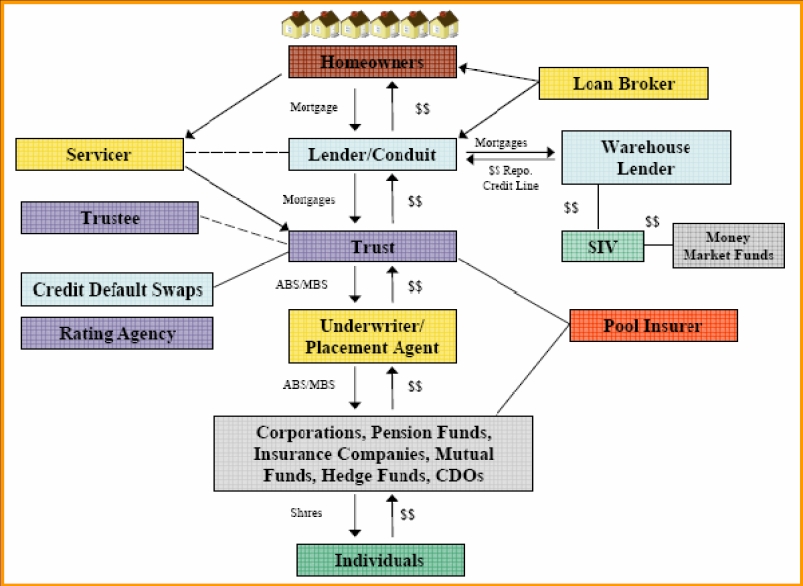
Share this:

  • Share on X (Opens in new window) X
  • Share on Facebook (Opens in new window) Facebook
Like Loading...

Understanding Mortgage Fraud ~ A Comprehensive Guide For Homeowners

31 Wednesday Jul 2013

Posted by BNG in Affirmative Defenses, Appeal, Banks and Lenders, Federal Court, Foreclosure Defense, Fraud, Judicial States, MERS, Mortgage Laws, Non-Judicial States, Notary, Note - Deed of Trust - Mortgage, Pro Se Litigation, Scam Artists, Securitization, State Court, Your Legal Rights

≈ Leave a comment

Tags

Blank endorsement, Business, MER, mortgage, Mortgage loan, Negotiable instrument, Real estate, Securitization

How Homeowners Can Effectively Determine Various Forms of Fraud in their Mortgage Loan With Defective mortgage documents.

A) Why Titles of Home Foreclosure Sale To Buyers Are Often Defective.

                    How Can We Deal With the Problem?

Securitization Flow Chart and Structure

sec1

sec2

B) Transfer of Promissory Note

 – –   Negotiable instrument under Article 3 of the UCC

–  Transferred by:

•   Endorsement

•   Delivery of the instrument

•   Acceptance of delivery

•   Negotiation = Endorsement + Delivery + Acceptance

C) Transfer of Mortgage

– – Mortgage is a real estate instrument

Subject to the statute of frauds

Must comply local real estate law

– Transferred by:

•   Written assignment

•   Delivery of the instrument

•   Acceptance of delivery

•   Recording of transferred mortgage

•   “Assignment” = Written Transfer/Assignment + Delivery + Acceptance + Recording

D)  Notarization Requirements

•   Most state laws require “strict” compliance

•   Signer must admit, by oath or affirmation, in the PRESENCE of notary to having voluntarily signed the document, and signer’s capacity

•   Signer must make the OATH or AFFIRMATION before signing

•   Must identify the signer by a federal or state issued photographic ID

•   Penalties include civil and criminal

•   Felony in most states to take a false acknowledgement

•   Document is invalid with improper notarization

E) The Alphabet Problem With Securitized Transfers

•   The loan closed in the name of the Broker/Lender

•   Broker is funded by Warehouse Line of Credit
Warehouse Lender then sells paper to a Special Investment Vehicle (SIV)

•   SIV then sells paper the Sponsor/Depositor

•   Sponsor or Depositor then transfers to Trust

F)  How Many Transfers

•   A-Transfer: Consumer to Broker

•   B-Transfer: Broker to Warehouse Lender

•   C-Transfer: Warehouse Lender to SIV

•   D-Transfer: SIV to the Depositor or Sponsor

•   E-Transfer: Depositor or Sponsor to Trust

G) How Many Documents

•   Four assignments and deliveries and acceptances of the Mortgage

•   Four endorsements and deliveries of the Note

•   Eight separate notarizations

•   Eight UCC-1 financing statements

•   Four recordings

•   Four filing and transfer fees

H) The Allonge

•   A paper attached to a negotiable note

•   Purpose is to provide written endorsement

•   Only used when back of negotiable instrument is FULL (no room)

•   No need for notarization

•   Simple signature and title sufficient,as with endorsement on note

I) Similar ABCDE Problem With the Mortgage Instrument

•   A. Consumer must sign and deliver to Broker

•   B. Broker must assign and deliver to the Warehouse Lender

•   C. Warehouse Lender must assign and deliver to the SIV

•   D. SIV must assign and deliver to the Depositor

•   E. Depositor must assign and deliver to the Trust

•   And all these assignments must be recorded!

J)  Who Holds the Bearer Paper and Mortgages for the Trust?

•   Normally a third-party bank that provides document custody services to the trust

•   Provides trailing document filings

•   Provides custody chambers for all members

•   Executes assignments for members

•   Execute endorsements for members

•   Executes deliveries and acceptances

•   Provide on-line document status certifications

K) What Does Trust Really Hold?

•   Electronic data with loan numbers & collateral descriptions

•   Electronic image of the original deed of trust

•   Electronic image of the original mortgage note

•   Rights in the documents by way of UCC-1 financing statements and the pooling & servicing agreements

L) The 3d-PartyOutsource Providers

•   Fidelity National Default Services

•   First American National Default Services

•   National Default Exchange, LP(Barrett Burke Owned Entity

•   Promiss Default Solutions(McCalla Raymer Owned Entity)

•   National Trustee Services(Morris Schneider Owned Entity)

•   LOGS Financial Services(Gerald Shapiro Owned Entity)

M) What Do the Outsource Providers Do for the Servicers?

•   Create Assignments

•   Create Allonges

•   Create Endorsements

•   Sign documents as if they were the VP or Secretary of a Bank, SIV, Depositor, Sponsor or the Trust

•   Notarize these documents

•   Create Lost Note Affidavits

•   Create Lost Assignment Affidavits

•   Create Lost Allonge Affidavits

•   Draft court pleadings and notices

•   Draft default correspondence, reports, etc.

N) How to Identify a Defective Endorsement or Allonge

•   Allonge can never be used to transfer a mortgage

•   Allonge can never be used if there is enough room on the original mortgage note for the written endorsement

•   Note is endorsed and not assigned

•   Date of the endorsement is before or after the date of the registration of trust

•   And much more …

O) Defective Endorsements

•   Notary is from Dakota County, Minnesota

•   Notary is from Hennepin County, Minnesota

•   Notary is from Jacksonville, Florida

•   Signor’s company has no offices in notary’s state

•   Date of endorsement and date of notarization are different

•   Signor’s name is stamped –not written in script

•   Signor claims to have signing authority but no authority attached

P) What About the Mortgages?

•   Assignments and delivery follow same model as with the notes

•   MERS is used to avoid registration of each assignment with local register of deeds

•   MERS claims no beneficial interest in the note

•   MERS claims no ownership rights in note or mortgage

•   MERS claims it is nominee for true owner

•   MERS delegates signing authority to all MERS members to sign documents as officers of MERS

•   MERS does not supervise any of it’s designated signors

•   MERS is not registered as a foreign corporation in most states

Q) How Does Trust Establish Lawful Ownership?

•   Unbroken chain of note endorsements and acceptances from A to B, B to C, C to D, and D to E

•   Unbroken chain of mortgage assignments and deliveries and acceptances from A to B, B to C, C to D, and D to E

•   Unbroken chain of UCC-1 financing filings throughout the chain

•   Unbroken chain of recorded mortgage assignments

R) But What Is Filed In a Typical Foreclosure?

•   Complaint alleging that the borrower (A) executed a note and mortgage in favor of the plaintiff (E)

•   Note and mortgage from borrower (A) to originating lender (B) attached

•   Sometimes a purported mortgage assignment from (B) to (E) attached, also purporting to assign the note

•   This assignment always defective, often not recorded

S) The Paper Trail and The Lack of Truth in Labeling

•   Electronic data

•   Fake dates & forged signatures

•   False notarization

•   False assignments

•   Fake endorsements

•   Fraudulent lost note affidavits

•   Recreated documents & records

•   Allonges and more

T)  Is the Trust Really Secured?

•   MAYBE –But it would be very difficult for any securitized trust to produce a valid set of original and unbroken assignments and endorsements

•   Even if the trust produces ALLof the required documents, there is still the issue of the legality of the role of MERS on all required documents for recording

To Learn How You Can Effectively Use Some of These As Solid Arguments to Effectively Defend and Save Your Home Visit: http://www.fightforeclosure.net

Share this:

  • Share on X (Opens in new window) X
  • Share on Facebook (Opens in new window) Facebook
Like Loading...
← Older posts
Newer posts →

Enter your email address to follow this blog and receive notifications of new posts by email.

Recent Posts

  • Are you facing foreclosure? consider these step
  • San Fernando Valley Con Man Pleads Guilty in Multi-Million Dollar Real Estate Fraud Scheme that Targeted Vulnerable Homeowners
  • Mortgage Application Fraud!
  • What Homeowners Must Know About Mortgage Forbearance
  • Cosigning A Mortgage Loan: What Both Parties Need To Know

Categories

  • Affirmative Defenses
  • Appeal
  • Bankruptcy
  • Banks and Lenders
  • Borrower
  • Case Laws
  • Case Study
  • Credit
  • Discovery Strategies
  • Fed
  • Federal Court
  • Foreclosure
  • Foreclosure Crisis
  • Foreclosure Defense
  • Fraud
  • Judgment
  • Judicial States
  • Landlord and Tenant
  • Legal Research
  • Litigation Strategies
  • Loan Modification
  • MERS
  • Mortgage fraud
  • Mortgage Laws
  • Mortgage loan
  • Mortgage mediation
  • Mortgage Servicing
  • Non-Judicial States
  • Notary
  • Note – Deed of Trust – Mortgage
  • Pleadings
  • Pro Se Litigation
  • Real Estate Liens
  • RESPA
  • Restitution
  • Scam Artists
  • Securitization
  • State Court
  • Title Companies
  • Trial Strategies
  • Your Legal Rights

Archives

  • June 2025
  • February 2022
  • March 2021
  • February 2021
  • September 2020
  • October 2019
  • July 2019
  • May 2019
  • April 2019
  • March 2019
  • January 2019
  • September 2018
  • July 2018
  • June 2018
  • May 2018
  • April 2018
  • March 2018
  • February 2018
  • January 2018
  • December 2017
  • November 2016
  • April 2016
  • March 2016
  • January 2016
  • December 2015
  • September 2015
  • October 2014
  • August 2014
  • July 2014
  • June 2014
  • May 2014
  • April 2014
  • January 2014
  • December 2013
  • November 2013
  • October 2013
  • September 2013
  • August 2013
  • July 2013
  • June 2013
  • May 2013

Recent Posts

  • Are you facing foreclosure? consider these step
  • San Fernando Valley Con Man Pleads Guilty in Multi-Million Dollar Real Estate Fraud Scheme that Targeted Vulnerable Homeowners
  • Mortgage Application Fraud!
  • What Homeowners Must Know About Mortgage Forbearance
  • Cosigning A Mortgage Loan: What Both Parties Need To Know
Follow FightForeclosure.net on WordPress.com

RSS

  • RSS - Posts
  • RSS - Comments

Tags

5th circuit court 9th circuit 9th circuit court 10 years Adam Levitin adding co-borrower Adjustable-rate mortgage adjustable rate mortgage loan administrative office of the courts adversary proceeding affidavits Affirmative defense after foreclosure Alabama Annual percentage rate Appeal Appeal-able Orders Appealable appealable orders Appealing Adverse Decisions Appellate court Appellate Issues appellate proceeding appellate record applying for a mortgage Appraiser Areas of Liability arguments for appeal Arizona Article 9 of the Japanese Constitution Asset Asset Rental Assignment (law) Attorney Fees Attorney general August Aurora Loan Services of Nebraska automatic stay avoid foreclosure Avoid Mistakes During Bankruptcy Avoid Mistakes in Bankruptcy bad credit score bank bank forecloses Bank of America Bank of New York Bankrupcty Bankruptcy bankruptcy adversary proceeding bankruptcy appeal Bankruptcy Appeals Bankruptcy Attorney bankruptcy code bankruptcy court Bankruptcy Filing Fees bankruptcy mistakes bankruptcy on credit report bankruptcy process Bankruptcy Trustee Banks Banks and Lenders Bank statement Barack Obama Berkshire Hathaway Bill Blank endorsement Borrower borrower loan borrowers Borrowers in Bankruptcy Boston Broward County Broward County Florida Builder Bailout Business Buy and Bail Buyer Buyers buying a house buying foreclosed homes California California Court of Appeal California foreclosure California Residents Case in Review Case Trustees Center for Housing Policy CFPB’s Response chapter 7 chapter 7 bankruptcy chapter 11 chapter 11 bankruptcy Chapter 11 Plans chapter 13 chapter 13 bankruptcy Chinese style name Chunking circuit court Citi civil judgments Civil procedure Clerk (municipal official) Closed End Credit Closing/Settlement Agent closing argument collateral order doctrine collection Collier County Florida Colorado Complaint Computer program Consent decrees Consequences of a Foreclosure Consumer Actions Consumer Credit Protection Act Content Contractual Liability Conway Cosigning A Mortgage Loan Counsels Court Court clerk courts Courts of Nevada Courts of New York Credit credit bureaus Credit Counseling and Financial Management Courses credit dispute letter credit disputes Credit history Creditor credit repair credit repair company credit report credit reports Credit Score current balance Debt Debt-to-income ratio debtor Deed in lieu of foreclosure Deed of Trust Deeds of Trust defaulting on a mortgage Default judgment Defendant Deficiency judgment deficiency judgments delinquency delinquency reports Deposition (law) Detroit Free Press Deutsche Bank Dingwall Directed Verdict Discovery dispute letter District Court district court judges dormant judgment Double Selling Due process Encumbered enforceability of judgment lien enforceability of judgments entry of judgment Equifax Equity Skimming Eric Schneiderman Escrow Evans Eviction execution method execution on a judgment Experian Expert witness extinguishment Fair Credit Reporting Act (FCRA) Fake Down Payment False notary signatures Fannie Mae Fannie Mae/Freddie Mac federal bankruptcy laws Federal Bureau of Investigation Federal Court federal courts Federal government of the United States Federal Home Loan Bank Board Federal Housing Administration Federal Judgments Federal Rules of Civil Procedure federal statute Federal tax FHA FICO Fictitious Loan Filing (legal) filing for bankruptcy Finance Finance charge Financial institution Financial reports Financial Services Financial statement Florida Florida Homeowners Florida Supreme Court Fonts Forbearance foreclose foreclosed homes foreclosing on home Foreclosure foreclosure auction Foreclosure Crisis foreclosure defense foreclosure defense strategy Foreclosure in California foreclosure in Florida Foreclosure laws in California Foreclosure Pending Appeal foreclosure process Foreclosure Rescue Fraud foreclosures foreclosure suit Forms Fraud fraud prevention Fraudulent Appraisal Fraudulent Documentation Fraudulent Use of Shell Company Freddie Mac fresh financial start Glaski good credit good credit score Good faith estimate Governmental Liability HAMP HAP hardship home Home Affordable Modification Program home buyer Home insurance homeowner homeowners home ownership Homes Horace housing counselor How Many Bankruptcies Can a Homeowner File How Much Debt Do I Need To File Bankruptcy HSBC Bank USA Ibanez Ibanez Case Identify Theft injunction injunctive injunctive relief installment judgments Internal Revenue Service Interrogatories Investing involuntary liens IOU issuance of the remittitur items on credit report J.P. Morgan Chase Jack Conway Jack McConnell joint borrowers JPMorgan Chase JPMorgan Chase Bank Juarez Judgment judgment creditors judgment expired Judgments after Foreclosure Judicial judicial foreclosures Judicial States July Jury instructions Justice Department Kentucky Kristina Pickering Landlord Language Las Vegas late payment Late Payments Law Lawsuit lawsuits Lawyer Lawyers and Law Firms Lease Leasehold estate Legal Aid Legal Aid by State Legal Assistance Legal burden of proof Legal case Legal Help Legal Information lender lenders Lenders and Vendors lending and servicing liability Lien liens lien stripping lien voidance lifting automatic stay Linguistics Lis pendens List of Latin phrases litigator load modification Loan Loan Modification Loan Modification and Refinance Fraud loan modification specialists Loan origination loans Loan Servicer Loan servicing Los Angeles loses Making Home Affordable Massachusetts Massachusetts Supreme Judicial Court Mastropaolo MBA Letter MBIA McConnell Means Test Forms Mediation mediation program Medical malpractice MER MERS Michigan Monetary Awards Monetary Restitution money Montana mortgage Mortgage-backed security Mortgage Application Fraud Mortgage broker mortgage company Mortgage Coupon Mortgage Electronic Registration System Mortgage fraud Mortgage law mortgage lender Mortgage loan mortgage loan modification mortgage loan modifications mortgage loans Mortgage mediation Mortgage modification Mortgage note mortgages Mortgage servicer Mortgage Servicing Fraud motion Motion (legal) Motion in Limine Motions National Center for State Courts National City Bank National Mortgage Settlement Natural Negotiable instrument Nelva Gonzales Ramos Nevada Nevada Bell Nevada Foreclosure Nevada mortgage loans Nevada Supreme Court New Jersey New Mexico New York New York Stock Exchange New York Times Ninth Circuit non-appealable non-appealable order Non-judicial non-judicial foreclosure non-judicial foreclosures Non-judicial Foreclosure States Non-Judicial States non-recourse nonjudicial foreclosures North Carolina note Notice Notice of default notice of entry of judgment Nueces County Nueces County Texas Objections Official B122C-2 Official Form B122C-1 Ohio Options Oral argument in the United States Orders Originator overture a foreclosure sale Owner-occupier Payment Percentage Perfected periodic payments personal loans Phantom Sale Plaintiff Plan for Bankruptcy Pleading post-judgment pre-trial Pro Bono Process for a Foreclosure Processor Process Service Produce the Note Promissory note pro per Property Property Flip Fraud Property Lien Disputes property liens pro se Pro se legal representation in the United States Pro Se Litigating Pro Se litigator Pro Se trial litigators Protecting Tenant at Foreclosure Act Protecting Tenants PSA PTFA public records purchase a new home Quiet title Real estate Real Estate Agent Real Estate Liens Real Estate Settlement Procedures Act Real property RealtyTrac Record on Appeal refinance a loan Refinance Fraud Refinancing registered judgment Regulatory (CFPB) relief remittance reports remove bankruptcy remove bankruptcy on credit report Remove Late Payments Removing Liens renewal of judgment renewing a judgment Reno Reno Air Request for admissions Rescission Residential mortgage-backed security Residential Mortgage Lending Market RESPA Restitution Reverse Mortgage Fraud Rhode Island robert estes Robert Gaston Robo-signing Sacramento Scam Artists Scope Secondary Mortgage Market Securitization securitized Security interest Se Legal Representation Self-Help Seller servicer servicer reports Services servicing audit setting aside foreclosure sale Settlement (litigation) short sale Short Sale Fraud Social Sciences Social Security South Dakota Special agent standing state State Court State Courts state law Statute of Limitations statute of limitations for judgment renewals statute of repose stay Stay of Proceedings stay pending appeal Straw/Nominee Borrower Subpoena Duces Tecum Summary judgment Supreme Court of United States Tax lien tenant in common Tenants After Foreclosure Tenants Without a Lease Tennessee Texas The Dodd Frank Act and CFPB The TRID Rule Thomas Glaski TILA time-barred judgment Times New Roman Times Roman Timing Title 12 of the United States Code Title Agent Tolerance and Redisclosure Transferring Property TransUnion trial Trial court TRO true owners of the note Trust deed (real estate) Trustee Truth in Lending Act Tuesday Typeface Types of Real Estate Liens U.S. Bancorp U.S. Securities and Exchange Commission UCC Underwriter Uniform Commercial Code United States United States Attorney United States Code United States Congress United States Court of Appeals for the First Circuit United States Department of Housing and Urban Development United States Department of Justice United States district court United States District Court for the Eastern District of California United States federal courts United States federal judge Unperfected Liens US Bank US Securities and Exchange Commission valuation voluntary liens Wall Street Warehouse Lender Warehouseman Washington Washington Mutual Wells Fargo Wells Fargo Bank withdrawal of reference write of execution wrongful foreclosure wrongful foreclosure appeal Wrongful Mortgage Foreclosure Yield spread premium

Fight-Foreclosure.com

Fight-Foreclosure.com

Pages

  • About
  • Buy Bankruptcy Adversary Package
  • Buy Foreclosure Defense Package
  • Contact Us
  • Donation
  • FAQ
  • Services

Archives

  • June 2025
  • February 2022
  • March 2021
  • February 2021
  • September 2020
  • October 2019
  • July 2019
  • May 2019
  • April 2019
  • March 2019
  • January 2019
  • September 2018
  • July 2018
  • June 2018
  • May 2018
  • April 2018
  • March 2018
  • February 2018
  • January 2018
  • December 2017
  • November 2016
  • April 2016
  • March 2016
  • January 2016
  • December 2015
  • September 2015
  • October 2014
  • August 2014
  • July 2014
  • June 2014
  • May 2014
  • April 2014
  • January 2014
  • December 2013
  • November 2013
  • October 2013
  • September 2013
  • August 2013
  • July 2013
  • June 2013
  • May 2013

Website Powered by WordPress.com.

Privacy & Cookies: This site uses cookies. By continuing to use this website, you agree to their use.
To find out more, including how to control cookies, see here: Cookie Policy
  • Subscribe Subscribed
    • FightForeclosure.net
    • Join 349 other subscribers
    • Already have a WordPress.com account? Log in now.
    • FightForeclosure.net
    • Subscribe Subscribed
    • Sign up
    • Log in
    • Report this content
    • View site in Reader
    • Manage subscriptions
    • Collapse this bar
 

Loading Comments...
 

    %d