• About
  • Buy Bankruptcy Adversary Package
  • Buy Foreclosure Defense Package
  • Contact Us
  • Donation
  • FAQ
  • Services

FightForeclosure.net

~ Your "Pro Se" Foreclosure Fight Solution!

FightForeclosure.net

Category Archives: MERS

Why Homeowners Lose on Appeal – A Review of Wrongful Foreclosure Appeal Case

02 Monday Dec 2013

Posted by BNG in Appeal, Case Laws, Case Study, Federal Court, Foreclosure Defense, Fraud, MERS, Pleadings, Pro Se Litigation

≈ Leave a comment

Tags

Arizona, Bank of America, Florida, MERS, Mortgage Electronic Registration System, New York, Washington, Wells Fargo

A CASE IN REVIEW (1)

UNITED STATES COURT OF APPEALS FOR THE NINTH CIRCUIT

No. 09-17364    D.C. No. 2:09-cv-00517-JAT

OLGA CERVANTES, an unmarried
woman; CARLOS ALMENDAREZ, a
married man; ARTURO MAXIMO, a
married man, individually and on
behalf of a class of similarly
situated individuals,
Plaintiffs-Appellants,
v.

OPINION
COUNTRYWIDE HOME LOANS, INC., a
New York corporation; MORTGAGE
ELECTRONIC REGISTRATION SYSTEMS,
INC., a subsidiary of MERSCORP,
INC., a Delaware corporation; ý MERSCORP, INC.; FEDERAL HOME
LOAN MORTGAGE CORPORATION, a
foreign corporation, AKA Freddie
Mac; FEDERAL NATIONAL
MORTGAGE ASSOCIATION, a foreign
corporation; GMAC MORTGAGE,
LLC, a Delaware corporation;
NATIONAL CITY MORTGAGE, a
foreign company and a division of
National City Bank, a foreign
company; J.P. MORGAN CHASE
BANK, N.A., a New York
corporation; CITIMORTGAGE, INC., a
New York corporation;

HSBC MORTGAGE CORPORATION,
U.S.A., a Delaware corporation;
AIG UNITED GUARANTY
CORPORATION, a foreign
corporation; WELLS FARGO BANK,
N.A., a California corporation,
DBA Wells Fargo Home Equity;
BANK OF AMERICA, N.A., a foreign
corporation; GE MONEY BANK, a
foreign company; PNC FINANCIAL
SERVICES GROUP, INC., a
Pennsylvania corporation; No. 09-17364
NATIONAL CITY CORPORATION, a D.C. No. subsidiary of PNC Financial  Services Group; N 2:09-cv-00517-JAT ATIONAL CITY
BANK, a subsidiary of National OPINION
City Corporation; MERRILL LYNCH
& COMPANY, INC., a subsidiary of
Bank of America Corporation;
FIRST FRANKLIN FINANCIAL
CORPORATION, a subsidiary of
Merrill Lynch & Company, Inc.;
LASALLE BANK, N.A., a subsidiary
of Bank of America; TIFFANY &
BOSCO P.A., an Arizona
professional association,
Defendants-Appellees.

Appeal from the United States District Court
for the District of Arizona
James A. Teilborg, District Judge, Presiding
Argued and Submitted
February 16, 2011—San Francisco, California
Filed September 7, 2011

Before: Richard C. Tallman, Johnnie B. Rawlinson,* and
Consuelo M. Callahan, Circuit Judges.
Opinion by Judge Callahan

*Due to the death of the Honorable David R. Thompson, the Honorable
Johnnie B. Rawlinson, United States Circuit Judge for the Ninth Circuit,
has been drawn to replace him on this panel. Judge Rawlinson has read
the briefs, reviewed the record, and listened to the audio recording of oral
argument held on February 16, 2011.

COUNSEL
William A. Nebeker and Valerie R. Edwards, Koeller
Nebeker Carlson & Haluck, LLP, Phoenix, Arizona, and Robert
Hager and Treva Hearne, Hager & Hearne, Reno, Nevada,
for the appellants.
Timothy J. Thomason, Mariscal Weeks McIntyre & Friedlander,
P.A., Phoenix, Arizona, Thomas M. Hefferon, Goodwin
Procter, LLP, Washington, DC, Howard N. Cayne,
Arnold & Porter, LLP, Washington, DC, Stephen E. Hart,
Federal Housing Finance Agency, Washington, DC, Mark S.
Landman, Landman Corsini Ballaine & Ford P.C., New York,
New York, and Robert M. Brochin, Morgan, Lewis & Bockius,
LLP, Miami, Florida, for the appellees.

OPINION

CALLAHAN, Circuit Judge:
This is a putative class action challenging origination and
foreclosure procedures for home loans maintained within the
Mortgage Electronic Registration System (MERS). The plaintiffs
appeal from the dismissal of their First Amended Complaint
for failure to state a claim. In their complaint, the
plaintiffs allege conspiracies by their lenders and others to use
MERS to commit fraud. They also allege that their lenders
violated the Truth in Lending Act (TILA), 15 U.S.C. § 1601
et seq., and the Arizona Consumer Fraud Act, Ariz. Rev. Stat.
§ 44-1522, and committed the tort of intentional infliction of
emotional distress by targeting the plaintiffs for loans they
could not repay. The plaintiffs were denied leave to file their
proposed Second Amended Complaint, and to add a new
claim for wrongful foreclosure based upon the operation of
the MERS system.

On appeal, the plaintiffs stand by the sufficiency of some
of their claims, but primarily contend that they could cure any
pleading deficiencies with a newly amended complaint, which
would include a claim for wrongful foreclosure. We are
unpersuaded that the plaintiffs’ allegations are sufficient to
support their claims. Although the plaintiffs allege that
aspects of the MERS system are fraudulent, they cannot
establish that they were misinformed about the MERS system,
relied on any misinformation in entering into their home
loans, or were injured as a result of the misinformation. If
anything, the allegations suggest that the plaintiffs were
informed of the exact aspects of the MERS system that they
now complain about when they agreed to enter into their
home loans. Further, although the plaintiffs contend that they
can state a claim for wrongful foreclosure, Arizona state law
does not currently recognize this cause of action, and their
claim is, in any case, without a basis. The plaintiffs’ claim
depends upon the conclusion that any home loan within the MERS system is unenforceable through a foreclosure sale, but
that conclusion is unsupported by the facts and law on which
they rely. Because the plaintiffs fail to establish a plausible
basis for relief on these and their other claims raised on
appeal, we affirm the district court’s dismissal of the complaint
without leave to amend.

     I.
The focus of this lawsuit—and many others around the
country—is the MERS system.

1. How MERS works
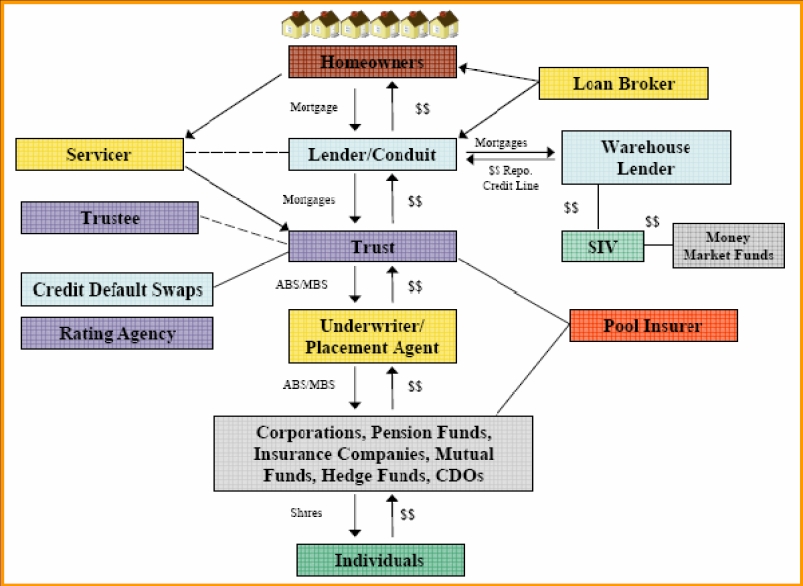
MERS is a private electronic database, operated by MERSCORP,
Inc., that tracks the transfer of the “beneficial interest”
in home loans, as well as any changes in loan servicers. After
a borrower takes out a home loan, the original lender may sell
all or a portion of its beneficial interest in the loan and change
loan servicers. The owner of the beneficial interest is entitled
to repayment of the loan. For simplicity, we will refer to the
owner of the beneficial interest as the “lender.” The servicer
of the loan collects payments from the borrower, sends payments
to the lender, and handles administrative aspects of the
loan. Many of the companies that participate in the mortgage
industry—by originating loans, buying or investing in the
beneficial interest in loans, or servicing loans—are members
of MERS and pay a fee to use the tracking system. See Jackson
v. Mortg. Elec. Registration Sys., Inc., 770 N.W.2d 487,
490 (Minn. 2009).

When a borrower takes out a home loan, the borrower executes
two documents in favor of the lender: (1) a promissory
note to repay the loan, and (2) a deed of trust, or mortgage,
that transfers legal title in the property as collateral to secure
the loan in the event of default. State laws require the lender
to record the deed in the county in which the property is located. Any subsequent sale or assignment of the deed must
be recorded in the county records, as well.

This recording process became cumbersome to the mortgage
industry, particularly as the trading of loans increased.
See Robert E. Dordan, Mortgage Electronic Registration Systems
(MERS), Its Recent Legal Battles, and the Chance for a
Peaceful Existence, 12 Loy. J. Pub. Int. L. 177, 178 (2010).
It has become common for original lenders to bundle the beneficial
interest in individual loans and sell them to investors
as mortgage-backed securities, which may themselves be
traded. See id. at 180; Jackson, 770 N.W.2d at 490. MERS
was designed to avoid the need to record multiple transfers of
the deed by serving as the nominal record holder of the deed
on behalf of the original lender and any subsequent lender.
Jackson, 770 N.W.2d at 490.

At the origination of the loan, MERS is designated in the
deed of trust as a nominee for the lender and the lender’s
“successors and assigns,” and as the deed’s “beneficiary”
which holds legal title to the security interest conveyed. If the
lender sells or assigns the beneficial interest in the loan to
another MERS member, the change is recorded only in the
MERS database, not in county records, because MERS continues
to hold the deed on the new lender’s behalf. If the beneficial
interest in the loan is sold to a non-MERS member, the
transfer of the deed from MERS to the new lender is recorded
in county records and the loan is no longer tracked in the
MERS system.
In the event of a default on the loan, the lender may initiate
foreclosure in its own name, or may appoint a trustee to initiate
foreclosure on the lender’s behalf. However, to have the
legal power to foreclose, the trustee must have authority to act
as the holder, or agent of the holder, of both the deed and the
note together. See Landmark Nat’l Bank v. Kesler, 216 P.3d
158, 167 (Kan. 2009). The deed and note must be held
together because the holder of the note is only entitled to repayment, and does not have the right under the deed to use
the property as a means of satisfying repayment. Id. Conversely,
the holder of the deed alone does not have a right to
repayment and, thus, does not have an interest in foreclosing
on the property to satisfy repayment. Id. One of the main
premises of the plaintiffs’ lawsuit here is that the MERS system
impermissibly “splits” the note and deed by facilitating
the transfer of the beneficial interest in the loan among lenders
while maintaining MERS as the nominal holder of the
deed.
The plaintiffs’ lawsuit is also premised on the fact that
MERS does not have a financial interest in the loans, which,
according to the plaintiffs, renders MERS’s status as a beneficiary
a sham. MERS is not involved in originating the loan,
does not have any right to payments on the loan, and does not
service the loan. MERS relies on its members to have someone
on their own staff become a MERS officer with the
authority to sign documents on behalf of MERS. See Dordan,
12 Loy. J. Pub. Int. L. at 182; Jackson, 770 N.W.2d at 491.
As a result, most of the actions taken in MERS’s own name
are carried out by staff at the companies that sell and buy the
beneficial interest in the loans. Id.

2. The named plaintiffs
The three named plaintiffs in this case, Olga Cervantes,
Carlos Almendarez, and Arturo Maximo, obtained home
loans or refinanced existing loans in 2006. All three signed
promissory notes with their lenders—Cervantes with Countrywide
Home Loans, and Almendarez and Maximo with First
Franklin. Each executed a deed of trust in favor of his or her
lender, naming MERS as the “beneficiary” and as the “nominee”
for the lender and lender’s “successors and assigns.”
All three plaintiffs are Hispanic, and Almendarez and Maximo
do not speak or read English. Almendarez and Maximo
negotiated the mortgage loans with their lenders in Spanish, but were provided with, and signed, copies of their loan documents
written in English.
The plaintiffs subsequently defaulted on their loans. Following
Cervantes’s default, trustee Recontrust Company initiated
non-judicial foreclosure proceedings by recording a
notice of a trustee’s sale in the county records. The parties
have not addressed the status of the noticed sale. Following
defaults by Almendarez and Maximo, their lender, First
Franklin, appointed LaSalle Bank as its trustee to initiate nonjudicial
foreclosure proceedings. MERS recorded documents
with the county assigning its beneficial interest in the deeds
of trust to La Salle Bank. Later, Michael Bosco of Tiffany &
Bosco was substituted in as First Franklin’s trustee. Michael
Bosco sold Almendarez’s house at public auction in February
2009. The sale of Maximo’s property was cancelled in April
2009.

3. Procedural history
Cervantes filed suit in March 2009. Almendarez and Maximo
joined the lawsuit, and the plaintiffs filed their First
Amended Complaint a few days later. The First Amended
Complaint names several defendants, including the plaintiffs’
lenders, the trustees for the lenders, MERS, and MERS members
who are named only as co-conspirators based on their
role in using the MERS system. The defendants filed several
motions to dismiss, prompting the plaintiffs to file a motion
for leave to amend, along with a proposed Second Amended
Complaint. The district court held a hearing on the various
motions, at which the plaintiffs orally proposed to amend their
complaint with a wrongful foreclosure claim. The district
court granted the motions to dismiss the First Amended Complaint,
and denied the motion for leave to amend on the
ground that amendment would be futile. The plaintiffs appeal.

    II.
We have jurisdiction under 28 U.S.C. § 1291. We review
de novo the district court’s dismissal for failure to state a claim pursuant to Federal Rule of Civil Procedure 12(b)(6).
Mendiondo v. Centinela Hosp. Med. Ctr., 521 F.3d 1097,
1102 (9th Cir. 2008). “To survive a motion to dismiss, a complaint
must contain sufficient factual matter, accepted as true,
to state a claim to relief that is plausible on its face.” Ashcroft
v. Iqbal, 129 S. Ct. 1937, 1949 (2009) (internal quotation
marks omitted). Dismissal is proper when the complaint does
not make out a cognizable legal theory or does not allege sufficient
facts to support a cognizable legal theory. Mendiondo,
521 F.3d at 1104. A complaint that alleges only “labels and
conclusions” or a “formulaic recitation of the elements of the
cause of action” will not survive dismissal. Bell Atl. Corp. v.
Twombly, 550 U.S. 544, 555 (2007).

The district court’s denial of leave to amend the complaint
is reviewed for an abuse of discretion. Gompper v. VISX, Inc.,
298 F.3d 893, 898 (9th Cir. 2002). Although leave to amend
should be given freely, a district court may dismiss without
leave where a plaintiff ’s proposed amendments would fail to
cure the pleading deficiencies and amendment would be
futile. See Cook, Perkiss & Liehe, Inc. v. N. Cal. Collection
Serv. Inc., 911 F.2d 242, 247 (9th Cir. 1990) (per curiam).1

1The plaintiffs have requested that we take judicial notice of orders of
the United States District Court for the District of Arizona dismissing
complaints without prejudice in pending multidistrict litigation concerning
MERS. The plaintiffs imply that it was inconsistent for the same district
court to deny leave to amend here. We deny the requests because the
orders are not relevant.

                               III.
The plaintiffs challenge the dismissal of their complaint
without leave to amend but, on appeal, only address the district
court’s: (1) dismissal of their claim for conspiracy to
commit fraud through the MERS system; (2) failure to
address their oral request for leave to add a wrongful foreclosure
claim; (3) dismissal of trustee Tiffany & Bosco from the suit; (4) denial of leave to amend their pleadings regarding equitable tolling of their TILA and Arizona Consumer Fraud Act claims; and (5) dismissal of their claim for intentional infliction of emotional distress. We address these claims in
turn, and do not consider the dismissed claims that are not
raised on appeal. Entm’t Research Group v. Genesis Creative
Group, 122 F.3d 1211, 1217 (9th Cir. 1997) (“We will not
consider any claims that were not actually argued in [appellant’s]
opening brief.”).

1. Conspiracy to commit fraud through the MERS
system
On appeal, the plaintiffs contend that they sufficiently
alleged a conspiracy among MERS members to commit fraud.
In count seven of the First Amended Complaint, they allege
that MERS members conspired to commit fraud by using
MERS as a sham beneficiary, promoting and facilitating predatory
lending practices through the use of MERS, and making
it impossible for borrowers or regulators to track the changes
in lenders.

[1] Under Arizona law, a claim of civil conspiracy must be
based on an underlying tort, such as fraud in this instance.
Baker ex rel. Hall Brake Supply, Inc. v. Stewart Title & Trust
of Phoenix, Inc., 5 P.3d 249, 256 (Ariz. Ct. App. 2000). To
show fraud, a plaintiff must identify “(1) a representation; (2)
its falsity; (3) its materiality; (4) the speaker’s knowledge of
its falsity or ignorance of its truth; (5) the speaker’s intent that
it be acted upon by the recipient in the manner reasonably
contemplated; (6) the hearer’s ignorance of its falsity; (7) the
hearer’s reliance on its truth; (8) the right to rely on it; [and]
(9) his consequent and proximate injury.” Echols v. Beauty
Built Homes, Inc., 647 P.2d 629, 631 (Ariz. 1982).

[2] The plaintiffs’ allegations fail to address several of
these necessary elements for a fraud claim. The plaintiffs have
not identified any representations made to them about the MERS system and its role in their home loans that were false
and material. None of their allegations indicate that the plaintiffs
were misinformed about MERS’s role as a beneficiary,
or the possibility that their loans would be resold and tracked
through the MERS system. Similarly, the plaintiffs have not
alleged that they relied on any misrepresentations about
MERS in deciding to enter into their home loans, or that they
would not have entered into the loans if they had more information
about how MERS worked. Finally, the plaintiffs have
failed to show that the designation of MERS as a beneficiary
caused them any injury by, for example, affecting the terms
of their loans, their ability to repay the loans, or their obligations
as borrowers. Although the plaintiffs allege that they
were “deprived of the right to attempt to modify their toxic
loans, as the true identity of the actual beneficial owner was
intentionally hidden” from them, they do not support this bare
assertion with any explanation as to how the operation of the
MERS system actually stymied their efforts to identify and
contact the relevant party to modify their loans. Thus, the
plaintiffs fail to state a claim for conspiracy to commit fraud
through the MERS system, and dismissal of the claim was
proper.

[3] While the plaintiffs’ allegations alone fail to raise a
plausible fraud claim, we also note that their claim is undercut
by the terms in Cervantes’s standard deed of trust, which
describe MERS’s role in the home loan.2 For example, the
plaintiffs allege they were defrauded because MERS is a
“sham” beneficiary without a financial interest in the loan, yet
the disclosures in the deed indicate that MERS is acting
“solely as a nominee for Lender and Lender’s successors and
assigns” and holds “only legal title to the interest granted by Borrower in this Security Instrument.” Further, while the
plaintiffs indicate that MERS was used to hide who owned the
loan, the deed states that the loan or a partial interest in it “can
be sold one or more times without prior notice to Borrower,”
but that “[i]f there is a change in Loan Servicer, Borrower will
be given written notice of the change” as required by consumer
protection laws. Finally, the deed indicates that MERS
has “the right to foreclose and sell the property.” By signing
the deeds of trust, the plaintiffs agreed to the terms and were
on notice of the contents. See Kenly v. Miracle Props., 412 F.
Supp. 1072, 1075 (D. Ariz. 1976) (explaining that a deed of
trust is “an essentially private contractual arrangement”). In
light of the explicit terms of the standard deed signed by Cervantes,
it does not appear that the plaintiffs were misinformed
about MERS’s role in their home loans.

2Cervantes’s deed of trust, attached to MERSCORP’s reply in support
of its motion to dismiss, may be considered at the pleadings stage because the complaint references and relies on the deed, and its authenticity is unquestioned. See Swartz v. KPMG LLP, 476 F.3d 756, 763 (9th Cir. 2007) (per curiam).

[4] Moreover, amendment would be futile. In their proposed
Second Amended Complaint, the plaintiffs seek to add
further detail concerning how MERS works in general and
how it has facilitated the trade in mortgage-backed securities.
But none of the new allegations cure the First Amended Complaint’s
deficiencies: the plaintiffs have not shown that they
received material misrepresentations about MERS that they
detrimentally relied upon. Accordingly, we affirm the district
court’s dismissal, without leave to amend, of the claim for
conspiracy to commit fraud through the MERS system.

2. Wrongful foreclosure
The plaintiffs contend that the district court abused its discretion
by dismissing their complaint without leave to add a
wrongful foreclosure claim. The only mention of a wrongful
foreclosure claim was during the hearing on the plaintiffs’
motion for leave to amend and the defendants’ motions to dismiss.
Although the plaintiffs expressed their intention to add
a wrongful foreclosure claim, they failed to include it in their
proposed Second Amended Complaint. Moreover, during the
hearing, the plaintiffs stated only a general theory of the claim: they posited that any foreclosure on a home loan tracked in the MERS system is “wrongful” because MERS is not a true beneficiary. As the plaintiffs describe it on appeal, their claim is that “the MERS system was used to facilitate wrongful foreclosure based on the naming of MERS as the
beneficiary on the deed of trust, which results in the note and
deed of trust being split and unenforceable.”

[5] The plaintiffs’ oral request to add a wrongful foreclosure
claim was procedurally improper and substantively
unsupported. The district court’s local rules require the plaintiffs
to submit a copy of the proposed amended pleadings
along with a motion for leave to amend. See D. Ariz. Civ. L.
R. 15.1. The plaintiffs failed to do so. Further, they failed to
provide the district court with an explanation of the legal and
factual grounds for adding the claim. It is particularly notable
here that Arizona state courts have not yet recognized a
wrongful foreclosure cause of action. Although a federal court
exercising diversity jurisdiction is “at liberty to predict the
future course of [a state’s] law,” plaintiffs choosing “the federal
forum . . . [are] not entitled to trailblazing initiatives
under [state law].” Ed Peters Jewelry Co. v. C & J Jewelry
Co., Inc., 124 F.3d 252, 262- 63 (1st Cir. 1997) (affirming
dismissal of a wrongful foreclosure claim when no such
action existed under state law). Under the circumstances, we
conclude that it was not an abuse of discretion for the district
court to deny leave to amend without addressing the plaintiffs’
proposed claim for wrongful foreclosure. See Gardner
v. Martino (In re Gardner), 563 F.3d 981, 991 (9th Cir. 2009)
(concluding that the district court did not abuse its discretion
by denying leave to amend where the party seeking leave
failed to attach a proposed amended complaint in violation of
local rules and failed to articulate a factual and legal basis for
amendment).

[6] In any event, leave to amend would be futile because
the plaintiffs cannot state a plausible basis for relief. Looking
to states that have recognized substantive wrongful foreclosure claims, we note that such claims typically are available
after foreclosure and are premised on allegations that the borrower
was not in default, or on procedural issues that resulted
in damages to the borrower. See, e.g., Ed Peters Jewelry Co.,
124 F.3d at 263 n.8 (noting that the Massachusetts Supreme
Court recognized a claim for wrongful foreclosure where no
default had occurred in Mechanics Nat’l Bank of Worcester v.
Killeen, 384 N.E.2d 1231, 1236 (Mass. 1979)); Fields v. Millsap
& Singer, P.C., 295 S.W.3d 567, 571 (Mo. Ct. App.
2009) (stating that “a plaintiff seeking damages in a wrongful
foreclosure action must plead and prove that when the foreclosure
proceeding was begun, there was no default on its part
that would give rise to a right to foreclose” (internal alteration
and citation omitted)); Gregorakos v. Wells Fargo Nat’l
Ass’n, 647 S.E.2d 289, 292 (Ga. App. 2007) (“In Georgia, a
plaintiff asserting a claim of wrongful foreclosure must establish
a legal duty owed to it by the foreclosing party, a breach
of that duty, a causal connection between the breach of that
duty and the injury it sustained, and damages.” (internal quotation
marks and alteration omitted)); Collins v. Union Fed.
Sav. & Loan Ass’n, 662 P.2d 610, 623 (Nev. 1983) (“[T]he
material issue of fact in a wrongful foreclosure claim is
whether the trustor was in default when the power of sale was
exercised.”). Similarly, the case that the plaintiffs cite for the
availability of a wrongful foreclosure claim under Arizona
law, Herring v. Countrywide Home Loans, Inc., No. 06-2622,
2007 WL 2051394, at *6 (D. Ariz. July 13, 2007), recognized
such a claim where the borrower was not in default at the time
of foreclosure. The plaintiffs have not alleged that Cervantes’s
or Maximo’s homes were sold and, in any event, all are
in default and have not identified damages. Thus, under the
established theories of wrongful foreclosure, the plaintiffs
have failed to state a claim.

Instead, the plaintiffs advance a novel theory of wrongful
foreclosure. They contend that all transfers of the interests in
the home loans within the MERS system are invalid because
the designation of MERS as a beneficiary is a sham and the system splits the deed from the note, and, thus, no party is in
a position to foreclose.

[7] Even if we were to accept the plaintiffs’ premises that
MERS is a sham beneficiary and the note is split from the
deed, we would reject the plaintiffs’ conclusion that, as a necessary
consequence, no party has the power to foreclose. The
legality of MERS’s role as a beneficiary may be at issue
where MERS initiates foreclosure in its own name, or where
the plaintiffs allege a violation of state recording and foreclosure
statutes based on the designation. See, e.g., Mortgage
Elec. Registration Sys. v. Saunders, 2 A.3d 289, 294-97 (Me.
2010) (concluding that MERS cannot foreclose because it
does not have an independent interest in the loan because it
functions solely as a nominee); Landmark Nat’l Bank, 216
P.3d at 165-69 (same); Hooker v. Northwest Tr. Servs., No.
10-3111, 2011 WL 2119103, at *4 (D. Or. May 25, 2011)
(concluding that the defendants’ failure to register all assignments
of the deed of trust violated the Oregon recording laws
so as to prevent non-judicial foreclosure). But see Jackson,
770 N.W.2d at 501 (concluding that defendants’ failure to
register assignments of the beneficial interest in the mortgage
loan did not violate Minnesota recording laws so as to prevent
non-judicial foreclosure). This case does not present either of
these circumstances and, thus, we do not consider them.

[8] Here, MERS did not initiate foreclosure: the trustees
initiated foreclosure in the name of the lenders. Even if
MERS were a sham beneficiary, the lenders would still be
entitled to repayment of the loans and would be the proper
parties to initiate foreclosure after the plaintiffs defaulted on
their loans. The plaintiffs’ allegations do not call into question
whether the trustees were agents of the lenders. Rather, the
foreclosures against Almendarez and Maximo were initiated
by the trustee Tiffany & Bosco on behalf of First Franklin,
who is the original lender and holder of Almendarez’s and
Maximo’s promissory notes. Although it is unclear from the
pleadings who the current lender is on plaintiff Cervantes’s loan, the allegations do not raise any inference that the trustee
Recontrust Company lacks the authority to act on behalf of
the lender.

Further, the notes and deeds are not irreparably split: the
split only renders the mortgage unenforceable if MERS or the
trustee, as nominal holders of the deeds, are not agents of the
lenders. See Landmark Nat’l Bank, 216 P.3d at 167. Moreover,
the plaintiffs have not alleged violations of Arizona
recording and foreclosure statutes related to the purported
splitting of the notes and deeds.

[9] Accordingly, the plaintiffs have not raised a plausible
claim for wrongful foreclosure, and we conclude that dismissal
of the complaint without leave to add such a claim was
not an abuse of discretion.

3. Injunctive relief against Tiffany & Bosco
[10] The plaintiffs contend that the district court improperly
dismissed the trustee Tiffany & Bosco from this suit
under Arizona Revised Statute 33-807(E). Section 33-807(E)
provides that a “trustee is entitled to be immediately dismissed”
from any action other than one “pertaining to a
breach of the trustee’s obligations,” because the trustee is otherwise
bound by an order entered against a beneficiary for
actions that the trustee took on its behalf. The only breach that
the plaintiffs allege against Tiffany & Bosco is that it failed
to recognize that its appointment was invalid. According to
the plaintiffs, the appointment was invalid because MERS is
a sham beneficiary and lacks power to “appoint” a trustee.
However, a trustee such as Tiffany & Bosco has the “absolute
right” under Arizona law “to rely upon any written direction
or information furnished to him by the beneficiary.” Ariz.
Rev. Stat. § 33-820(A). Thus, Tiffany & Bosco did not have
an obligation to consider whether its presumptively legal
appointment as trustee, which was recorded in the county
records, was invalid based on the original designation of MERS as a beneficiary. Accordingly, Tiffany & Bosco was
properly dismissed.

4. Equitable Tolling and Estoppel
The plaintiffs contend that the district court failed to
address the equitable tolling of their claims under TILA and
the Arizona Consumer Fraud Act and, in any event, abused its
discretion by denying the plaintiffs leave to amend their allegations
in support of equitable tolling and estoppel. A district
court may dismiss a claim “[i]f the running of the statute is
apparent on the face of the complaint.” Jablon v. Dean Witter
& Co., 614 F.2d 677, 682 (9th Cir. 1980). However, a district
court may do so “only if the assertions of the complaint, read
with the required liberality, would not permit the plaintiff to
prove that the statute was tolled.” Id.

[11] The plaintiffs’ claims under TILA and the Arizona
Consumer Fraud Act are subject to one-year statutes of limitations.
15 U.S.C. § 1640(e); Ariz. Rev. Stat. § 12-541(5). Both
limitations periods began to run when the plaintiffs executed
their loan documents, because they could have discovered the
alleged disclosure violations and discrepancies at that time.
See 15 U.S.C. § 1640(e) (the one-year limitations period for
a TILA claim begins when the violation occurred); Alaface v.
Nat’l Inv. Co., 892 P.2d 1375, 1379 (Ariz. Ct. App. 1994) (a
cause of action for consumer fraud under Arizona law accrues
“ ‘when the defrauded party discovers or with reasonable diligence
could have discovered the fraud’ ”). The running of the
limitations periods on both claims is apparent on the face of
the complaint because the plaintiffs obtained their loans in
2006, but commenced their action in 2009.

[12] The plaintiffs have not demonstrated a basis for equitable
tolling of their claims. “We will apply equitable tolling
in situations where, despite all due diligence, the party invoking
equitable tolling is unable to obtain vital information bearing
on the existence of the claim.” Socop-Gonzalez v. I.N.S., 272 F.3d 1176, 1193 (9th Cir. 2001) (internal quotation marks
and alterations omitted). The plaintiffs suggest that their
TILA claim should have been tolled because Almendarez and
Maximo speak only Spanish, but received loan documents
written in English. However, the plaintiffs have not alleged
circumstances beyond their control that prevented them from
seeking a translation of the loan documents that they signed
and received. Thus, the plaintiffs have not stated a basis for
equitable tolling. See Hubbard v. Fidelity Fed. Bank, 91 F.3d
75, 79 (9th Cir. 1996) (per curiam) (declining to toll TILA’s
statute of limitations when “nothing prevented [the mortgagor]
from comparing the loan contract, [the lender’s] initial
disclosures, and TILA’s statutory and regulatory requirements”).

[13] In addition, the plaintiffs have not demonstrated a
basis for equitable estoppel. Equitable estoppel “halts the statute
of limitations when there is active conduct by a defendant,
above and beyond the wrongdoing upon which the plaintiff ’s
claim is filed, to prevent the plaintiff from suing in time.” See
Guerrero v. Gates, 442 F.3d 697, 706 (9th Cir. 2006) (internal
quotation marks omitted). The First Amended Complaint
alleges only that the defendants “fraudulently misrepresented
and concealed the true facts related to the items subject to disclosure.”
The plaintiffs, however, have failed to specify what
true facts are at issue, or to establish that the alleged misrepresentation
and concealment of facts is “above and beyond the
wrongdoing” that forms the basis for their TILA and Arizona
Consumer Fraud Act claims. Guerrero, 442 F.3d at 706.

[14] The district court therefore properly dismissed the
plaintiffs’ claims under both TILA and the Arizona Consumer
Fraud Act as barred by a one-year statute of limitations. The
plaintiffs did not add any new facts to the proposed Second
Amended Complaint, and do not suggest any on appeal, that
would support applying either equitable tolling or equitable
estoppel to their claims. Thus, the district court also did not
abuse its discretion by denying leave to amend.

5. Intentional Infliction of Emotional Distress
The plaintiffs contend that they sufficiently stated a claim
for intentional infliction of emotional distress. When ruling on
a motion to dismiss such a claim under Arizona law, a district
court may determine whether the alleged conduct rises to the
level of “extreme and outrageous.” See Cluff v. Farmers Ins.
Exch., 460 P.2d 666, 668 (Ariz. Ct. App. 1969), overruled on
other grounds by Godbehere v. Phoenix Newspapers, Inc.,
783 P.2d 781 (Ariz. 1989).

[15] Here, the plaintiffs fail to meet that threshold. They
allege that the lenders’ “actions in targeting Plaintiffs for a
loan, misrepresenting the terms and conditions of the loan,
negotiating the loan, and closing the loan” were “extreme and
outrageous because of the Plaintiffs’ vulnerability” and “because
the subject of the loan was each Plaintiff ’s primary residence.”
This conduct, though arguably offensive if true, is
not so outrageous as to go “beyond all possible bounds of
decency.” Lucchesi v. Frederic N. Stimmell, M.D., Ltd., 716
P.2d 1013, 1015 (Ariz. 1986) (en banc). The plaintiffs essentially
allege that the lenders offered them loans that the lenders
knew they could not repay; this is not inherently “extreme
and outrageous.” Moreover, the plaintiffs do not allege any
additional support for their claim in their proposed Second
Amended Complaint. Accordingly, the district court properly
dismissed, without leave to amend, the plaintiffs’ claim for
intentional infliction of emotional distress.

IV.
The district court properly dismissed the plaintiffs’ First
Amended Complaint without leave to amend. The plaintiffs’
claims that focus on the operation of the MERS system ultimately
fail because the plaintiffs have not shown that the
alleged illegalities associated with the MERS system injured
them or violated state law. As part of their fraud claim, the
plaintiffs have not shown that they detrimentally relied upon any misrepresentations about MERS’s role in their loans. Further,
even if we were to accept the plaintiffs’ contention that
MERS is a sham beneficiary and the note is split from the
deed in the MERS system, it does not follow that any attempt
to foreclose after the plaintiffs defaulted on their loans is necessarily
“wrongful.” The plaintiffs’ claims against their original
lenders fail because they have not stated a basis for
equitable tolling or estoppel of the statutes of limitations on
their TILA and Arizona Consumer Fraud Act claims, and
have not identified extreme and outrageous conduct in support
of their claim for intentional infliction of emotional distress.

Thus, we AFFIRM the decision of the district court.

If you have been a victim of wrongful foreclosure and need help in saving your home from fraudulent foreclosure, you need to know the Foreclosure Fundamentals that will ensure that you stick it to these illegal entities rather than having your case thrown out by the courts that favors the deep pockets. To get the real arsenals that will blow the lids off of these crime pots – visit: http://www.fightforeclosure.net

0.000000 0.000000

Share this:

  • Click to share on X (Opens in new window) X
  • Click to share on Facebook (Opens in new window) Facebook
Like Loading...

How Homeowners in Wrongful Foreclosure Can Identify Faulty Documents or If They Have Been Victims of Foreclosure Fraud

17 Saturday Aug 2013

Posted by BNG in Affirmative Defenses, Federal Court, Foreclosure Defense, Fraud, Judicial States, Loan Modification, MERS, Non-Judicial States, Note - Deed of Trust - Mortgage, Your Legal Rights

≈ Leave a comment

1. Any document signed by an officer of MERS. MERS states at http://www.mersinc.org that:
Employees of the servicer will be certifying officers of MERS. This means they are authorized to sign any necessary documents as an officer of MERS. The certifying officer is granted this power by a corporate resolution from MERS. In other words, the same individual that signs the documents for the servicer will continue to sign the documents, but now as an officer of MERS. MERS Consent to Cease and Desist Order by the Comptroller of the Currency (OCC)

3. The signor of the document states that they are acting “solely as nominee” for some other party.
4. The document was notarized in Dakota County, Minnesota
5. The document was notarized in Hinnepin County, Minnesota
6. The document was notarized in Duval County, Florida
7. The document was notarized in Palm Beach County, Florida
8. The document was notarized in Pinellas CountyFlorida
9. The document was notarized in San Diego County, CA
10. The document was notarized in Fulton County, GA
11. The document was notarized in Polk County, IA
12. The document was notarized in Travis County, Texas
13. The document was notarized in Harris County, Texas
14. The document was notarized in Salt Lake County, Utah
15. The document was execute the same day it was filed with the Court
16. The party who signed the document executed it as “an authorized agent” for the servicer or the Plaintiff.
17. The party who signed the document executed it as “an attorney in fact” for the servicer or the Plaintiff.
18. The name of the signing party is stamped on the documents in block letters.
19. The name of the servicer or Plaintiff is stamped on the document in block letters.
20. The document appears to be a standard form with “fill-in-the-blanks” for the names of the signors and entities.
21. The paragraph numbers are not consistent (for example the first page may end with paragraph 7 and the second page may start with paragraph 10)
22. The party who signed the document and the notary are the same person.
23. You cannot read the signature of the signor and the name is not printed out on the document. (some people refer to these a “squiggle marks”) The bottom line is you cannot decipher any name or word on the document.
24. The signature on the document consists of one loop in the shape of an “S” or something that looks like an “8”.
25. The date of the signature and the date of the notarization are not the same.
26. The same “officer” or Vice President” of a mortgage company or lender is also the “Vice President” or “officer” of many other entities or lenders in the chain of assignments or endorsements.
27. The same “officer” or “ Vice President” of a lender signing the documents is located in various cities throughout the United States.
28. The document includes numerous pre-stamped names and signatures.
29. The document includes a second page or last page notarization that does not conform in type font, style, format, texture, age, from the primary pages of the document.
30. Backdating effective dates on assignments.
31. Signatures of officers are dated years after an entity has been out of business, merged with another company or filed for bankruptcy.
32. The party who signed the document executed it as a representative of the servicer.
33. The notary failed to attach a notarial seal.
34. The notary failed to sign the notarization.
35. The name of the party appearing before the notary is blank.
36. The name of the party appearing before the notary is block stamped.
37. The endorsement is not at the foot of the note, but on a separate page or allonge to the note. (if there is room at the foot of the note, the endorsement must appear there. An allonge may only be used if there is insufficient room at the foot of the note for the endorsement)
38. The document purports to assign the mortgage or the deed of trust from the originator directly to the trust.
39. The document that purports to assign the mortgage of deed of trust to the Trust is dated BEFORE the Trust was registered with the SEC.
40. The document that purports to assign the mortgage of deed of trust to the Trust was signed AFTER the cut-off date for the transfer of all such to the Trust pursuant to the Pooling and Servicing Agreement.
41. The origination date on the mortgage note is not within the origination and cut-off dates provided for by the terms of the Pooling and Servicing Agreement.
42. The mortgage note is assigned rather than endorsed from Party “A” to Party “B” or from any party to another party or entity.
43. The mortgage note is endorsed from the originator to the securitized Trust.
44. The mortgage note is endorsed from the originator to the current mortgage servicer.
45. The mortgage note is endorsed from the originator to the depositor for the securitized trust.
46. The affidavit is a “Lost Note Affidavit” filed by the mortgage servicer.
47. The affidavit is a “Lost Note Affidavit” filed by the Trustee for the securitized Trust and claims they never received the original Note. ( You can only file a lost note affidavit under the UCC if you possessed the Note before it was lost)
48. The assignment of mortgage or deed of trust was filed or signed after the filing of the bankruptcy case.
49. The assignment of mortgage or deed of trust was filed or signed after the foreclosure proceeding began/was filed.
50. The assignment of mortgage or deed of trust was filed or signed after the filing of the Motion for Relief from Stay in Bankruptcy Court.
51. The affidavit was signed by an employee MR Default Servicers or has the MR Default Servicers information on the document as an identification number.
52. The affidavit was signed by an employee Promiss Solutions or has the Promiss Solutions information on the document as an identification number.
53. The affidavit was signed by an employee NDEx Technologies, LLC or has the NDEx information on the document as an identification number.
54. The affidavit was signed by the same attorney that signed the foreclosure complaint.
55. The affidavit was filed by an employee of the attorney that filed the foreclosure complaint.
63. The return address on the Assignment or affidavit is to a third party provider, such as Financial Dimensions, Inc, FANDO or FNFS.
64. The transferor and the transferee have the exact same physical address including the same street and/or P.O. box numbers.
65. The document bears the image: “This is not a certified copy”
66. The document refers to a Power of Attorney, but no such document is attached or filed and recorded.

Share this:

  • Click to share on X (Opens in new window) X
  • Click to share on Facebook (Opens in new window) Facebook
Like Loading...

Quiet Title Action ~ What Florida Home Owners Need to Know

14 Wednesday Aug 2013

Posted by BNG in Affirmative Defenses, Appeal, Banks and Lenders, Federal Court, Foreclosure Crisis, Foreclosure Defense, Fraud, Judicial States, Litigation Strategies, Loan Modification, MERS, Mortgage Laws, Non-Judicial States, Pleadings, Pro Se Litigation, State Court, Trial Strategies, Your Legal Rights

≈ 2 Comments

Tags

Center for Housing Policy, Florida, Foreclosure, MER, Mortgage Electronic Registration System, RealtyTrac, Securitization, United States

Quiet Title Actions: How to Force the Banks To Prove Up

The Foreclosure Crisis

I. THE FORECLOSURE CRISIS

• ISSUE ONE: Who Owns Your Note?

1. The Securitization Process:
– A. Originator Sells To Nominee (First Sale)
– B. The Nominee Sells To Depositor (Second Sale)
– C. The Depositor Sells to the REMIC Trust
• The REMIC Trust created to hold “pool” of mortgages and sell “shares” in
the REMIC Trust to investors.
• A Trustee is designated to operate the trust (typically a bank).
• The REMIC Trust operates through “Bylaws” and “Pooling and Servicing
Agreements”.
• The Pooling and Servicing Agreement outlines how the income from the
mortgages will be managed and the Servicing Agent who will collect income
and foreclose in the event of default.

The Foreclosure Crisis

• One in every 365 housing units in the United States was branded with a foreclosure notice recorded in December 2011, according to RealtyTrac.com. That means 850,000 Americans got a big lump of coal in their stocking from Uncle Scrooge.
• Over 2,076,764 American homes are now in foreclosure.
• One in every 165 housing units in California (more that twice the national average) received a foreclosure notice in December, for a total of 80,488 properties. In Nevada, the figure was one in every 93 houses.
• USA Today reports that almost 1 in 5 children in Nevada lived or live in owneroccupied homes that were lost to foreclosure or are at risk of being lost. The percentages are 15% in Florida, 14% for Arizona, and 12% for California. That’s about one in eight children in California. Five years into the foreclosure crisis, an estimated 2.3 million children have lived in homes lost to foreclosure.
• RealtyTrac reports that foreclosure and REO (real estate-owned) homes accounted for 24 percent of all residential sales during the fourth quarter of 2011.
• Here in relatively affluent Palm Beach County, homeowners are No. 1 in the state for the average number of loans in foreclosure that are delinquent. It has the fourth highest number of foreclosures, 45,829 with an average delinquency of 623 days.

Florida’s Foreclosure Statistics

• Florida is leading the country in foreclosure rates.
• Florida metro areas dominate the top 25 list for cities with the worst foreclosure rates — including the eight highest in the nation, according to a report released Tuesday.#
• In all, 17 of the top 25 cities with the highest foreclosure rates as of March are Florida cities, according to the Center for Housing Policy, the research arm of the Washington, D.C.-based National Housing Conference. #
• With a 10.9 percent foreclosure rate, Jacksonville is ranked 18th overall, but 14 other Florida cities had higher rates. Miami topped the list with the nation’s highest rate of 18.2 percent. #
• Miami’s conventional mortgage foreclosure rate in March was 14.2 percent, while its subprime rate was 39.1 percent. Jacksonville’s conventional foreclosure rate was 7.8 percent while its subprime rate was 29 percent.
• But given the fact that Florida cities made up 15 of the 25 cities with the highest “serious” mortgage delinquency rates — either behind by 90 days behind or more or now in foreclosure, there could be more foreclosures in the state’s future. And just like on the foreclosure list, Miami was also first, with a delinquency rate of 23.6 percent; and Jacksonville was 18th, with a rate of 15.6 percent.

Who Owns Your House?

• ISSUE ONE: WHO OWNS YOUR HOUSE?
– Promissory Note (the “Note”): Loan Agreement
– Mortgage/Deed of Trust: Power of Sale Document
– Grant Deed: You own until you breach the Promissory Note and
your Lender (or Others) use the Power of Sale Document to
Foreclose
– Before Securitization: Your Lender held your Note was always
the Foreclosing Entity.
– After Securitization: No One Knows Who Owns Your Note

Who Owns Your Note?

ISSUE TWO: Who Owns Your Note?
1. The Securitization Process:
– A. Originator Sells To Nominee (First Sale)
– B. The Nominee Sells To Depositor (Second Sale)
– C. The Depositor Sells to the REMIC Trust
• The REMIC Trust created to hold “pool” of mortgages and sell “shares” in
the REMIC Trust to investors.
• A Trustee is designated to operate the trust (typically a bank).
• The REMIC Trust operates through “Bylaws” and “Pooling and Servicing
Agreements”.
• The Pooling and Servicing Agreement outlines how the income from the
mortgages will be managed and the Servicing Agent who will collect income
and foreclose in the event of default.

• Why Is There a Question?
1. The Securitization Process: No One Knows Who Owns Your
Note
– The Original Lenders Failed to Properly Assign Your Note to
Subsequent Purchasers
– Incompetent Personnel
– No Training: No One Trained to Sell Notes Properly
– Never Occurred Before: Prior to Securitization Didn’t
Transfer or Sell Notes
– Thousands of Assignments Left Blank
– Remic Trusts Never Receive Assignments or Possession of
Notes: Current litigation

2. Mortgage Electronic Registration System, Inc
1. Created by over 44 Financial Institutions in 1998 to Avoid the
Registration of Securitized Mortgages : Saves Millions of
Dollars in Recordation fees;
2. Presently Being Sued in (5) States for Unlawfully failing to pay
Recording Fees on Securitized Mortgage Transactions
• WHAT IS MERS FUNCTION?
– TO CAMOUFLAGE THE SALE OF YOUR LOAN TO MULTIPLE
ENTITIES IN THE SECURITIZATION PROCESS;
– AVOID RECORDING FEES ON EVERY SALE OF YOUR LOAN
TO SUBSEQUENT PURCHASERS.
– ACT AS “BENEFICIARY” OF YOUR DEED OF TRUST OR
“NOMINEE” OF YOUR MORTGAGE

What is MERS?

• “MERS is a mortgage banking ‘utility’ that registers
mortgage loans in a book entry system so that … real
estate loans can be bought, sold and securitized (Similar
to Wall Street’s book entry utility for stocks and bonds is
the Depository Trust and Clearinghouse.”
• MERS is enormous. It originates thousands of loans
daily and is the mortgagee of record for at least 40
million mortgages and other security documents.
• MERS acts as agent for the owner of the note. Its
authority to act should be shown by an agency
agreement. Of course, if the owner is unknown, MERS
cannot show that it is an authorized agent of the owner.

Result: BANKS CAN’T PROVE THEY OWN YOUR LOAN

• The Wall Street Journal Picks Up the Scent
• An article by Nick Timiraos appeared in The Wall Street Journal on June 1, 2011 – “Banks Hit Hurdle to Foreclosures.”
• “Banks trying to foreclose on homeowners are hitting another roadblock,” Timiraos writes, “as some delinquent borrowers are successfully arguing that their mortgage companies can’t prove they own the loans and therefore don’t have the right to foreclose.”
• If you (or I) try to boot a homeowner into the street without any proof that we’re entitled to the property, the cops will lock us up. Stealing is stealing, whether it is somebody’s wallet or their 3-bedroom 2-bath in the suburbs with two dogs and a kid. When a bank tries to steal the bungalow without proof that they have a right to foreclose, it’s a “hurdle” or “another roadblock.”
• Semantics aside, this is good news for all people holding grant deeds. This year, the Journal reports, cases in California, North Carolina, Alabama, Florida, Maine, New York, New Jersey, Texas, Massachusetts and other states have raised questions about whether banks properly demonstrated ownership.
• In some cases, borrowers are showing courts that banks failed to properly assign ownership of mortgages after they were pooled into mortgage-backed securities. In other cases, borrowers say that lenders backdated or fabricated documents to fix those errors.
• “Flawed mortgage-banking processes have potentially infected millions of foreclosures, and the damages against these operations could be significant and take years to materialize,” said Sheila Bair, chairman of
the Federal Deposit Insurance Corp., in testimony to a Senate committee last month.
• In March, an Alabama court said J.P. Morgan Chase & Co. couldn’t foreclose on Phyllis Horace, a delinquent homeowner in Phenix City, Ala., because her loan hadn’t been properly assigned to its owners
– a trust that represents investors – when it was securitized by Bear Stearns Cos. The mortgage assignment showed that the loan hadn’t been transferred to the trust from the subprime lender that originated it.

The Problem With MERS

• Federal bankruptcy courts and state courts have found that MERS and its member banks often confused and misrepresented who owned mortgage notes. In thousands of cases, they apparently lost or mistakenly destroyed loan documents.
• The problems, at MERS and elsewhere, became so severe last fall that many banks temporarily suspended foreclosures.
• Not even the mortgage giant Fannie Mae, an investor in MERS, depends on it these days.
• “We would never rely on it to find ownership,” says Janis Smith, a Fannie Mae spokeswoman, noting it has its own records.
• Apparently with good reason. Alan M. White, a law professor at the Valparaiso University School of Law in Indiana, last year matched MERS’s ownership records against those in the public domain.
• The results were not encouraging. “Fewer than 30 percent of the mortgages had an accurate record in
MERS,” Mr. White says. “I kind of assumed that MERS at least kept an accurate list of current ownership.
They don’t. MERS is going to make solving the foreclosure problem vastly more expensive.”
• The Arkansas Supreme Court ruled last year that MERS could no longer file foreclosure proceedings there, because it does not actually make or service any loans. Last month in Utah, a local judge made the no-lessstriking decision to let a homeowner rip up his mortgage and walk away debt-free. MERS had claimed ownership of the mortgage, but the judge did not recognize its legal standing.
• And, on Long Island, a federal bankruptcy judge ruled in February that MERS could no longer act as an “agent” for the owners of mortgage notes. He acknowledged that his decision could erode the foundation of the mortgage business.
• But this, Judge Robert E Grossman said, was not his fault.
• “This court does not accept the argument that because MERS may be involved with 50 percent of all residential mortgages in the country,” he wrote, “that is reason enough for this court to turn a blind eye to
the fact that this process does not comply with the law.”

Legal Issues

1. SEPARATION OF THE NOTE AND THE DEED
• In the case of MERS, the Note and the Deed of Trust are held by separate entities. This can pose a unique problem dependent upon the court. The prevailing case law illustrates the issue:
• “The Deed of Trust is a mere incident of the debt it secures and an assignment of the debt carries with it the security instrument. Therefore, a Deed Of Trust is inseparable from the debt and always abides with the debt. It has no market or ascertainable value apart from the obligation it secures.
• A Deed of Trust has no assignable quality independent of the debt, it may not be assigned or transferred apart from the debt, and an attempt to assign the Deed Of Trust without a transfer of the debt is without effect. “
• This very “simple” statement poses major issues. To easily understand, if the Deed of Trust and the Note are not together with the same entity, then there can be no enforcement of the Note. The Deed of Trust enforces the Note. It provides the capability for the lender to foreclose on a property. If the Deed is separate from the Note, then enforcement, i.e. foreclosure cannot occur.
The following ruling summarizes this nicely.
• In Saxon vs Hillery, CA, Dec 2008, Contra Costa County Superior Court, an action by Saxon to foreclose on a property by lawsuit was dismissed due to lack of legal standing. This was because the Note and the Deed of Trust were “owned” by separate entities. The Court ruled that when the Note and Deed of Trust were separated, the enforceability of the Note was negated until rejoined.

2. MERS IS A NOMINEE AND NOT THE HOLDER OF THE NOTE
• The question now becomes as to whether a Note Endorsed in Blank and transferred to different entities does allow for foreclosure. If MERS is the foreclosing authority but has no entitlement to payment of the money, how could they foreclose? This is especially true if the true beneficiary
is not known. Why do I raise the question of who the true beneficiary is?
• THE MERS WEBSITE STATES…..
• “On MERS loans, MERS will show as the beneficiary of record. Foreclosures should be commenced in the name of MERS. To effectuate this process, MERS has allowed each servicer to choose a select number of its own employees to act as officers for MERS.
Through this process, appropriate documents may be executed at the servicer’s site on behalf of MERS by the same servicing employee that signs foreclosure documents for non-MERS loans. Until the time of sale, the foreclosure is handled in same manner as non-MERS foreclosures. At the time of sale, if the property reverts, the Trustee’s Deed Upon Sale will follow
a different procedure. Since MERS acts as nominee for the true beneficiary, it is important that the Trustee’s Deed Upon Sale be made in the name of the true beneficiary and not MERS. Your title company or MERS officer can easily determine the true beneficiary. Title companies have indicated that they will insure subsequent title when these procedures are followed.”

3. MERS IS THE NOMINEE AND NOT THE BENEFICIARY
• To further reinforce that MERS is not the true beneficiary of the loan, one need only look at the following Nevada Bankruptcy case, Hawkins, Case No. BK-S-07-13593-LBR (Bankr.Nev. 3/31/2009) (Bankr.Nev., 2009) – “A “beneficiary” is defined as “one designated to benefit from an appointment, disposition, or assignment . . . or to receive something as a result of
a legal arrangement or instrument.” BLACK’S LAW DICTIONARY 165 (8th ed. 2004). But it is obvious from the MERS’ “Terms and Conditions” that MERS is not a beneficiary as it has no rights whatsoever to any payments, to any servicing rights, or to any of the properties secured by the loans. To reverse an old adage, if it doesn’t walk like a duck, talk like a duck, and quack like a duck, then it’s not a duck.”
• When the initial Deed of Trust is made out in the name of MERS as Nominee for the Beneficiary and the Note is made to AB Lender, there should be no issues with MERS acting as an Agent for AB Lender. Hawkins even recognizes this as fact.
• The issue does arise when the Note transfers possession. Though the Deed of Trust states “beneficiary and/or successors”, the question can arise as to who the successor is, and whether Agency is any longer in effect. MERS makes the argument that the successor Trustee is a MERS
member and therefore Agency is still effective, and there does appear to be merit to the argument on the face of it.The original Note Holder, AB Lender, no longer holds the note, nor is entitled to payment. Therefore, that Agency relationship is terminated. However, the Note is endorsed in blank, and no Assignment has been made to any other entity, so who is the true
beneficiary? And without the Assignment of the Note, is the Agency relationship intact?

4. MERS FORECLOSURE PROCEDURES
• There, you have it. Direct from the MERS website. They admit that they
name people to sign documents in the name of MERS. Often, these are
Title Company employees or others that have no knowledge of the actual
loan and whether it is in default or not.
• Even worse, MERS admits that they are not the true beneficiary of the loan.
In fact, it is likely that MERS has no knowledge of the true beneficiary of the
loan for whom they are representing in an “Agency” relationship. They
admit to this when they say “Your title company or MERS officer can
easily determine the true beneficiary.
• Why are the Courts Accepting MERS as a Nominee or Agent of the
“Lenders”? The “beneficiary” term is erroneous. Even MERS states it
is not a “beneficiary”.
• If so, MERS cannot assign deeds of trust or mortgages to third parties
legally.

• ISSUE THREE: Does MERS have the Right to Participate in Your
Foreclosure?
– NO. According to the Majority of Federal Court Opinions and Every State Supreme Court decision which has addressed this Issue: Oregon and Washington Supreme Ct Decisions Pending
– Every Attorney General who has examined the legality of MERS has determined it is illegal business enterprise: New York; Delaware; Oregon, Washington, Idaho; with more to come.
_ Declared Unlawful Business Organization : ( In re: Agard, No. 10-77338, 2011 Bankr. LEXIS 488, at 58-59 (Bankr. E.D.N.Y. Feb 10, 2011)
_ In California, the federal court determined that MERS has to have a written contract with the new noteholder in order to have the authority to appoint or assign the beneficial interest in the note sufficient to foreclose (In re: Vargas: US Dist Ct, Central Dist of Calif; Case No LA 08-107036-SB).
– Judge Michael Simon of the Oregon Federal Court has found that MERS cannot assign its beneficiary status in a deed of trust to a third party for foreclosure purposes due to the fact that MERS does not under Oregon law have the legal authority to do so (James, et al v Reconstruct Trust, et al: US Dist Ct. Case No: 3:11-cv-00324-ST).

         Solutions

QUIET TITLE ACTIONS: Definition
• quiet title action n. a lawsuit to establish a party’s title to real property
against anyone and everyone, and thus “quiet” any challenges or claims to
the title. Such a suit usually arises when there is some question about clear
title, there exists some recorded problem (such as an old lease or failure to
clear title after payment of a mortgage), an error in description which casts
doubt on the amount of property owned, or an easement used for years
without a recorded description. An action for quiet title requires description
of the property to be “quieted,” naming as defendants anyone who might
have an interest (including descendants—known or unknown—of prior
owners), and the factual and legal basis for the claim of title. Notice
must be given to all potentially interested parties, including known and
unknown, by publication. If the court is convinced title is in the plaintiff (the
plaintiff owns the title), a quiet title judgment will be granted which can be
recorded and thus provide legal “good title.“

• QUIET TITLE ACTIONS:
– Purpose: Require All Adverse Claims to Title to Prove to the Court the
Worthiness of Their Claim:
– Mortgages/Deeds Of Trust:
• Who is the Owner of Your Note? Prove It
• Who is the Beneficiary of Your Deed of Trust/Mortgage? The Owner of the
Note
• Who has the Legal Right to Foreclose?
– ONLY THE OWNER OF THE NOTE IS A TRUE BENEFICIARY
– ONLY THE BENEFICIARY OF THE MORTGAGE OR DEED OF
TRUST OR ITS LEGAL REPRESENTATIVE CAN FORECLOSE
– MERS IS NOT A BENEFICIARY-According to its own Website
– MERS IS NOT A LEGAL REPRESENTATIVE OF ANY REMIC TRUST
» No Contract
» At Best MERS has a Contractual Relationship with Original Lender

• FLORIDA QUIET TITLE STATUTES-Civil Practice and Procedure
• 65.061 Quieting title; additional remedy.—
• (1) JURISDICTION.–Chancery courts have jurisdiction of actions by any person or corporation claiming legal or equitable title to any land…. and shall determine the title of plaintiff and may enter judgment quieting the title and awarding possession to the party entitled thereto….
• (2) GROUNDS.–When a person or corporation not the rightful owner of land has any conveyance or other evidence of title thereto, or asserts any claim, or pretends to have any right or title thereto, any person or corporation is the true and equitable owner of land the record title to which is not in the person or corporation because of the defective execution of any deed or mortgage because of the omission of a seal thereon, the lack of witnesses, or any defect or omission in the wording of the acknowledgment of a party or parties thereto, when the person or corporation claims title thereto by the defective instrument and the defective instrument was apparently made and delivered by the grantor to convey or mortgage the real estate and was recorded in the county where the land lies which may cast a cloud on the title of the real owner….
• (4) JUDGMENT.–If it appears that plaintiff has legal title to the land or is the equitable owner thereof based on one or more of the grounds mentioned in subsection (2), or if a default is entered against defendant (in which case no evidence need be taken), the court shall enter judgment removing the alleged cloud from the title to the land and forever quieting the title in plaintiff and those claiming under him or her since the commencement of the action and adjudging plaintiff to have a good fee simple title to said land or the interest thereby cleared of cloud.

DECLARATORY RELIEF
• WHO OWNS THE NOTE? WHO IS ENTITLED TO FORECLOSE?
• FEDERAL RULES OF CIVIL PROCEDURE: RULE 57. DECLARATORY JUDGMENT
• 28 U.S.C. §2201. Rules 38 and 39 govern a demand for a jury trial. The existence of another adequate remedy does not preclude a declaratory judgment that is otherwise appropriate. The court may order a speedy hearing of a declaratory-judgment action.
• The fact that a declaratory judgment may be granted “whether or not further relief is or could be prayed” indicates that declaratory relief is alternative or cumulative and not exclusive or extraordinary. A declaratory judgment is appropriate when it will “terminate the controversy” giving rise to the proceeding. Inasmuch as it often involves only an issue of law
on undisputed or relatively undisputed facts, it operates frequently as a summary proceeding, justifying docketing the case for early hearing as on a motion, as provided for in California (Code Civ.Proc. (Deering, 1937) §1062a), Michigan (3 Comp.Laws (1929) §13904), and Kentucky
(Codes (Carroll, 1932) Civ.Pract. §639a–3).
• The “controversy” must necessarily be “of a justiciable nature, thus excluding an advisory decree upon a hypothetical state of facts.” Ashwander v. Tennessee Valley Authority, 297 U.S. 288, 325, 56 S.Ct. 466, 473, 80 L.Ed. 688, 699 (1936). The existence or nonexistence of any right, duty, power, liability, privilege, disability, or immunity or of any fact upon which such legal relations depend, or of a status, may be declared.

• WRONGFUL FORECLOSURE:
• What is a Wrongful Foreclosure Action?
• A wrongful foreclosure action typically occurs when the lender starts a
judicial foreclosure action when it simply has no legal cause. Wrongful
foreclosure actions are also brought when the service providers accept
partial payments after initiation of the wrongful foreclosure process, and
then continue on w i t h the f o r e c l o s u r e process. These
predatory lending strategies, as well as other forms of misleading
homeowners, are illegal.
• The borrower is the one that files a wrongful disclosure action with the court against the service provider, the holder of the note and if it is a non-judicial foreclosure, against the trustee complaining that there was an illegal, fraudulent or willfully oppressive sale of property under a power of sale contained in a mortgage or deed or court judicial proceeding. The borrower can also allege emotional distress and ask for punitive damages in a wrongful foreclosure action.

• FRAUD CLAIMS
• Mortgage Payments: Have you been paying mortgage payments to the
wrong financial institution?
• JP Morgan Chase: Bought “Assets” of WAMU from FDIC in 2008
– All Mortgage Loans from 2003-2008 were already sold to REMIC Trusts
– What Did Chase Bank Buy? Servicing Contracts?
– Can Chase Bank Foreclose on Notes It Does Not Own?
• One West Bank: Bought “Assets” of IndyMac from FDIC in 2008
– All Mortgage Loans from 2003-2008 were already sold to REMIC Trusts
– What did One West Bank Buy? Servicing Contracts?
– Can One West Foreclose on Notes It Does Not Own?
• Bank of America: Bought “Servicing Contracts” from Countrywide in 2008
– All Mortgage Loans from 2003-2008 were already sold to REMIC Trusts
– What Did Bank of America Buy? Servicing Contracts
– Can Bank of America Foreclose on Notes It Does Not Own?

• QUIET TITLE LITIGATION:
– Potential Outcomes:
• Actual Quiet Title: Removal of All Liens, Encumbrances,
Mortgages:
• Principal Reduction: Mediation or Arbitration Resulting in
Substantial Reduction in Your Mortgage Balance
• Damage Claims against Financial Institutions: Punitive Damages?
• TROS and Injunctions: Stopping the Foreclosure Process
• Did Default Insurance Pay Off My Mortgage
• Declaratory Relief:
– Who Do I Pay My Mortgage To?
– Who Can Foreclose on My House?

Credit Rehabilitation
• Credit Rehabilitation
• The Fair Credit Reporting Act (FCRA) gives you the right to contact credit bureaus directly and dispute items on your credit reports. You can dispute any and all items that are inaccurate, untimely, misleading, biased, incomplete or unverifiable (questionable items). If the bureaus cannot verify that the information on their reports is indeed correct, then those items must be deleted.
• PeabodyLaw has created the “Mortgage Audit Plan”:
– Obtain a Securitization Audit from Audit Pros, Inc.
– Peabody Law will utilize the results of your Securitization Audit to file a
court action seeking a court order removing all negative credit reporting
items from your credit history based upon the findings of the audit.
– Upon receipt of Court Judgment rendering the nullification of unlawful
and erroneous credit references, Peabody Law will send a Demand
Letter with the Judgment attachment to each Credit Reporting Agency
demanding retraction and removal of all negative credit references
relating to mortgage payments, foreclosures, short sales, etc.

For a Complete Pro Se “Do It Yourself” Foreclosure Defense Kit With Well Drafted Pleadings and Step By Step Guide For Saving Your Home Visit: http://www.fightforeclosure.net

25.788969 -80.226439

Share this:

  • Click to share on X (Opens in new window) X
  • Click to share on Facebook (Opens in new window) Facebook
Like Loading...

Who Has Standing To Foreclose? – A Review of Massachusettes Case & Other Jurisdictions

09 Friday Aug 2013

Posted by BNG in Affirmative Defenses, Appeal, Banks and Lenders, Case Laws, Case Study, Federal Court, Foreclosure Defense, Fraud, Judicial States, Legal Research, Litigation Strategies, MERS, Mortgage Laws, Non-Judicial States, Note - Deed of Trust - Mortgage, Pleadings, Pro Se Litigation, Securitization, State Court, Your Legal Rights

≈ Leave a comment

Tags

Fannie Mae, Foreclosure, Ibanez, Massachusetts, Massachusetts Supreme Judicial Court, U.S. Bancorp, Uniform Commercial Code, US Bank

                                            Introduction

As a result of the collapse of the housing market in this country in or around 2008, the number of residential foreclosures has increased exponentially, putting unprecedented strains on the system.

Although most foreclosures are uncontested, since there is rarely any doubt that the borrower has defaulted in repayment of the debt, in the past several years a cottage industry has developed challenging the creditor’s “standing” to foreclose, sometimes colloquially known as the “show me the Note” defense.

The Commonwealth of Massachusetts has seen its share of this phenomenon, maybe more than its share.

This post will briefly review the string of Massachusetts judicial decisions over the past several years addressing various aspects of the foreclosure standing question, and will use those cases to “issue-spot” and frame questions that practitioners in every state should consider and perhaps need to answer before moving ahead with foreclosures or to defend past foreclosures in litigation, whether in defense of borrowers’ lawsuits or in eviction proceedings. Other notables decisions will also be surveyed to flesh out the issues and arguments further, without attempting to be exhaustive of the subject or to present the proverbial 50-State survey.

                                   The Massachusetts Story

We begin with the Massachusetts foreclosure story. In early 2009, a judge on Massachusetts specialized Land Court called into question a title standard of the State’s Real Estate Bar Association that had been relied upon by the Massachusetts foreclosure Bar. REBA Title Standard No. 58 said that a foreclosure was not defective so long as an assignment of the mortgage was obtained at any time before or after the foreclosure. In other words, the title could be cleared by obtaining an assignment even after the conduct of the foreclosure auction sale. Land Court Judge Keith Long in U.S. Bank, N.A. v. Ibanez, 2009 WL 795201 (Mass. Land Ct. Mar. 26, 2009), held that the title standard did not correctly state Massachusetts law, and that under the Massachusetts foreclosure statute, M.G.L. c. 244, a creditor had to be the mortgagee to foreclose. In 2011, the Massachusetts Supreme Judicial Court in U.S. Bank, N.A. v. Ibanez, 458 Mass. 637 (2011), affirmed, holding that a foreclosing entity, if not the original mortgagee, must hold an assignment of the mortgage at the time it first published the notice of sale.

If the assignment of the mortgage was obtained after publication of the notice, a subsequently-completed foreclosure is unlawful and void.

Because Massachusetts is a non-judicial foreclosure jurisdiction, the foreclosing creditor does not have available ares judicata defense to a post-foreclosure challenge to title or possession.

Thus, the Massachusetts Court has held that a borrower or other defendant in an eviction action can defend by contesting the validity of a purchaser’s title if it stems from an invalid foreclosure, even if the mortgagor had done nothing to contest the foreclosure itself. Bank of New York v. Bailey, 460 Mass. 327 (2011).

The plaintiffs in Ibanez were securitization trustees and while the evidence in the record was incomplete, contributing to the result, the trustees were presumed to have held the notes in the respective loan pools, including the defendants’ notes, for the benefit of the investors. The Ibanez Court required the mortgagee to hold an assignment, and implicitly found that it would not be sufficient to confer standing to foreclose to hold the note without also holding the mortgage or obtaining an assignment, but nothing in the decision presaged a requirement that the mortgagee possess the note.

The argument that the mortgagee must also hold the note to foreclose was pressed to the Massachusetts high court almost immediately in the wake of Ibanez. This issue arises in Massachusetts because, contrary to the majority and longstanding American rule that the mortgage is mere security for the note and follows the note as a matter of law, Carpenter v. Longan, 83 U.S. 271 (1872), Massachusetts is a title-theory state that allows for the note and mortgage to be held separately. Under Article 3 of the Uniform Commercial Code (“UCC”), a note can be transferred by delivery of possession of an endorsed note, but Massachusetts, as a title theory state, requires a signed instrument to convey a mortgage, “which represents legal title to someone’s home.” Ibanez, 458 Mass. at 649. Comparable to the equity of redemption residing in the mortgagor, to reclaim legal title by repaying the debt and redeeming the mortgage, the owner of the note under Massachusetts law holds beneficial ownership of the mortgage and has the right to compel an assignment of the mortgage by the mortgagee, who holds the mortgage in trust for the holder of the note, in what has been described as a resulting trust implied by law. Id. at 652.

In Eaton v. Fannie Mae, 462 Mass. 569 (2012), the Court laid down a new rule that foreclosing mortgagees must either (a) hold the note, or (b) be acting on behalf of the note holder. In other words, the Court held that “one who, although not the note holder himself, acts as the authorized agent of the note holder,” may exercise the power of sale. Id. at 586. Notably, unlike in Ibanez where the Court rejected entreaties for prospective application of its decision, the Eaton court chose to apply its holding prospectively only to foreclosures noticed after the date of the decision out of “concern for litigants and others who have relied on existing precedents,” this being a “new rule.” Id. at 588.

Massachusetts courts, like courts elsewhere, have also considered the standing of Mortgage Electronic Registration Systems, Inc. (“MERS”) to foreclose mortgages and to assign mortgages for foreclosure. MERS, discussed in greater detail below, holds title to mortgages as nominee for MERS Members. The Eaton court discussed MERS in several footnotes, see 462 Mass. 569 nn. 5, 7, 27 & 29, and implicitly accepted MERS’ pre-foreclosure assignment of the mortgage to the mortgage servicer.

In a federal court appeal earlier this year, the First Circuit Court of Appeals in Boston held expressly that MERS has the authority to assign mortgages it holds as nominee. Culhane v. Aurora Loan Services, — F.3d —-, 2013 WL 563374 (1st Cir., Feb. 15, 2013). Indeed, in the District Court decision the Court of Appeals affirmed, District Judge William Young remarked that “the MERS system fits perfectly into the Massachusetts model for the separation of legal and beneficial ownership of mortgages.” Culhane v. Aurora Loan Services, 826 F. Supp. 2d 352, 371 (D. Mass. 2011).

The recent Massachusetts mortgage foreclosure decisions were surprising, bordering on shocking, both to lenders and the Massachusetts real estate and foreclosure bars. In Ibanez, the Court disapproved a title standard of the well-respected statewide real estate bar group that conveyancers and others looked to for guidance, and in Eaton the Massachusetts Court for the first time announced a requirement that a foreclosing mortgagee be able to demonstrate its relationship to the mortgage note notwithstanding that there is no requirement under Massachusetts law to record or file notes or note transfers. 462 Mass. at 586;see also Wells Fargo Bank, N.A. v. McKenna , 2011 WL 6153419, at *2 n.1 (Mass. Land Ct. Dec. 8, 2011) (“There never has been recording of notes at the registries of deeds at any time. Notes are never recorded—not (as they may be in some other states) when the initial mortgage is recorded, nor at any time after that, including at the time, following the auction sale, when the foreclosure deed and

affidavit are put on at the registry.”). Whether the greater numbers of foreclosures and the perceived financial excesses and highly publicized alleged “sloppiness” of the mortgage industry have caused some courts to be more “pro-consumer,” or it is only that some of the legal doctrines underlying foreclosure standing had not been closely examined in a century or more, the rulings were unexpected. In part, they may represent the challenge of adapting historical, and in some cases ancient, property law to modern commerce, or vice versa. But they point out the critical need to understand state law, and to not take for granted that traditional custom and practice will be upheld, or that courts will not struggle applying that law or those established customs and practice to non-traditional modern mortgage ownership structures.

Mortgage notes, representing the debt for which the mortgages are collateral, will generally qualify as negotiable instruments whose ownership and transfer is governed by the principles of Article 3 of the UCC, adopted largely intact in most American jurisdictions. But despite the efforts of the UCC Commissioners to harmonize the law of security interests, including in some respects in real property, mortgage law and mortgage foreclosure in particular remains predominantly a creature of local state law. Thus, for mortgage foreclosure purposes, where the foreclosing creditor stands, in the legal vernacular, may depend on where the house sits. The discussion below frames some of the key standing inquiries suggested by the Massachusetts experience, and surveys some recent case law from across the country addressing the same or similar questions, and compares and contrasts the judicial precedents.

Although subsidiary questions such as whether the state is a title theory or lien theory jurisdiction, and whether the mortgage is deemed to follow the note as a matter of law, may affect how the questions are answered in any particular state, the core questions remain the same and can generally be framed in the following terms:

1. What relationship must the foreclosing entity have to the mortgage (or to the corresponding deed of trust in jurisdictions that know the security instrument by that terminology), and at what time must it hold or have it?

2. What relationship, if any, must the foreclosing entity have to the promissory note secured by the mortgage (or by the deed of trust), and at what time?

3. Does MERS when it holds the mortgage as nominee (or when it is named as beneficiary under a deed of trust) have standing to foreclose, or the ability to assign the mortgage (or deed of trust) to the lender, trustee or servicer for foreclosure?

4. Who has standing to foreclose in the securitization context, given the legal relationships under the standard Pooling and Servicing Agreement between and among the securitization trustee, the mortgage servicer and, where applicable, MERS as nominee under the mortgage (or deed of trust)?

There is a large body of case law nationwide on all of these questions, with additional decisions being handed down on virtually a daily basis; what follows below is only a representative sampling intended to illustrate the more significant issues and arguments, to inform the analysis of applicable local state law.

        1. Relationship Between Foreclosing Entity and Mortgage.

In U.S. Bank, N.A. v. Ibanez, 458 Mass. 637 (2011), as discussed above, the Massachusetts Supreme Judicial Court held that a foreclosing entity must hold an assignment of the mortgage at the time of the publication of the notice of sale. Other states differ on whether they require a foreclosing party to hold the mortgage either at the time of the foreclosure sale itself or when notice is issued.

In considering any question of a party’s status in the foreclosure process, it is first important to note whether jurisdictions are judicial or non-judicial jurisdictions:

– Judicial  foreclosure states require the foreclosing party to initiate a court proceeding in order to foreclose. The foreclosure complaint seeks permission from the court to foreclose on the secured property.

– Non-judicial foreclosure jurisdictions do not require court involvement. Instead, the foreclosing entity must follow certain practices as set by state statute, such as mailing notices of acceleration and default, and publishing notice in the local papers. That entity often is the deed of trust trustee, under state law. If the borrower wishes to contest the sale, he or she may seek to enjoin it before the sale occurs.

Twenty-two states are considered judicial foreclosure jurisdictions, whereas 28 are deemed non-judicial.

In New York, where foreclosures are conducted judicially, one court recently stated that “a plaintiff has standing where it is both the holder or assignee of the subject mortgage and the holder or assignee of the underlying note at the time the action is commenced.” Wells Fargo Bank, N.A. v Wine, 90 A.D.3d 1216, 1217 (N.Y. App. Div. 3d Dep’t 2011).

To a similar effect, one Florida court has said a party must “present evidence that it owns and holds the note and mortgage in question in order to proceed with a foreclosure action.” Gee v. U.S. Bank N.A., 72 So. 3d 211, 213 (Fla. Dist. Ct. App. 5th Dist. 2011). But a different Florida appellate court has held that an assignment of the mortgage may not be necessary at the time a complaint is filed. Standing to bring a judicial foreclosure requires “either an assignment or an equitable transfer of the mortgage prior to the filing of the complaint.” McLean v. JP Morgan Chase Bank N.A., 79 So. 3d 170, 172 (Fla. Dist. Ct. App. 4th Dist. 2012). Because ownership of a mortgage follows an assignment of the debt under that case, the mortgage does not need to be assigned to the plaintiff before the Complaint is filed if it proves ownership of the note at that time.

New Jersey, also a judicial state, has said that if a foreclosing creditor bases standing to foreclose on assignment of the mortgage, the assignment must precede filing of the foreclosure complaint; however, if the foreclosing creditor held the note at the time of filing the complaint, assignment of the mortgage is unnecessary to establish standing to foreclose. Deutsche Bank Nat’l Trust Co. v. Mitchell, 422 N.J. Super. 214, 222-25 (App. Div. 2011). There, although Deutsche Bank had not proved its standing because the mortgage assignment it relied on was executed a day after it filed its complaint, the Court remanded to allow Deutsche Bank to demonstrate standing by proving that it possessed the note prior to filing the complaint. Contrast state filing rules with the law of a non-judicial state like Michigan, which allows a foreclosing party to be “either the owner of the indebtedness or of an interest in the indebtedness secured by the mortgage or the servicing agent of the mortgage.” MCL 600.3204(1)(d)). Thus, under the statute, a loan servicer is expressly authorized to foreclose regardless of whether it holds the note or mortgage. However, by the date of the foreclosure sale, the mortgage must be assigned to the foreclosing party if it is not the original mortgagee. MCL 600.3204(3).

Where an assignment of the mortgage may be required in order to foreclose, there are differences regarding whether the assignment of mortgage is required to be recorded.

– Massachusetts: In U.S. Bank, N.A. v. Ibanez, 458 Mass. 637 (2011), although the Court required the foreclosing entity to hold the mortgage, it notably did not require the assignment of mortgage be recorded – or even be in recordable form.

– California, likewise, does not require that assignments of a deed of trust be recorded prior to foreclosure, despite a statutory pre-foreclosure recording requirement for mortgage assignments (mortgages are uncommon in California). Calvo v. HSBC Bank USA, N.A., 199 Cal. App. 4th 118, 122-2 (Cal. App. 2d Dist. 2011).

– New York, recording is also not required. See, e.g., Bank of NY v. Silverberg, 86 A.D.3d 274, 280 (N.Y. App. Div. 2nd Dep’t 2011) (rejecting contention that absence of recorded assignment allowed inference that plaintiff did not own the note and mortgage; “an assignment of a note and mortgage need not be in writing and can be effectuated by physical delivery”).

But some non-judicial states require that assignments of deeds of trusts or mortgages be recorded before a foreclosure can occur:

– Oregon: Ore. Rev. Stat. § 86.735(1)

– Idaho: Idaho Stat. § 45-1505(1)

– Minnesota: Minn. Stat. § 580.02(3)

– Montana: Mont. Code Ann. § 71-1-313(1)

– Wyoming: Wyo. Stat. § 34-4-103(a)(iii)

Regardless of any requirement, assignees typically record mortgage assignments to put the world on notice of their interest. See MetLife Home Loans v. Hansen, 48 Kan. App. 2d 213 (Kan. Ct. App. 2012) (“The assignment of the Mortgage was merely recorded notice of a formal transfer of the title to the instrument as required by recording statutes, which are primarily designed to protect the mortgagee against other creditors of the mortgagor for lien-priority purposes, not to establish the rights of the mortgagee vis-à-vis the mortgagor.”

                           Need for Correct Corporate Names

When an assignment of mortgage is required, it must also be assigned to the correct corporate entity. Confusion over corporate names can impede foreclosures.

For example, the servicer of a loan filed a judicial foreclosure action alleging that it was the assignee of the original lender. Bayview Loan Servicing, L.L.C. v. Nelson, 382 Ill. App. 3d 1184 (Ill. App. Ct. 5th Dist. 2008). Reversing the trial court’s judgment in favor of the servicer (Bayview Loan Servicing, L.L.C.), the Court of Appeals held that the servicer was not allowed to foreclose because the mortgage was not assigned to it. Rather, the mortgage had been assigned to an affiliated entity, Bayview Financial Trading Group, L.P. Id. at 1187. Without any evidence that the foreclosing entity held the note or mortgage, the fact that it was servicer was insufficient to allow it to foreclose. Id. at 1188.

But the situation was different in a judicial foreclosure filed in the same state by Standard Bank, which was the successor to the originator of the loan as a result of several mergers and name changes. Std. Bank & Trust Co. v. Madonia, 964 N.E.2d 118 (Ill. App. Ct. 1st Dist. 2011). The mortgagors argued that the plaintiff bank was required to show a mortgage assignment or endorsement of the note to it. Rejecting that argument, the Court held that the plaintiff bank retained all of the interests of the originator, including those under the note and mortgage, as a result of the mergers. Id. at 123.

A court may require proof of a merger. The note and mortgage in this case were assigned to Wells Fargo Home Mortgage, Inc. Wells Fargo Bank, N.A. v. deBree, 2012 ME 34 (Me. 2012). Upon the borrowers’ default, Wells Fargo Bank, N.A. filed a complaint as “Successor by Merger to Wells Fargo Home Mortgage, Inc.” The trial court granted summary judgment for Wells Fargo Bank. On appeal, the Maine Supreme Judicial Court held that Wells Fargo Bank had not proved its ownership of the mortgage note and mortgage because there was no evidence that it, as opposed to Wells Fargo Home Mortgage, Inc., owned the instruments. Id. at ¶ 9. The Court rejected the Bank’s arguments that the borrowers had waived their argument, and it declined to take judicial notice that Wells Fargo Home Mortgage had merged into Wells Fargo Bank. Id.at ¶¶ 9-10. The showing of ownership was necessary for the Bank to prevail on summary judgment, so the foreclosure judgment was vacated. Id. at ¶ 11.

                 2. Relationship Between Foreclosing Entity and Note

In Eaton v. Fannie Mae, 462 Mass. 569 (2012), discussed above, the Massachusetts Supreme Judicial Court announced a new rule, applicable to foreclosures noticed after June 22, 2012 (the date of the decision), requiring that foreclosing mortgagees must either (a) hold the note; or (b) be acting on behalf of the noteholder, at the time of foreclosure. In other words, the Court held that “one who, although not the note holder himself, acts as the authorized agent of the note holder” may exercise the power of sale.

Various courts in other states are split as to whether a foreclosing entity must hold the note.

California, for example, allows by statute non-judicial foreclosure by the “trustee, mortgagee, or beneficiary, or any of their authorized agents.” Debrunner v. Deutsche Bank National Trust Co., 204 Cal. App. 4th 433, 440 (Cal. App. 6th Dist. 2012) (quoting Cal. Civ. Code § 2924(a)(1)). The party foreclosing need not have possession of or a beneficial interest in the note because no such prerequisite appears in comprehensive statutory framework. Id. at 440-42.

In Idaho, a non-judicial foreclosure state, the state supreme court expressly rejected the idea that a party must have ownership of the note and mortgage. Trotter v. Bank of N.Y. Mellon, 152 Idaho 842, 861-62 (2012). Rather, “the plain language of the [deed of trust foreclosure] statute makes it clear that the trustee may foreclose on a deed of trust if it complies with the requirements contained within the Act.” Id. at 862.

Despite these states’ rejections of any requirement to hold the note, some courts in other jurisdictions do seem to require the foreclosing party to also be the noteholder, for example, or perhaps at least an agent or authorized person:

– New York: According to this intermediate appellate division, judicial foreclosure plaintiff must both hold the note and the mortgage at the time the action is commenced. Wells Fargo Bank, N.A. v Wine, 90 A.D.3d 1216, 1217 (N.Y. App. Div. 3d Dep’t 2011).

– Florida: In Florida, the holder of a note, or its representative, may foreclose. Gee v. U.S. Bank N.A., 72 So. 3d 211, 213 (Fla. Dist. Ct. App. 5th Dist. 2011). If the plaintiff is not the payee of the note, it must be endorsed to the plaintiff or in blank. Id.

– Maryland: The transferee of an unendorsed promissory note has the burden of establishing its rights under the note by proving the note’s prior transfer history, especially where the mortgagor requests an injunction to stop foreclosure. Anderson v. Burson, 424 Md. 232, 245 (2011). Thus, the Court held that although the agent of the substitute trustee under the mortgage had physical possession of the note, it was not a holder of the note because there was no valid endorsement; it could nevertheless still enforce the note based on concessions from the mortgagors. Id. at 251-52.

– Oklahoma: “To commence a foreclosure action in Oklahoma, a plaintiff must demonstrate it has a right to enforce the note and, absent a showing of ownership, the plaintiff lacks standing.” Wells Fargo Bank, N.A. v. Heath, 2012 OK 54, ¶ 9 (Okla. 2012).

– Washington: Under Washington’s non-judicial foreclosure statute, the trustee is required to “have proof that the beneficiary is the owner of any promissory note or other obligation secured by the deed of trust.” RCW61.24.030(7)(a). Note, however, that borrowers cannot bring a judicial action based on a beneficiary or trustee’s failure to prove to the borrower that the beneficiary owns the note. Frazer v. Deutsche Bank Nat. Trust Co., 2012 WL 1821386, at *2 (W.D. Wash. May 18, 2012) (“[T]he Washington Deed of Trust Act requires that a foreclosing lender demonstrate its ownership of the underlying note to the trustee, not the borrower.”).

Some jurisdictions more clearly take an either/or approach to foreclosing. In Michigan, for example, the foreclosing entity must be “either the owner of the indebtedness or of an interest in the indebtedness secured by the mortgage or the servicing agent of the mortgage.” Residential Funding Co., LLC v. Saurman, 490 Mich. 909 (2011) (quoting MCL 600.3204(1)(d)). The question in Saurman was whether foreclosures by MERS, as a mortgagee that did not hold the note, were proper. The Michigan Supreme Court upheld the foreclosures because the mortgagee’s interest in the note—even though not an ownership interest—was a sufficient interest in the indebtedness to allow it to foreclose.

There are other state courts that follow the either/or approach as well, for example:

– Ohio: In CitiMortgage, Inc. v. Patterson, 2012 Ohio 5894 (Ohio Ct. App., Cuyahoga County Dec. 13, 2012), the Ohio Court of Appeals held that a party has standing if “at the time it files its complaint of foreclosure, it either (1) has had a mortgage assigned or (2) is the holder of the note.” Id. at ¶ 21. Thus, the plaintiff in Patterson had standing because it possessed the note when it filed its complaint, even though the mortgagewas not assigned until later. Id. at ¶ 22.

– Alabama: In Sturdivant v. BAC Home Loans Servicing, LP, — So.3d —-, 2011 Ala. Civ. App. LEXIS 361 (Ala. Civ. App. Dec. 16, 2011), the Alabama Court of Civil Appeals ruled that a party lacked standing to foreclose because it was not yet the assignee of a mortgage when it initiated foreclosure. In Perry v. Fannie Mae, 100 So. 3d 1090 (Ala. Civ. App. 2012), the Court explained that the mortgage need not be assigned to a foreclosing party at the time it initiates foreclosure if it is a holder of the note. Because the evidence showed that the foreclosing party held the note at the time it initiated foreclosure proceedings, the foreclosure was proper. Id. at 1094-96.

– New Jersey: As noted in the preceding section, New Jersey recognizes standing to file a complaint to foreclose based on either assignment of the mortgage or possession of the note. Deutsche Bank Nat’l Trust Co. v. Mitchell, 422 N.J. Super. 214, 222 (App. Div. 2011).

MERS is a system for electronically tracking interests in mortgages that are traded on the secondary market. MERS members (approximately 6,000) agree that MERS serves as mortgagee or beneficiary, and when loan ownership or servicing rights are sold from one MERS member to another, MERS remains the titleholder to the security.

                                   3. Standing of MERS

                                         What is MERS?

MERS is a system for electronically tracking interests in mortgages that are traded on the secondary market. MERS members (approximately 6,000) agree that MERS serves as mortgagee or beneficiary, and when loan ownership or servicing rights are sold from one MERS member to another, MERS remains the titleholder to the security instrument as nominee on behalf of whomever owns the loan. MERS is modeled on the “book entry system” used to track ownership in stock exchanges.

The use of nominees predates MERS: “The use of a nominee in real estate transactions, and as mortgagee in a recorded mortgage, has long been sanctioned as a legitimate practice.” In re Cushman Bakery, 526 F. 2d 23, 30 (1st Cir. 1975) (collecting cases). However, the concept of a nominee serving as agent for one member of a group of possible principals—where the principal may change in a way not reflected in the public record—has fostered arange of reactions, from commendation to criticism to confusion, but ultimately MERS (and its members) have repeatedly prevailed in foreclosure challenge litigation.

                               Authority of MERS to Foreclose

Most courts to consider the issue have ruled that MERS may serve as mortgagee or beneficiary and foreclose, for example:

– Texas: Athey v. MERS, 314 S.W. 3d 161, 166 (Tex. App. 2010) (MERS could foreclose, though it never held the note).

– Utah: Burnett v. MERS, 2009 WL 3582294 (D. Utah Oct. 27, 2009) (“MERS had authority under the Deed of Trust to initiate foreclosure proceedings”).

– Nevada: Croce v. Trinity Mortg. Assurance Corp. 2009 WL 3172119, at 3 (D. Nev. Sept. 28, 2009) (collecting cases from Georgia, California, Florida, and Colorado rejecting argument “that MERS does not have standing as a beneficiary under the Note and Deed of Trust, and therefore, is not authorized to participate in the foreclosure proceedings.”); see also Edelstein v. Bank of N.Y. Mellon,286 P.3d 249, 254 (Nev. 2012) (“The deed of trust also expressly designated MERS as the beneficiary… it is an express part of the contract that we are not at liberty to disregard, and it is not repugnant to the remainder of the contract.”).

– Michigan: Residential Funding Corp. v. Saurman, 805 N.W. 2d 183 (Mich. 2011) held that MERS had a sufficient interest to foreclose because it owned “legal title to a security lien whose existence is wholly contingent on the satisfaction of the indebtedness.”

In addition, at least two states—Minnesota (Minn. Stat. § 507.413) and Texas (Tex. Prop. Code § 51.0001)—have enacted statutes recognizing that MERS can foreclose.

Some state courts, nevertheless, have raised various questions about MERS’s role as it relates to foreclosures.

– Oregon: In Niday v. GMAC Mortg., 284 P. 3d 1157 (Or. App. 2012), the Oregon Court of Appeals ruled that MERS did not meet Oregon’s statutory definition of “beneficiary,” disagreeing with the majority of trial court rulings that had ruled MERS could serve as beneficiary.

Niday is on appeal to the Supreme Court of Oregon; oral argument was heard January 8, 2013.

– Maine: The Maine Supreme Court has ruled that MERS cannot meet its definition of “mortgagee,” and thus had no standing to foreclose judicially. MERS v. Saunders, 2 A. 3d 289 (Me. 2010) (“MERS is not in fact a ‘mortgagee’ within the meaning of our foreclosure statute”).

– Washington: Bain v. Metro. Mortg. Group, Inc., 285 P.3d 34, 46 (Wash. 2012) ruled that MERS did not meet the statutory definition of deed of trust beneficiary, though Bain did not explain whether this impaired foreclosure proceedings.

 Nearly two years ago, MERS changed its rules of membership to provide that the noteholder must arrange for an assignment to be executed from MERS to the foreclosing entity prior to commencement of any foreclosure proceeding, judicial or non-judicial. So, this issue may be a legacy question after all.

                         Authority of MERS to Assign Mortgage

Even before the change in the membership rules, MERS often assigned mortgages to the foreclosing entity so that entity could foreclose. Some borrowers have argued that, as nominee, MERS does not have the power to assign the mortgage. These challenges have been almost universally rejected, as the security instruments expressly authorize MERS, as nominee, to take any action required of its principal and refer to the mortgagee or beneficiary as MERS and its “successors and assigns.” Indeed the First Circuit recently rejected this very argument. See Culhane v. Aurora Loan Services, — F.3d —-, 2013 WL 563374 (1st Cir., Feb. 15, 2013).

Likewise, the fact that an assignment of the security instrument may occur after the transfer of the note is not problematic, and makes sense under the MERS model: “[MERS] members often wait until a default or bankruptcy case is filed to have a mortgage or deed of trust assigned to them so that they can take steps necessary to seek stay relief and/or to foreclose…. [T]he reason they wait is that, if a note is paid off eventually, as most presumably are, MERS is authorized to release the [deed of trust] without going to the expense of ever recording any assignments.”Edelstein, 286 P.3d at 254.

Borrowers have also claimed that MERS lacks authority to assign the note. Since MERS typically does not hold notes, language in MERS assignments referencing the note in addition to the mortgage likely reflects a lack of precision. Insofar as MERS did not hold a note the issue is immaterial.

                             Splitting” the Note and Mortgage

Some borrowers have alleged that the naming of MERS as holder of title to the mortgage, while the lender holds title to the note, separates the note from the security instrument thereby rendering assignments void and the security instrument unenforceable. As one court has colorfully described it, the debt is the cow, and the mortgage the cow’s tail—while the debt can survive without the security instrument, the instrument has no independent vitality without the debt. See Commonwealth Prop. Advocates, LLC v. MERS, 263 p.3d 397, 403 (Utah App. 2011).

As noted, in Massachusetts, those arguments have been squarely rejected as Massachusetts permits the note and mortgage to be held separately. Indeed the District of Massachusetts remarked that the “MERS system fits perfectly into the Massachusetts model for the separation of legal and beneficial ownership of mortgages.” Culhane v. Aurora Loan Services, 826 F. Supp. 2d 352, 371 (D. Mass. 2011), aff’d — F.3d —-, 2013 WL 563374 (1st Cir. Feb. 15, 2013).

This theory has typically been rejected elsewhere as well, as, if successful, it would “confer[] an unwarranted windfall on the mortgagor.” Id. (citing Restatement (Third) of Prop.: Mortgages § 5.4 cmt. a). In Edelstein, 286 P.3d 249, 255 (Nev. 2012), for example, the court held that in Nevada, “to have standing to foreclose, the current beneficiary of the deed of trust and the current holder of the promissory note must be the same.” However, under the MERS system, the parties agree that MERS holds the security instrument while the note is transferred among its members—as long as the two instruments are united in the foreclosing entity prior to foreclosure, the Nevada court held, the foreclosing entity has standing to foreclose in that state.

Along similar lines, some borrowers allege that operation of MERS makes it impossible to identify who the proper noteholder is, because only the security instrument (not the note) was assigned by MERS. “A ‘show me the note’ plaintiff typically alleges a foreclosure is invalid unless the foreclosing entity produces the original note.” Stein v. Chase Home Fin., LLC, 662 F. 3d 976, 978 (8th Cir. 2011). Of course, when the foreclosing entity is able to produce the note, the claim is typically defeated on summary judgment, id., and many courts considering “show me the note” arguments in the MERS context have dismissed them as a matter of law without any inquiry into note ownership. E.g., Diessner v. MERS, 618 F. Supp. 2d 1184, 1187 (D. Ariz. 2009) (“district courts have routinely held that Plaintiff’s ‘show me the note’ argument lacks merit”) (collecting cases from California, Nevada, and Arizona) (internal quotations omitted).

                             Unrecorded Assignment Theories

Some states (including Massachusetts after November 1, 2012)statutorily require that, in order to bring a non-judicial foreclosure, all assignments of thesecurity instrument must be recorded.  E.g., ORS 86.735(1) (Oregon) (trustee sale may proceed only if “any assignments of the trust deed by the trustee or the beneficiary … are recorded”). In Oregon, a few borrowers have successfully argued that, because the security follows the debt as a matter of law, transfers of the debt while MERS remains lienholder of record result in assignments that go unrecorded, precluding non-judicial foreclosure.  See Niday, 284 P. 3d at 1169 (“any assignments” language in ORS 86.735(1) includes “assignment by transfer of the note, ” and that all such assignments from the initial lender to subsequent lenders must be recorded prior to commencement of a non-judicial foreclosure proceeding).  Niday is under review by the Supreme Court of Oregon, which heard oral argument on January 8, 2013.

Other courts considering the same argument have rejected it. For instance, Minnesota, Idaho, and Arizona have the same statutory requirement that assignments must be recorded, but have not found note transfers to trigger an obligation to create and record an assignment of the corresponding security instrument. E.g., Jackson v. MERS, 770 N.W.2d 487 (Minn. 2009) (answering “no” to certified question: “Where an entity, such as defendant MERS, serves as mortgagee of record as nominee for a lender and that lender’s successors and assigns and there has been no assignment of the mortgage itself, is an assignment of the ownership of the underlying indebtedness for which the mortgage serves as security an assignment that must be recorded prior to the commencement of a mortgage foreclosure by advertisement under Minn. Stat. ch. 580?”); Homeyer v. Bank of America, N.A.,2012 WL 4105132, at *4 (D. Idaho Aug. 27, 2012) (“Idaho law does not require recording each assignment of a trust deed based upon transfer of the underlying note.”); Ciardi v. Lending Co., Inc., 2010 WL 2079735, at *3 (D. Ariz. May 24, 2010) (“Plaintiffs have failed to cite any Arizona statute that requires the recording of a promissory note or even the assignment of a promissory note.”). These cases ruled that a transfer of a promissory note does not create an “assignment” for purposes of those statutes.

                                         4. Securitization Standing

                                           What is Securitization?

Securitization is the packaging of debt into instruments broadly referred to as “mortgage-backed securities”; one court has described it with analogies: “One could analogize this process to taking raw ingredients and combining them to make bread then selling the slices individually, or putting different kinds of meat into a sausage grinder then selling the individual sausages. What is born from this process are new debt instruments, sold on the open market, that have pooled-and-sliced home loans as their ingredients. Different debt instruments work in different ways, but the basic concept is that home loan debt gets repackaged and sold to other investors rather than being held by the bank that originated the loan.” Bisson v. Bank of America, N.A., — F.Supp.2d —-, 2013 WL 325262, at *1 (W.D. Wash. Jan. 15, 2013). The securitization market emerged to facilitate the inflow of capital to fund home loans, and it “allows banks to spread mortgage risk across the financial system rather than hold it all themselves.”  Id.

Although securitization has fallen well off its peak of approximately $1 trillion in originations in 2006, it is projected to rise from $4 billion in 2012 to $25-30 billion in 2013.

There are several parties to a securitization agreement, but the borrower is not one of them. A typical securitization arrangement involves the following parties:

· Originator: The originator is the party identified as “lender” on note and mortgage (or deed of trust).

· Depositor: The depositor is either the originator or someone that buys loans from originators and pools them into securities pursuant to a Pooling and Servicing Agreement (“PSA”) to which the depositor, trustee, and master servicer are parties.

· Trust: Entity into which loans are pooled (e.g., “Structured Asset Securities Corp. Mortgage Pass-Through Certificates, Series 2006-Z”). Sometimes referred to as a “Special Purpose Vehicle,” “Real Estate Mortgage Investment Conduit” or “REMIC,” orsimply a “Mortgage-Backed Security.”

· Trustee/Custodian: The trustee of the securitization trust (not to be confused with the trustee of a deed of trust, which conducts non-judicial foreclosure sales in deed of trust states) holds loans on behalf of the individual security holders, receiving the borrower’s payments from the loan servicer.

· Individual Investors: Shares of mortgage-backed securities are purchased by investors who, when loans are paid on schedule, ultimately benefit from borrowers’ mortgage payments.

· Master Servicer: The master servicer under the PSA services the individual loans in the pool, interfacing with borrowers, collecting loan payments and transferring them to the trust, and often handling foreclosures and post-foreclosure property management.

           The Effect of Securitization on Foreclosure

Securitization adds complexity to chain of title to the mortgage, and chain of ownership of the note. See, e.g., In re Almeida, 417 B.R. 140, 142-45 (Bankr. D. Mass. 2009) (describing chain of title to a mortgage securing a securitized note); In re Samuels, 415 B.R. 8, 16-22 (considering challenge to direct assignment of mortgage from originator to trustee, not including an intervening assignment to the trust).

Some borrowers have claimed that insurance contracts or credit default swap agreements preclude default—i.e., the trust was insured against loss, collected the insurance when the borrower defaulted, and should not be allowed to foreclose as well because such foreclosure would grant a “double recovery.” Larota-Florez v. Goldman Sachs Mortg. Co., 719 F. Supp. 2d 636, 642 (E.D. Va. 2010). These arguments have not gained traction. Horvath v. Bank of N.Y., N.A., 641 F.3d 617, 626 n.2 (4th Cir. 2011) (rejecting argument that trustee of securitization trust “should not have been able to foreclose on his property because they did not suffer any losses from his default,” because “that defense does not allow individuals in default on a mortgage to offset their outstanding obligations by pointing to the mortgagee’s unrelated investment income”); Commonwealth, 2011 UT App 232 ¶¶ 3, 10 (rejecting argument “that defendants, having been paid off in the sale of the loan, could not seek a second payoff by foreclosure of the Trust Deed” as a “mere conclusory allegation” that could not sustain a viable claim).

Other borrowers have commissioned “securitization audits,” which purportedly trace the history of the loan in an attempt to cast doubt upon whether the foreclosing entity has standing. These arguments have also generally failed. E.g., Norwood v. Bank of America, 2010 WL 4642447 (Bankr. N.D. Ga. Oct. 25, 2010); Dye v. BAC Home Loans Servicing, LP, 2012 WL 1340220 (D. Or. Apr. 17, 2012) (granting motion to dismiss despite findings of “Mortgage Securitization Audit”). Still other borrowers have challenged the foreclosing entity’s compliance with the PSA. As noted above, borrowers are not parties to these agreements; as such, courts have generally found that borrowers do not have standing to challenge the foreclosing entity’s compliance or lack thereof with it. See, e.g., In re Correia, 452 B.R. 319, 324 (1st Cir. B.A.P. 2011) (stating that debtors, who were not parties to the PSA or third-party beneficiaries thereof, lacked standing to challenge defendants’ compliance with PSA); Sami v. Wells Fargo Bank, 2012 WL 967051, at *5-6 (N.D. Cal. Mar. 21, 2012) (rejecting claim “that Wells Fargo failed to transfer or assign the note or Deed of Trust to the Securitized Trust by the ‘closing date,’ and that therefore, ‘under the PSA, any alleged assignment beyond the specified closing date’ is void”).

                       Which Securitization Parties May Foreclose?

As discussed above, there are several parties to a securitization. The parties most likely to be involved in a foreclosure are the trustee and servicer. On occasion, foreclosures have been conducted in the name of MERS.

As the party interfacing with the borrowers on a day-to-day basis, the servicer is often in best practical position to handle foreclosure proceedings, but may be required, under some states’ laws, to demonstrate its entitlement to foreclose on behalf of the securitization trustee. So, for example, in Maine, a judicial foreclosure state, the servicer must show its authority to enforce the note. See Bank of America, N.A. v. Cloutier, 2013 WL 453976, at *3 (Me. Feb. 7, 2013) (foreclosure plaintiff must “identify the owner or economic beneficiary of the note and, if the plaintiff is not the owner, to indicate the basis for the plaintiff’s authority to enforce the note pursuant to Article 3-A of the UCC”).

Most non-judicial states do not apply special requirements to loan servicers; the only significant inquiry is whether the trustee of the deed of trust was properly appointed by the beneficiary of record. In Utah, for example, “the statute governing non-judicial foreclosure in Utah does not contain any requirement that the trustee demonstrate his or her authority in order to foreclose. The court declines to create a requirement where the legislature chose not to include one. Therefore, the court holds that, under the terms of the relevant documents and the current statute, [a trustee] is not required to demonstrate its authority to foreclose before initiating a foreclosure proceeding.” Hoverman v. CitiMortgage, Inc., 2011 U.S. Dist. LEXIS 86968, at *16-17 (D. Utah Aug. 4, 2011); see also Trotter, 275 P.3d at 861 (Idaho 2012) (“A trustee is not required to prove it has standing before foreclosing on a deed of trust” as long as “the Appointment of Successor Trustee, Notice of Default, and Notice of Trustee’s Sale complied with the statutoryrequirements and were recorded as specified in the statute”).

The situation can change, however, if the loan becomes involved in a judicial proceeding, such as a bankruptcy. To move for relief from stay in bankruptcy—even in a deed of trust state—a servicer must somehow show authority to enforce the note, though assignment of the security instrument may not be necessary. E.g., In re Tucker, 441 B.R. 638, 645 (Bankr. W.D. Mo. 2010) (“even if, as here, the deed of trust is recorded in the name of the original lender…, the holder of the note, whoever it is, would be entitled to foreclose, even if the deed of trust had not been assigned to it.”). And, conversely, failure to show authority to enforce the note can lead to denial of motions for relief from stay. E.g., In re Wilhelm, 407 B.R. 392 (Bankr. D. Idaho 2009) (denying relief from stay to group of movants that included both servicers and securitization trustees because they presented insufficient proof that they owned the notes in question); In re Mims, 438 B.R. 52, 57 (Bankr. S.D.N.Y. 2010) (servicer that held title to themortgage but did not show it had been assigned the note was not a “real party in interest” in proceeding to lift stay).

In addition to the servicer, the trustee is often the foreclosing party. As the party holding title to the loan on behalf of the loan investors, the trustee is certainly a proper party to foreclose—if it has the right to do so under state law, which may require that it have been formally assigned the mortgage.

In Massachusetts, for instance—and as discussed more above—the trustee must also hold an assignment of the mortgage. In Ibanez, the trustee commenced foreclosures before they had been assigned the mortgages, and did not record assignments until after the foreclosure was completed. The trustee argued it had already received the note when the loan had been securitized years earlier, and that gave it all it needed to foreclose. The court rejected that argument—Massachusetts, as a “title theory” state, requires assignment of mortgage to foreclose. Securitization may have showed intent to assign mortgages, but was not an actual assignment.

Lien-theory states often take a different position, and do not require a trustee to also hold the mortgage, which is nothing more than the right to enforce a lien. See, e.g., Edelstein v. Bank of N.Y. Mellon, 286 P.3d 249, 254 (Nev. 2012);KCB Equities, Inc. v. HSBC Bank USA, N.A. , 2012 Tex. App. LEXIS 4418, at *4-5 (Tex. App.—Dallas).

                                       Conclusion

The recent Massachusetts foreclosure case law is likely some what atypical, driven as it has been by some relatively unusual aspects of Massachusetts law.

But the questions the Massachusetts Supreme Judicial Court has been called upon to answer, concerning the necessary relationship between the lien of the security interest, the debt and the foreclosing creditor, are universal and have been the subject of considerable litigation across the country during the recent “foreclosure crisis.” And the questions are controlled for the most part by state law, and state property and foreclosure law are much less uniform than the law governing the notes themselves as negotiable instruments. This paper has identified the principal issues and arguments so practitioners can ask the right questions and try to determine the law in their particular jurisdiction before proceeding.

For More Information How You Can Use Solid Augments To Effective Challenge and Save Your Home Visit: http://www.fightforeclosure.net

Share this:

  • Click to share on X (Opens in new window) X
  • Click to share on Facebook (Opens in new window) Facebook
Like Loading...

Understanding Mortgage Fraud ~ A Comprehensive Guide For Homeowners

31 Wednesday Jul 2013

Posted by BNG in Affirmative Defenses, Appeal, Banks and Lenders, Federal Court, Foreclosure Defense, Fraud, Judicial States, MERS, Mortgage Laws, Non-Judicial States, Notary, Note - Deed of Trust - Mortgage, Pro Se Litigation, Scam Artists, Securitization, State Court, Your Legal Rights

≈ Leave a comment

Tags

Blank endorsement, Business, MER, mortgage, Mortgage loan, Negotiable instrument, Real estate, Securitization

How Homeowners Can Effectively Determine Various Forms of Fraud in their Mortgage Loan With Defective mortgage documents.

A) Why Titles of Home Foreclosure Sale To Buyers Are Often Defective.

                    How Can We Deal With the Problem?

Securitization Flow Chart and Structure

sec1

sec2

B) Transfer of Promissory Note

 – –   Negotiable instrument under Article 3 of the UCC

–  Transferred by:

•   Endorsement

•   Delivery of the instrument

•   Acceptance of delivery

•   Negotiation = Endorsement + Delivery + Acceptance

C) Transfer of Mortgage

– – Mortgage is a real estate instrument

Subject to the statute of frauds

Must comply local real estate law

– Transferred by:

•   Written assignment

•   Delivery of the instrument

•   Acceptance of delivery

•   Recording of transferred mortgage

•   “Assignment” = Written Transfer/Assignment + Delivery + Acceptance + Recording

D)  Notarization Requirements

•   Most state laws require “strict” compliance

•   Signer must admit, by oath or affirmation, in the PRESENCE of notary to having voluntarily signed the document, and signer’s capacity

•   Signer must make the OATH or AFFIRMATION before signing

•   Must identify the signer by a federal or state issued photographic ID

•   Penalties include civil and criminal

•   Felony in most states to take a false acknowledgement

•   Document is invalid with improper notarization

E) The Alphabet Problem With Securitized Transfers

•   The loan closed in the name of the Broker/Lender

•   Broker is funded by Warehouse Line of Credit
Warehouse Lender then sells paper to a Special Investment Vehicle (SIV)

•   SIV then sells paper the Sponsor/Depositor

•   Sponsor or Depositor then transfers to Trust

F)  How Many Transfers

•   A-Transfer: Consumer to Broker

•   B-Transfer: Broker to Warehouse Lender

•   C-Transfer: Warehouse Lender to SIV

•   D-Transfer: SIV to the Depositor or Sponsor

•   E-Transfer: Depositor or Sponsor to Trust

G) How Many Documents

•   Four assignments and deliveries and acceptances of the Mortgage

•   Four endorsements and deliveries of the Note

•   Eight separate notarizations

•   Eight UCC-1 financing statements

•   Four recordings

•   Four filing and transfer fees

H) The Allonge

•   A paper attached to a negotiable note

•   Purpose is to provide written endorsement

•   Only used when back of negotiable instrument is FULL (no room)

•   No need for notarization

•   Simple signature and title sufficient,as with endorsement on note

I) Similar ABCDE Problem With the Mortgage Instrument

•   A. Consumer must sign and deliver to Broker

•   B. Broker must assign and deliver to the Warehouse Lender

•   C. Warehouse Lender must assign and deliver to the SIV

•   D. SIV must assign and deliver to the Depositor

•   E. Depositor must assign and deliver to the Trust

•   And all these assignments must be recorded!

J)  Who Holds the Bearer Paper and Mortgages for the Trust?

•   Normally a third-party bank that provides document custody services to the trust

•   Provides trailing document filings

•   Provides custody chambers for all members

•   Executes assignments for members

•   Execute endorsements for members

•   Executes deliveries and acceptances

•   Provide on-line document status certifications

K) What Does Trust Really Hold?

•   Electronic data with loan numbers & collateral descriptions

•   Electronic image of the original deed of trust

•   Electronic image of the original mortgage note

•   Rights in the documents by way of UCC-1 financing statements and the pooling & servicing agreements

L) The 3d-PartyOutsource Providers

•   Fidelity National Default Services

•   First American National Default Services

•   National Default Exchange, LP(Barrett Burke Owned Entity

•   Promiss Default Solutions(McCalla Raymer Owned Entity)

•   National Trustee Services(Morris Schneider Owned Entity)

•   LOGS Financial Services(Gerald Shapiro Owned Entity)

M) What Do the Outsource Providers Do for the Servicers?

•   Create Assignments

•   Create Allonges

•   Create Endorsements

•   Sign documents as if they were the VP or Secretary of a Bank, SIV, Depositor, Sponsor or the Trust

•   Notarize these documents

•   Create Lost Note Affidavits

•   Create Lost Assignment Affidavits

•   Create Lost Allonge Affidavits

•   Draft court pleadings and notices

•   Draft default correspondence, reports, etc.

N) How to Identify a Defective Endorsement or Allonge

•   Allonge can never be used to transfer a mortgage

•   Allonge can never be used if there is enough room on the original mortgage note for the written endorsement

•   Note is endorsed and not assigned

•   Date of the endorsement is before or after the date of the registration of trust

•   And much more …

O) Defective Endorsements

•   Notary is from Dakota County, Minnesota

•   Notary is from Hennepin County, Minnesota

•   Notary is from Jacksonville, Florida

•   Signor’s company has no offices in notary’s state

•   Date of endorsement and date of notarization are different

•   Signor’s name is stamped –not written in script

•   Signor claims to have signing authority but no authority attached

P) What About the Mortgages?

•   Assignments and delivery follow same model as with the notes

•   MERS is used to avoid registration of each assignment with local register of deeds

•   MERS claims no beneficial interest in the note

•   MERS claims no ownership rights in note or mortgage

•   MERS claims it is nominee for true owner

•   MERS delegates signing authority to all MERS members to sign documents as officers of MERS

•   MERS does not supervise any of it’s designated signors

•   MERS is not registered as a foreign corporation in most states

Q) How Does Trust Establish Lawful Ownership?

•   Unbroken chain of note endorsements and acceptances from A to B, B to C, C to D, and D to E

•   Unbroken chain of mortgage assignments and deliveries and acceptances from A to B, B to C, C to D, and D to E

•   Unbroken chain of UCC-1 financing filings throughout the chain

•   Unbroken chain of recorded mortgage assignments

R) But What Is Filed In a Typical Foreclosure?

•   Complaint alleging that the borrower (A) executed a note and mortgage in favor of the plaintiff (E)

•   Note and mortgage from borrower (A) to originating lender (B) attached

•   Sometimes a purported mortgage assignment from (B) to (E) attached, also purporting to assign the note

•   This assignment always defective, often not recorded

S) The Paper Trail and The Lack of Truth in Labeling

•   Electronic data

•   Fake dates & forged signatures

•   False notarization

•   False assignments

•   Fake endorsements

•   Fraudulent lost note affidavits

•   Recreated documents & records

•   Allonges and more

T)  Is the Trust Really Secured?

•   MAYBE –But it would be very difficult for any securitized trust to produce a valid set of original and unbroken assignments and endorsements

•   Even if the trust produces ALLof the required documents, there is still the issue of the legality of the role of MERS on all required documents for recording

To Learn How You Can Effectively Use Some of These As Solid Arguments to Effectively Defend and Save Your Home Visit: http://www.fightforeclosure.net

Share this:

  • Click to share on X (Opens in new window) X
  • Click to share on Facebook (Opens in new window) Facebook
Like Loading...

How Pro Se Foreclosure Defense Litigants Can Effectively Defend & Save Their Homes

25 Thursday Jul 2013

Posted by BNG in Affirmative Defenses, Appeal, Case Laws, Case Study, Discovery Strategies, Federal Court, Foreclosure Defense, Judicial States, Legal Research, Litigation Strategies, MERS, Mortgage Laws, Non-Judicial States, Note - Deed of Trust - Mortgage, Pleadings, Pro Se Litigation, State Court, Trial Strategies, Your Legal Rights

≈ Leave a comment

Tags

Courts of New York, HSBC Bank USA, Law, Mortgage loan, New York, Plaintiff, Pro se legal representation in the United States, standing, United States

I    General Answer Issues

•   Be sure to raise lack of standing as a defense in the homeowner’s answer if the plaintiff’s ownership of the note and mortgage is questionable. Standing/capacity to sue may be waived if not raised in the answer.

 •  Late Answers: 

 •  Pro se homeowners often do not file answers and do not seek attorneys until they receive notice of the settlement conference. In these circumstances, homeowner attorneys should serve and file a late answer. If the plaintiff rejects the answer, file a motion to compel acceptance of the late answer.

•   A court may permit a defendant to file a late answer “upon a showing of reasonable excuse for delay or default.” CPLR § 3012(d); Cirillo v.Macy’s, Inc., 61 A.D.3d 538, 540, 877 N.Y.S.2d 281, 283 (1st Dep’t 2009).

•   Mortgagor’s belief that foreclosure action was stayed during ongoing settlement negotiations with mortgagee was reasonable excuse for filing late answer. HSBC Bank USA, N.A. v. Cayo, 2011, 34 Misc.3d 850, 934 N.Y.S.2d 792.

•   Courts have routinely permitted service of a late answer where the delay was not willful, the defendant has meritorious defenses, and service of the answer does not unfairly prejudice the plaintiff. See, e.g., Nickell v. Pathmark Stores, Inc., 44 A.D.3d 631, 632, 843 N.Y.S.2d 177, 178 (2d Dep’t 2007); Jolkovsky v. Legeman, 32 A.D.3d 418, 419, 819 N.Y.S.2d 561, 562 (2d Dep’t 2006); Watson v. Pollacchi, 32 A.D.3d 565, 565-66, 819 N.Y.S.2d 612, 613 (3d Dep’t 2006); Nason v. Fisher, 309 A.D.2d 526, 526, 765 N.Y.S.2d 32, 33 (1st Dep’t 2003)

•   Allowance of a late answer is consistent with New York’s strong public policy in favor of a determination of controversies on the merits. See, e.g., Jones v. 414 Equities LLC, 57 A.D.3d 65, 81, 866 N.Y.S.2d 165, 178 (1st Dep’t 2008);Hosten v. Oladapo, 52 A.D.3d 658, 658-59, 858 N.Y.S.2d 915, 916 (2d Dep’t 2008); Kaiser v. Delaney, 255 A.D.2d 362, 362, 679N.Y.S.2d 686, 687 (2d Dep’t 1998).

Where the defendant has answered but not asserted a standing defense, a motion for leave to amend to assert a standing defense should be granted if such amendment causes no prejudice to plaintiff. U.S. Bank Natl. Assn. v. Sharif, 89 A.D.3d 723, 933 N.Y.S.2d 293, 2011 N.Y. Slip Op. 07835 (2d Dep’t Nov. 1, 2011) (motions for leave to amend should be freely granted absent prejudice or surprise from the delay in seeking leave; reversing denial of leave and holding that trial court should have dismissed for lack of standing upon plaintiff’s failure to submit either written assignment of note or evidence of physical delivery).

• New York law permits reciprocal attorney’s fees for homeowner’s attorney in defending against foreclosure on residential mortgages: RPL § 282.

 II.  Affirmative Defenses and Counter Claims

A.   Standing and Capacity To Sue

 •    Many documents needed to establish standing were “robo-signed”

•   Sloppiness in assigning mortgages to mortgage securitization trusts often makes it difficult for plaintiff trusts (or servicers) to establish standing.

 1.   The Difference Between Standing and Capacity to Sue

 a.   Standing Is Jurisdictional

•   U.S. Constitution Article III – Case and Controversy Requirement

•   Siegel on New York Practice: “It is the law’s policy to allow only an aggrieved person to bring a lawsuit. One not affected by anything a would-be defendant has done or threatens to do ordinarily has no business suing, and a suit of that kind can be dismissed at the threshold for want of jurisdiction without reaching the merits. When one without the requisite grievance does bring suit, and it’s dismissed, the plaintiff is described as lacking “standing to sue” and the dismissal as one for lack of subject matter jurisdiction.”

•   “Standing to sue is critical to the proper functioning of the judicial system. It is a threshold issue. If standing is denied, the pathway to the courthouse is blocked. The plaintiff who has standing, however, may cross the threshold and seek judicial redress….The rules governing standing help courts separate the tangible from the abstract or speculative injury, and the genuinely aggrieved from the judicial dilettante or amorphous claimant.” Saratoga County Chamber of Commerce, Inc. v. Pataki,   100 N.Y. 801, 766 N.Y.S.2d 654, 798 N.E.2d 1047 (2003)

•   New York courts have treated standing as a common law concept, in contrast to federal approach, where it rests on constitutional and prudential grounds. New York case law tends to blend standing with capacity to sue.

b. Capacity to Sue v. Standing

•   Capacity to sue goes to the litigant’s status, i.e., its power to appear and bring its grievance before the court. For example, a foreign corporation or LLC may not bring an action unless it is registered with the Secretary of State; minors lack legal capacity, etc.

•   Standing requires an inquiry into whether the litigant has an interest in the claim at issue that the law will recognize as a sufficient predicate for determining the issue at the litigant’s request. Is the relief sought in the case properly sought by this plaintiff?

 2. Standing in a Foreclosure Case

 •  Foreclosing plaintiff must own the note and the mortgage at the inception of the action. Deutsche Bank National Trust Co. v. Barnett, 88, A.D. 3d 636, 931 N.Y.S. 2d 630, 2011 WL 4600619 (2d Dep’t Oct. 4, 2011); Kluge v. Fugazy ,145 A.D. 2d 537, 536 N.Y. S. 2d 92 (2d Dep’t 1988)

•   Note: represents contractual debt obligation Mortgage: represents collateral security for debt

•   Assignment of the mortgage without assignment of the debt, i.e. the note, is a nullity.

•   Assignment must be complete before foreclosure is commenced

•   Assignment can be by written assignment or by physical delivery of note and mortgage.

•   An indorsed note (to the plaintiff or in blank) is not sufficient: the plaintiff must prove physical delivery before the foreclosure was commenced.

•   If a written assignment involved and has a date, the execution date generally controls.

•   Back dated assignment are ineffective absent proof of prior physical delivery. Wells Fargo v. Marchione, 69 A.D. 3d 204, 887 N.Y. S. 2d 615 (2d Dep’t 2009)

 3. Common Assignment Red Flags in Foreclosure Cases

Assignments that jump over links in the chain of title, including timing.

•  Suspicious or contradictory endorsements and allonges.

•  Assignments from MERS as nominee

•  Robo-signing of assignment documents

•  Mortgage-Backed Securities Investment Vehicles: Pooling and Servicing Agreements and non-compliance with trust closing dates and other terms

 4. MERS and Standing

•  Second Department: assignment from MERS when MERS is designated merely as nominee of lender, and never owned note, is ineffective to confer standing on its assignee.

Bank of New York v. Silverberg, 86 A.D. 3d 274, 926 N.Y.S. 2d 532 (2d Dep’t 2011). See also In re Lippold, 2011 WL 3890540 (SDNY Bkrtcy 2011)(MERS, as assignor, could not legally assign the note as prior holder of note and mortgage only conferred legal rights with respect to the mortgage); In re Agard, 444 B.R. 231 (SDNY Bkrtcy 2011) (mortgage naming MERS as nominee did not authorize it to assign)

•  Issues concerning who executes assignments on behalf of MERS (plaintiff’s counsel, robo-signing servicer employees?)

 5. Waiver of Standing Defenses

•  CPLR 3211(e) only provides that capacity to sue is waived; no mention of standing.

•  Wells Fargo Bank v. Mastropaolo, 42 A.D. 3d 239, 837 N.Y.S. 2d 247 (2d Dep’t 2007); HSBC v. Dammond, 59 A.D. 3d 679, 875 N.Y.S. 2d 490, 875 N.Y. S. 2d 490, (2d Dep’t 2009); Countrywide v. Delphonse, 64 A.D. 3d 624, 883 N.Y. S. 2d 135 (2d Dep’t 2009).

•  Cf. Security Pacific Nat’l Bank v. Evans, 31 A.D. 2d 278, 820 N.Y.S. 2d 2 (1stDep’t 2006) (plaintiff lender commenced action after merging with anotherbank; lack of legal capacity waived; not an issue of standing)

•  Some trial courts have held there is no waiver of standing defense where plaintiff had not appeared or answered altogether. Deutsche Bank v. McRae, 894 N.Y. S. 2d 720 (Allegheny Cty. 2010); Citigroup v. Bowling, 25 Misc. 3d 1244A, 906 N.Y. S. 2d 778 (Kings Cty. 2009).

 6.Leave to Amend Answer to Assert Standing Defense

U. S. Bank, Natl. Assn. v. Sharif, 89 A.D. 3d 723,933 N.Y.S. 2d 293, 2011 NY Slip Op 07835 (2d Dep’t Nov. 1, 2011) (reversing denial of leave to amend to assert standing and denial of motion to dismiss for lack of standing where plaintiff demonstrated no prejudice and failed to establish its standing to foreclose). Aurora v. Thomas, 70 A.D. 3d 986, 897 N.Y.S.2d 140 (2d Dep’t 2010) (affirming grant of motion for leave to amend to assert standing and capacity to sue, finding no waiver where documents relied upon were revealed during discovery); HSBC v. Enobakhare, 2010 Slip Op 31925 (U) (Richmond Cty. 2010) (granting motion for leave to amend answer; amended answer could assert defenses that were arguably waived by failure to assert originally)

• Deutsche Bank v. Ramotar, 30 Misc. 3d 1208(A), 2011 WL 66041 (Kings Cty. 2011) (denying summary judgment and order of reference, granting defendant who had previously answered pro se leave to file amended answer asserting standing and robo-signing defenses)

 7. Standing as a Meritorious Defense to Vacate Default Judgments/Plaintiff’s Motions for Default/Summary Judgment/Order of Reference and Absence of Standing

 •  Prima facie case in a foreclosure case requires showing of ownership of note and mortgage. Campaign v. Barba, 23 A.D. 3d 327, 805 N.Y.S. 86 ( 2d Dep’t  2005)

•  Distinction between moving to dismiss for lack of standing when defense has arguably been waived and opposition to plaintiff’s motion for summary judgment and order of reference for failure to establish ownership of note (prima facie case)

8. Sua Sponte  Dismissals on Standing Grounds/Robo-signing Concerns

•  Financial Freedom v. Slinkosky, 28 Misc. 3d 1209(a) (Suffolk Cty. 2010) (denying summary judgment where plaintiff failed to submit note and mortgage and failed to demonstrate standing) HSBC Bank USA, N.A. v Taher, NY Slip Op 51208(U) (Sup. Ct. Kings Cty., July 1, 2011) (denying order of reference, making detailed analysis of robo-signed assignments and affidavits of merit and amounts due, questioning employment histories of individuals who signed papers on behalf of different entities, determining that plaintiff lacked standing to foreclose because, among other reasons, assignment of mortgage from MERS as nominee, which never owned note, was ineffective, and dismissing with prejudice. In light of frivolous motion for order of reference by HSBC and its counsel, court scheduled hearing on sanctions and ordered chief executive officer of HSBC to personally appear at hearing)

9. Standing as Meritorious Defense (for leave to file untimely answer or to vacate default)

 •   Deutsche Bank National Trust Co. v. Ibaiyo,  20910-08 (Queens Ct. 2009) (meritorious defense criteria for CPLR § 3012 motion to extend defendant’s time to answer)

•  Maspeth Federal Av. & Loan Ass’n v. McGown, 77 A.D. 3d 890, 909 N.Y. S. 2d 642 (2d Dep’t 2010) (trial court has considerable discretion on applications to vacate default and extend time to answer when determining existence of meritorious defense and reasonable excuse for default)

 10. True Capacity to Sue Issues

•  BCL §1372 (prohibits lawsuits by foreign corporations not authorized to do business in NY)

• Exception for foreign banking corporations via BCL § 103(a) and Banking Law § 200(4).

•  Sutton Funding LLC v. Parris,  24 Misc. 3d 889, 878 N.Y.S.2d 610 (Kings Cty. 2009) (dismissing foreclosure where plaintiff was not a foreign bank and was not authorized to do business in NY)

 B.  Federal Fair Debt Collection Practices Act (FDCPA), 15 U.S.C. § 1692-1692p

 1. Scope of FDCPA Coverage

a.  Who is covered

•  Applies to debt collectors. § 1692a(6)

•  Debt collector is any person who uses any instrumentality of interstate commerce or the mails in any business the principal purpose of which is the collection of any debts

•  For §1692f(6) purposes it also includes any business the principal purpose of which is the enforcement of security interests.

 •  Or, any person who regularly collects, directly or indirectly, debts  owed or due or asserted to be owed or due another.

 •  Includes debt buyers

 •  Includes attorneys who regularly collect consumer debts.

 •  There used to be an exemption for attorneys collecting on behalf of and in the name of a client. In 1986, Congress repealed this exemption.

b. Who is not covered

 • Original creditors.  § 1692a(6)(F)(ii)

 • It does include any creditor who, in the process of collecting his own debts, uses any name other than his own which would indicate that a third person is collecting or attempting to collect such debts. § 1692a(6)

 • Creditors employees or agents collecting in the name of the creditor. § §692a(6)(A)

 • State and federal officials performing their duties, such as the IRS or U.S. Dept. of Education. § 1692a(6)(C)

 • Persons collecting debts not in default, such as some servicers. §1692a(6)(F)(iii)

• Process servers. §1692a(6)(D)

 • At least one court has held that they are covered if they are engaging in sewer service Mel Harris v. Sykes, 757 F.Supp.2d 413 (2010)

 c. What transactions are covered Consumer debts

 •  Consumer is defined in § 1692a(3) as “any natural person obligated or allegedly obligated to pay any debt”

 •  Does not apply to artificial entities, such as corporations Debts are defined in § 1692a(5) as any obligation of a consumer to pay money

 •  underlying transaction must be for money, property, insurance, or services

 •  must be primarily for personal, family or household purposes

 •  no business debts or fines Communications – § 1692a(2)

 •  Means the conveying of information regarding a debt directly or indirectly to any person through any medium

 •  Also applies to statements and activities during the course of litigation. Heintz v. Jenkins , 514 U.S. 291 (1995)

 •  Recent amendments to FDCPA clarify that a legal pleading

cannot be considered an “initial communication” under FDCPA.

•  Note that this is a narrow amendment; other provisions of FDCPA still apply.

 2. Substantive Consumer Protections

 •  Cease communications. § 1692c

 •  Dispute/verification. § 1692g

 •  Notice within 5 days of initial communication

 •  Right to dispute within 30 days of receiving notice

 •  Once debt collector receives dispute in writing, must stop all debt collection activity (including filing a lawsuit) until it provides “verification” of the debt.

 •  NOTE: Local NYC law expands these dispute rights. Under local law, consumers can request verification at any time. NYC Admin Code § 20-493.2.

 •  Verification must include (1) copy of the contract or other agreement creating the obligation to pay (2) copy of final account statement (3) an accounting itemizing the total amount do, specifying principal, interest, and other charges.

 For each additional charge, the debt collection must state the date and basis for the charge. See  § 2-190 of the Rules of the City of New York.

 3. Prohibited Activities

 •  Communications. §§1692b & 1692c

 •  Contacting consumer after consumer sends cease communication letter

 •  Contacting consumer who is represented by counsel

 •  Contacting third parties about a consumer’s debt

 •  Contacting consumer at work if debt collector has reason to know that consumer’s employer prohibits such communication

 •  Common scenario: Debt collector can’t reach consumer, so calls consumer’s neighbor/family member/employer and leaves telephone number and message for the consumer to call back about an important matter. This is a violation.

 •  Harassment or Abuse. § 1692d

 •  Debt collector may not engage in conduct the natural consequence of which is to harass, oppress, or abuse any person in connection with collection of debt

 •  Includes: threats of violence, use of profanity, repeated telephone calls for purpose of harassment, calling without disclosure of identity (e.g. threats to repossess property)

 •  False or Misleading Representations. § 1692e

•  False representation of character, amount, or legal status of any debt (e.g., suing for more interest and fees than is actually owed)

 •  Threat to take any action that cannot legally be taken or is not intended to be taken

 •  Implying that consumer could be arrested or children taken away for nonpayment of debt

 •  Pretending to be attorney, marshal

 •  Making false or inaccurate reports to credit reporting agencies

 •  Unfair Practices. § 1692f

 •  Using unfair or unconscionable means to collect a debt

 •  Collection of any amount (including interest and fees) that is not actually owed

 •  Threatening to take or repossess property (a) without the right; (b) without the intent; (c) if property is exempt

 4. FDCPA Litigation and Remedies

 a. Statute of limitations

 • one year from the date on which the violation occurs – § 1692k(d)

 • No continuing violations doctrine

 b. Jurisdiction

 • May bring in either state or federal court

 • May also bring as a counterclaim in a debt collection suit

 c. Construction

 • Strict liability statute – proof of the debt collector’s intent is not required

 • intent is a factor that can be used when calculating damages

 • Courts apply a “least sophisticated consumer” standard to analyze violations

 d. Remedies

 • Up to $1000 statutory damages

• A majority of courts hold that capped at $1,000 per action no matter how many violations are joined in the lawsuit

 • Per Plaintiff

 • Sometimes per Defendant, depending on the violation

 • Factors used by courts in determining statutory awards:

 • Intent to commit the violation or evade the protections

 • Repetition of the violations

 • Timely correction of the violations

 • Multiple consumers affected by the violations

• Prior violations by the collector for similar acts

 • Actual damages

 • Attorney’s fees

 • Declaratory relief

 • No Injunctive relief

 C. NYS Banking Law Defenses

 1. Banking Law § 6-l

 • Applies to loans made after April 1, 2003.

 • Covers “high – cost home loans”: a first lien residential mortgage loan, not exceeding conforming loan size for a comparable dwelling as established by the Federal National Mortgage Association in which (1) the APR exceeds eight percentage points over the yield on Treasury securities having comparable periods of maturity; or (2) total points and fees exceed 5% of the total loan amount, excluding certain bona fide discount points if total loan is $50,000 or more.

 • Prohibits, inter alia, (1) lending without regard to a borrower’s ability to repay; (2) points and fees in excess of 3% of the loan; (3) loan flipping; (4) kickbacks to mortgage brokers; (5) points and fees when lender refinances its own high-cost loan; (6) balloon payments, negative amortization, and default interest rates.

 • Provides private right of action with 6-year statute of limitations (from origination); actual and statutory damages; attorney fees; possible rescission of the loan.

 • Intentional violation may result in voiding of the loan.

 2. Banking Law § 6-m

 • Covers “sub-prime home loan”: a loan where the fully indexed APR for the first-lien loan exceeds by more than 1.75, or for a subordinate loan by more than 3.75, the average commitment rate for loans in the northeast region with a comparable duration as published in the Freddie Mac Primary Mortgage Market Survey (PMMS) in the week prior to the week in which the lender received a completed loan application.

 • Lenders must take reasonable steps to verify that the borrower has the ability to repay the loan, including taxes and insurance.

 • Prohibitions similar to those in Banking Law §6-l.

 • Lenders must disclose charges for taxes and insurance and must escrow such payments after July 1, 2010.

If you are ready to take the battle to these interlopers, in order to defend and save the home that is rightfully yours, visit http://www.fightforeclosure.net


40.714353 -74.005973

Share this:

  • Click to share on X (Opens in new window) X
  • Click to share on Facebook (Opens in new window) Facebook
Like Loading...

A Unique Anti-MERS Decision!

09 Tuesday Jul 2013

Posted by BNG in Affirmative Defenses, Appeal, Case Laws, Case Study, Federal Court, Foreclosure Defense, Litigation Strategies, MERS, Non-Judicial States, Pleadings, Pro Se Litigation, Securitization

≈ Leave a comment

Tags

Clerk (municipal official), MERS, Mortgage Electronic Registration System, Motion (legal), Nelva Gonzales Ramos, Nueces County, Nueces County Texas, Texas

gonzalesjudgenelva

The judge’s denial of MERS/BoA’s Motion to Dismiss in the case of Nueces County v.  MERS et al. is AMAZING!  Not because it’s novel, but because it actually follows the law!   Some of our customers are now using many of these same arguments–any sane, reasonable person would have!  You have got to read this decision!

Normally I might be tempted to highlight a sentence or two from the judge’s order and then mumble through my understanding of it, but with this brilliant order, all that needs to be done is to provide the blockbuster, bombshell quotes from it (for those who may not have the time or inclination to read it).  The quotes themselves are commentary enough, so here goes:

1. “MERS does not, however, hold any beneficial interest in the deeds of trust, and it is not a beneficiary of the deeds of trust.  It is merely an agent or nominee of the beneficiary.” (p. 14)

2. “By having itself designated as the “beneficiary under the security instrument” in the deeds of trust presented to the County Clerk for recordation in the County’s property records, knowing that it would be listed as the grantee of the security interest in the property, it appears that MERS asserted a legal right in the properties.  The Court concludes that, viewing the FAC’s allegations in the light most favorable to Plaintiff, one could plausibly infer that the recorded deeds of trust [naming MERS as “beneficiary”] constituted fraudulent liens or claims against real property or an interest in real property. ” (p. 14)

3.  “While Defendants may not have acted with the actual purpose or motive to cause harm to the County, the FAC alleges that through their creation of MERS, Defendants intended to establish their own recording system in order to avoid having to record transfers or assignments with the County and paying the associated filing fees. (FAC ¶¶ 2, 3, 17.)  Accordingly, one can reasonably infer from the allegations set forth in the FAC that Defendants were aware of the harmful effects the fraudulent liens would have on the County.  That is sufficient to establish intent.” (p. 16)

4. “Accordingly, the Court concludes that the FAC sets forth sufficient facts to give rise to a plausible inference that Defendants made false statements to the County regarding their rights under the deeds of trust and their relationships to the borrowers in the mortgages issued by MERS members.” (p. 22)

5. “County records as having a security interest in the properties.  Accordingly, viewing the allegations of the FAC in the light most favorable to Plaintiff, the Court concludes that one could plausibly infer that Defendants made material misrepresentations of fact to Plaintiff in the deeds of trust presented to the County for filing.” (p. 23)

We’re so excited we can hardly contain ourselves!  This judge gets it EXACTLY right!  She even defers to Carpenter v. Longan!  There is obviously a major schism in the Texas federal judiciary, and this judge–Nelva Gonzales Ramos (an Obama appointee)–comes down on exactly the right side!

For More Information How You Can Use Well Crafted Arguments that Resulted to Major Ruling Against MERS Visit http://www.Fightforeclosure.net

Share this:

  • Click to share on X (Opens in new window) X
  • Click to share on Facebook (Opens in new window) Facebook
Like Loading...

How Backdated Mortgage Assignment Came Back To Haunt Foreclosure Lender

08 Monday Jul 2013

Posted by BNG in Appeal, Case Laws, Case Study, Foreclosure Defense, Judicial States, Legal Research, MERS, Non-Judicial States

≈ Leave a comment

Tags

Foreclosure, Ibanez, Juarez, Loan, Massachusetts, Mortgage loan, U.S. Bancorp, US Bank

(1st Cir. Feb. 12, 2013)

U.S. First Circuit Court of Appeals Reinstates Borrower’s Wrongful Foreclosure Claim. (What Makes This Case Appealing is the Ibanez Ruling As Earlier Published on this Blog).

In a rare victory for a wrongful foreclosure claimant at the U.S. Court of Appeals for the First Circuit in Boston, the court reversed a dismissal of the borrower’s claims, ruling that a back-­‐dated mortgage assignment rendered a foreclosure void.

The case is Juarez v. Select Portfolio Servicing, Inc. (11-­‐2431)

Backdated Mortgage Assignment Proves Fatal

Melissa Juárez purchased a home in Dorchester, Massachusetts on August 5, 2005, financing it with reputed sub-­‐prime lender New Century Mortgage.
The mortgage was packaged and bundled into a real estate mortgage investment conduit (“REMIC”), a special type of trust that receives favorable tax treatment, ultimately being held by U.S. Bank, as trustee.

Juárez could not afford the payments on the mortgage and defaulted.
Foreclosure proceedings began in the summer of 2008, culminating in the sale of her home at an auction in October 22,2008.

She claims, however, that lender did not hold the note and the mortgage at the time they began the foreclosure proceedings against her, and that the foreclosure was therefore illegal under Massachusetts mortgage law.

The problem in the case centered around the mortgage assignment into U.S. Bank, as trustee — the same problem the same bank faced in the landmark U.S. Bank v. Ibanez case.
The “Corporate Assignment of Mortgage,” appears to have been back-­‐dated. It was dated October 16, 2008 and recorded in the corresponding registry of deeds on October 29, 2008, after the foreclosure had been completed. However, at the top of the document, it stated: “Date of Assignment: June 13, 2007,” in an obvious attempt to date it back prior to the foreclosure.

First Circuit Reinstates Borrower’s Wrongful Foreclosure Claims

After federal judge Denise Casper dismissed Juarez’s claims entirely on a motion to dismiss, the First Circuit reinstated the majority of Juarez’s claims.

U.S. Bank claimed that the back–‐dated mortgage assignment was merely a confirmatory assignment in compliance with the Ibanez ruling, but the appeals Court concluded otherwise:

 Nothing in the document indicates that it is confirmatory of an assignment executed in 2007. Nowhere does the document even mention the phrase “confirmatory assignment.” Neither does it establish that it confirms a previous assignment or, for that matter, even make any reference to a previous assignment in its body.

Lacking a valid mortgage assignment in place as of the foreclosure, U.S. Bank lacked the authority to foreclose, the court ruled, following the Ibanez decision. Ms. Juarez will now get the opportunity to litigate her claims in the lower court.

Will Lenders Learn Their Lesson?

The take–‐away from this case is that courts are finally beginning to scrutinize the problematic mortgage assignments in wrongful foreclosure cases.

This ruling may also affect how title examiners and title insurance companies analyze the risk of back titles with potential back–‐dated mortgage assignments.

If a lender records a true confirmatory assignment, it must do much better than simply state an effective date.

To learn how you can use similar invalid assignment arguments to effectively challenge and reverse your wrongful foreclosure, visit http://www.fightforeclosure.net

Share this:

  • Click to share on X (Opens in new window) X
  • Click to share on Facebook (Opens in new window) Facebook
Like Loading...

What Homeowners Needs to know About Mortgage Assignments and Endorsements

04 Thursday Jul 2013

Posted by BNG in Affirmative Defenses, Appeal, Foreclosure Defense, Fraud, MERS, Mortgage Laws, Non-Judicial States, Note - Deed of Trust - Mortgage, Your Legal Rights

≈ Leave a comment

Tags

IOU, MERS, Mortgage Electronic Registration System, Mortgage law, Mortgage loan, Promissory note, Trust deed (real estate), Uniform Commercial Code

When a potential homeowner takes out a loan to purchase a home, you are required to sign two documents: a promissory note and a mortgage (or deed of trust).

Assignments and endorsements are the ways that these documents are transferred between banks. Read on to learn the difference between an assignment of mortgage (or deed of trust) and an endorsement of the note.

How To Understand Mortgage Transactions

To fully understand the difference between an assignment of mortgage (or deed of trust) and endorsement of the note, you must understand the basic terms and documents involved in a residential mortgage transaction.

Mortgagee and mortgagor. A “mortgagee” is the lender. The mortgagee gives the loan to the “mortgagor,” who is the homeowner/borrower.

Loan documents. The loan transaction consists of two main documents: the mortgage (or deed of trust) and a promissory note. The mortgage (or deed of trust) is the document that pledges the property as security for the debt and permits a lender to foreclosure if you fail to make the monthly payments, whereas the promissory note is the IOU that contains the promise to repay the loan. The purpose of the mortgage (or deed of trust) is to provide security for the loan that is evidenced by a promissory note.

Loan Transfers. Banks often sell and buy mortgages from each other. An “assignment” is the document that is the legal record of this transfer from one mortgagee to another. In a typical transaction, when the mortgagee sells the debt to another bank, an assignment is recorded and the promissory note is endorsed (signed over) to the new bank.

These documents are separate and each has its own distinct set of rules that govern how they are exchanged between banks.

Assignments of Mortgage (or Deed of Trust)

An assignment transfers all of the interest the original mortgagee had under the mortgage (or deed of trust) to the new bank. Generally, the mortgage (or deed of trust) is recorded shortly after the mortgagors sign it and, if the mortgage is subsequently transferred, each assignment is to be recorded in the county land records.

The Role of MERS in the Assignment Process

When mortgages are transferred frequently, assignments are sometimes neglected. MERS (the Mortgage Electronic Registration System, Inc.), a company created by the mortgage banking industry, was developed to track ownership of mortgages. This eliminates the need for separate assignments when the loan is transferred. In some mortgage transactions, the mortgage will designate MERS as the mortgagee (solely as a nominee for the lender). These loans are referred to as MERS as Original Mortgagee (MOM) loans. In other cases, the loan may be assigned to MERS (solely as a nominee for the lender) at some point later in its life cycle after the loan closes. MERS then acts as an agent for the owner of the loan, but it never owns the mortgage loan or services it.

Promissory Notes

When a loan changes hands, the promissory note is endorsed (signed over) to the new owner of the loan. In some cases, the note is endorsed in blank which makes it a bearer instrument under Article 3 of the Uniform Commercial Code. This means that any party that possesses the note has the legal authority to enforce it.

Assignments and endorsements prove which bank owns the debt and may bring the foreclosure action. If the documentation was not proper, this can be a defense to foreclosure in some cases.

To find out how you can effectively use solid mortgage assignments and endorsement arguments and case laws for wrongful foreclosure defense visit: http://www.fightforeclosure.net

Share this:

  • Click to share on X (Opens in new window) X
  • Click to share on Facebook (Opens in new window) Facebook
Like Loading...

What Homeowners Needs To Know About MERS

03 Wednesday Jul 2013

Posted by BNG in Affirmative Defenses, Appeal, Federal Court, Foreclosure Defense, Fraud, Litigation Strategies, MERS, Non-Judicial States, Pleadings, Securitization, Trial Strategies

≈ Leave a comment

Tags

Lien, MERS, Mortgage Electronic Registration System, Mortgage law, Mortgage loan, Promissory note, Real property, United States

In 1993, key residential mortgage lending industry participants1 gathered in order to bring then current developments in technology to the forefront in the establishment of a central, electronic registry for tracking interests in mortgage loans, thereby facilitating the transfer, acquisition and identification of those interests for custodians, servicers, investors and other participants in the industry. The goal was to eliminate the need and administrative expense for paper assignments of various mortgage-related rights as much as possible. The result of these efforts was the creation of the Mortgage Electronic Registration System, known as the MERS® System.2

Prior to the development of the MERS® System, when an interest in a mortgage loan was transferred, the parties would often change the mortgagee by assigning and recording the security instrument in the land records.3 Mortgage loans were frequently originated in the name of one lender and then transferred to aggregators, which might transfer contractual servicing rights to still another party. In each case, an assignment was recorded so that the purchaser or servicer would appear in the land records4 so that they would receive service of process and other legal notices as the lienholder in the public land records. To complicate matters further, when the servicing remained with the seller, the seller often remained mortgagee of record. If servicing changed hands, the land records were updated only if the new servicer wanted to receive service of process.5 This process could take a long time to complete—up to six months for a modest loan portfolio. County recorder offices struggled to manage the volume of filings, which threatened the integrity of the land title recordation system and jeopardized the ability of consumers to obtain residential mortgage loans. Error rates as high as 33% were common, with assignments recorded in the wrong sequence or missing altogether—clouding title to properties.6

The founders of the MERS® System intended for it to be a system that was open and available to mortgage industry participants, applying information technology to reduce costs and streamline the process, similar to implementation by the securities industry of book entry systems.

The stated benefits of the initially proposed MERS® System concept7 were:

a. Elimination of the need for subsequent assignments of the mortgage lien following closing of a loan.

b. Significant simplification of the loan tracking process.

c. Improvement of the lien release process.

d. Assistance in fraud reduction.

e. Simplification of procedures for delivering legal notices to mortgagees by providing an accurate database of beneficial owners of mortgage rights.

f. Cost reduction through voluntary immobilization of the mortgage note.8

The MERS® System was put into effect with the organization of Mortgage Electronic Registration Systems, Inc. (“MERS Inc.”), which serves as “mortgagee”, “grantee” or “beneficiary” (depending on state law; we will use the term “mortgagee” to refer to all three) in the security instrument, as nominee for the original lender and subsequent beneficial owners of the secured note. MERS Inc. is a wholly owned subsidiary of MERSCORP Holdings, Inc. (“MERSCORP Holdings”), which is owned by certain member financial institutions that utilize its services. The industry leaders, having worked hard to develop and achieve these laudable and practical goals, clearly had no idea what would befall the residential mortgage industry, nor how their motives and intentions would be twisted and vilified by critics in the current economic downturn.9

The Principles of MERS

The principles behind the MERS® System were derived from similar principles governing the establishment and function of the book entry registration and transfer system for securities established by The Depository Trust Company (“DTC”). Like the MERS® System, DTC is a member-owned institution that was created for the benefit of broker-dealer participants to facilitate transfers of securities in the securities markets. The benefits to the efficiency of securities transfers brought about by DTC have been clearly demonstrated and widely accepted.10 Much as “Cede & Co.” (the nominee holder of title to securities for DTC) does for beneficial owners of securities in the securities markets, MERS Inc. acts as the nominee of the lender (and its successors and assigns), who are beneficial owners of mortgage loans in the mortgage industry. In so doing, MERS Inc. becomes the mortgagee or beneficiary of record for the related mortgages and/or deeds of trust, for the benefit of the lender participants in the MERS® System.

To understand how the MERS® System operates, it is important to clarify the basic elements of a mortgage loan, which typically consists of two documents: (i) a promissory note between the lender and the borrower that sets forth the terms of the loan and establishes the obligation of the borrower to repay the loan secured by real property; and, (ii) a security instrument, which may be called a “mortgage,” “deed of trust” or a “security deed” (depending on state law; we will use the term “mortgage” to refer to all three), evidencing the pledge of the purchased or refinanced property as collateral or security for the loan. The mortgage is recorded in the real property records in order to provide public notice to third parties of the security interest encumbering the property. Sometimes the terms “note” and “mortgage” have been used interchangeably, resulting in confusion. They represent two different documents with separate but interrelated functions. For that reason, as discussed below and based on long-standing case law and regulations, it is not necessary that both documents be in the name of the same person or entity.

It is also important to understand what the MERS® System is and what it is not. Under the MERS® System, MERS Inc. and its parent, MERSCORP Holdings, serve two distinct functions. First, MERSCORP Holdings owns, operates and maintains the MERS® System, which is an electronic database or registry of mortgage loans that tracks changes in servicing rights and beneficial ownership interests in residential mortgage loans. Second, MERS Inc. serves as the mortgagee or beneficiary of record, or holder of the mortgage lien, in the public land records for the benefit of its members.

MERS Inc. claims no right to retain payments made on the promissory notes. It is not a mortgage banker. MERS Inc. does not take applications, underwrite loans, make decisions on whether to extend credit, collect mortgage payments, hold escrows for taxes and insurance or provide any loan servicing functions. MERS Inc. does not lend money or acquire the right to receive payments on mortgage loans. MERS Inc. does not receive compensation from consumers, just fees from its members.11

The bifurcation of roles and parties was not instituted by MERS Inc., rather it has a long history in mortgage finance and other developing commercial operations and in fact has been incorporated into state laws and regulations as will be discussed below.12 Where the mortgage (or an assignment thereof) names MERS Inc. as the mortgagee (or assignee of the mortgagee), then MERS Inc. has legal title13 to the real estate interest serving as collateral for the repayment of the loan, and the owner(s) of the note owns the beneficial interest in the loan secured by the mortgage. In such capacity, MERS Inc. remains the mortgagee of record, and pursuant to its contractual agreements with its members who are owners of the notes or servicers acting on behalf of the owners, any transfer of ownership or servicing must be communicated to the MERS® System to enable it to track such changes in order to provide the owner and servicer with filings and communications that MERS Inc. receives in its capacity as mortgagee of record. The borrower deals with the loan servicer—not MERS Inc.—in all matters of payment, modification or default on the loan.

In mortgage (non-deed of trust) states, the operative document defining MERS Inc.’s rights and functions is the mortgage. MERS Inc. is neither a party to, nor named in, the promissory note. Representative language can be found in a typical form of mortgage naming MERS Inc. as the original mortgagee14, which identifies three parties: the borrower, the lender and MERS Inc. MERS Inc. is further described as a separate corporation that is acting as mortgagee solely as a nominee for lender and lender’s successors and assigns. Under the mortgage, the borrower mortgages, grants and conveys to MERS Inc. (solely as nominee for lender and lender’s successors and assigns) and to the successors and assigns of MERS Inc., the property described therein. Furthermore, the mortgage includes an acknowledgment from the borrower that MERS Inc. holds only legal title15 to the interests granted by the borrower, but if necessary to comply with law or custom, MERS Inc. (as nominee for lender and lender’s successors and assigns) has the right: to exercise any or all of those interests, including, but not limited to, the rights to foreclose and sell the mortgaged property; and to take any action required of the lender, including, but not limited to, releasing and canceling the mortgage. Thus, the express language of the mortgage instrument authorizes MERS Inc. to act on behalf of the lender in serving as the legal titleholder and exercising any of the rights granted to the lender thereunder.

In deed of trust states, the operative document defining MERS Inc.’s rights and functions is the deed of trust. Representative language can be found in a typical form of deed of trust naming MERS Inc. as the original beneficiary16, which identifies four parties: the borrower, the lender, the trustee and MERS Inc. MERS Inc. is described as a separate corporation that is acting solely as a nominee for lender and lender’s successors and assigns. In addition, MERS Inc. and the successors and assigns of MERS Inc. are further designated as the beneficiary of the deed of trust (solely as nominee for lender and lender’s successors and assigns). Under the deed of trust, the borrower grants and conveys to the trustee, in trust, with power of sale, the property described therein. Furthermore, the deed of trust includes an acknowledgment from the borrower that MERS Inc. holds only legal title to the interests granted by the borrower, but if necessary to comply with law or custom, MERS Inc. (as nominee for lender and lender’s successors and assigns) has the right: to exercise any or all of those interests, including, but not limited to, the rights to foreclose and sell the property; and to take any action required of the lender, including, but not limited to, releasing and canceling the deed of trust. Thus, the express language of the deed of trust also authorizes MERS Inc. to act on behalf of the lender in serving as the legal titleholder and exercising any of the rights granted to the lender thereunder.

The Myths of MERS

In this section, we will address some of the more prevalent myths surrounding the MERS® System that have been perpetuated by various MERS’ critics and we will explain the facts and legal analysis that clarify and dispel such myths.

MYTH: The MERS® System is fraudulent and illegal.

FACT: The MERS® System is based upon sound legal principles and its legal validity has been upheld by a vast majority of the courts.17 The MERS® System relies on established principles of real property law, the law of negotiable instruments, and basic contract law that will be discussed herein.18 Rules governing security interests in personal property under the Uniform Commercial Code (UCC) also support the legal model for the MERS® System.19 Courts have long recognized the validity of using a nominee or agent as mortgagee as may appear in the mortgage instrument for recording purposes on behalf of the note owner.20 Agency relationships may be established by private contract, and common law principles of principal and agent shall supplement the rules governing secured transactions pursuant to UCC §1-103(b). Under Article 9 of the UCC, it is not necessary to record a mortgage assignment when the mortgage note is transferred or sold.21 Moreover, under real estate law, legal title can remain in a mortgagee (such as MERS Inc.) without invalidating the security instrument even though another party owns or holds the related promissory note.22 Significantly, the original recorded mortgage remains in place and provides sufficient notice of the lien to third parties, which is the primary purpose of such lien recording provisions.23

State legislatures have also recognized the validity and appropriateness of the MERS® System. For example, as a result of questions raised about the MERS® System, the Minnesota Legislature passed an amendment to the Minnesota Recording Act that expressly permits nominees to record “[a]n assignment, satisfaction, release, or power of attorney to foreclose.”24 The amendment, frequently called “the MERS statute,” went into effect on August 1, 2004.25

The Minnesota “MERS statute” provides that:

“An assignment, satisfaction, release, or power of attorney to foreclose is entitled to be recorded in the office of the county recorder or filed with the registrar of titles and is sufficient to assign, satisfy, release, or authorize the foreclosure of a mortgage if:

(1) a mortgage is granted to a mortgagee as nominee or agent for a third party identified in the mortgage, and the third party’s successors and assigns;

(2) a subsequent assignment, satisfaction, release of the mortgage, or power of attorney to foreclose the mortgage, is executed by the mortgagee or the third party, its successors or assigns; and

(3) the assignment, satisfaction, release, or power of attorney to foreclose is in recordable form.”26

In addition, under the Texas Property Code, the definition of “mortgagee” expressly includes a “book entry system,” which is defined as a national book entry system for registering a beneficial interest in a security instrument that acts as a nominee for the grantee, beneficiary, owner, or holder of the security instrument and its successors and assigns. 27 The definition of “book entry system” has been construed by several Texas courts to specifically include the MERS® System.28

MYTH: MERS Inc. lacks authority to act as mortgagee/beneficiary of record.

FACT: The authority of MERS Inc. to act as mortgagee/beneficiary of record is delegated by MERS’ members pursuant to well-established principles of property and agency law. Under general agency law, an agent has authority to act on behalf of its principal where the principal “manifests assent” to the agent “that the agent shall act on the principal’s behalf and subject to the principal’s control, and the agent manifests or otherwise consents to so act.”29 Under the terms of the FNMA/FHLMC Uniform Security Instrument form of mortgage, MERS Inc. has the right to exercise any or all rights of the lender and its successors and assigns, including, but not limited to, the rights to foreclose and sell the mortgaged property, and to take any action required of the lender including, but not limited to, releasing and canceling the mortgage. Courts throughout the country have recognized that a lender who holds the beneficial interest in a loan may lawfully designate MERS Inc. as its nominee to hold legal title to the mortgage and serve as mortgagee of record, and have routinely enforced the provisions of mortgages in which MERS Inc. is named the mortgagee of record.30

MYTH: MERS Inc. does not have standing or authority to foreclose or seek relief from an automatic stay in bankruptcy.31

FACT: The concept of standing means that a party must have a legal interest or claim or the right to seek judicial enforcement of an obligation or action for relief in order to initiate a lawsuit or proceed in a legal action. Numerous courts have considered whether MERS Inc. is a real party in interest with standing to foreclose on a property or to move for relief from the automatic stay in bankruptcy (which prohibits creditors from pursuing any remedies upon a debtor’s bankruptcy filing). MERS Inc. has such interest and authority both (1) by express contractual terms, and (2) by law. First, the form of mortgage that appoints MERS as mortgagee and the MERS member agreement each grants MERS Inc. the authority to take action on behalf of a lender and its successors and assigns, including the enforcement of the rights and remedies under the mortgage. Specifically, the express language of a typical mortgage (where MERS Inc. is the mortgagee) provides that “if necessary to comply with law or custom, MERS Inc. (as nominee for lender and lender’s successors and assigns) has the right: to exercise any or all of those interests, including, but not limited to, the right to foreclose and sell the [mortgaged property]; and to take any action required of lender including, but not limited to, releasing and canceling this [mortgage].” Second, Section 5.4(c) of the Restatement (Third) of Property (Mortgages) specifically provides that “[a] mortgage may be enforced only by, or on behalf of, a person who is entitled to enforce the obligation the mortgage secures”.32 Courts throughout the country have routinely and consistently held that MERS Inc. has both standing and authority to foreclose and seek relief on behalf of the beneficial owners of mortgage loans.33 The court in In re Huggins identified four reasons why MERS Inc. has standing to seek relief from an automatic stay in bankruptcy. “First, MERS is acting as nominee for [the noteholder], which holds the note . . . second, MERS is the record mortgagee under the Mortgage with the powers expressly set forth therein, including the power of sale . . . third, the Massachusetts foreclosure statute expressly authorizes the exercise of sale powers by a mortgagee, or person authorized to sell, precisely the position occupied by MERS . . . finally, a denial of MERS foreclosure right as mortgagee would lead to anomalous and perhaps inequitable results, to wit, if MERS cannot foreclose though named as mortgagee, then either [the noteholder] can foreclose though not named as a mortgagee or no one can foreclose, outcomes not reasonably or demonstrably intended by the parties.”34

However, there are also several minority decisions that, in some form, have taken issue with MERS Inc.’s authority to foreclose.35 None of them, to our knowledge, has invalidated a mortgage for which MERS is the nominee, and none of these decisions has challenged MERS Holdings’ ability to operate as a central system to track changes in the ownership and servicing of loans. Several decisions adverse to MERS Inc. have been reversed upon appeal, vacated or clarified by other court decisions.36

Notwithstanding the foregoing, in July 2011, MERS revised its Rules of Membership to prohibit the initiation of foreclosures in the name of MERS Inc. Under the revised rule37, MERS members are required to cause MERS Inc., through a MERS signing officer, to execute an assignment of the mortgage lien from MERS Inc. to the servicer, investor or a third party, prior to the initiation of a foreclosure proceeding or the commencement of an action for relief of an automatic stay in bankruptcy.

MYTH: The MERS® System creates an impermissible “split” between the mortgage and the note.

FACT: There is no “split” between the mortgage and the note because MERS Inc. holds the mortgage as mortgagee and nominee or agent for the Lender and its successors and assigns.38 MERS Inc. only appears in the security instrument and acts as a mortgagee of record in a nominee or agency capacity for the beneficial owner of the note.39

While litigants and critics continue to raise the issue that the use of MERS Inc. results in a purported impermissible split of the note from the mortgage, thereby rendering both unenforceable, their arguments have been consistently rejected by the courts. For example, in a recent Ninth Circuit case, Cervantes v. Countrywide Home Loans Inc., et al.,40 the plaintiff class alleged conspiracies by their respective lenders and others to use MERS Inc. to commit fraud as a sham beneficiary, among other things. The court found that plaintiffs failed to identify any representations made about the MERS® System and its role in their loans that were false and material; none of the plaintiffs’ allegations indicated that they were misinformed either about MERS Inc.’s role as a beneficiary or the possibility that their loans would be resold and tracked through the MERS® System; and they failed to show that the designation of MERS Inc. as beneficiary caused them any injury by, for example, affecting the terms of their loans, their ability to repay the loans or their obligations as borrowers.41 The court reviewed the express language of the documents the borrowers signed containing the substance of disclosure explained above and found that by executing the documents the plaintiffs agreed to the terms and were on notice of their content.42 “[T]he notes and deeds [mortgages] are not irreparably split: the split only renders the mortgage unenforceable if MERS or the trustee, as nominal holders of the deeds, are not agents of the lenders.”43 This distinction goes to the crux of the argument and the MERS critics. If a debt represented by a note is secured by collateral, then such collateral may not be separated from the note; although it may be held in the name of a different party as nominee or agent for the owner of the note; that is, the security follows the debt and in fact is released upon payment in full of such debt. MERS Inc. does not contend it acts in any capacity other than as mortgagee holding as agent or nominee for the lender. In a similar vein, recently a multi-district litigation (MDL) case involving MERS Inc. in Arizona was dismissed, citing in part the plaintiffs’ express agreement in the mortgages that MERS Inc. is the lienholder of record as agent for the lender and its assigns.44

The use of an agent to hold legal title in the mortgage while another holds a beneficial interest in the mortgage loan has a long history in the residential housing industry. For example, starting in the 1930s, mortgage lenders would originate and sell mortgage loans to investors under the Federal Housing Administration’s (“FHA”) insured loan program. The originating lenders would service and hold the mortgage loans, as mortgagee of record on behalf of the beneficial owners, whose names were not recorded in the county land records. Prior to the advent of residential mortgage securitization in the 1960s, it was common for two or more savings and loan associations to acquire a portfolio of mortgage loans and take participation interests therein. The participated mortgage loans were typically serviced by a mortgage loan servicer, as mortgagee of record on behalf of the various participants, whose names were also not recorded in the county land records. With the development of residential mortgage securitization in the late 1960s and early 1970s, Ginnie Mae, under its guarantee agreement, became the equitable owner of pooled loans while the originator or aggregator of the loans either remained or became the mortgagee of record and serviced the loans as an independent contractor for the benefit of investors in the Ginnie Mae mortgage-backed securities.45 Fannie Mae and Freddie Mac followed suit using a similar model.

In addition, the Restatement (Third) of Property (Mortgages) confirms that an agent may be used to enforce a mortgage on behalf of a note owner and even instructs that “[c]ourts should be vigorous in seeking to find such [an agency] relationship, since the result is otherwise likely to be a windfall for the mortgagor and the frustration of [the note owner’s] expectation of security.”46

Moreover, even the U.S. Bankruptcy Code accounts for this bifurcated structure by making it clear that a mortgage that is recorded in the name of a servicer that becomes a debtor in bankruptcy while it holds bare legal title to the mortgage does not become an asset of that servicer/debtor’s bankruptcy estate: “property in which a debtor holds . . . only legal title and not an equitable interest, such as a mortgage secured by real property, or an interest in such mortgage, sold by the debtor but as to which the debtor retains legal title to service or supervise . . . becomes property of the estate . . . only to the extent of the debtor’s legal title to such property, but not to the extent of any equitable interest in such property that the debtor does not hold.”47

MYTH: A transfer of the note requires a corresponding assignment of the mortgage.

FACT: A transfer of the mortgage note does not require a corresponding assignment of the mortgage. Under the MERS® System, MERS Inc. is named in the mortgage as nominee for the lender and its successors and assigns. The UCC, which has been adopted, with slight variations, by all 50 states, governs the transfer or sale of notes (whether they are determined to be negotiable or non-negotiable).48 However, the recordation of mortgages and requirements for their enforcement are governed by real estate law. This bifurcation of applicable law does not render their application mutually exclusive; rather, both the UCC and applicable real estate law in the respective jurisdiction must be complied with in order to have an enforceable note representing an obligation to pay, and an enforceable lien on the real property that is collateral for the note.

Under the UCC, a note sale or transfer is effective and enforceable upon meeting three criteria: (i) the buyer giving value, (ii) to a seller with rights in the note and (iii) execution of a security or purchase agreement that either describes the note or is accompanied by possession of the note.49

Once the note is sold or transferred such that the conveyance is enforceable or “attaches” as described above, there is a corresponding automatic transfer of the seller’s interest in the mortgage to the buyer. Section 9.203(g) of the UCC states “The attachment of a security interest [which includes the right of a buyer of the note] in a right to payment or performance secured by a security interest or other lien on personal or real property is also attachment of a security interest in the security interest, mortgage or other lien.”50 These UCC rules do not address priorities of the security interest in the underlying property, enforcement of the mortgage, or the impact of filing or non-filing.51 Those issues are governed by the real estate law of the jurisdiction in which the property is located. But it is clear that under the UCC, the transfer or sale of the note includes conveyance of seller’s interest in the underlying mortgage.52 In order for the buyer of the note to be comfortable about its ability to foreclose or take any other necessary steps to realize on the collateral, it must have a contractual relationship with the mortgagee of record. Under the MERS® System, that contractual relationship exists, and MERS Inc. has been granted the right and authority to act on behalf of the owner(s) of the note as well as the servicer of the note. The roles are outlined by contract among the parties which specifies their duties and responsibilities under both the UCC framework as well as the real property recordation system.

MYTH: The MERS® System makes it harder for home owners to identify the servicer and beneficial owners of their mortgage loans.

FACT: The MERS® System actually makes it easier for home owners to identify the servicer and beneficial owner of loans that are registered on the MERS® System. The servicer is the party primarily responsible for negotiating loan modifications and conducting foreclosure proceedings. If a mortgage loan has been securitized, the “owner” of the mortgage loan will typically be a trust, which under the terms of the related pooling and servicing agreement, has delegated all loan servicing authority to the servicer. Consequently, the servicer is the crucial contact for homeowners seeking to modify or renegotiate the terms of their loans due to financial hardships, and the identity of the servicer is readily available to troubled borrowers if their mortgage loan is registered with the MERS® System. The MERS® System maintains a toll-free number (888.679.6377) and an Internet website (www.mers-servicerid.org) that enable borrowers to identify the servicer, and in most cases, the beneficial owner of their mortgage loan, if their mortgage loan is registered on the MERS® System.53 New servicers and beneficial owners of a loan are required to identify themselves on the MERS® System within days of the actual transfer of interests.

In addition, homeowners have other statutorily-mandated access to such information. Under the Real Estate Settlement Procedures Act (RESPA)54, mortgage loan servicers are required to notify borrowers when the servicing of their loan changes, and under recent changes to the Truth in Lending Act (TILA)55, transferees of mortgage loans are now required to notify borrowers when the ownership of their mortgage loan changes. This seems axiomatic since otherwise the borrower would not know where to send payments. Furthermore, the Dodd–Frank Wall Street Reform and Consumer Protection Act56 amended RESPA to require mortgage loan servicers to respond to qualified written requests from borrowers for the identity and address of the owner, or assignee, of their loan within ten business days after receipt thereof.57 These legislative and regulatory provisions validate and preserve the goals and intent of the original MERS system concept.

MYTH: MERS signing officers lack authority to act on behalf of MERS Inc.

FACT: MERS Inc. is a Delaware corporation and its actions are governed by its bylaws and the Delaware General Corporation Law (DGCL). Under the DGCL, there is no requirement that an officer of a corporation be an employee of that corporation.58 In addition, under the DGCL, there is no requirement that individuals serving as officers of a corporation be employed or compensated by that corporation.

Under Delaware law, a corporation may by board resolution appoint officers to carry out the corporation’s business.59 In addition, Section 142(a) of the DGCL provides that “any number of offices may be held by the same person unless the certificate of incorporation or bylaws otherwise provide.”

Since MERS Inc. has no employees, a majority of the actions taken by MERS Inc. in its capacity as mortgagee under mortgages and/or deeds of trust are taken by designated officers commonly referred to as “certifying or signing officers.” The signing officers are generally officers of MERS’ members that are responsible for carrying out servicing functions on behalf of such MERS members.

The MERS Inc. signing officers are appointed pursuant to a corporate resolution, duly adopted pursuant to authority granted by the Board of Directors of MERS Inc. Pursuant to the corporate resolution, these signing officers are appointed as assistant secretaries, assistant vice presidents and vice presidents of MERS Inc. and their authority is limited to: (1) executing lien releases, (2) executing mortgage assignments, (3) executing foreclosure documents, (4) executing proofs of claims and other bankruptcy related documents (e.g., motions for relief of the automatic stay), (5) executing modification and subordination agreements needed for refinancing activities, (6) endorsing over checks made payable to MERS Inc. (in error) by borrowers, (7) taking such other actions and executing documents necessary to fulfill the MERS member’s servicing duties, and (8) taking such ministerial actions and, in such ministerial capacity, executing and delivering all such instruments and documents as the officer(s) of MERS Inc. deem necessary or appropriate in order to effectuate fully the purpose of each and all of the foregoing powers, in each case only with respect to the loan owned by the related member.60 In order to be eligible for appointment as a signing officer of MERS Inc., a person must demonstrate a basic knowledge of the MERS® System and pass an annual certifying examination administered by MERSCORP Holdings.

We are not aware of any relevant case law that would suggest that the MERS Inc. business model of appointing signing officers is either inappropriate or illegal. In fact, several courts have upheld the MERS Inc. signing officer business model.61

The propriety of the MERS Inc. signing officer business model has also been upheld in an ethics opinion from the New York State Bar Association62 which found that no conflict of interest exists in violation of New York state bar professional conduct rules when an attorney serves as an officer of the mortgagee of record/assignor for the purpose of executing a mortgage assignment and also represents the assignee in the prosecution of the subsequent foreclosure action.

Courts have consistently upheld the authority of MERS Inc., in its capacity as mortgagee, to assign mortgages.63 When plaintiffs have challenged the authority of MERS Inc. signing officers to execute assignments in connection with foreclosure or bankruptcy proceedings, courts have consistently found that such plaintiffs lack standing to challenge such assignments because they are not parties thereto and are not the intended beneficiaries thereof.64 Significantly, such plaintiffs have failed to articulate any correlation between the alleged lack of authority and a resulting harm to the plaintiff occasioned thereby.

MYTH: The MERS® System creates a cloud on real estate titles.

FACT: The servicer (acting on behalf of the beneficial owner(s) of the note) is the entity responsible for initiating and completing foreclosure actions and, as such, the servicer (not MERS Inc.) is the entity that is responsible for assuring that mortgage assignments and mortgage notes are properly assigned to the real party in interest (i.e., the servicer or the note owner) prior to the commencement of foreclosure proceedings. MERS® System members have a substantial interest in providing accurate and current information because they rely on the MERS® System to obtain current information about note owners and servicers, as well as to obtain or receive legal notices served on MERS Inc. as mortgagee of record.65 Using MERS Inc. as the mortgagee of record actually reduces the possibility of missed or incorrect assignments that would create an unclear “chain of title” as to who is the actual mortgagee or beneficiary of the security instrument. When MERS Inc. serves as mortgagee, the recorded chain of title to the mortgage starts with MERS Inc. at origination and ends with MERS Inc. when it either releases the lien or assigns the lien to another entity.66 The MERS® System also streamlines the lien release process, reducing research time and recording fees.

MYTH: The MERS® System usurps the function of local recording officials to track changes in ownership of real property.

FACT: The land records have never been an authoritative source for who owns beneficial interests in and servicing rights to mortgages.67 The primary purpose of land records was not to track mortgage loan ownership rights, but to provide public notice of liens filed against the property in order to protect the lienholder (and not the debtor).68 A mortgage and any assignment of mortgage is typically recorded to protect the lienholder, and is generally not required by the county; rather there are incentives to record and disincentives for not recording.69 When a loan is registered on the MERS® System, the MERS member is required to record the mortgage (or assignment of mortgage) in the name of MERS Inc., at the loan owner’s expense, in the appropriate recording office.70 Thus, the public is placed on notice that MERS Inc. is the mortgagee of record for the benefit of its members, and MERS Inc., in its capacity as lienholder, holds a perfected security interest in the real property that is valid against other lenders, judgment creditors or potential purchasers of the mortgaged property. More importantly, the role of the MERS® System is not to record or track changes in ownership of real property; rather the MERS® System tracks non-recordable contract interests in servicing rights and ownership of promissory notes secured by the related property for the benefit of MERS Inc. members. Consequently, the land records system continues to perform the services of recording ownership changes without usurpation by MERS Inc., and MERS Inc. performs the functions its members designed and created, both of which facilitate real estate ownership and financing by fulfilling their separate but interrelated roles.

One court considering the allegation of usurpation of a government function concluded: “Since the law does not require payment of a recording fee when new assignments are not recorded, and since the public is not using the ‘MERS private recording system’ to determine the true nature of encumbrances upon real estate, MERS is not usurping any governmental authority or power.”71

MYTH: The MERS® System is a revenue evasion tool that deprives counties of needed revenues.

FACT: Recording fees are paid upon filing the original mortgage naming MERS Inc. as mortgagee. The MERS® System merely reduces the need to pay additional recording fees associated with subsequent transfers of mortgage loans or mortgage loan servicing rights among MERS members. Avoidance of these fees (which is not illegal) does not constitute revenue evasion. Fees are paid in exchange for a service. If the service is not required or necessary, then there is no “lost” revenue.72 As even one of the most vocal critics of MERS acknowledges, the real property records have become voluminous and difficult and expensive to search.73 Many county recording offices have not kept up with advances in technology or efficiency as other industries have, and simply were unable to efficiently and effectively handle the increasing volume of mortgage transactions as access to capital markets gave more consumers the ability to buy homes. Thus spawned the innovations and creativity of the private market and the development of the MERS® System. However, it is also important to note that the transaction volume for which county recorders would receive a fee should not decrease due to the use of the MERS® System from pre-securitization levels. MERS facilitates transfers of the note from originator to aggregator to depositor to trust—a minimum of three transfers in a short period of time—that did not occur prior to the development of the securitization market. A new mortgage or a release of mortgage must still be recorded any time that the borrower refinances or pays off her mortgage. Therefore, filing fees will still be paid for the several ongoing transactions requiring a filing in the public records. In a recent case brought against MERS Inc. by a county to recover damages for alleged intentional failure to record assignments and claiming unjust enrichment and civil conspiracy, the District Court held that, “There is simply no requirement to record assignments under Iowa law. To the extent the County’s claims rely on such a requirement, they fail to state a claim upon which relief can be granted.”74

MYTH: The MERS® System created or enabled securitization.

FACT: Securitization existed long before the development of the MERS® System. The earliest securitized transactions date back to the early 1970s and were the sales of pooled mortgage loans by the Government National Mortgage Association (Ginnie Mae). These transactions were followed by the Federal Home Loan Mortgage Corporation (Freddie Mac) and Federal National Mortgage Association (Fannie Mae) in the early 1980s. The MERS® System did not originate until the mid-1990s. It is true that the MERS® System has facilitated the ease and efficiency with which securitization transactions are conducted, and this has been positive for bringing affordable financing options to more people. Securitization itself is not an evil to be vilified or destroyed. As Treasury Secretary Timothy Geithner said in announcing the Term Asset-Backed Securities Loan Facility (TALF) in February 2009, “No financial recovery plan will be successful unless it helps restart securitization markets for sound loans made to consumers and businesses.”75

The Merits of MERS

To hear some commentators characterize the MERS® System,76 one might think that it is a nefarious scheme of the financial oligarchy to obfuscate real property records, deprive tax-paying citizens of knowledge concerning the ownership of their mortgage loans and divest overburdened county recorders of direly needed revenue from recording fees. That is simply not the case. The MERS® System is a perfectly legal and valid system for the electronic registration and tracking of beneficial ownership of mortgage loans and servicing rights. It was created by some of the leading participants in the mortgage industry77 for the purpose of facilitating the operation of the secondary mortgage market. It has substantially increased the efficiency of mortgage loan transfers within the secondary mortgage market, and has played a significant role in establishing the U.S. housing market, despite recent troubles, as the envy of the free market world.78

Since its inception in 1995, the MERS® System has become a critical component of the American mortgage finance industry.79 More than 74 million mortgages have been recorded in the name of MERS Inc., of which 27 million are currently active. The MERS® System has streamlined the way residential and commercial mortgage loans are sold, traded and securitized by eliminating the need to prepare and record separate assignments of the mortgage lien. By doing so, the MERS® System has saved consumers, investors, and the mortgage industry millions of dollars each year in recording fees and related costs as well as reduced the problems and errors associated with multiple filings, and reduced delays in transactions.80

In addition to providing an electronic registration and tracking system to track conveyances of mortgage loans and servicing rights in the secondary market, the MERS® System creates accountability and transparency, helps reduce recordation costs (which may ultimately benefit the borrower), reduces the risk of errors in recordkeeping, eliminates breaks in the chain of title and makes it easier to keep track of liens as loans are sold to other investors.81 In addition, the MERS® System fills an information void that county recorders cannot provide—the identity of the current servicer and beneficial owner of the mortgage loan. Furthermore, the current and easily accessible information on the MERS® System assists homeowners, lenders and title insurers in arranging for consolidations, loan modifications, payoff statements, deeds in lieu of foreclosure, short sales and releases.

The MERS Mortgage Identification Number, or “MIN”, which assigns a unique identifying number to each loan for the life of the loan, and the MERS® System have been fully integrated into the U.S. mortgage loan industry, and together they are the single most important existing tools for tracking loan level data in the home loan process.82 Through its use of MIN, the MERS® System helps:

Identify for homeowners the servicer and, in most cases, the beneficial owner of their mortgage loans;
Investors and credit rating agencies analyze the credit quality of mortgaged-backed securities;
Regulators monitoring compliance with the law;
Public agencies track housing and economic trends;
Local governments identify the parties responsible for maintaining vacant properties in connection with neighborhood preservation efforts;83
Keep distressed borrowers in their homes by speeding up the modification process; and
Law enforcement officials fight fraud by tracking down criminals who attempt to obtain multiple loans secured by the same property.

Conclusion

While the recent recession brought one of the worst economic calamities experienced in several generations, it is disingenuous to attribute its cause, even in part, to a process and structure designed to facilitate efficiency and home ownership and bring about modernization long overdue in the mortgage finance industry, particularly one that had been modeled after a similar system successfully implemented by DTC in the securities industry. Homeowners who are facing foreclosure for failure to pay their respective mortgage loans may present a sympathetic cause, but the fact of the matter is that many participants in the residential mortgage process share in the blame for an overheated and unsustainable market. But none of this should overshadow the legitimate benefits brought to the mortgage industry by the MERS® System.

In sum, through thousands of lawsuits, many of which were held to be without merit, MERS Inc. has established that the process and structure of the MERS® System are based upon sound legal principles. Mistakes have been made, and improvements to the process have been implemented to ensure that the MERS® System will continue to serve and advance the goal of providing efficient and effective mortgage tracking. But those detractors who allege deceptive practices, flawed systems, and conspiracies have been, and will continue to be, proven without merit. In some cases, they seem to be more interested in obfuscating the issue of a lender pursuing its rightful claim to collateral upon default of a loan rather than bringing transparency or improvement to a process that, while not perfect, functioned fairly well. In those areas where deficiencies have been discovered or improvements identified, MERS Inc. and its members have been quick to respond. We would all do well to learn the lessons from the recent fiscal calamity and work to bring about prudent and appropriate changes to rebuild a vibrant and transparent mortgage finance market that continues to include, and benefit from, the MERS® System.

1. Participants included the Mortgage Bankers Association (MBA), the Federal National Mortgage Association (Fannie Mae), the Government National Mortgage Association (Ginnie Mae), the Federal Housing Administration (FHA), and the Department of Veterans Affairs (VA).

2. See Phyllis K. Slesinger & Daniel McLaughlin, Mortgage Electronic Registration System, 31 Idaho Law Review 805 (1995).

3. Allen H. Jones, Setting the Record Straight on MERS, MORTGAGE BANKING 34 (May 2011).

4. Slesinger & Mclaughlin, supra note 2, at 809.

5. Jones, supra note 3 at 36.

6. R.K. Arnold, Yes, There is Life on MERS, 11 PROB. & PROP. 33, 34 (1997); Jones, supra note 3, at 36.

7. Slesinger & Mclaughlin, supra note 2, at 817.

8. Id. Under the initial MERS concept, the mortgage note would be immobilized through the development of standardized document custodian eligibility requirements or ratings to increase confidence in any particular custodian. Due to resistance by mortgage loan servicers, this aspect of the MERS concept was eliminated.

9. See Christopher L. Peterson, Two Faces: Demystifying the Mortgage Electronic Registration System’s Land Title Theory, 53 William and Mary Law Review 1 (October 2011); see also, Christopher L. Peterson, Foreclosure, Subprime Mortgage Lending, and the Mortgage Electronic Registration System, 78 University of Cincinnati Law Review 4 (Summer 2010); David. E. Woolley and Lisa D. Herzog, MERS: The Unreported Effects of Lost Chain of Title on Real Property Owners, 8 Hastings Business Law Journal, 365 (Summer 2012).

10. According to its website (www.dtcc.com/about/business), DTC provides custody and asset servicing for more than 3.6 million securities issues from the United States and 121 other countries and territories, valued at US$36.5 trillion. In 2010, DTC settled nearly US$1.66 quadrillion in securities transactions.

11. See Mortgage Electronic Registration Systems, Inc. v. Nebraska Department of Banking and Finance, 704 N.W.2d 784, 787 (Neb. Oct. 21, 2005).

12. See infra notes 24-28 and accompanying text.

13. As described below, in deed of trust states, the trustee technically holds legal title to the property, in trust, and MERS Inc. is named as beneficiary in the deed of trust, in a nominee capacity for the owner of the note. For purposes of this discussion, it is important to understand that one party may hold legal title to a mortgage while another party owns the beneficial interest therein. See infra note 15 and notes 38-47 and accompanying text.

14. A sample form of the FNMA/FHLMC Uniform Instrument with MERS as original mortgagee is available on the FHLMC’s website at http://www.freddiemac.com/uniform/unifmers.html.

15. According to BLACK’S LAW DICTIONARY (9th ed. 2009), “legal title” is “a [form of] title that evidences apparent authority but does not necessarily signify full and complete title or beneficial interest” in property. This differs from equitable title, or beneficial ownership, which gives the holder thereof the right to the use and economic benefit of the property.

16. A sample form of the FNMA/FHLMC Uniform Instrument with MERS as original beneficiary is available on the FHLMC’s website at http://www.freddiemac.com/uniform/unifmers.html.

17. See, e.g., MERSCORP, Inc. v. Romaine, 861 N.E.2d 81 (N.Y. 2006) (N.Y. court of appeals found that recording MERS instruments did not violate New York recording statutes and ordered the county clerk to accept MERS mortgages, MERS assignments and other MERS instruments); Jackson v. Mortgage Electronic Registration System, Inc., 770 N.W.2d 487 (Minn. 2009) (court held that case law establishes that a party can hold legal title to the security instrument without owning the promissory note; the cases demonstrate that an assignment of only the promissory note, which carries with it an equitable assignment of the security instrument, is not an assignment of legal title that must be recorded for purposes of a foreclosure [under the Minnesota statutory foreclosure scheme]); In re Mortgage Electronic Registration Systems (MERS) Litigation, 744 F. Supp. 2d 1018, 1029 (D. Ariz. 2010) (court dismissed plaintiff’s claims alleging that the MERS system was fraudulent and that the MERS system facilitated fraudulent activity); In re Tucker, 441 B.R. 638 (Bankr. W.D. Mo. 2010) (finding that the language of the deed of trust clearly authorized MERS to act on behalf of the lender in serving as the legal title holder); Cervantes v. Countrywide Home Loans Inc., et. al., 656 F.3d 1034 (9th Cir. 2011) (court upheld that MERS is a legitimate system for tracking transfers of home mortgage loans and that MERS’ interposition as record title holder to the deed of trust does not invalidate the transaction); Taylor v. Deutsche Bank Nat’l Trust Co., 44 So. 3d 618 (Fla. 5th DCCA 2010) (found that the mortgage granted to MERS legal status as mortgagee, which MERS could assign to the foreclosing bank under the UCC); Mortgage Elec. Registration Sys., Inc. v. Bellestri, 2010 WL 2720802 (E.D. Mo. 2010) (finding that Bellistri’s failure to provide notice to MERS violated MERS’ constitutional due process rights); Deutsche Bank Natl. Trust Co. v. Traxler, 2010-Ohio-3940 (court recognized MERS’ authority to assign mortgage when designated as both nominee and mortgagee); Fuller v. Mortgage Elec. Registration Sys. Inc., United States District Court, Middle District of Florida, Jacksonville Division (Case No. 3:11-cv-1153-J-20MCR) (June 27, 2012) (court found that “MERS has not committed an unlawful act, or a lawful act by unlawful means” and that “the Florida courts have consistently affirmed the use of MERS as the designated mortgagee of record and the principle that MERS may serve as mortgagee or as nominee for the lender and the lender’s successors and assigns.”); Smith v. Saxon Mortgage, 446 Fed. Appx. 239 (11th Cir. 2011) (appellate court found that district court correctly held that the Security Deed granted MERS the power of sale and the authority to assign the security deed); Volkes v. BAC Home Loans Servicing LP f/k/a Countrywide Home Loans Servicing, LP, 2012 WL 642673 (appellate court found that district court correctly held that the MERS assignment was valid).

18. Clark and Clark, MERS Under Attack: Perspective on Recent Decisions from Kansas and Minnesota, CLARKS’ SECURED TRANSACTIONS MONTHLY, February 2010, at p.2.

19. Id.

20. Id. at 2, citing In re Cushman Bakery, 526 F.2d 23 (1st Cir. 1975), cert. denied, 425 U.S. 937 (1976). See also, Residential Funding Co., v. Saurman, 490 Mich. 909; 805 N.W.2d 183 (Mich. 2011) (“It has never been necessary that the mortgage should be given directly to the beneficiaries. The security is always made in trust to secure obligations, and the trust and the beneficial interest need not be in the same hands. The choice of a mortgagee is a matter of convenience.”) (quoting Adams v. Niemann, 46 Mich. 135, 137 (Mich. 1881)); Jackson v. MERS, Inc., 770 N.W.2d 487 (Minn. 2009) (“A party can hold legal title to the security instrument without holding an interest in the promissory note.”); Boruchoff v. Ayvasian, 323 Mass. 1, 10 (Mass. 1948) (“[W]here a mortgage and the obligation secured thereby are held by different persons, the mortgage is regarded as an incident to the obligation, and, therefore, held in trust for the benefit of the owner of the obligation.”); First Nat’l Bank v. Nat’l Grain Corp., 131 A. 404, 406-07 (Conn. 1925) (“[A] mortgage may be held for the security of the real creditor, whether he is the party named as mortgagee or some other party, for the provisions of a mortgage are not necessarily personal to the mortgagee named. The real party in interest may be an assignee of the mortgagee or someone subrogated to his rights under the mortgage, or even a third person not answering either of these descriptions.”); Commercial Germania Trust and Sav. Bank v. White, 81 SO. 753, 754 (La. 1919) (“a mortgagor may make a mortgage in favor of a nominal . . . mortgagee”); Ogden State Bank v. Barker, 40 P. 769, 769 (Utah 1895) (“The mere fact that the mortgagee was not the real owner of the notes, but was simply a trustee or agent for the owners, does not affect the validity of the mortgage.”); Lawrenceville Cement Co. v. Parker, 15 N.Y.S. 577, 578 (Sup.Ct. 1891) (holding that bank official could hold mortgage, as mortgagee, for bank, which held the underlying promissory note).

21. See §9-203(g) of the UCC, which codifies the common law principle that the “mortgage follows the note.” In addition, by analogy, §9-310(c) of the UCC provides that if a secured party assigns a perfected security interest, an Article 9 filing is not required to continue the perfected status of the security interest against creditors from the original debtor. The original filing provides sufficient notice of the lien.

22. See infra notes 38-47 and accompanying text.

23. See Clark and Clark, supra note 18, at p. 3; Plymouth County, Iowa v. Merscorp, Inc. et. al. (Case No. C-12-4022-MWB) (U.S. Dist. Ct., No. Dist. of Iowa, Western Div.) (Aug. 21, 2012) (there is no statute in Iowa that requires the recording of mortgages or assignments of mortgages, but the failure to record will render the mortgage or assignment void in favor of subsequent purchasers and existing creditors who are without notice). See also infra note 68 and accompanying text.

24. Act of Apr. 6, 2004, ch. 153, §2, 2004 Minn. Laws 76, 76-77 (codified at Minn. Stat. §507.413 (2008)).

25. Id.

26.  Minn. Stat. §507.413(a).

27. See Tex. Prop. Code §§51.0001(4) and 51.0001(1).

28.  See e.g., Richardson v. CitiMortgage, 2010 WL 4818556 (E.D.Tex. Nov. 22, 2010).

29.  RESTATEMENT (THIRD) OF AGENCY §1.01 (2006).

30. See, e.g., Romaine, 861 N.E.2d 81, 97 (MERS is a “proper mortgagee” and MERS Mortgages are “proper conveyance[s]’ for purposes of the recording statute.”); Deutsche Bank National Trust Co. v. Pietranico, 928 N.Y.S.2d 818 (Sup. Ct. Suffolk Cty. 2011) (The mortgage “expressly grants MERS the right to act on behalf of the lender as required by law and custom, including, but not limited to, the right to foreclose and sell the property and the right to take any action required of the Lender such as releasing and canceling the mortgage.”); U.S. Bank N.A. v. Flynn, 897 N.Y.S.2d 855, 857 (Sup. Ct. Suffolk Cty. 2010) (“MERS is acting as the nominee of the owner of the note and mortgage in which MERS is additionally designated as the mortgagee of record.”); Trent v. Mortg. Elec. Reg. Sys., Inc., 288 F. Appx. 571 (11th Cir. 2008) (“[MERS] is the mortgagee.”); In re MERS Litig., 744 F. Supp. 2d 1018, 1027 (D. Ariz. 2010) (“”[F]rom the very language of the deeds of trust, to which Plaintiffs agreed in entering into their home loan transaction, MERS is still acting as the nominee for the current holder of the promissory note . . . Nevada case law universally holds that [MERS security instruments] are enforceable.”); Calif. ex. rel. Bates v. Mortg. Elec. Reg. Sys., 2011 WL 892646, at *3 (E.D. Cal. Mar. 11, 2011) (The mortgage is “recorded in the public land records, making MERS the mortgagee of record.”); In re Tucker, 441 B.R. 638, 645 (Bankr. W.D. Mo. 2010) (“The language of the recorded Deed of Trust clearly authorizes MERS to act on behalf of the Lender in serving as the legal title holder to the beneficial interest under the Deed of Trust and exercising any of the rights granted to the Lender thereunder.”); Wade v. Meridias Cap., Inc., 2011 WL 997161, at *2 (D. Utah Mar. 17, 2011) (“MERS was appointed as the beneficiary and nominee for the Lender and its successors and assigns and granted power to act in their stead.”); Ciardi v. Lending Co., 2010 WL 2079735, at *3 (D. Ariz. May 24, 2010) (“To the extent Plaintiffs rely on a theory that the beneficiary must have an interest in the actual note, Plaintiffs have failed to cite any law so requiring.”).

31.  As of July 22, 2011, MERS formally amended and implemented its Rules of Membership to provide that members are no longer authorized to initiate foreclosures in the name of MERS Inc. and an assignment of the mortgage from MERS Inc. to the foreclosing party must be recorded (informally suspended in February 2011).

32. Supra note 29 (emphasis added).

33. See, e.g., Eaton v. Federal National Mortgage Association, SJC-11041, 2012 WL 2349008 (Mass. June 22, 2012) (In order to exercise the statutory power of sale in Massachusetts, a mortgagee must either be the holder of the underlying promissory note or be acting under the authority of the note holder; physical possession of the mortgage note is not required in order to foreclose); Residential Funding Co. v. Saurman, 490 Mich. 909; 805 N.W.2d 183 (2011) (MERS Inc. is the owner of an interest in the indebtedness secured by the mortgage for purposes of Michigan statutory requirements and may thus conduct nonjudicial foreclosures by advertisement); Gomes v. Countrywide Home Loans, Inc., 192 Cal. App. 4th 1149, at 1156-57 (Cal. Ct. App. 2011) (The court concluded that even if there was a legal basis for an action to determine if MERS had the authority to initiate foreclosure, the language in the deed of trust granted MERS authority to initiate a nonjudicial foreclosure); Payette v. Mortgage Elec. Registration Sys., Inc., No. PC-2009-5875 (R.I. Supp. Ct. Aug. 22, 2011) (As a matter of contract, the mortgage signed by plaintiffs recognized MERS’ rights to act as nominee for IndyMac and for IndyMac’s “successors and assigns”); In re Mortgage Elect. Registration Sys., Inc. (MERS) Litig., No. 2:09-md-2119, 2010 WL 4038788, at *8 (D. Ariz. Sept. 30, 2010) (“Plaintiffs have not cited any legal authority where the naming of MERS . . . was cause to enjoin a non-judicial foreclosure as wrongful.”); Commonwealth Property Advocates, LLC v. Mortgage Elect. Registration Sys., Inc., Nos. 10-4182, 10-4193, 10-4215, 2011 WL 6739431, at *7 (10th Cir. Dec. 23, 2011) (affirming that MERS may foreclose as nominee for lender and its successors and assigns); Trent v. Mortg. Elec. Reg. Sys., Inc., 288 Fed. Appx. 571, 572 (11th Cir. 2008) (“Under the mortgage contracts, [MERS] has the legal right to foreclose on the debtors’ property. [MERS] is the mortgagee.”); Johnson v. Mortg. Elec. Reg. Sys., Inc., 252 Fed. Appx. 293, 294 (11th Cir. 2007) (affirming summary judgment to MERS on foreclosure of plaintiff’s property); Nicholson v. OneWest Bank, 2010 WL 2732325, at *4 (N.D. Ga. April 20, 2010) (“[T]he nominee of the lender has the ability to foreclose on a debtor’s property even if such nominee does not have a beneficial interest in the note secured by the mortgage.”); Orzoff v. Mortgage Elec. Registration Sys., 2009 WL 4643229, at *9-10 (D. Nev. March 26, 2009) (“This Court has previously determined that MERS does have such standing [to participate in foreclosure proceedings, and] . . . Courts around the country have held the same.”); Swanson v. EMC Mort. Corp., Case No. CV F 09-1507 LJO DLB (E.D. Cal. Oct. 29, 2009) (“MERS correctly notes that as [deed of trust] beneficiary, MERS is empowered to commence foreclosure proceedings . . .”); In re: Sina, No. A06-200, 2006 WL 2729544, at *2 (Minn. App., Sept. 26, 2006) (“Because MERS is the record assignee of the mortgage, we conclude that MERS had standing to foreclose); Silvas v. GMAC Mortgage, LLC, No. CV-09-265-PHX-GMS, 2009 WL 4573234, at *8 (D. Ariz. Jan. 5, 2010) (MERS empowered to foreclose where MERS is designated on deed of trust as beneficiary); Diessner v. Mortgage Elec. Registration Sys., 618 F. Supp. 2d 1184, 1187-91 (D. Ariz. 2009) (MERS and trustee under deed of trust are authorized to institute non-judicial foreclosure proceeding); Reynoso v. Paul Financial, LLC, No. 09-3225 SC, 2009 WL 3833298, at *2 (N.D. Cal. Nov. 16, 2009) (naming of MERS as initial beneficiary under deed of trust, as nominee for the lender, and the subsequent transfer of the deed of trust from MERS to a transferee was effective and did not hinder transferee’s right to foreclose); Blau v. America’s Servicing Co., No. CV-08-773, 2009 WL 3174823, at *8 (D. Ariz. Sept. 29, 2009) (MERS authorized under deed of trust to act on behalf of lender and transfer its interests); Farahani v. Cal-Western Recon. Corp., No. 09-194, 2009 WL 1309732, at *2-3 (N.D. Cal. May, 2009) (MERS authorized to pursue non-judicial foreclosure action); Vazquez v. Aurora Loan Servs., No 2:08-cv-01800-RCJRJJ, 2009 WL 1076807, at *1 (D. Nev. Apr. 20, 2009) (loan documents sufficiently demonstrate MERS’ standing “with respect to the loan and the foreclosure”); Pfannenstiel v. Mortgage Elect. Registration Sys., Inc., No. CIV S-08-2609, 2009 WL 347716, at *4 (E.D. Cal. Feb. 11, 2009) (dismissing plaintiff ’s claim that MERS lacked authority to foreclose); Trent v. Mortg. Elec. Reg. Sys., Inc., 288 Fed. Appx. 571, 572 (11th Cir. 2008) (MERS “has the legal right to foreclose on the debtors’ property” and “is the mortgagee”); Peyton v. Recontrust Co., No. TC021868, Notice of Ruling, at 2 (Cal. Super. Ct. County of Los Angeles S. Cent. Dist. Oct. 15, 2008) (MERS may foreclose under California law); Johnson v. Mortgage Elect. Registration Sys., Inc., 252 Fed. Appx. 293, 294 (11th Cir. 2007) (summary judgment for MERS on its action for foreclosure of plaintiff ’s property); In re Smith, 366 B.R. 149, 151 (Bankr. D. Colo. 2007) (MERS has standing to conduct foreclosure on behalf of the beneficiary); Mortgage Elect. Registration Sys., Inc. v. Revoredo, 955 So.2d 33, 34 (Fla. Dist. Ct. App. 2007) (“Because, however, it is apparent – and we so hold – that no substantive rights, obligations or defenses are affected by use of the MERS device, there is no reason why mere form should overcome the salutary substance of permitting the use of this commercially effective means of business.”); Mortgage Elect. Registration Sys., Inc. v. Ventura, CV054003168S, 2006 WL 1230265, at *1 (Conn. Super. Apr. 20, 2006) (MERS is proper party in foreclosure); King v. American Mortgage Network, et. al., Case No. 1:09-CV-125 TS (D. Utah, Aug. 16, 2010) (court, interpreting the language of the deed of trust, held that MERS had the authority to initiate foreclosure proceedings, appoint a trustee and foreclosure and sell the mortgaged property); Mortgage Elec. Registration Sys., Inc. v. Coakley, 41 A.D.3d 674 (NY App. 2007) (court held that MERS had right to foreclose pursuant to the clear and unequivocal terms of the mortgage instrument).

34. 357 B.R. 180, 183 (Bank. D.Mass. 2006).

35. See Niday v. GMAC Mortgage, LLC, Case No. A147430 (Or. Ct. App., Jul. 18, 2012) (appellate court held that, in connection with a non-judicial foreclosure, Oregon law requires a beneficiary of a trust deed to be a party to whom the underlying loan repayment obligations is owed) (Editor’s Note: as of the date of this article, the Niday case is on appeal to the Oregon Supreme Court); Mortgage Elec. Registration Sys., Inc. v. Graham, 44 Kan. App. 2d 547, 229 P.3d 420 (Kan. App. 2010) (having suffered no injury, MERS lacked standing to bring a foreclosure action); Mortgage Elec. Registration Sys., Inc. v. Saunders, 2 A.3d 289, 297 (Me. 2010) (finding that MERS could not enforce the note and that the substitution of Deutsche Bank for MERS was proper); In re Box, No. 10-20086, 2010 WL 2228289, at *5 (Bankr W.D. Mo. June 3, 2010) (finding that MERS, as beneficiary and nominee under the deed of trust lacked authority to assign the mortgage note because it never “held” the note itself); In re Hawkins, No. BK-S-07-13593-LBR, 2009 WL 901766, at *3 (Bankr. D. Nev. Mar. 31, 2009) (finding that MERS was not a true “beneficiary” under a deed of trust, that, under the UCC, MERS was not entitled to enforce the note, and that “[i]n order to foreclose, MERS must establish there has been a sufficient transfer of both the note and deed of trust, or that it has authority under state law to act for the note’s holder”); Bain v. Metropolitan Mortgage Group, Inc. et. al. and Selkowitz v. Litton Loan Servicing, LP et. al. (No. 86206-1) (Wash. August 16, 2012). The Washington Supreme Court held that MERS Inc. is not a lawful beneficiary under the Washington Deed of Trust Act because it is not “the holder of the instrument or document evidencing the obligations secured by the deed of trust” as required thereunder; that is, if MERS Inc. never held the note, then it is not a lawful beneficiary. However, in response to MERS Inc.’s argument that lenders and their assigns may name it as their agent, the court stated, “That is likely true and nothing in this opinion should be construed to suggest that an agent cannot represent the holder of a note. Washington law, and the deed of trust act itself, approves of the use of agents.” No doubt that point will be made forcefully when the lower court proceeding resumes.

36. See, e.g., Residential Funding Corporation v. Saurman, 292 Mich. App. 321, 807 N.W.2d 412 (Mich. Ct. App. Apr. 21, 2011) (court held that MERS did not meet the requirements to non-judicially foreclose by advertisement because MERS did not own an “interest in the indebtedness” as required by the foreclosure statute), rev’d, 490 Mich. 909, 805 N.W.2d 183 (Mich., 2011); Mortgage Electronic Registration Systems Inc. v. George Azize, et. al., NO. 2D05-4544 (Fla. App. 2 Dist. Sept. 19, 2005) (trial court held that MERS was not a proper party to bring a foreclosure action), rev’d, 965 So.2d 151 (Fla. App. 2 Dist. Feb. 21, 2007); Mortgage Electronic Registration Systems Inc. v. Oscar Revoredo, et. al., NO. 3D05-2572 (Fla. App. 3 Dist. Nov. 4, 2005) (trial court held that MERS must establish ownership of the note in order to have standing to foreclose), rev’d, 955 So.2d 33 (Fla. App. 3 Dist. Mar 14, 2007); U.S. Bank National Association v. Salazar, 448 B.R. 814 (S.D. Ca. Apr. 12, 2011) (bankruptcy court concluded a foreclosure sale was void because MERS, as record deed of trust beneficiary, failed to record a deed of trust assignment to U.S. Bank prior to the foreclosure sale and U.S. Bank was identified on the trustee’s deed as the “foreclosing beneficiary”), rev’d, 470 B.R. 557 (Bankr. S.D. Cal. Mar. 15, 2012); In re Agard, 444 B.R. 231 (Bankr. E.D.N.Y. Feb 10, 2011) (bankruptcy court found that the language of the mortgage document itself and MERS role as mortgagee did not provide MERS with the authority to “effectuate a valid assignment of mortgage”), vacated in part by Agard v. Select Portfolio Servicing, Inc., 2012 WL 1043690 (E.D.N.Y. Mar. 28, 2012); see also, U.S. Bank v. Howie, infra note 43 (interpreting the Kansas Supreme Court’s decision in Landmark Nat’l Bank v. Kesler).

37. See MERSCORP, Inc. Rules of Membership, Rule 8 – Required Assignments for Foreclosure and Bankruptcy, Section 1(e).

38. See RESTATEMENT (THIRD) PROPERTY (MORTGAGES), §5.4, comment e (1997). See also Residential Funding Co. v. Saurman, 490 Mich. 909; 805 N.W.2d 183 (2011) (Michigan Supreme Court held that a mortgage and note are to be construed together and that “the trust and the beneficial interest need not be in the same hands . . . The choice of mortgagee is a matter of convenience.”); Horvath v. Bank of New York, N.A., et al., No. 1:09-cv-1129, Dkt No. 38 (E.D. Va. Jan. 29, 2010) (aff’d., 4th Cir., No. 10-1528, May 19, 2011) (court held that “the ‘split’ of [Plaintiff’s] promissory notes from the deeds of trust does not render the deeds of trust unenforceable. The deeds of trust continue to grant a promissory note holder security . . .”).

39. See Joyce Palomar, 3 Patton & Palomar on Land Titles §5.67.50 (3d ed. 2009) (“[C]ourts have accepted MERS as reconciling modern lending practices with traditional real property law” and “recognize the entity serving as nominee or agent as the record holder of the encumbrance.”).

40. 656 F.3d 1034 (9th Cir. 2011).

41. Id. at 1042.

42. Id.

43. Id. at 1044, citing Landmark Nat’l Bank v. Kesler, 216 P.3d 158, 167 (Kan. 2009). See also, U.S. Bank v. Howie, No. 106,415 (Kans. App. June 8, 2012) in which an appellate court interpreted the Kansas Supreme Court’s decision in Landmark as supporting MERS Inc.’s role as agent of the lender under the plain language of the mortgage. The Howie court further held that because MERS Inc. was acting as agent of the lender, the mortgage and the note were never severed and the lender, as present holder of both the note and mortgage, was entitled to foreclose on the mortgage. Some people misunderstand the term “unenforceable” as confirming fraudulent or illegal behavior on the part of the lender. But this is not necessarily the case. A mortgage may be declared unenforceable due to a mistake or unanticipated occurrence without fault by the lender, with the inequitable result that the lender/creditor who lent money to the borrower secured by a mortgaged property would be unable to foreclose and realize on its collateral.

44. In re MERS Litigation, 744 F. Supp. 2d 1018 (D. Ariz. 2010); see also Martinez v. Mortgage Elec. Registration Sys., Inc. (In re Martinez), 444 B.R. 192 (Bankr. D. Kan. 2011) (the court found that the language in the mortgage, the MERS membership agreement, and the affidavit of MERS’ treasurer, were sufficient to establish that MERS was clearly acting as an agent for Countrywide at all relevant times while holding the mortgage; the mortgage and the note were never split and remained enforceable); Drake v. Citizens Bank of Effingham (In re Corley), 447 B.R. 375 (Bankr. S.D. Ga. 2011) (the note and the mortgage were not split; they were executed together at inception and remain linked via the language in the documents that contemplate the agency relationship formed by the designation of MERS as nominee).

45. See, e.g., Consol. Mortg. & Fin. Corp. v. Landrieu, 493 F. Supp. 1284, 1286-87 (D. D.C. 1980) (discussing the Mortgage Backed Securities Program and Ginnie Mae’s role).

46. Supra note 38.

47. See U.S. Bankruptcy Code, 11 U.S.C. §541(d).

48. See UCC §§9.109(b); 3.102 and 3.201-204.

49.  See UCC §9.203. For a thorough review of the issues under the UCC discussing rights of the “owner” of a note, the party entitled to enforce the note, transfer of the note, and the impact of transfer on the underlying mortgage, see Report of the Permanent Editorial Board for the Uniform Commercial Code ― Application of the Uniform Commercial Code to Selected Issues Relating to Mortgage Notes (Nov. 14, 2011), Amer. Law Institute and National Conf. on Uniform State Laws.

50. UCC §9.203(g) (emphasis added); See also UCC §9.308(e), providing the same rule for perfection.

51. See Official Comment 6 to UCC §9.308.

52. For an excellent discussion and survey of relevant state case law on this issue, see Transfer and Assignment of Residential Mortgage Loans in the Secondary Market, ASF White Paper Series (November 16, 2011) at http://www.americansecuritization.com/uploadedFiles/ASF_White_Paper_11_16_10.pdf.

53.  Although the disclosure of the identity of the note owner is optional, 97% of the over 3,000 MERS® System members make such disclosure.

54. See 24 C.F.R. §3500.21(d).

55. See 12 C.F.R. §226.39.

56.  Pub.L. 111-203, H.R. 4173.

57. See 12 U.S.C. §2605(k) (1) (D).

58. See Haft v. Dart Group Corp., 841 F. Supp. 549, 572 (D.Del. 1993).

59. Del. Code. Ann. Title 8, Sections 122 and 142.

60. Exercise of authority granted under clauses (3) and (4) is subject to rule changes effective July 22, 2011, limiting the member’s ability to initiate foreclosures and make filings in bankruptcy proceedings in the name of MERS Inc.

61. See Bain v. Metro Mortg. Grp., 2010 WL 891585, at *6 (W.D. Wash. Mar. 11, 2010) (holding that MERS’s designation of Members’ employees as “vice president” and “assistant vice president” was not deceptive within the meaning of the Washington State Consumer Protection Act). See also Jackman v. Hasty, 2011 WL 5599075, at *3 (N.D. Ga., Nov. 15, 2011) (Defendants “were appointed as agents of MERS by a corporate resolution . . . According to the resolution, [Defendants] have authority to, among other things, “[a]ssign the lien of any mortgage loan registered on the MERS® System’ . . . and “[e]xecute any and all documents necessary to foreclose upon the property securing any mortgage loan registered on the MERS® System’ . . . The evidence thus shows that Defendants . . . although not employees of MERS, were duly appointed agents of MERS who had authority to assign the Security Deed to LaSalle on behalf of MERS. LaSalle thus had legal authority to foreclose on the Property.”); Ocwen Loan Servicing LLC v. Kroening, 2011 WL 5130357, at *5 (D. Ill. Oct. 28, 2011) (“The assignment was executed for MERS by Scott Anderson. Anderson is an employee of Ocwen, but was designated by Corporate Resolution as an assistant secretary and vice president of MERS, and as such had the authority to assign any mortgage naming MERS as the mortgagee.”).

62. New York State Bar Association, Committee on Professional Ethics, Formal Opinion #847 (12/21/2010).

63. See, e.g., Davis v. U.S. Bank Nat’l Ass’n, 2012 WL 642544 (Nev. Feb. 24, 2012); Bertrand v. SunTrust Mortgage, Inc., 2011 WL 1113421, at *4 (D. Or. Mar. 23, 2011) (stating that the language in the Deed of Trust “grants MERS the power to initiate foreclosure and to assign its beneficial interest . . .”); Wade v. Meridias Cap., Inc., 2011 WL 997161, at *2 (D. Utah Mar. 17, 2011) (“Under the plan terms of the Trust Deed, . . . MERS was appointed as the beneficiary and nominee for the Lender and its successors and assigns and granted power to act in their stead, including making assignments and instituting foreclosure.”) (emphasis in original); Germon v. BAC Home Loans Servicing, L.P., 2011 WL 719591, at *2 (S.D. Cal. Feb. 22, 2011) (stating that under the Deed of Trust “MERS had the legal right to initiate nonjudicial foreclosures and could assign such right.”); Saxon Mortg Servs., Inc. v. Coakley, 921 N.Y.S.2d. 552, 553 (App. Div. 2011) (rejecting foreclosure defendant’s contention that MERS’s assignment of mortgage was improper); Perry v. Nat’l Default Serv’g Corp., 2010 WL 3325623, at *4 (N.D. Cal. Aug. 20, 2010) (observing that numerous courts have held that “MERS had the right to assign its beneficial interest to a third party.”); Rogan v. CitiMortgage, Inc. (In re Jessup), 2010 WL 2926050, at *3 (Bankr. E.D. Ky. July 22, 2010) (MERS had authority to execute an assignment as nominee of lender because “the language in the Lender’s own instrument is sufficient to identify MERS as such.”); GMAC Mortg., LLC v. Reynolds, 2010 WL 7746836, at *2 (Mass. Land Ct. Nov. 30, 2010) (“MERS, as mortgagee of record, has the authority to assign the mortgage.”); In re Relka, 2009 WL 5149262, at *4-5 (Bankr. D. Wyo. Dec. 22, 2009) (The Deed of Trust granted MERS “the right to assign the mortgage.”); Taylor v. Deutsche Bank Nat. Trust Co., 44 So. 3d 618, 623 (Fla. 5th DCCA 2010) (The mortgage granted MERS the “explicit and agreed upon authority to make . . . an assignment.”).

64. See, e.g., Williams v. U.S. Bank Nat’l Ass’n, 2011 WL 2293260 at *1 (E.D. Mich. June 9, 2011) (“To the extent Plaintiffs challenge any assignment from MERS to U.S. Bank, Plaintiffs lack standing to do so because they were not a party to those assignments.”); Bridge v. Aames Capital Corp., 2010 WL 3834059, at *3 (N.D. Ohio Sept. 29, 2010) (“Courts have routinely found that a debtor may not challenge an assignment between an assignor and assignee”); Livonia Prop. Holdings, LLC, 717 F. Supp. 2d 724, 735 (E.D. Mich. 2010) (“Borrower disputes the validity of the assignment [of mortgage] documents. But, as a non-party to those documents, it lacks standing to attack them.”).

65. Jones, supra note 3, at 36.

66. Jones, supra note 3, at 36, 38.

67. Id.

68. See Amoskeag Bank v. Chagnon, 572 A2d 1153, 1155 (N.H. 1990) (“The purpose then of the recording statutes…is to provide notice to the public of a conveyance of or encumbrance on real estate.”); Corpus v. Arriaga, 294 S.W.3d 629, 635 (Tex. App. 2009) (“The purpose of recording statutes in Texas is to give notice to persons of the existence of the instrument.”); Burnett v. County of Bergen, 968 A.2d 1151 (N.J. 2009) (“The very purpose of recording and filing [assignments of mortgages, deeds, discharges of mortgages, and other public records] is to place the world on notice of their contents.”).

69. See Fuller v. Mortgage Electronic Registration Systems, Inc., (U.S. Dist. Ct., Middle District of Fla.,Jacksonville Div.) (Case No. 3:11–CV–1153–J–20MCR) (June 27, 2012) at p. 3, fn. 1.

70. MERSCORP Holdings, Inc. Rules of Membership, Rule 2 – Registration on the MERS System, Section 5(a).

71. See Fuller, supra note 69, at pp. 18-19.

72. Joe Murin, MERS: Myths, Misconceptions and Realities, July 22, 2010 (available at http://mortgagenewsdaily.com/channels/voiceofhousing/164078.aspx); see also Fuller, supra note 69 and accompanying text.

73. Peterson, Foreclosures and MERS, supra note 9 at 1365-66.

74. Plymouth County, supra note 23 at p. 17.

75. Remarks of Treasury Secretary Timothy Geithner Introducing the Financial Stability Plan, February 10, 2009 (available at http://www.treasury.gov/press-center/press-releases/Pages/tg18.aspx).

76. See Christopher L. Peterson articles, supra note 9.

77. MERS’ principal owners are the Mortgage Bankers Association, Fannie Mae, Freddie Mac, Bank of America, JPMorgan Chase Bank, HSBC, CitiMortgage, GMAC, American Land Title Association and Wells Fargo Bank.

78.See, http://www.aei.org/article/economics/financial-services/housing-finance/housing-affordability-us-is-the-envy-of-the-developed-world; see also http://absalonproject.com/wp-content/uploads/2010/12/Harvard-Lea-110v5.pdf.

79. Jones, supra note 3, at 40.

80. For an excellent discussion of the background, issues and certain case law developments regarding the MERS® System, see Beau Phillips, MERS: The Mortgage Electronic Registration System, 63 Consumer Fin. L.Q. Rep. 262 (Fall Winter 2009).

81. Murin, supra note 72.

82. Id.

83. Over 600 government institutions (cities, municipalities and states) utilize the MERS System free of charge to locate property preservation contacts for loans registered on the MERS System.

Share this:

  • Click to share on X (Opens in new window) X
  • Click to share on Facebook (Opens in new window) Facebook
Like Loading...
← Older posts
Newer posts →

Enter your email address to follow this blog and receive notifications of new posts by email.

Recent Posts

  • Are you facing foreclosure? consider these step
  • San Fernando Valley Con Man Pleads Guilty in Multi-Million Dollar Real Estate Fraud Scheme that Targeted Vulnerable Homeowners
  • Mortgage Application Fraud!
  • What Homeowners Must Know About Mortgage Forbearance
  • Cosigning A Mortgage Loan: What Both Parties Need To Know

Categories

  • Affirmative Defenses
  • Appeal
  • Bankruptcy
  • Banks and Lenders
  • Borrower
  • Case Laws
  • Case Study
  • Credit
  • Discovery Strategies
  • Fed
  • Federal Court
  • Foreclosure
  • Foreclosure Crisis
  • Foreclosure Defense
  • Fraud
  • Judgment
  • Judicial States
  • Landlord and Tenant
  • Legal Research
  • Litigation Strategies
  • Loan Modification
  • MERS
  • Mortgage fraud
  • Mortgage Laws
  • Mortgage loan
  • Mortgage mediation
  • Mortgage Servicing
  • Non-Judicial States
  • Notary
  • Note – Deed of Trust – Mortgage
  • Pleadings
  • Pro Se Litigation
  • Real Estate Liens
  • RESPA
  • Restitution
  • Scam Artists
  • Securitization
  • State Court
  • Title Companies
  • Trial Strategies
  • Your Legal Rights

Archives

  • June 2025
  • February 2022
  • March 2021
  • February 2021
  • September 2020
  • October 2019
  • July 2019
  • May 2019
  • April 2019
  • March 2019
  • January 2019
  • September 2018
  • July 2018
  • June 2018
  • May 2018
  • April 2018
  • March 2018
  • February 2018
  • January 2018
  • December 2017
  • November 2016
  • April 2016
  • March 2016
  • January 2016
  • December 2015
  • September 2015
  • October 2014
  • August 2014
  • July 2014
  • June 2014
  • May 2014
  • April 2014
  • January 2014
  • December 2013
  • November 2013
  • October 2013
  • September 2013
  • August 2013
  • July 2013
  • June 2013
  • May 2013

Recent Posts

  • Are you facing foreclosure? consider these step
  • San Fernando Valley Con Man Pleads Guilty in Multi-Million Dollar Real Estate Fraud Scheme that Targeted Vulnerable Homeowners
  • Mortgage Application Fraud!
  • What Homeowners Must Know About Mortgage Forbearance
  • Cosigning A Mortgage Loan: What Both Parties Need To Know
Follow FightForeclosure.net on WordPress.com

RSS

  • RSS - Posts
  • RSS - Comments

Tags

5th circuit court 9th circuit 9th circuit court 10 years Adam Levitin adding co-borrower Adjustable-rate mortgage adjustable rate mortgage loan administrative office of the courts adversary proceeding affidavits Affirmative defense after foreclosure Alabama Annual percentage rate Appeal Appeal-able Orders Appealable appealable orders Appealing Adverse Decisions Appellate court Appellate Issues appellate proceeding appellate record applying for a mortgage Appraiser Areas of Liability arguments for appeal Arizona Article 9 of the Japanese Constitution Asset Asset Rental Assignment (law) Attorney Fees Attorney general August Aurora Loan Services of Nebraska automatic stay avoid foreclosure Avoid Mistakes During Bankruptcy Avoid Mistakes in Bankruptcy bad credit score bank bank forecloses Bank of America Bank of New York Bankrupcty Bankruptcy bankruptcy adversary proceeding bankruptcy appeal Bankruptcy Appeals Bankruptcy Attorney bankruptcy code bankruptcy court Bankruptcy Filing Fees bankruptcy mistakes bankruptcy on credit report bankruptcy process Bankruptcy Trustee Banks Banks and Lenders Bank statement Barack Obama Berkshire Hathaway Bill Blank endorsement Borrower borrower loan borrowers Borrowers in Bankruptcy Boston Broward County Broward County Florida Builder Bailout Business Buy and Bail Buyer Buyers buying a house buying foreclosed homes California California Court of Appeal California foreclosure California Residents Case in Review Case Trustees Center for Housing Policy CFPB’s Response chapter 7 chapter 7 bankruptcy chapter 11 chapter 11 bankruptcy Chapter 11 Plans chapter 13 chapter 13 bankruptcy Chinese style name Chunking circuit court Citi civil judgments Civil procedure Clerk (municipal official) Closed End Credit Closing/Settlement Agent closing argument collateral order doctrine collection Collier County Florida Colorado Complaint Computer program Consent decrees Consequences of a Foreclosure Consumer Actions Consumer Credit Protection Act Content Contractual Liability Conway Cosigning A Mortgage Loan Counsels Court Court clerk courts Courts of Nevada Courts of New York Credit credit bureaus Credit Counseling and Financial Management Courses credit dispute letter credit disputes Credit history Creditor credit repair credit repair company credit report credit reports Credit Score current balance Debt Debt-to-income ratio debtor Deed in lieu of foreclosure Deed of Trust Deeds of Trust defaulting on a mortgage Default judgment Defendant Deficiency judgment deficiency judgments delinquency delinquency reports Deposition (law) Detroit Free Press Deutsche Bank Dingwall Directed Verdict Discovery dispute letter District Court district court judges dormant judgment Double Selling Due process Encumbered enforceability of judgment lien enforceability of judgments entry of judgment Equifax Equity Skimming Eric Schneiderman Escrow Evans Eviction execution method execution on a judgment Experian Expert witness extinguishment Fair Credit Reporting Act (FCRA) Fake Down Payment False notary signatures Fannie Mae Fannie Mae/Freddie Mac federal bankruptcy laws Federal Bureau of Investigation Federal Court federal courts Federal government of the United States Federal Home Loan Bank Board Federal Housing Administration Federal Judgments Federal Rules of Civil Procedure federal statute Federal tax FHA FICO Fictitious Loan Filing (legal) filing for bankruptcy Finance Finance charge Financial institution Financial reports Financial Services Financial statement Florida Florida Homeowners Florida Supreme Court Fonts Forbearance foreclose foreclosed homes foreclosing on home Foreclosure foreclosure auction Foreclosure Crisis foreclosure defense foreclosure defense strategy Foreclosure in California foreclosure in Florida Foreclosure laws in California Foreclosure Pending Appeal foreclosure process Foreclosure Rescue Fraud foreclosures foreclosure suit Forms Fraud fraud prevention Fraudulent Appraisal Fraudulent Documentation Fraudulent Use of Shell Company Freddie Mac fresh financial start Glaski good credit good credit score Good faith estimate Governmental Liability HAMP HAP hardship home Home Affordable Modification Program home buyer Home insurance homeowner homeowners home ownership Homes Horace housing counselor How Many Bankruptcies Can a Homeowner File How Much Debt Do I Need To File Bankruptcy HSBC Bank USA Ibanez Ibanez Case Identify Theft injunction injunctive injunctive relief installment judgments Internal Revenue Service Interrogatories Investing involuntary liens IOU issuance of the remittitur items on credit report J.P. Morgan Chase Jack Conway Jack McConnell joint borrowers JPMorgan Chase JPMorgan Chase Bank Juarez Judgment judgment creditors judgment expired Judgments after Foreclosure Judicial judicial foreclosures Judicial States July Jury instructions Justice Department Kentucky Kristina Pickering Landlord Language Las Vegas late payment Late Payments Law Lawsuit lawsuits Lawyer Lawyers and Law Firms Lease Leasehold estate Legal Aid Legal Aid by State Legal Assistance Legal burden of proof Legal case Legal Help Legal Information lender lenders Lenders and Vendors lending and servicing liability Lien liens lien stripping lien voidance lifting automatic stay Linguistics Lis pendens List of Latin phrases litigator load modification Loan Loan Modification Loan Modification and Refinance Fraud loan modification specialists Loan origination loans Loan Servicer Loan servicing Los Angeles loses Making Home Affordable Massachusetts Massachusetts Supreme Judicial Court Mastropaolo MBA Letter MBIA McConnell Means Test Forms Mediation mediation program Medical malpractice MER MERS Michigan Monetary Awards Monetary Restitution money Montana mortgage Mortgage-backed security Mortgage Application Fraud Mortgage broker mortgage company Mortgage Coupon Mortgage Electronic Registration System Mortgage fraud Mortgage law mortgage lender Mortgage loan mortgage loan modification mortgage loan modifications mortgage loans Mortgage mediation Mortgage modification Mortgage note mortgages Mortgage servicer Mortgage Servicing Fraud motion Motion (legal) Motion in Limine Motions National Center for State Courts National City Bank National Mortgage Settlement Natural Negotiable instrument Nelva Gonzales Ramos Nevada Nevada Bell Nevada Foreclosure Nevada mortgage loans Nevada Supreme Court New Jersey New Mexico New York New York Stock Exchange New York Times Ninth Circuit non-appealable non-appealable order Non-judicial non-judicial foreclosure non-judicial foreclosures Non-judicial Foreclosure States Non-Judicial States non-recourse nonjudicial foreclosures North Carolina note Notice Notice of default notice of entry of judgment Nueces County Nueces County Texas Objections Official B122C-2 Official Form B122C-1 Ohio Options Oral argument in the United States Orders Originator overture a foreclosure sale Owner-occupier Payment Percentage Perfected periodic payments personal loans Phantom Sale Plaintiff Plan for Bankruptcy Pleading post-judgment pre-trial Pro Bono Process for a Foreclosure Processor Process Service Produce the Note Promissory note pro per Property Property Flip Fraud Property Lien Disputes property liens pro se Pro se legal representation in the United States Pro Se Litigating Pro Se litigator Pro Se trial litigators Protecting Tenant at Foreclosure Act Protecting Tenants PSA PTFA public records purchase a new home Quiet title Real estate Real Estate Agent Real Estate Liens Real Estate Settlement Procedures Act Real property RealtyTrac Record on Appeal refinance a loan Refinance Fraud Refinancing registered judgment Regulatory (CFPB) relief remittance reports remove bankruptcy remove bankruptcy on credit report Remove Late Payments Removing Liens renewal of judgment renewing a judgment Reno Reno Air Request for admissions Rescission Residential mortgage-backed security Residential Mortgage Lending Market RESPA Restitution Reverse Mortgage Fraud Rhode Island robert estes Robert Gaston Robo-signing Sacramento Scam Artists Scope Secondary Mortgage Market Securitization securitized Security interest Se Legal Representation Self-Help Seller servicer servicer reports Services servicing audit setting aside foreclosure sale Settlement (litigation) short sale Short Sale Fraud Social Sciences Social Security South Dakota Special agent standing state State Court State Courts state law Statute of Limitations statute of limitations for judgment renewals statute of repose stay Stay of Proceedings stay pending appeal Straw/Nominee Borrower Subpoena Duces Tecum Summary judgment Supreme Court of United States Tax lien tenant in common Tenants After Foreclosure Tenants Without a Lease Tennessee Texas The Dodd Frank Act and CFPB The TRID Rule Thomas Glaski TILA time-barred judgment Times New Roman Times Roman Timing Title 12 of the United States Code Title Agent Tolerance and Redisclosure Transferring Property TransUnion trial Trial court TRO true owners of the note Trust deed (real estate) Trustee Truth in Lending Act Tuesday Typeface Types of Real Estate Liens U.S. Bancorp U.S. Securities and Exchange Commission UCC Underwriter Uniform Commercial Code United States United States Attorney United States Code United States Congress United States Court of Appeals for the First Circuit United States Department of Housing and Urban Development United States Department of Justice United States district court United States District Court for the Eastern District of California United States federal courts United States federal judge Unperfected Liens US Bank US Securities and Exchange Commission valuation voluntary liens Wall Street Warehouse Lender Warehouseman Washington Washington Mutual Wells Fargo Wells Fargo Bank withdrawal of reference write of execution wrongful foreclosure wrongful foreclosure appeal Wrongful Mortgage Foreclosure Yield spread premium

Fight-Foreclosure.com

Fight-Foreclosure.com

Pages

  • About
  • Buy Bankruptcy Adversary Package
  • Buy Foreclosure Defense Package
  • Contact Us
  • Donation
  • FAQ
  • Services

Archives

  • June 2025
  • February 2022
  • March 2021
  • February 2021
  • September 2020
  • October 2019
  • July 2019
  • May 2019
  • April 2019
  • March 2019
  • January 2019
  • September 2018
  • July 2018
  • June 2018
  • May 2018
  • April 2018
  • March 2018
  • February 2018
  • January 2018
  • December 2017
  • November 2016
  • April 2016
  • March 2016
  • January 2016
  • December 2015
  • September 2015
  • October 2014
  • August 2014
  • July 2014
  • June 2014
  • May 2014
  • April 2014
  • January 2014
  • December 2013
  • November 2013
  • October 2013
  • September 2013
  • August 2013
  • July 2013
  • June 2013
  • May 2013

Website Powered by WordPress.com.

Privacy & Cookies: This site uses cookies. By continuing to use this website, you agree to their use.
To find out more, including how to control cookies, see here: Cookie Policy
  • Subscribe Subscribed
    • FightForeclosure.net
    • Join 349 other subscribers
    • Already have a WordPress.com account? Log in now.
    • FightForeclosure.net
    • Subscribe Subscribed
    • Sign up
    • Log in
    • Report this content
    • View site in Reader
    • Manage subscriptions
    • Collapse this bar
 

Loading Comments...
 

    %d