• About
  • Buy Bankruptcy Adversary Package
  • Buy Foreclosure Defense Package
  • Contact Us
  • Donation
  • FAQ
  • Services

FightForeclosure.net

~ Your "Pro Se" Foreclosure Fight Solution!

FightForeclosure.net

Category Archives: Non-Judicial States

How Homeowners Can Spot Fraudulent Mortgage Documents

02 Monday Dec 2013

Posted by BNG in Affirmative Defenses, Fraud, Judicial States, Non-Judicial States, Pro Se Litigation, Trial Strategies, Your Legal Rights

≈ Leave a comment

Tags

Florida, MERS, Mortgage Electronic Registration System, National City Bank, Texas, Trust deed (real estate), United States, Wall Street

This post is designed to assist struggling homeowners who find themselves in an unfortunate situation of wrongful foreclosure by illegal entities who are foreclosing without legitimate documents. Most securitized loans are being wrongfully foreclosed by entities who does not have any interest in the properties they are foreclosing.

If MERS is listed on your Deed of Trust there’s a better chance than not that there is fraud involved in your mortgage documents. MERS was used by the Wall Street Banks to avoid paying county recorder fees and real estate transfer tax fees.   You will need to visit your County Recorder’s office to obtain copies of all of your real property records from the first filing on your current loan up to today.

1.     The Mortgage or Deed of Trust is assigned from the Originator directly to the Trustee for the Securitized Trust.

2.     The Mortgage or Deed of Trust is assigned months and sometimes years after the date of the origination of the underlying mortgage note.

3.     The Mortgage or Deed of Trust is assigned from the initial aggregator directly to the Securitized Trust with no assignments to the Depositor or the Sponsor for the Trust.

4.     The Mortgage or Deed of Trust is executed, dated or assigned in a manner inconsistent with the mandatory governing rules of Section 2.01 of the Pooling and Servicing Agreement.

5.     The assignment of the Mortgage or Deed of Trust is executed by a legal entity that was no longer in existence on the date the document was executed.

6.     The assignment of the mortgage or Deed of Trust is executed by an entity whose name is different than the entity named in the original document (i.e., National City Bank Corporation in lieu of ABC Corporation as a division of National City Bank).

7.     The assignment was executed by a party pursuant to a Power of Attorney but no Power of Attorney is attached to the instrument or filed with the instrument or otherwise recorded with local land registry.

8.     The mortgage note is allegedly transferred in a single document along with the Mortgage or Deed of Trust (i.e., “Assignment of the Note and Mortgage”).  You cannot “assign” a mortgage note.  You can only “negotiate” a mortgage note under Article 3 of the UCC.

9.     The assignment is executed by a party who claims to be an “attorney in fact” for the assignor.

10.    The assignment is notarized by a notary in Dakota County, Minnesota.

11.    The assignment is notarized by a notary in Hennepin County, Minnesota.

12.    The assignment is notarized by a notary in Duval County, Florida.

13.    The assignment is executed by an officer or secretary of MERS.

14.    The assignment is notarized by a secretary or paralegal employed by the attorney for the mortgage servicer.

15.    The assignment is executed or notarized by an employee of MR Default Services, Promiss Solutions LLC, National Default Exchange, LP, LOGS Financial Services, or some similar third-party.

16.    The endorsement on the note is actually on an allonge affixed to the note.  In most states, an allonge cannot be used if there is a sufficient amount of room at the “foot” or the “bottom” of the original note for the endorsement.

17.    The allonge is not “permanently” affixed to the original note. The term permanent excludes the use of staples and tape and as a result you must use a sold fastener such as glue.  Allonges are commonly referred to “in the business” as “tear-off fraud papers.”

18.    The note proffered in evidence is not the original but a copy of the “certified copy” provided to the debtors at the closing.

19.    The note is endorsed in blank with no transfer and delivery receipts.  It is fine to endorse a note in blank, in which case it becomes “bearer” paper under the UCC.  However, in order to prove a true sale from the Sponsor to the Depositor you must have written delivery and transfer receipts and proof of pay outs and pay in transactions.

20.    The note proffered in evidence is not endorsed at the foot of the note or on an affixed allonge.

21.    The assignment of the mortgage or deed of trust post-dates the filing of the court pleading.

22.    The assignment of the mortgage or deed of trust is executed after the filing of the court pleadings but claims to be “legally effective” before the filing.  For example, the deed of trust is assigned on June 1, 2009, with an effective date of May 1, 2007.

23.    The parties who executed the assignment and who notarized the signature are in fact the same parties.

24.    The signor states that he or she is an “agent” for the executing entity.

25.    The signor states that he or she is an “attorney in fact” for the executing entity.

26.    The signor states that he or she is an employee of the executing entity but claims to have custody and control of the records of the entity.

27.    The signor of the document makes statements about the status of the mortgage debt based on his or her review of the “records of the plaintiff” or the “records of the moving party.”

28.    The proponent of the original note files an Affidavit of Lost Note.

29.    The signor claims that the allegations in the court pleading are correct but the assignment of the mortgage and/or delivery and transfer of the note occurs after the law suit or the motion for relief from stay was filed.

30.    One or more of the operative documents in the case is signed by one of the attorneys for the mortgage servicer.

31.    The default payment history filed in the case is prepared by the attorney for the mortgage servicer or a member of his or her staff.

32.    The affidavit filed in support of legal fees is not signed by an attorney with the firm involved in the case.

33.    The name of one or more of the signors is stamped on the document.

34.    The document is a form with standard “fill-in-the-blanks” for names and amounts.

35.    The signature of one or more parties on the document is not legible and looks like something a three year old might have done.

36.    The document is dated and signed years before the document is actually filed with the register of real estate documents or deeds or mortgages.

37.    The proffered document has the word C O P Y stamped on or embedded in the document.

38.    The document is executed by a notary in Denton County, Texas.

39.    The document is executed by a notary in Collin County, Texas.

40.    The document includes a legend “Hold for” a named law firm after recording.

41.    The document was drafted by a law firm representing the mortgage servicer in the pending case.

42.    The document includes any type of bar code that was not added by the local register or filing clerk for such instruments.

43.    The document includes a reference to an “instrument number.”

44.    The document includes a reference to a “form number.”

45.    The document does not include any reference to a Master Document Custodian.

46.    The document is not authenticated by any officer or authorized agent of a Master Document Custodian.

47.    The paragraph numbers on the document are not consistent (the last paragraph on page one is 7 and the first paragraph on page two starts with number 9).

48.    The endorsement of the note is not at the “foot” or “bottom” of the last page of the note.  For example, a few states allow an endorsement on the back of the last page of the note but the majority requires it at the foot of the note.

49.    The document purports to assign the mortgage or the deed of trust to the Trustee for the Securitized Trust before the Trust was registered with the Securities and Exchange Commission.  This type of registration is normally referred to as a “shelf registration.”

50.    The document purports to transfer the note to the Trustee for the Securitized Trust before the date the Trust provides for the origination date of instruments in the Trust.  The Prospectus, the Prospectus Supplement and the Pooling and Servicing Agreement will clearly state that the pool of notes includes those originated between date X and date Y.

51.    The document purports to transfer the note to the Trustee for the Securitized Trust after the cut-off date for the creating of such instruments for the Trust.

52.    The origination date on the mortgage note is not within the origination and cut-off dates provided for the by terms of the Pooling and Servicing Agreement.

53.    The “Affidavit of a Lost Note” is not filed by the Master Document Custodian for the Trust but by the Servicer or some other third-party.

54.    The document is signed by a “bank officer” without any designation of the office held by the said officer.

55.    The affidavit includes the following language on the bottom of each page:  ”This is an attempt to collect a debt.  Any information obtained will be used for that purpose.”

56.    The document is signed by a person who identifies himself or herself as a “media supervisor” for the proponent.

57.    The document is signed by a person who identifies himself or herself as a “media coordinator” for the proponent.

58.    The document is signed by a person who identifies himself or herself as a “legal coordinator” for the movant.

59.    The date of the signature on the document and the date the signature was notarized are not the same.

60.    The parties who signed the assignment and who notarized the signature are located in different states or counties.

61.    The transferor and the transferee have the same physical address including the same street and post office box numbers.

62.    The assignor and the assignee have the same physical address including the same street and post office box numbers.

63.    The signor of the document states that he or she is acting “solely as nominee” for some other party.

64.    The document refers to a power of attorney but no power of attorney is attached.

65.    The document bears the following legend:  ”This is not a certified copy.”

66.    The document is signed by:  (these are just a few names, do site search from more robo-signers)

Jose Aguilar

Joseph Alvarado

Felix Amenumey

Natalie Anderson

Pam Anderson

Scott Anderson or by Scott W. Anderson

Pamela Ariano

Leticia Arias

Chris Arndt

Aimee Austin

Gina  Avila

Katrina Bailey

Fern Baker

Janice M. Baker

Lorraine Balara

Steve Ballman

Steve Bashmakov

Michael Bender

Jamie Bilot

Marnessa Birckett

Sarah Block

Janette Boatman

Michele Boiko

Sheri Bongaarts

Beth Borse

Christie Bouchard

Diane Bowser

Christopher Bray

Tammy Brooks-Saleh or Tammy Saleh

Sandy Broughton

Jenny Brouwer

Jacqueline Brown

Paul Bruha

Lins Bryce

Rita Bucolo

Judy Buseman

Butler & Hosch, P.A.

Becky Byrne

Rodney Cadwell

Robin Callahan

Carolyn Cari

Jeffrey P. Carlson

Nancy L. Carlson

Richard J. Carlson

Robin Carmody

Marvell Carmouche

Amy Jo Cauthern-Munoz

Kristi M. Caya

Kim Chambers

Carol Chapman

Keith Chapman

Hari Charagundla

Debra Chieffe

Christina Ching

Dave Chiodo

Jim Clark

Tara Clayton

John Cody

Robyn Colburn

Rebecca Colgan

Karen Cook

Frank Coon

Julie Coon

Julie Cordova

Jeremy Cox

Cathy Crawford

Kevin Crecco

Dave Cunningham

Michael Curry

Nanci Danekar

Amie Davis

Vickie Day

Yvette Day

Teresa DeBaker

Jody Delfs

Richard Delgado

Mike Dian

Dulce Diaz

Larry Dingmann

Kathleen Doherty

Jason Dreher

Jennifer Duncan

Kimbretta Duncan

Ronald Durant

Neil E. Dyson

Shirley Eads

Salena Edwards

Judy Faber

Sue Filiczkowski

Donna Fitton

Sean Flanagan

Angela L. Freckman

Verdine A. Freeman

Eric Friedman

Fedelis Fondungallah

Barb Frost

LeAllen Frost

Fanessa Fuller

Laura Furrick

Sarah Gacek

Judi Gambrel

Elizabeth Geretschlaeger

Peggy Glass

Dory or Dorey Goebel

Alma Gonzales

Eileen J. Gonzales

Kathleen Gowan

Kelly Graham

Steven Y. Green

Steven Grout

Cathy Hagstrom

Michelle Halyard

Craig Hanlon

Michael Hanna

Donna Harkness

Michael Hebling

Renee L. Hensley

May Her

Jim Herman

Laura Hescott

Dave Hillen

Joseph P. Hillery

Craig Hinson

Bob Hora

Teddi Horan

Robert L. Horn

Chrys Houston

JK Huey

Paul Hunt

Vickie Ingamells

Cassandra Inouye

Andrea Jenkins

Ashley Johnson

Mary B. Johnson

Janet Jones

Tina Jones

Peggy Jordon

Etsuko Kabeya

Jamil Kahin

Robert E. Kaltenbach

Pam Kammerer

Gloria Karau

Vishal Karingada

Rhonda Kastli

Andrew Keardy

Patricia Kelleher

Scott Keller

Bryan Kerr

John Kerr

Kim Kinney

Sandy Kinnunen

LeeAnne Kramer

Mutru Kumar

Martha Kunkle

Margie Kwaitanowski

Vicki Kyle

Sukhada Lad

Brian J. LaForest

Diane LaFrance

Patricia Lambengco

Kyurstina Lawton

Toccoa Lenair

Bharati Lengade

Lindsey Lesch

Whitney Lewis

Marie Lockwood

Stephanie Lowe

Todd Luckey

Michele Luszcz

Joseph Lutz

Hang Luu

Frank Madden

Lisa Magnuson

William Maguire

Michael G. Mand

Silvia Marchan

Charmaine Marchesi

Brock Martin

Joel Martinson

Denise A. Marvel

Mary Maxwell

Christopher Mayall

Patrick McClain

Mary McGrath

Hattie McLaughlin

Noel McNally

Donna McNaught

Michael Mead

Marcia Medley

Susan Meier

Marisa Menza

Pamela Michael

Linda Miller

Steve Moe

Nancy Mooney

Joanne Moore

Melody Moore

Taylor Moore

Ruth Morgan

Michael H. Moreland

Treva Moreland

Annmarie Morrison

Melissa Mosloski

Kim Mullins

Patricia Murray

Ginny Neidert

Steve A. Nielsen

Susan Nightingale

Colleen O’Donnell

Richard Olasande

Mitchell Oringer

Clothilde Ortega

Amy Payment

Dawn Peck

Bonnie Pelletier

Patte Peloquin

Joseph Pensabene

Kenneth R. Perkins

Jennifer Peters

Charity Peterson

Joyce Petty

Ann Pinto

Ingrid Pittman

Bernadette Polux

Tamara Price

Erika Puentes

Beverly Quaresima

Shivani L. Ram

Antonia Ramirez

Rona Ramos

Myron Ravelo

Peter Read

Keith S. Reno

Anthony N. Renzi

Dawn L. Reynolds

Jeff Rivas

Jose Rivera

Bill Rizzo

Paula Rosato

Margery A. Rotundo

Sarah Rubin or Sara Rubin

Paige Sahr

Tammy Saleh

Kendall Sanders

Cindy Sandoval

Dianna Sandoval

Kimberly Sanford

Josephine Sciarrino

Stephanie Scott

Jenee Simon

Laura Siess

Gregory Smallwood

Rosalie Solano

Erika Spencer

Joseph Spicer

Renae Stanton

Jeffrey Stephan

Maya Stevenson

Richard Stires

Judith Stone

September Stoudemire

Roy Stringfellow

Anne Sutcliffe

Rachel Switzer

Emmanuel Tabot

Mary Taylor

Varsha Thakkar

Bernice Thell

Keith Torok

Deb Twining

Kenneth Ugwuadu

R.P. Umali

Keo Maney Kue Vang

Jason Vecchio

Rebecca Verdeja

Vinod Vishwakarma

Fifi Volgarakis

Janet Vollmer

Kim Waldroff

Linda Walton

Lisa Watson

John Wesley

Katrina Whitfield-Bailey or by Katrina Whitfield or by Katrina Bailey

Joanne Wight

Cathy Williams

Paul Williams

Kristine Wilson

Mary Winbauer

Rebecca Wirtz

Danielle Woods

Janine Yamoah

Jerry Yang

Elizabeth Yeranosian

Mellisa Ziertman

Jan Zimmerman

Stephen Zindler

Katie Zrust

If you find yourself in an unfortunate situation of losing or about to your home to wrongful fraudulent foreclosure, visit: http://www.fightforeclosure.net

0.000000 0.000000

Share this:

  • Click to share on X (Opens in new window) X
  • Click to share on Facebook (Opens in new window) Facebook
Like Loading...

Florida Homeowner’s Guide to a Civil Lawsuit

02 Saturday Nov 2013

Posted by BNG in Affirmative Defenses, Appeal, Discovery Strategies, Federal Court, Foreclosure Defense, Judicial States, Litigation Strategies, Non-Judicial States, Pleadings, Pro Se Litigation, State Court, Trial Strategies, Your Legal Rights

≈ Leave a comment

Tags

Chinese style name, Directed Verdict, Florida, Lawsuit, Times New Roman, Typeface, United States, Warehouseman

This post is intended to offer a general introduction to, and overview of, the course of a “typical” civil lawsuit for homeowners wishing to fight their foreclosure in other to save their homes. Because of the vast array of actions that may be pursued in Florida courts, an exhaustive discussion of the rights, remedies, and procedures available is beyond the scope of this post.

Moreover, this post will focus mainly on the pretrial proceedings, which tend to be more “mysterious” and less publicized than the actual trial. Indeed, pretrial proceedings can be a valuable way of savings your home as many banks and lenders who were in the business of illegal wrongful foreclosure with fraudulently manufactured sets of mortgage documents never take homeowners serious until it gets to that stage. The reason why they take a homeowner serious from that point on is that Banks and lenders will then start making major expenses on legal fees to attorneys retained to respond to the wrongful foreclosure complaints filed by homeowners. With an average wrongful foreclosure litigation lasting between 2 to 5 years, and many homeowners living in their homes mortgage free throughout the litigation period without making a dime in mortgage payments, most smart Lenders and Banks try to cut their loses by quickly modifying mortgage loans with terms most favorable to homeowners in order for homeowners to remain in their rightfully owned dream homes. This fit would not have been accomplished by simply asking the banks to modify a mortgage loan as most loans have been securitized to investors. Lenders and banks from that point on serves only as “servicers” (Not Owners) to the securitized investment trusts From that point after the securitization, they are no longer owners of the mortgage loans, but simply servicers of the trust, unless they later repurchase it after default. They may try to trick homeowners into thinking that they still own their mortgage loans, absolutely not! That’s why they are giving homeowners run around in order to foreclose and steal the home right behind your nose. Folks! they can’t modify mortgage loans for the simple fact that “they cannot modify what they don’t own” period! There are thousands of investors that own the mortgage pools.  Mortgage pools are controlled by PSA (Pooling and Servicing Agreement) and they must obtain consent authorizations from all investors (Real Owners), in order to modify any loans in the securitized pools that is why it is nearly impossible to modify most loans unless you take them to Court to prove their ownership, which they cannot do. Then and only then will the Lenders and Banks get those consent from investors as investors do not want to lose assets and in most times the loans will simply be repurchased from the trust by your lender after default before modification. Once repurchased, your loan is ‘get this’, “no longer a secured debt” but an unsecured debt and your “home” is no longer used as a collateral to your mortgage loan debt. Your mortgage loan may also have been paid off by forced place insurance your lender placed on your loan when you took out your loan, as that is taken out to cover their loses in the event of your default on the mortgage loan. That this why they are charging you the forced placed insurance premium when you took out your mortgage loan, in order to collect large sums of money that reduces your mortgage debt and in most cases, “pays off your entire mortgage loan” when you default. But they will still try to foreclose on you as if your loan is still a secured debt which it is not. They perpetrate those fraud due to your ignorance. That’s of course if you keep quite and let them steal your home right under your nose.

While many homeowners are familiar with the general procedures applicable in criminal cases, they may be less familiar with civil proceedings. For example, unlike criminal defendants, civil litigants enjoy no constitutional speedy trial rights. As a result, civil proceedings may seem unduly lengthy, particularly in counties where the court dockets are especially congested. Courts try to speed up the process and encourage extra-judicial resolution of disputed claims, for example, through court-annexed mediation or arbitration.

I. The Pleadings

A. The Complaint
B. Answer
C. Responsive Motions
D. Counterclaims
E. Crossclaims and Third-Party Claims
F. Amendment

II. Pretrial Procedure

A. Discovery
B. Discovery Methods
C. Protective Orders
D. Sanctions

III. Dismissal

A. Voluntary Dismissal
B. Involuntary Dismissal
C. Summary Judgment

IV. Non-Judicial Methods of Resolution

A. Mediation
B. Arbitration
C. Offers of Judgment

V. Trial

A. Demand for Jury
B. Jury Selection
C. Opening Statements
D. Motion for Directed Verdict
E. Closing Argument
F. Jury Instructions
G. Verdict

VI. Conclusion
————————–

I. The Pleadings.

The term “pleadings” often is used synonymously (and incorrectly) to refer to any documents filed with the court. However, this term has a more limited and technical meaning. The “pleadings” in a lawsuit are simply those filings that set forth either (a) the complaining party’s allegations and causes of action; or (b) the defending party’s responses to those allegations along with any defenses or causes of action the defending party may assert. This becomes significant only when the Florida Rules of Civil Procedure distinguish between “pleadings” and other documents. For example, a motion to dismiss for failure to state a cause of action is directed solely to the “pleadings” and the court may not consider any other filings, such as exhibits, deposition testimony, interrogatory answers, etc.

A. The Complaint.

A civil action is commenced by filing a complaint or petition. Fla. R. Civ. P. 1.050. This initial pleading filed by the complaining party generally consists of factual allegations, a description of the legal claims based on those allegations, and a request for relief. Fla. R. Civ. P. 1.110(b). Some pleadings are subject to special rules. For example, in actions alleging injury or death arising out of medical malpractice, the pleadings are required to include a certificate that counsel has conducted “a reasonable investigation as permitted by the circumstances to determine that there are grounds for a good faith belief that there has been negligence in the care or treatment of the claimant.” Fla. Stat. Sec. 766.104(1) (2003). “Good faith” may be demonstrated by a written expert opinion that there is evidence of medical negligence. Id. Failure to comply with this section may subject the party to an award of fees and costs. Id. These special pleading rules are in addition to the pre-suit notice requirements applicable to medical malpractice claims. See Fla. Stat. Sec. 766.106 (2003). A lawsuit may involve one defendant, multiple defendants, or even a class of defendants. The procedures and requirements for certifying a class of plaintiffs or defendants are found in Fla. R. Civ. P. 1.220. Similarly, the lawsuit may involve multiple plaintiffs or a class of plaintiffs.

A complaint may assert more than one count. It may state different causes of action, even if they are inconsistent. This common practice is called pleading “in the alternative.” Sometimes the conduct complained about may support more than one cause of action, depending on what discovery reveals. For example, Adam contracts to sell a piece of commercial real estate to Bob. Adam decides to accept a better offer from Charles. Bob brings a lawsuit against Adam after Adam reneges on their agreement. Bob may seek monetary damages because he will have to incur additional expenses in finding another suitable property. However, Bob also may sue in the alternative, for “specific performance,” which simply means that the original contract between Bob and Adam would be enforced and Adam would be required to sell the property to Bob, instead of paying Bob money damages.

Therefore, a party often does not have to choose initially which theory it will proceed on; however, the party ultimately can recover only once. Therefore, Bob cannot have both remedies and will have to choose which one he wants.

A party also may plead claims that are inconsistent with each other. As one court has noted, this is because “the pleadings in a cause are merely a tentative outline of the position which the pleader takes before the case is fully developed on the facts.” Hines v. Trager Constr. Co., 188 So. 2d 826, 831 (Fla. 1st DCA), cert. denied, 194 So. 2d 618 (Fla. 1966). This rule applies equally to defendants. Therefore, a defendant may raise defenses that are inconsistent with each other.

The relief most commonly sought is money damages. Compensatory damages are intended to compensate the injured party for its loss. Punitive or exemplary damages are awarded beyond the actual loss and are intended to punish the wrongdoer and to deter similar conduct by others. The availability of punitive damages is limited by statute and court rule. See Fla. Stat. Sec. 768.72 (2003). This statute prevents a party from even including a claim for punitive damages in the complaint until that party has presented record evidence sufficient to support a jury verdict for punitive damages. This is important because the party seeking punitive damage is not entitled to the discovery of information concerning the other party’s financial net worth until the court is satisfied that a triable claim for punitive damages has been established. Id. In 2003, these requirements were incorporated into Fla. R. Civ. P. 1.190(f).

A party also may seek injunctive relief, i.e., an order by the court directing a party to do some act (positive) or to refrain from doing some act (negative). Once such an order is entered by a court, noncompliance with that order may be punishable as contempt of court.

One form of injunctive relief frequently requested is “specific performance,” which is essentially a direction to a party to perform its contract. Specific performance may be requested in land sales contracts and non-compete agreements. However, this remedy is not available to enforce certain types of contracts, such as personal service contracts.

A party also may seek declaratory relief. The trial courts have jurisdiction “to declare rights, status, and other equitable or legal relations whether or not further relief is or could be claimed.” Fla. Stat. Sec. 86.011 (2003). This may include the interpretation and declaration of rights under “a statute, regulation, municipal ordinance, contract, deed, will, franchise, or other article, memorandum, or instrument in writing.” Fla. Stat. Sec. 86.021 (2003). The declaration may be affirmative or negative and “has the force and effect of a final judgment.” Fla. Stat. Sec. 86.011 (2003). For example, declaratory judgment proceedings frequently are initiated by insurance companies seeking a determination of their obligation to defend against another action.

B. Answer.

After being served with the initial pleading, the defendant (or respondent) must respond to it. A defendant has a couple of options at this stage.

Typically the defendant files an answer, which responds to each allegation of the complaint and which may set forth one or more defenses. Fla. R. Civ. P. 1.110(c). Under the rules of civil procedure, “affirmative defenses” must be asserted in a responsive pleading or motion to dismiss or they will be waived. Fla. R. Civ. P. 1.110(d). Affirmative defenses are those defenses that “avoid” rather than deny. For example, the statute of limitations is an affirmative defense. By raising this defense, the defendant asserts that even if the defendant committed all of the horrible acts alleged by the plaintiff, the plaintiff has no cause of action because the action was not filed in a timely fashion. In that respect the claim is “avoided,” rather than denied.

C. Responsive Motions.

In lieu of, or in addition to, filing an answer, the defendant may move to challenge the legal sufficiency of the claims raised by the plaintiff. Fla. R. Civ. P. 1.140. These rules apply equally to counterclaims, crossclaims, and third-party claims. This motion is not a “pleading.” The defendant may argue that the complaint “fails to state a claim,” that is, even assuming that the facts alleged in the complaint are true, the law does not recognize a cause of action. Fla. R. Civ. P. 1.140(b)(6). For example, a store patron sues the grocery store for damages after he is assaulted by a third person in the vacant lot next door. The grocery store will move to dismiss, claiming that the store patron has failed to state a cause of action because it has no duty to protect customers off the premises. An out-of-state defendant might argue that the court lacks “personal jurisdiction” over him or her Fla. R. Civ. P. 1.140(b)(2). because he or she lacks sufficient “contacts” with the state, such as an office or business transactions in the state. This is based on the federal due process clause. Before a court may exercise personal jurisdiction over a nonresident defendant, that defendant must possess “certain minimum contacts with the state” so that “maintenance of the suit does not offend ‘traditional notions of fair play and substantial justice’.” Walt Disney Co. v. Nelson, 677 So. 2d 400, 402 (Fla. 5th DCA 1996) (quoting International Shoe Co. v. Washington, 326 U.S. 310, 316 (1945)).

Other defenses that might be raised at this stage include failure to join an indispensable party, Fla. R. Civ. P. 1.140(b)(7). lack of subject matter jurisdiction, Fla. R. Civ. P. 1.140(b)(1). Subject matter jurisdiction refers to the court’s authority or competence to preside over certain matters. For example, by statute, circuit courts lack subject matter jurisdiction to hear matters involving amounts less than $15,000.00. The subject matter for such actions is vested in the county courts. See Fla. Stat. Sec. 34.01(1)(c) (2003). improper venue, Fla. R. Civ. P. 1.140(b)(3). Venue is governed by Fla. Stat. Ch. 47 (2003), except where the Legislature has provided for special venue rules. See, e.g., Fla. Stat. Sec. 770.05 (2003) (limiting choice of venue in actions involving “libel or slander, invasion of privacy, or any other tort founded upon any single publication, exhibition, or utterance”). and insufficiency of process Fla. R. Civ. P. 1.140(b)(4). “Insufficiency of process” refers to the actual document which is served. To determine if the process is adequate, one should examine it to determine that it is signed by a clerk of court or the clerk’s deputy, it bears the clerk’s seal, a correct caption, the defendant’s correct name, the name of the appropriate state, the return date, the name and address of the party or lawyer causing process to be issued, and the name of any defendant organization. If it is not a summons, it should comply with the statute or rule that authorizes its issuance. See H.

Trawick, Florida Practice & Procedure Sec. 8-22, at 170-72 (1999). or service of process. Fla. R. Civ. P. 1.140(b)(5). A defect in the “service of process” claims that the defendant was not served appropriately: for example, he or she was not served personally, when required. Service of process is governed by Fla. R. Civ. P. 1.070 and by Fla. Stat. Chs. 48, 49 (2003). Certain defenses are waived if not raised either by an answer (or other responsive pleading) or by motion to dismiss, such as personal jurisdiction, improper venue, and insufficiency of process or service of process. Fla. R. Civ. P. 1.140(h)(1).

A defendant also may move for “a more definite statement” if the pleading is so vague or ambiguous that the defendant cannot frame a sufficient response to it Fla. R. Civ. P. 1.140(e). or it may move to “strike” portions as “redundant, immaterial, impertinent or scandalous.” Fla. R. Civ. P. 1.140(f).

D. Counterclaims.

In addition to its responsive pleading, a defendant may file a counterclaim, which operates like a complaint, except that the defendant is now the counterclaim plaintiff. Fla. R. Civ. P. 1.170. Thus, a counterclaim sets out factual allegations, legal claims, and a request for relief, just like a complaint. Id. A counterclaim requires a response by the “counterclaim defendant,” who was the plaintiff in the initial complaint. See Fla. R. Civ. P. 1.100(a) and 1.110(c).

Counterclaims may be “permissive” or “compulsory.” Fla. R. Civ. P. 1.170(a), (b). A counterclaim is “compulsory” and, therefore, must be raised in he current action if it “arises out of the transaction or occurrence that is the subject matter of the opposing party’s claim and does not require for its adjudication the presence of third parties over whom the court cannot acquire jurisdiction.” Fla. R. Civ. P. 1.170(a). On the other hand, a counterclaim is “permissive” if it does not arise out of the transaction or occurrence that is the subject matter of the opposing party’s claim. Fla. R. Civ. P. 1.170(b). This designation determines whether the counterclaim must be raised at this time or whether the defendant/counterclaim plaintiff can bring a separate action on the counterclaim. Fla. R. Civ. P. 1.170(a), (b).

E. Crossclaims and Third-Party Claims.

A defendant may file a crossclaim against another defendant Fla. R. Civ. P. 1.170(g). or may file a third-party complaint against a nonparty. Fla. R. Civ. P. 1.170(h). Crossclaims and third-party claims include factual allegations, legal claims, and requests for relief. They also require a response by the crossclaim or third-party defendants. Fla. R. Civ. P. 1.100(a). In practice, the pleadings can become quite complicated because of the number of possible claims which may be asserted. For example, a crossclaim defendant can assert a counterclaim against the crossclaim plaintiff and can assert a third-party claim against other nonparties. Multiple plaintiffs who are subject to a counterclaim can assert cross-claims against each other or third-party claims against other nonparties. There may be fourth party complaints. Understanding the availability of crossclaims, counterclaims and third-party claims by various parties aids in comprehension when one is faced with a lengthy caption identifying one party as a defendant, a counterclaim plaintiff, a crossclaim defendant, and a third-party plaintiff, all at the same time.

F. Amendment.

A party may amend the pleading once as a matter of right if there has been no responsive pleading. Otherwise, leave of court or written consent of the other side is required. Fla. R. Civ. P. 1.190(a). Leave of court is “given freely when justice so requires.” Id. Frequently a party will amend the pleading to cure any deficiencies addressed by a motion to dismiss. Amendments may be allowed even after trial under certain circumstances. Fla. R. Civ. P. 1.190(b).

II. Pretrial Procedure.

After responsive pleadings or motions are due, the court may schedule a case management conference to try to expedite and streamline litigation, for example, by scheduling service of papers, coordinating complex litigation, addressing discovery issues, pretrial motions and settlement issues, requiring the parties to file stipulations, etc. Fla. R. Civ. P. 1.200(a).
Later, the court may schedule a pretrial conference to address simplification of issues, amendments, admissions by one party, experts, etc. The failure of a party or its attorney to cooperate in these conferences may result in sanctions. Fla. R. Civ. P. 1.200(b), (c); Fla. Stat. Sec. 768.75(1) (2003).

A. Discovery.

Discovery occupies a large part of most civil lawsuits because Florida courts do not favor trial “by ambush.” Therefore, the rules of civil procedure encourage, indeed mandate, complete discovery. In practice, however, discovery disputes occupy a large amount of attorney and judge time.

Generally, discovery is allowed of “any matter, not privileged, that is relevant to the subject matter of the pending action.” Fla. R. Civ. P. 1.280(b)(1). In this context, “relevance” has a very broad meaning. Information is discoverable if it “appears reasonably calculated to lead to the discovery of admissible evidence.” Id.

The goals of discovery are several. Each party desires to know what the other party intends to present at trial so as to avoid any nasty surprises. Each party also seeks to obtain evidence either to support its claims and/or defenses or rebut the opposing party’s claims and/or defenses, whether directly or through impeachment. Discovery permits a party to obtain information concerning what documents the other side intends to introduce, what that party’s experts and other witnesses will say and how that party intends to prove its claims and/or defenses. In cases in which punitive damages legitimately have been sought, the plaintiff may obtain financial worth information from the alleged wrongdoer. However, keep in mind that punitive damages only may be requested with prior permission of the court. See Fla. Stat. Sec. 768.72 (2003).

While discovery is very broad, it is not without limitation. For example, the other side generally cannot discover privileged information. Fla. R. Civ. P. 1.280(b)(1). Examples of evidentiary privileges recognized by statute are: journalist’s privilege, Fla. Stat. Sec. 90.5015 (2003); attorney-client communications, Fla. Stat. Sec. 90.502 (2003); psychotherapist-patient communications, Fla. Stat. Sec. 90.503 (2003); sexual assault counselor-victim communications, Fla. Stat. Sec. 90.5035 (2003); domestic violence advocate-victim communications, Fla. Stat. Sec. 90.5036 (2003); husband-wife communications, Fla. Stat. Sec. 90.504 (2003); communications to clergy, Fla. Stat. Sec. 90.505 (2003); accountant-client communications, Fla. Stat. Sec. 90.5055 (2003); and trade secrets, Fla. Stat. Sec. 90.506 (2003). The rules also restrict a party’s ability to obtain documents and tangible things prepared “in anticipation of litigation” by the other side. Fla. R. Civ. P. 1.280(b)(3). This is also known as the “work-product” privilege. The rules severely limit a party’s ability to discover information concerning experts who have been retained by the other side in anticipation of litigation but who are not expected to testify at trial. Fla. R. Civ. P. 1.280(b)(4)(B).

B. Discovery Methods.

There are several mechanisms for obtaining discovery. To a large extent, the type of discovery method employed and its timing depend on the information desired and the particular style of the legal practitioner.

1. Depositions.

A “deposition” is an oral examination of a person under oath that is recorded by a stenographer and may be videotaped or audiotaped. Fla. R. Civ. P. 1.310. A party deponent may be required to produce documents during the examination. Fla. R. Civ. P. 1.310(b)(5). Depositions of parties may be used by the other side for any purpose. Fla. R. Civ. P. 1.330(a)(2). Depositions may be taken by telephone. Fla. R. Civ. P. 1.310(b)(7). Depositions frequently are used to impeach subsequent testimony. Sometimes, depositions may be taken prior to the filing of a civil action or during appeal to preserve testimony. Fla. R. Civ. P. 1.290. Depositions may or may not be transcribed, depending upon the wishes of the parties. Depositions also may be conducted on written questions. See Fla. R. Civ. P. 1.320. This method is not used frequently.

2. Interrogatories.

“Interrogatories,” another common discovery method, are written questions that are served on a party Although the rules allow for any person to be deposed, interrogatories and requests for admission may be directed only to parties. See Fla. R. Civ. P. 1.340(a) (“a party may serve upon any other party written interrogatories”) and 1.370(a) (“[A] party may serve upon any other party a written request for the admission of the truth of any matters within the scope of rule 1.280(b)”). and that require written responses within thirty (30) days. Fla. R. Civ. P. 1.340(a). The rules limit the number of questions to thirty (30) without court approval. Id. Form interrogatories pre-approved by the Florida Supreme Court must be used if applicable. Id. Interrogatories must be answered separately, fully, in writing, and under oath unless objections are made. Id. Like deposition testimony, interrogatory answers frequently are used to impeach subsequent testimony.

A party may produce records in lieu of answering an interrogatory if the answer may be derived from those records and if it is equally burdensome for the party to determine the answer as it is for the party seeking the information. Fla. R. Civ. P. 1.340(c).

3. Production of Documents and Things by Parties.

A party may be required to produce documents or other tangible things for inspection and/or copying by the other side. Fla. R. Civ. P. 1.350(a). “Documents” are defined broadly to include writings, drawings, graphs, charts, photographs, phono-records and other “data compilations” from which information may be obtained or translated. See Fla. R. Civ. P. 1.350. The party seeking the information may test and sample the tangible items. Fla. R. Civ. P. 1.350(a)(2). A party may request to enter upon designated land or property to inspect some object or operation. Fla. R. Civ. P. 1.350(a)(3).

4. Production of Documents and Things by Nonparties.

A party also may obtain documents from nonparties by issuing a subpoena directing production of documents or things without deposition. See Fla. R. Civ. P. 1.351(a). Other parties must be notified at least ten (10) days before the subpoena issues so that they may object. Fla. R. Civ. P. 1.351(b). If another party objects, this method of nonparty discovery becomes unavailable. Fla. R. Civ. P. 1.351(c). If there is no objection, the nonparty may comply with the subpoena by providing copies of the documents or things sought. Fla. R. Civ. P. 1.351(e).

5. Mental and Physical Examinations.

In certain circumstances, a party may request that a qualified expert conduct a physical or mental examination of a party, or a person in that party’s control or custody. Fla. R. Civ. P. 1.360(a). This discovery method is utilized most often in personal injury cases and otherwise when a person’s physical or mental condition is in controversy. The party requesting the examination must demonstrate good cause. Fla. R. Civ. P. 1.360(a)(2).

6. Request for Admissions.

An important, but often under-utilized, form of discovery is the “request for admissions.” Fla. R. Civ. P. 1.370. One party serves upon another party a written request that the party admit to the truth of certain matters, including statements or opinions of fact or the application of law to fact, or the genuineness of documents. Fla. R. Civ. P. 1.370(a). If the other side fails to respond or object within thirty (30) days, the facts are considered admitted, which means that they are conclusively established. Fla. R. Civ. P. 1.370(b). The requesting party also may move to determine the sufficiency of the responses. Fla. R. Civ. P. 1.370(a). If the court decides that a response does not comply with the rule, the matter may be deemed admitted or an amended answer required. Id. If a party fails to admit a matter and the other side later proves that matter, the party may have to pay the costs incurred by the other side in making that proof. Id. Recently, the Florida Supreme Court revised the rules of civil procedure to limit the number of requests for admissions to thirty (30).Fla. R. Civ. P. 1.370(a).

C. Protective Orders.

At any time, a party or nonparty from whom discovery is sought may ask the court to enter a protective order to protect that person from “annoyance, embarrassment, oppression, or undue burden or expense.” Fla. R. Civ. P. 1.280(c). Such a protective order may prohibit discovery, limit its scope, or effectuate other protective measures. Id.

D. Sanctions.

A party who is dissatisfied with the other side’s cooperation in discovery may seek an order compelling discovery. Fla. R. Civ. P. 1.380(a). If a motion to compel is granted, the opposing party shall pay the moving party’s expenses incurred in obtaining the order, which may include attorney’s fees, unless the opposition to the motion was justified or other circumstances make an award of expenses unjust. Fla. R. Civ. P. 1.380(a)(4). Similarly, if the motion is denied, the moving party shall pay the nonmoving party’s expenses unless the motion was substantially justified or other circumstances make an award of expenses unjust. Id.

If the court orders discovery, failure to obey that order may be punishable as contempt. Fla. R. Civ. P. 1.380(b). The court has many available sanctions for discovery violations, particularly when the recalcitrant person is a party. Certain matters may be deemed established or a party may be prevented from opposing or supporting claims or defenses or from introducing evidence. Fla. R. Civ. P. 1.380(b)(2). The court may strike pleadings, dismiss the action, or enter a default judgment. Id. However, the failure to submit to a physical or mental examination is not punishable by contempt. Fla. R. Civ. P. 1.380(b)(2)(E).

III. Dismissal.

Frequently, civil actions are dismissed before a trial on the merits of the underlying claims. In addition to settlement, dismissal of a civil action may come about under a number of circumstances.

A. Voluntary Dismissal.

A party’s ability to dismiss its own action is limited by the rules of civil procedure. Fla. R. Civ. P. 1.420. The dismissal rules also apply to counterclaims, crossclaims, and third-party claims. A party may dismiss its lawsuit voluntarily without a court order prior to trial, as long as no motion for summary judgment has been heard or one has been denied and the case has not been submitted to the fact-finder. Fla. R. Civ. P. 1.420(a)(1)(A). An action may be dismissed by stipulation of the parties. Fla. R. Civ. P. 1.420(a)(1)(B). If the plaintiff previously has dismissed a similar case, this second dismissal will operate as an adjudication on the merits and the plaintiff will not be permitted to refile the action. Fla. R. Civ. P. 1.420(a)(1). Otherwise, the plaintiff may be able to refile the action. However, the plaintiff may be required to pay costs before bringing a similar action against the same party. Fla. R. Civ. P. 1.420(d).

B. Involuntary Dismissal.

The court may enter an order of dismissal as a sanction for failure to comply with court rules or orders. Fla. R. Civ. P. 1.420(b). In evaluating whether the compliance merits this drastic sanction, the court considers the intent of the noncompliant party, the existence of previous sanctions, the involvement of the client, the degree of prejudice to the other side, and any justification for noncompliance. See H. Trawick, Florida Practice & Procedure Sec. 21-5, at 335-37 (1999).

If a case is tried to the court (i.e., without a jury), a party may seek involuntary dismissal if the other side, after completing its presentation of evidence, has failed to show a right to relief. Fla. R. Civ. P. 1.420(b).
Unless the order states that the dismissal is without prejudice, an involuntary dismissal under this rule is an adjudication on the merits and precludes the plaintiff from refiling the action. See, e.g., Drady v. Hillsborough County Aviation Auth., 193 So. 2d 201 (Fla. 2d DCA 1967), cert. denied, 210 So. 2d 223 (Fla. 1968).

An action shall be dismissed by the court for failure to prosecute if there has been no record activity for one year unless the court has stayed the action or a party shows good cause prior to the hearing. Fla. R. Civ. P. 1.420(e). In practice, this rule is strictly enforced.

C. Summary Judgment.

After the lawsuit has been filed, either party may move for summary judgment, subject to certain time restrictions. Fla. R. Civ. P. 1.510. Unlike a motion to dismiss, a motion for summary judgment does more than challenge the legal sufficiency of the complaint. Of course, a summary judgment motion may be directed to a counterclaim, crossclaim, or third-party claim in the same manner. In moving for a summary judgment, one argues that the opposing party cannot present evidence that would be sufficient to demonstrate a “genuine issue as to any material fact” and that the moving party is entitled to judgment as a matter of law. Fla. R. Civ. P. 1.510(c). Orders granting summary judgment are scrutinized closely on appeal.

The motion for summary judgment may be supported or opposed by competent affidavits made on personal knowledge that set forth admissible facts. Fla. R. Civ. P. 1.510(a), (b), (e). The parties also may rely upon depositions and answers to interrogatories. Fla. R. Civ. P. 1.510(e). However, in evaluating a motion for summary judgment, a trial judge may not weigh evidence or assess credibility. If the material facts are in dispute, summary judgment may not be entered and the litigation continues.

IV. Non-Judicial Methods of Resolution.

There are several ways in which a case may be resolved by the parties before trial, with the assistance of “alternative dispute resolution” techniques.

A. Mediation.

Mediation is “a process whereby a neutral third person called a mediator acts to encourage and facilitate the resolution of a dispute between two or more parties. It is an informal and nonadversarial process with the objective of helping the disputing parties reach a mutually acceptable and voluntary agreement.” Fla. Stat. Sec. 44.1011(2) (2003). The parties also may stipulate to mediation. Fla. R. Civ. P. 1.710(b). Mediation does not suspend the discovery process. Fla. R. Civ. P. 1.710(c).

Some civil actions are never ordered to mediation, including bond estreatures, habeas corpus and extraordinary writs, bond validations, criminal or civil contempt proceedings, or any other matters specified by the chief judge of that court. Fla. R. Civ. P. 1.710(b).

The mediator may be chosen by the parties or may be appointed by the court. The chief judge maintains a list of mediators who have been certified by the Florida Supreme Court. Fla. Stat. Sec. 44.102(5) (2003). When possible, qualified individuals who have volunteered their time to serve as mediators shall be appointed. Fla. Stat. Sec. 44.102(5)(a) (2003). Often parties agree on a particular mediator in order to select someone with specialized knowledge or expertise in the area under consideration.

Parties who fail to appear at mediation without good cause are subject to sanctions. Fla. R. Civ. P. 1.720(b). The mediator controls the mediation process. Fla. R. Civ. P. 1.720(d). Counsel are permitted to communicate privately with their clients. Id. If the parties and mediator agree, mediation can proceed without counsel. Id. The mediator can meet privately with the parties or their counsel. Fla. R. Civ. P. 1.720(e).

If the mediation results in no agreement, the mediator reports this to the court without comment or recommendation. Fla. R. Civ. P. 1.730(a). The mediator also may identify pending motions or outstanding legal issues, discovery process or other actions whose resolution could facilitate the possibility of a settlement. Id. If an agreement is reached, it is reduced to writing and signed by the parties and their counsel. Fla. R. Civ. P. 1.730(b). Mediation proceedings are privileged, subject to limited exceptions. Fla. Stat. Sec. 44.102(3) (2003). Written communications in mediation are also exempt from Florida’s Public Records Act.Fla. Stat. Sec. 44.102(3) (2003).

B. Arbitration.

There are generally two types of court-ordered arbitration: mandatory non-binding arbitration and voluntary binding arbitration. In addition, arbitration often is ordered when the parties previously have agreed contractually to submit their claims to arbitration. See Fla. Stat. Sec. 682.02 (2003).

1. Mandatory (Non-Binding) Arbitration.

The court may direct the parties to participate in mandatory, non-binding arbitration. See Fla. Stat. Sec. 44.103(2) (2003). Unlike mediation, which is relatively informal, arbitration is similar to a mini-trial because arbitrators may administer oaths, take testimony, issue subpoenas and apply to the court for orders compelling attendance and production. Fla. Stat. Sec. 44.103(4) (2003). The arbitrator (or arbitration panel) renders a written decision that will become final if the parties do not submit a timely request for a trial de novo. Fla. Stat. Sec. 44.103(5) (2003). If a party requests a trial de novo and does not achieve a result that is more favorable than the arbitration award, that party may be assessed costs, including fees. Fla. Stat. Sec. 44.103(6) (2003).

2. Voluntary (Binding) Arbitration.

The parties also may agree in writing to submit their action to binding arbitration, except when constitutional issues are involved. Fla. Stat. Sec. 44.104(1) (2003). The parties may agree on the selection of one or more arbitrators; otherwise, they will be appointed by the court. Fla. Stat. Sec. 44.104(2) (2003). As in mandatory non-binding arbitration, the arbitrator has the power to administer oaths, issue subpoenas, etc. Fla. Stat. Sec. 44.104(7) (2003). A majority of the arbitrators may render a decision. Fla. Stat. Sec. 44.104(8) (2003). The Florida Rules of Evidence apply to voluntary binding arbitration proceedings. Fla. Stat. Sec. 44.104(9) (2003). Appeals to the circuit court are limited to statutorily defined issues, such as failure of the arbitrators to comply with procedural or evidentiary rules, misconduct, etc. Fla. Stat. Sec. 44.104(10) (2003). Disputes involving child custody, visitation, or child support, or the rights of a nonparty to the arbitration are non-arbitrable. Fla. Stat. Sec. 44.104(14) (2003). In addition, the court may require the parties in a medical malpractice action to submit to non-binding arbitration before a panel of arbitrators consisting of a plaintiff’s attorney, a health care practitioner or defense attorney, and a trial attorney. See Fla. Stat. Sec. 766.107(1) (2003). The panel considers the evidence and decides the issues of liability, amount of damages, and apportionment of responsibility among the parties, but may not award punitive damages. Fla. Stat. Sec. 766.107(3)(b) (2003). Voluntary binding arbitration is also available in medical malpractice actions. See Fla Stat. Sec. 766.207 (2003).

C. Offers of Judgment.

Before trial, a party may submit a written “offer of judgment” that offers to settle a claim on specified terms, e.g., for a specified amount, etc. Fla. Stat. Sec. 768.79(1) (2003). The other side has thirty (30) days to accept the offer in writing. If the plaintiff rejects an offer by a defendant under this section and ultimately obtains a judgment of no liability or at least twenty-five percent (25%) less than the offer, the plaintiff will be responsible for costs and fees from the date of the filing of the offer. Id. Likewise, if the defendant rejects a demand for judgment by the plaintiff under this section, and the plaintiff subsequently obtains a judgment that is at least twenty-five percent (25%) greater than the offer, the defendant will be responsible for plaintiff’s fees and costs incurred after the date of the filing of the demand. Id. An offer or demand may be withdrawn in writing at any time prior to its acceptance. Fla. Stat. Sec. 768.79(5) (2003). Another statute provides for the assessment of costs and fees against a party whose rejection of an offer of settlement subsequently is determined by the court to have been “unreasonable.” Unlike Fla. Stat. Sec. 768.79 an award of fees and costs under this section is not mandatory. However, this section does not apply to causes of action which accrue after October 1, 1990 and, therefore, the statute is all but obsolete. See Fla. Stat. Sec. 45.061 (2003). Given the availability of fees and costs under this section, it is a powerful mechanism for encouraging parties to consider settlement offers seriously.

V. Trial.

Although the majority of civil cases are resolved without a trial, many still proceed to trial. Once all motions directed to the last “pleading” Recall that “pleading” has a specialized meaning and refers to complaint and answer, counterclaim and response to counterclaim, crossclaim and response to crossclaim, etc.have been resolved of or, if no such motions were served, within twenty (20) days of the service of the last pleading, an action is “at issue,” and a party may notify the court that it is ready to be set for trial. Fla. R. Civ. P. 1.440(b). Typically, the court directs the parties to mediation if mediation already has not occurred. Otherwise, a trial date may be scheduled.

A. Demand for Jury.

The right to a jury trial in a civil case is not absolute and, in fact, may be waived if it is not demanded in a timely fashion. Fla. R. Civ. P. 1.430(d).

Typically, the demand for a jury trial is appended to the plaintiff’s complaint. A plaintiff may choose, however, for strategic purposes or otherwise, not to assert its jury trial right. However, both parties enjoy the right to a jury trial Fla. R. Civ. P. 1.430(a); Art. I, Sec. 22, Fla. Const. and a defendant who desires a jury trial typically will demand one in its answer or other responsive pleading. If a jury trial is not demanded within the time limits imposed by the rules of civil procedure, it is deemed waived. Fla. R. Civ. P. 1.430(d). If a jury trial is demanded, the demand thereafter may not be withdrawn without consent of the parties. Id.

A matter may be tried completely or partially to a jury. Fla. R. Civ. P. 1.430(c). However, parties are not entitled automatically to a jury trial in all cases because some matters, such as injunction proceedings, are not triable to a jury.

B. Jury Selection.

Assuming that a jury trial has been demanded, the first step in the trial process is jury selection. Prospective jurors may be provided with a questionnaire to determine any legal disqualifications (e.g., felony conviction). Fla. R. Civ. P. 1.431(a)(1). Fla. Stat. Sec. 40.013 (2003), disqualifies from jury service (1) those individuals who have been convicted of a felony and (2) the Governor, Lieutenant Governor, Cabinet officers, clerk of court, and judges. Fla. Stat. Sec. 40.013(1), (2)(a) (2003). This chapter also permits other individuals to be excused upon request, including law enforcement officers and their investigative personnel, expectant mothers and non-full-time employed single parents of children under six years old, practicing attorneys and physicians, the physically infirm, individuals over seventy (70) years old, individuals who demonstrate hardship, extreme inconvenience, or public necessity, and persons who care for certain incapacitated individuals. Id. Jurors also may be provided with questionnaires to assist in voir dire, or the oral examination of prospective jurors. Fla. R. Civ. P. 1.431(a)(2). The parties have the right to examine jurors orally on voir dire. Fla. R. Civ. P. 1.431(b). The court also may question prospective jurors. Id.

The parties may challenge any prospective juror “for cause,” i.e., if the juror is biased, incompetent, or related to a party or attorney for a party or has some interest in the action. Fla. R. Civ. P. 1.431(c)(1). There is no limit to the number of “for cause” challenges that may be raised. On the other hand, a party generally is limited to three (3) “peremptory” challenges, which do not require that the party establish cause, or any other reason for that matter. Fla. R. Civ. P. 1.431(d). However, there are constitutional limitations on peremptory challenges. For example, a party may not utilize its peremptory challenges to exclude prospective jurors in a racially discriminatory manner. See, e.g., State v. Johans, 613 So. 2d 1319, 1321 (Fla. 1993); State v. Neil, 457 So. 2d 481 (Fla. 1984); Laidler v. State, 627 So. 2d 1263 (Fla. 4th DCA 1993).

After the trial jury is selected, the court may provide for the selection of alternate jurors, and the parties generally are allowed one peremptory challenge for this process. Fla. R. Civ. P. 1.431(g). Alternate jurors are selected in the same manner as trial jurors, and are in all respects identical except that they are discharged if they are not needed when the jury retires to deliberate. Fla. R. Civ. P. 1.431(g)(1).

C. Opening Statements.

After a jury is selected, the parties present opening statements. Opening statements are not supposed to be arguments; rather, the parties should advise the jury of what the evidence will prove. After opening statements, the parties or the court may “invoke the rule,” which simply means that nonparty witnesses are excluded from the courtroom while others are testifying. Fla. Stat. Sec. 90.616 (2003). In addition, the witnesses are directed not to discuss the case with anyone other than the attorneys. H. Trawick, Florida Practice & Procedure Sec. 22-7, at 356 (1999).

D. Motion for Directed Verdict.

After the plaintiff presents its case-in-chief, the defendant may move for a directed verdict on the grounds that the plaintiff has failed to present sufficient evidence to justify submission of the case to the jury. Fla. R. Civ. P. 1.480(a). If the action is being tried to the court without a jury, the proper motion is a motion for involuntary dismissal under Fla. R. Civ. P. 1.420(b), as discussed earlier. If the motion is denied or reserved, the case proceeds, subject to the defendant’s ability to renew the motion at the close of the evidence. However, in a nonjury trial, renewal of the motion for involuntary dismissal at the close of the evidence is not authorized.

Orders granting directed verdict are unusual and scrutinized closely on appeal. Courts commonly “reserve ruling” on a motion for directed verdict and allow the case to proceed to the jury. This is a preferred approach because if the trial court grants a directed verdict and does not submit the case to the jury, and the directed verdict is overturned on appeal, the entire case must be retried. On the other hand, if the judge reserves ruling on the motion for directed verdict, the judge may override a subsequent plaintiff’s verdict and if that decision is overturned on appeal, the verdict may simply be reinstated without the necessity of a new trial.

After the plaintiff presents its case and any motions for directed verdict by either side are addressed, the defendant presents its case-in-chief. At the close of the defendant’s case, either party may move for a directed verdict. The plaintiff may present rebuttal evidence.

E. Closing Argument.

After the close of all the evidence, each side has an opportunity to present closing arguments. Because the plaintiff bears the burden of proof, the plaintiff is permitted to argue first and last (i.e., in rebuttal to defendant’s argument). The attorneys are required to confine their closing arguments to the evidence presented, along with its reasonable inferences. Alford v. Barnett Nat’l Bank, 137 Fla. 564, 188 So. 322 (1939). Case law restricts the types of arguments that may be presented in closing argument. For example, an attorney may not express a personal belief in his client or his client’s case. Miami Coin-O-Wash, Inc. v. McGough, 195 So. 2d 227 (Fla. 3d DCA 1967). He may not request that the jury place itself in his client’s shoes, i.e., the so-called “Golden Rule” argument. Bullock v. Branch, 130 So. 2d 74 (Fla. 1st DCA 1961).

F. Jury Instructions.

If the judge does not direct a verdict following the parties’ respective presentations, the case is submitted to a jury. Prior to the close of evidence, the parties must submit requested jury instructions. Fla. R. Civ. P. 1.470(b). These may include numerous form instructions pre-approved by the Florida Supreme Court. Additional instructions may need to be drafted and often there will be great debate between the parties on their wording.

The judge instructs the jurors on the manner in which they are expected to deliberate and the law that they must follow. Finally, the jurors retire to deliberate. Id. Frequently, the jury has questions during the deliberation process. The parties and their attorneys are notified of such questions. There may be some discussion or debate on how such questions are to be answered and the attorneys may object on the record to the answers ultimately provided to the jury.

G. Verdict.

Once the jury’s deliberations are complete, the verdict is announced in open court. A verdict may be either a “general” verdict or a “special” verdict. A general verdict “finds for a party in general terms on all issues within the province of the jury to determine.” H. Trawick, Florida Practice & Procedure Sec. 24-2, at 399 (1999). On the other hand, the court might employ a “special verdict,” which asks the jury to answer specific questions that determine the disputed facts. H. Trawick, Florida Practice & Procedure Sec. 24-3, at 400 (1999). For example, a special verdict form in a negligence action might require the jury to determine whether the defendant owed a duty to the plaintiff. If the answer to this question were negative, the court would enter judgment for the defendant because duty is an essential element of a negligence claim. A general verdict, on the other hand, might simply ask whether the jury’s verdict was for the plaintiff and, if so, for how much. Regardless of the form of verdict that is used, a separate verdict on each count must be required if requested by either party. H. Trawick, Florida Practice & Procedure Sec. 24-2, at 399 (1999). The verdict form is written and signed by the foreperson.

In negligence actions, the verdict is required to be itemized according to economic loss, noneconomic loss, and punitive damages (if awarded). Fla. Stat. Sec. 768.77(1) (2003). “Economic damages” refers to “past lost income and future lost income reduced to present value; medical and funeral expenses; lost support and services; replacement value of lost personal property; loss of appraised fair market value of real property; costs of construction repairs, including labor, overhead, and profit; and any other economic loss which would not have occurred but for the injury giving rise to the cause of action.” Fla. Stat. Sec. 768.81(1) (2003). In addition, damages must be itemized further into past and future damages. Fla. Stat. Sec. 768.77(2) (2003). Economic damages are computed before and after reduction to present value, but no other damages are reduced to present value. Id. After the verdict is read, either party may request that the individual jurors be polled. Each juror is asked then to confirm that the verdict read is his or her verdict. Once the requested polling is complete, the jury is discharged.

VI. Conclusion.

This post provides a general overview of the route of a civil lawsuit. Every lawsuit is different and the steps often vary dramatically. Pretrial proceedings frequently are overlooked as a valuable source of information. Although access to various components of the pretrial process is beyond the scope of this post, homeowners should view this post as a guide for successful wrongful foreclosure defense. Hopefully, this post will serve to “demystify” the pretrial process and assist homeowners gearing up to fight the wrongful foreclosure shops that are illegally snatching away their dream homes.

If you find yourself in an unfortunate situation of losing or about to lose your home to wrongful fraudulent foreclosure, and needed solutions to defend or reclaim your home please visit: http://www.fightforeclosure.net

27.664827 -81.515754

Share this:

  • Click to share on X (Opens in new window) X
  • Click to share on Facebook (Opens in new window) Facebook
Like Loading...

Judicial Versus Non-Judicial Foreclosure

31 Thursday Oct 2013

Posted by BNG in Foreclosure Crisis, Foreclosure Defense, Judicial States, Non-Judicial States, Note - Deed of Trust - Mortgage, Pro Se Litigation, Your Legal Rights

≈ Leave a comment

Tags

Florida, Foreclosure, New Jersey, New Mexico, Notice of default, Real estate, South Dakota, United States

Foreclosure-Process2-1024x791

In many discussions about mortgage foreclosures the terms
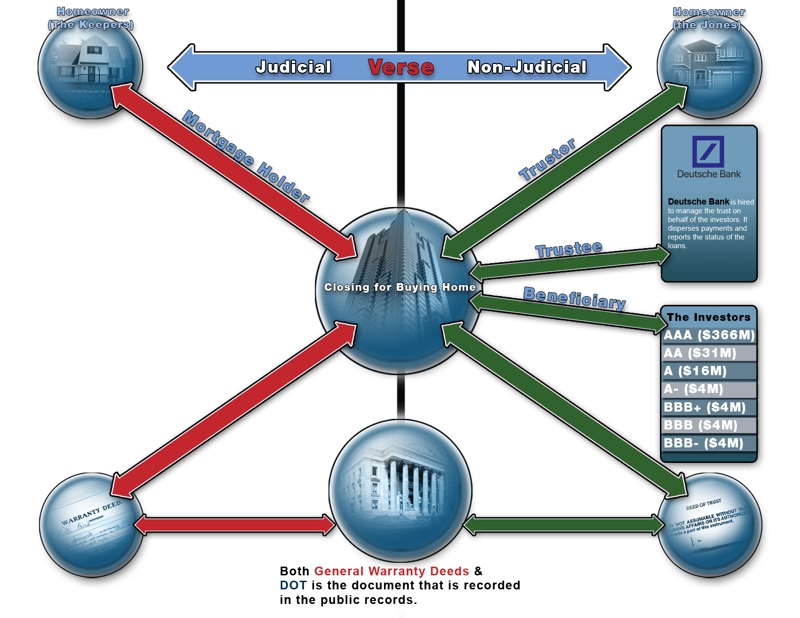
judicial and non-judicial foreclosure are used. They involve very different processes. These terms refer to how individual states handle real estate foreclosure. Under both systems, time frames and terms vary widely from state to state. The following is a brief, general description of both
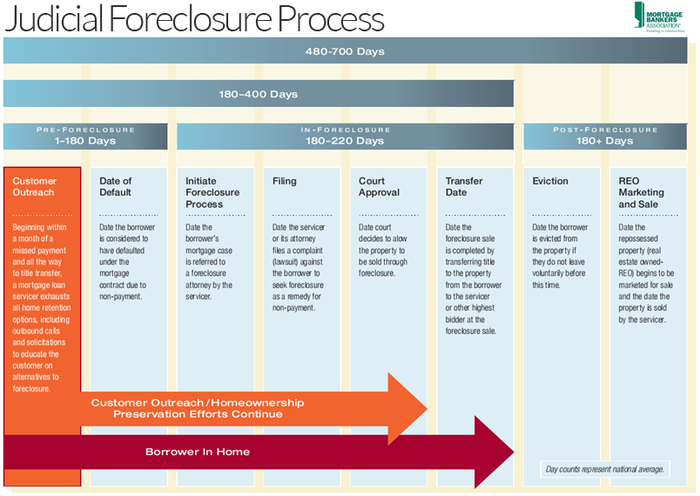
processes. The accompanying chart (see last page) depicts the varying time frames involved in the judicial foreclosure process.

foreclosure-stockdenslowfigure-1image-6922538539_image-69225_38539
Judicial Foreclosures

A judicial foreclosure is a court proceeding that begins when the lender files a complaint and records a notice in the public land records announcing a claim on the property to potential buyers, creditors and other interested parties. The complaint describes the debt, the borrower’s default and the amount owed. The complaint asks the court to allow the lender to foreclose its lien and take possession of the property as a remedy for non-payment.

foreclosureexplained

The homeowner is served notice of the complaint, either by mail, direct service or publication of the notice. The defendant (borrower) is permitted to dispute the facts (such as show that payments were made), offer defenses or present counterclaims by answering the complaint, filing a separate suit, and/or by attending a hearing arranged by the court. If the defendant shows there are differences of material facts, a trial will be held by the court to determine if foreclosure should occur. In the vast
majority of cases, however, the foreclosure action is undisputed because the borrower is in default and cannot offer facts to the contrary. If the court determines the homeowner did default and that the debt is valid, it will issue a judgment in favor of the servicer for the total amount owed, including costs for the foreclosure process. In order for the judge to determine the amount of the judgment, the servicer submits paperwork through an affidavit that itemizes the amounts due.

Twenty two states use judicial procedures as the primary way to foreclose.
These include: Connecticut, Delaware, Florida, Hawaii, Illinois, Indiana, Iowa, Kansas, Kentucky, Louisiana, Maine, New Jersey, New Mexico, New York, North Dakota, Ohio, Oklahoma, Pennsylvania, South Carolina, South Dakota, Vermont and Wisconsin.

In all other states, foreclosure is usually handled by attorneys who follow a state-provided process. In the mortgage documents, borrowers give lenders the “power of sale” outside of judicial process in the event of an uncured default. Documentation or affidavit issues are not common in these states because of the non-judicial nature of the process.

ar131472849801331
Next, the court will authorize a sheriff’s sale. The sale is an auction of the property open to anyone, and must be held in a public place. Procedures for a sheriff’s sale in each locality differ, but the individual with the highest bid is granted the property. After the sale is confirmed by the court, the deed, which transfers ownership, is prepared, recorded and the highest bidder becomes the owner of the property.

In most cases, the highest bidder is the servicer, who takes title of the property. The servicer then can sell the property. At this point, it is called
real estate owned (REO).

Visio-foreclosure timeline.vsd
Non-Judicial Foreclosures

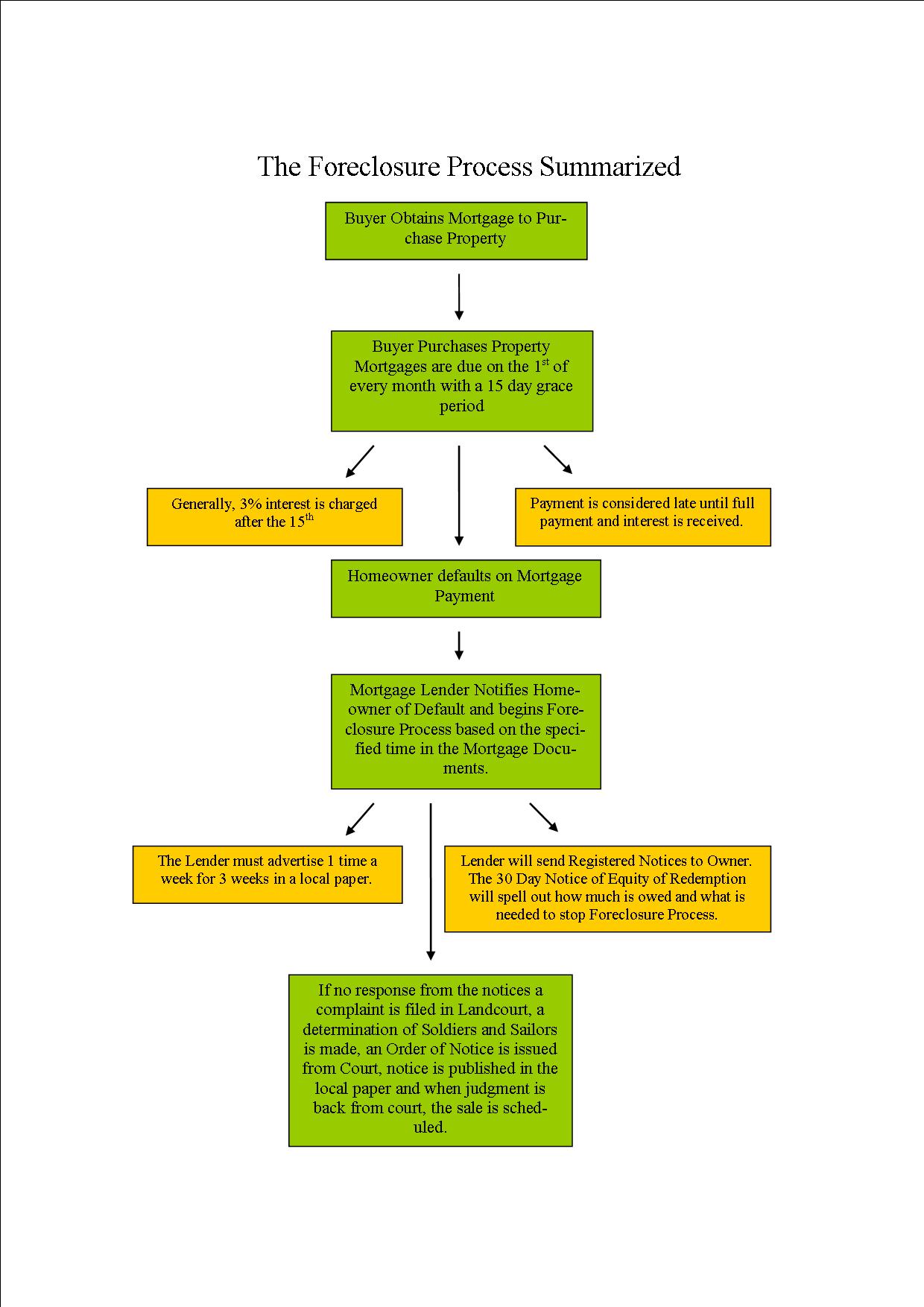
The requirements for non-judicial foreclosure are established by state statute; there is no court intervention. When the default occurs, the homeowner is mailed a default letter and in many states a
Notice of Default is recorded, at or about the same time. The homeowner may cure the debt during a prescribed period; if not, a Notice of Sale is mailed to the homeowner, posted in public places, recorded
at the county’s recorder’s office, and published in area newspapers
/legal publications. When the legally required notice period (determined by each state) has expired, a public auction is held and the highest
bidder becomes the owner of the property, subject to recordation of the deed. Prior to the sale, if the borrower disagrees with the facts of the case, he or she can try to file a lawsuit to enjoin the trustee’s sale.

short_sale_table_2

If you find yourself in an unfortunate situation of losing or about to lose your home to wrongful fraudulent foreclosure, and needed solutions to defend or reclaim your home please visit: http://www.fightforeclosure.net

0.000000 0.000000

Share this:

  • Click to share on X (Opens in new window) X
  • Click to share on Facebook (Opens in new window) Facebook
Like Loading...

Why Michigan Packaged Foreclosure Laws Were Designed to Harm Home Owners

28 Saturday Sep 2013

Posted by BNG in Case Study, Foreclosure Crisis, Foreclosure Defense, Judicial States, Loan Modification, Mortgage Laws, Non-Judicial States, Pro Se Litigation, Your Legal Rights

≈ Leave a comment

Tags

Bill, Detroit Free Press, Foreclosure, Home insurance, Loan, Michigan, Real estate, United States

The package of bills (HB 4765, HB4766, SB 380 and SB383) which has since been signed into Law on July 3rd by Michigan‘s Governor is designed to harm homeowners on both the front end and the back end of the foreclosure process by repealing Michigan’s pre-foreclosure negotiation law and by making it possible for banks to eliminate Michigan’s longstanding 6-month redemption period.

By repealing Michigan’s pre-foreclosure negotiation law, homeowners are forced into an increasingly vulnerable position of falling victim to widespread foreclosure scams.  Under the new policy, lender-designated agents are no longer required to meet with homeowners to avoid a foreclosure, and any person regardless of their qualifications can perform the role of a certified foreclosure counselor or legal aid attorney.

According to Detroit Free Press, by eliminating Michigan’s longstanding 6-month redemption period, at-risk homeowners could lose their homes immediately if the bank chooses to evict them.

“This means if a homeowner facing foreclosure has a leaky roof and the bank determines that it has the potential to do ‘imminent’ damage, the homeowner loses the redemption period and along with it, the chance to challenge an illegal or fraudulent foreclosure, come up with the money to save the home, sell it on a short sale or find a safe affordable new place to live. Instead they face immediate eviction.”

Because the laws definition of ‘damage’ is both broad and ambiguous, if the bank finds so much as a broken hinge or a closed off window, they could immediately move to evict the homeowner.  As outlined in SB 383, a bank representative has the authority to stop by a home unannounced to inspect both the exterior and interior of the home for any possible damages, and if denied access by the homeowner, the bank has license to disregard the redemption period and repossess the property immediately.

SEE DETAILS OF THE NEW LAW

NEWS ALERT: Michigan Governor Signs Foreclosure Bills HB 4765, HB 4766, SB 380, and SB 383

The following four Bills affecting Michigan’s non-judicial foreclosure process were signed into law by the Governor on July 3rd.

HB 4765

House Bill 4765 extends the sunset date for MCL §§ 600.3205a-3205d of the Michigan non-judicial foreclosure statute to January 9, 2014. Previously set to expire on June 30, 2013, these sections of the statute include the mandatory 90-day hold requiring loan modification mediations to occur prior to the commencement of non-judicial foreclosure actions of homestead properties where mortgagors “opt-in”. The requirements set forth in MCL §§ 600.3205a-3205d will have to be complied with through June 30, 2014, in regard to any non-judicial foreclosures for which the notice was published prior to January 10, 2014.

SB 380 and HB 4766

Senate Bill 380 and House Bill 4766 create MCL § 600.3206, which was designed to replace the current sections of the Michigan non-judicial foreclosure statute that dictate when mandatory mediations aimed at modifying loans are to occur. Effective January 10, 2014, if the servicer has signed a consent judgment in United States of America, et al. v. Bank of America Corp., et al., then that servicer will be required to send notice (similar to Michigan’s current pre-foreclosure mediation notice) to the mortgagor, allowing the mortgagor the opportunity to “opt-in” to a loan workout meeting prior to commencement of foreclosure proceedings.  Servicers that are not parties to the consent judgment will no longer be required to postpone commencement of non-judicial foreclosures to allow for mediations to occur on homestead properties where mortgagors “opt-in.”

SB 383

Senate Bill 383 adds a provision to MCL § 600.3240, which is the section of Michigan’s non-judicial foreclosure statute dictating post-sale redemption periods. This new provision grants the foreclosure sale purchaser the right to inspect the exterior and interior of the structures after the foreclosure sale as well as periodically during the redemption period. If inspection is unreasonably refused or property damage has occurred or is believed to be imminent, the purchaser may immediately commence summary proceedings to obtain possession of the property. The statute provides examples of what would be considered damage, which include failure to comply with local property maintenance ordinances, broken doors and windows, accumulated trash, stripped plumbing, etc. If a judgment for possession is granted in favor of the purchaser, the redemption period will be extinguished. These changes become effective January 10, 2014.

If you find yourself in an unfortunate situation of losing or about to your home to wrongful fraudulent foreclosure, visit: http://www.fightforeclosure.net

44.314844 -85.602364

Share this:

  • Click to share on X (Opens in new window) X
  • Click to share on Facebook (Opens in new window) Facebook
Like Loading...

Constitutional Rights of Florida Citizens Violated By Florida House Bill 87

28 Saturday Sep 2013

Posted by BNG in Foreclosure Defense, Judicial States, Mortgage Laws, Non-Judicial States, Pro Se Litigation, Your Legal Rights

≈ Leave a comment

Tags

Bill, Broward County, Broward County Florida, Collier County Florida, Due process, Florida, Foreclosure, Law

Representatives Kathleen Passidomo (District 106, Collier County) and George Moraitis, Jr. (District 93, Broward County) have supported the passing of House Bill 87, which denies residents the right to take their homes back after a wrongful foreclose.

According to House Bill 87, if a bank forecloses on a property, and if it is later discovered that the bank did not have standing to foreclose or that it was the incorrect bank with no beneficial interest in the loan, then the only available option to the homeowner is to sue for damages. The homeowner will no longer be afforded the opportunity to get his or her home back from the bank once the foreclosure has been finalized.

The people of Florida are demanding that proposed House Bill 87 not be allowed to pass into law in any form. The Bill is deemed unconstitutional because it violates Article 1, Sections 9 and 10 of Florida’s Constitution, which states that it is unlawful to pass any law or any Judicial and/or Executive Branch process which deprives any person of life, liberty or property without due process of law, and it prohibits the passing of any law that impairs the obligations of contracts.

If House Bill 87 is not killed, constituents and citizens of Florida, and any Florida property owner, will lose their individual property and due process rights. The “Kill House Bill 87” petition states:

“The people demand that House Bill 87 be voted down and not passed into law, as the proposed Bill is no more than another brazen attempt to further deprive U.S. citizens of their constitutional rights to due process of law in Florida’s courts, and will be used as a stepping stone to change the State of Florida into a non-judicial foreclosure state.”

The petition’s current goal is to gather 2,000 signatures. If you would like to support the voting down of the unconstitutional House Bill 87, then please sign the petition below.

To sign the petition please click here: http://petitions.moveon.org/sign/kill-house-bill-87?source=s.icn.em.mt&r_by=7041070

Fightforeclosure.net supports the people’s petition to eradicate House Bill 87. If you have been a victim of wrongful foreclosure and need help in saving your home from fraudulent foreclosure visit: http://www.fightforeclosure.net

27.664827 -81.515754
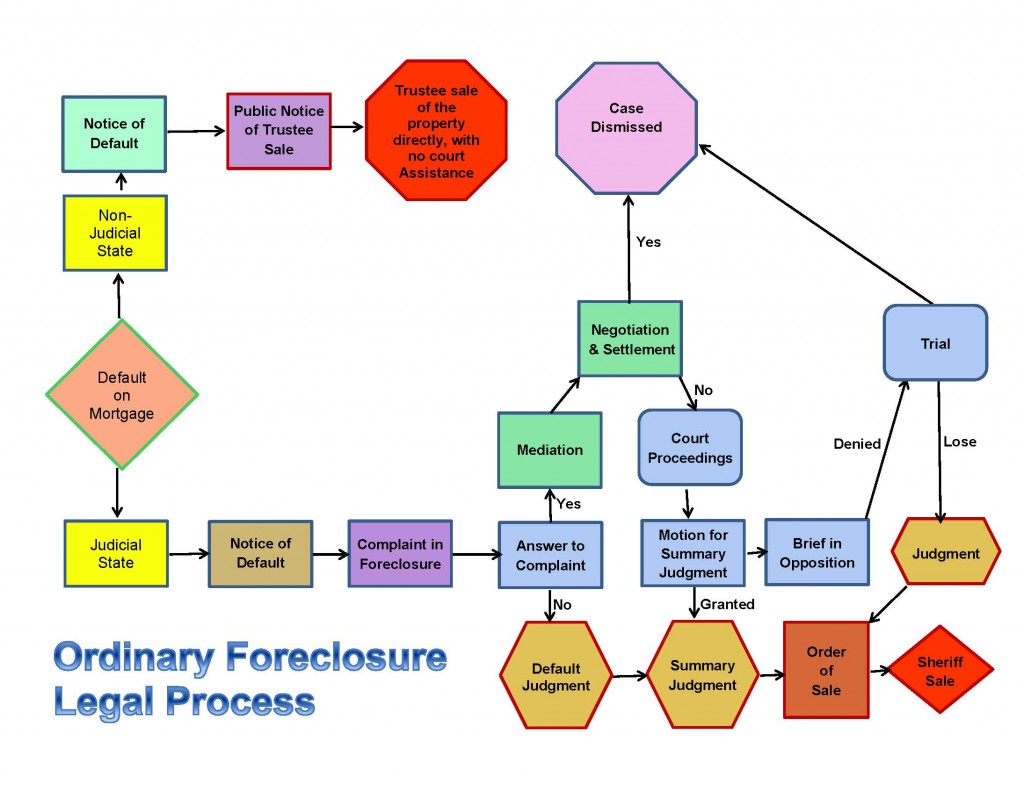
Share this:

  • Click to share on X (Opens in new window) X
  • Click to share on Facebook (Opens in new window) Facebook
Like Loading...

Nevada Foreclosure Rate Tops U.S. Again

25 Wednesday Sep 2013

Posted by BNG in Affirmative Defenses, Foreclosure Crisis, Non-Judicial States, Pro Se Litigation, Your Legal Rights

≈ 1 Comment

Tags

August, Florida, Foreclosure, Las Vegas, Nevada, Percentage, Real estate, RealtyTrac, Reno

Last month Nevada once again secured the top spot as the state with the nation’s highest foreclosure rate due to spikes in default notices and scheduled foreclosure auctions.

According to a report by the Irvine-based real estate analytics company, RealtyTrac, in August one out of every 359 Nevada housing units was the subject of a new foreclosure filing.  This number reflects more than two-and-a-half times the national average.

RealtyTrac defines foreclosure filings as:

“Including notices of default, notices of pending trustee sales and repossessions by banks.”

Additionally, RealityTrac stated that last month with one filing for every 323 housing units, Las Vegas was ranked third for the nation’s highest foreclosure rate among large metropolitan areas. Nevada’s foreclosure filings have increased over 100 percent compared to the previous month and nearly 11 percent percent over August 2012, due to the 226 percent increase in default notices and a 96 percent jump in scheduled foreclosure auctions compared with July.

RealtyTrac Vice President Daren Blomquist attempts to explain the recent jump in Nevada foreclosures saying:

“The foreclosure floodwaters have receded in most parts of the country, but lenders and communities continue to clean up the damage left behind, which means the recent uptick in bank repossessions is a trend that will likely continue into next year,” he said. “Meanwhile foreclosure flash floods will continue to hit some markets over the next few months as delayed foreclosure starts are quickly pushed into the pipeline.

Another explanation for Nevada’s increase in foreclosures is due to the possibility that bankers have identified how to operate under the new Assembly Bill 300 law that is supposed to make it easier for banks to seize homes from delinquent borrowers.

Under AB300, a bank’s affidavit no longer has to be based on personal knowledge of a home’s mortgage-document history before they foreclose. Instead, the bank’s affidavit can be founded on an assessment of internal lending records and either title paperwork or filings with the local county recorder.

For More Information on How To Effectively Challenge Your Lender/Bank In Order to Save Your Home Even If Foreclosure has taken place, Visit: http://www.fightforeclosure.net

38.802610 -116.419389

Share this:

  • Click to share on X (Opens in new window) X
  • Click to share on Facebook (Opens in new window) Facebook
Like Loading...

A Guide to California Homeowners Defending Post-Foreclosure Evictions

24 Saturday Aug 2013

Posted by BNG in Affirmative Defenses, Federal Court, Foreclosure Defense, Judicial States, Landlord and Tenant, Non-Judicial States, Pro Se Litigation, State Court, Your Legal Rights

≈ Leave a comment

Tags

Eviction, Foreclosure, HAP, Leasehold estate, Los Angeles, PTFA, Real estate, Sacramento

Elements of a Post-foreclosure Eviction
– Notice Requirements
– Compliance with CC 2924
– Present Right to Possession
Unlawful Detainer Litigation

Notice Requirements

Former Borrowers v. Tenants

– Former borrowers
3 days’ notice
– Tenants
90 days’ notice (in most cases)

Protecting Tenants at Foreclosure Act (Section 702)

– All bona fide tenants
Must be given at least 90 days’ notice
– Bona fide tenants with more than 90 days remaining on lease
Entitled to stay until the end of the lease, if lease entered into before “notice of foreclosure”

– EXCEPTION: lease may be terminated with a 90-day notice if purchaser will occupy unit as primary residence or if lease terminable at will under state law

Bona Fide Tenancy (PTFA)

A lease or tenancy is bona fide only if:
– Tenant is not the mortgagor or the mortgagor’s child, spouse, or parent; and
– Lease was the result of an arms length transaction; and
– Rent is not substantially less than fair market rent (unless the reduction is due to governmental subsidy)

HCV (Section 8) Tenants

– Section 8 tenants are deemed to be bona fide tenants. 74 Fed. Reg. 30108
– New owner takes title subject to both the Section 8 lease and the HAP contract

– EXCEPTION: Lease may be terminated with a 90 day notice if new owner will occupy unit as primary residence
– Any eviction notices must also be sent to the Housing Authority. 24 CFR 982.310(e)(2)(ii).

State Law Notice Requirements

CCP 1161b
– 60-day notice requirement for all tenants
– AB 2610 (effective 1/1/13):
– 90-day notice requirement for all tenants
– lease protections
– CCP 1161c
– Cover sheet requirement for post-foreclosure eviction notices

Service of Notice

Cal. law (CCP 1162):
– Personal service;
– Substitute service; or
– Posting and mail
– Does actual receipt cure service defects?
– Compare Valov v. Tank (1985) 168 CA3d 867 with Culver Ctr. Partners E #1 LP v. Baja Fresh Westlake Village, Inc. (2010) 185 CA4th 744

3/60/90 Day Notices

– Invalid? Alta Cmty. Invs. III v. Ottoboni, No. 1370195 (Cal. Super. Ct. July 29, 2010) (holding that 3/30/60/90 day notice is fatally ambiguous)

Post-FC Evictions in Just-Cause Jurisdictions

Just cause for eviction required
– Nonpayment of Rent
– 90-day notice required? PNMAC Mortg. v. Stanko, No. 11U04495, 2012 WL 845508 (Los Angeles, Cal. Super. Ct. Mar. 7, 2012) (yes)
– AB 1953 (effective 1/1/13):
– Cannot demand rent accrued before compliance with CC 1962
– Breach of Lease
– 90-day notice required?

Compliance with CC 2924

CCP 1161a

A person who holds over . . . may be removed therefrom as prescribed in this chapter:
– (3) Where the property has been sold in accordance with Section 2924 of the Civil Code, under a power of sale contained in a deed of trust executed by such person, or a person under whom such person claims, and the title under the sale has been duly perfected.
“Title” issues may be litigated in post-foreclosure UDs
– Malkoskie v. Option One Mortg. Corp., 188 Cal. App. 4th 968 (2010)

Properly Conducted Sale

Trustee must have authority to conduct sale
– Wells Fargo Bank, N.A. v. Detelder-Collins, No. APP10000325 (Riverside Super. Ct. App. Div. Mar. 28, 2012) (UD judgment reversed because plaintiff failed to provide substitution of trustee to show that trustee had authority to conduct sale)
Sale void if conducted in breach of loan mod.
– Barroso v. Ocwen Loan Servicing, LLC, 208 Cal. App. 4th 1001 (2012) (permanent modification)

Failure to provide proper foreclosure notices
– JP Morgan Chase v. Callandra, No. 1371026 (Cal. Super. Ct., Santa Barbara Co. Oct. 21, 2010) (tenant may challenge foreclosure based on failure to post NTS)
– But tender/prejudice requirement for former homeowners

Right to Possession – Present Right to Possession

Expiration of Notice Period?
– Expiration of Bona Fide Lease?
– Must still satisfy 90-day notice requirement

UD Litigation – Unlawful Detainer Process

Service of Summons and Complaint
– Personal;
– Substitute; or
– Nail and mail with court approval (after reasonable diligence)
– Five days to answer
– Pre-answer motions:
– Delta motion to quash (prejudgment claimant?)
– Demurrer (defect must appear on face of complaint)
– Answer
– Summary Judgment
– Trial

60-Day “Curtain” (CCP 1161.2)

Limited civil UDs are masked for the first 60 days
– Unmasked after 60 days unless tenant prevails within the 60 days

Except for post-foreclosure cases
– Permanently masked unless plaintiff prevails against all defendants after trial within 60 days

Unnamed Occupants

“Doe” occupants
– Must intervene in case by filing prejudgment claim of right to possession within 10 days of service
– BUT see AB 2610 (effective 1/1/13):
– PJCRTP form may be filled out and presented at any time, even after judgment

Appeal

Notice of appeal – 30 days after notice of entry of judgment
– No automatic stay of the writ of possession
– Ask for stay
– Trial court
– Writ proceeding in appellate division
– Appeal bond
– Little case law for post-foreclosure UD issues
21

Hypo

Tom Tenant’s 3-BR home in Sacramento, CA was sold at foreclosure sale on October 1. Tom’s existing lease expires on November 1, 2013. Under this lease, he pays $1,600 in rent each month under the lease, but the surrounding homes rent for about $2,300 per month. On October 5, Ivan Investor, who purchased the property at the trustee sale, served Tom with a 60-day notice to quit. Is the notice correct?

– What if Tom was a Section 8 HCV tenant?
– Or if Tom lived in Oakland instead of Sacramento?

Homeowners who finds themselves in a situation where their lender is fraudulently trying to use cooked up documents to steal their most prized possessions “their homes”, needs to do whatever is necessary to stop these interlopers from stealing their homes. To do this, homeowners need to fight them to the finish in order to avoid the situation of change of status from “borrowers to tenants” as described above. Homeowners in wrongful foreclosures should do their best to reclaim what is rightfully theirs even if the lenders initially succeeded in foreclosing using fraudulent documents. It can reversed and dismissed by the courts through vigorous litigation, that’s where http://www.fightforeclosure.net comes in.

foreclosure_dismissal_Proof

To learn how you can effectively use well structured (Pro Se “Self Representation”) litigation pleadings to effectively challenge and reclaim your status as a homeowner instead of a tenant, visit http://www.fightforeclosure.net

34.052234 -118.243685

Share this:

  • Click to share on X (Opens in new window) X
  • Click to share on Facebook (Opens in new window) Facebook
Like Loading...

How Attorney Mistakes Can Result to Homeowners Losing their Homes in Wrongful Foreclosure Litigation.

23 Friday Aug 2013

Posted by BNG in Banks and Lenders, Case Laws, Case Study, Federal Court, Foreclosure Defense, Judicial States, Litigation Strategies, Non-Judicial States, Pleadings, Pro Se Litigation, State Court, Trial Strategies, Your Legal Rights

≈ Leave a comment

Tags

Law, Lawsuit, Medical malpractice, North Carolina, Services, Statute of Limitations, Tennessee, United States

One of the biggest mistakes we see in various court cases especially in wrongful foreclosure cases where homeowners who are represented by counsel is the failure by plaintiffs’ attorneys to file the complaint within the statutes of limitation period. Attorneys fail to file a claim within the appropriate statutes of limitation for numerous reasons. For example, lawyers often fail to determine the correct statute of limitation applicable to the claim. For instance to effectively bring a TILA lawsuit against your lender, it must be filed within “One Year”, of your mortgage closing otherwise the courts can only allow the cause of action based on whether your motion for equitable tolling is granted or not.

For wrongful foreclosure homeowners who hired Attorneys to represent them, do not assume that your Attorney knows the statutes of limitation period for every cause of action you intend to bring against your lender to save your home, because if your Attorney miss all major causes of action that would have disqualified your lender from stealing your home as a result of fraud, you may end up losing your home even if your lender is liable for other violations which may entitle you to a couple of thousands of dollars in compensation. Your goal is to save your home, so it is not a matter to be taken for granted because you paid your Attorneys big bucks to represent you.

Litigation attorneys are at a greater risk of malpractice claims than all other types of attorneys. Typically, errors arising out of litigation accounted for 35% to 40% of all claims reported. Clients who lose suits often point to a
perceived error by their attorney as the reason their suit was unsuccessful and seek a remedy against the attorney. The main causes of malpractice stem from missing deadlines, failing to calendar, failing to file, failing to
meet discovery obligations, inadequate trial preparation, inappropriate post-trial actions and improper withdrawal. The use of good docketing and tickler systems and the development of good client relations can significantly reduce malpractice risk

While Attorneys obviously need to be knowledgeable about the substantive issues in any lawsuit, some Attorneys does not take care to learn and follow the procedural rules of court.

Even experienced Attorneys do not know every procedural rule for every court in which they practice. Rather, they know where to find the particular procedural rules governing the litigation and make sure they follow them,
thereby reducing their exposure to malpractice actions.

This post, while not exhaustive, provides important tips to help homeowners who are being represented by Attorneys ensure that they are getting their money’s worth thereby avoid common pitfalls that usually
result in malpractice liability when Attorneys fails their clients. After all when you pay someone $5000-$10000 to save your home, you expect them to put their best foot forward. However, always remember that (YOU ARE YOUR OWN BEST ADVOCATED), as a Pro Se Litigant with http://www.fightforeclosure.net

The post highlights ten prominent points during the course of litigation where attorneys are prone to make mistakes, emphasizing specific
types of rules and procedures that are often overlooked. Armed with the information contained in this post, homeowners can help reduce the possibility of losing the homes as a result of negligence conduct of their hired lawyers which could possibly exposure the lawyers to malpractice liability.

THESE FOLLOWING AREAS ARE WHERE THE HOMEOWNERS SHOULD PAY CLOSE ATTENTION TO – THESE ARE WHERE ATTORNEYS USUALLY MAKE MISTAKES.

A GOOD DOCKETING SYSTEM

Attorneys risk malpractice claims when they correctly identify the expiration date of a claim but fail to file the complaint in a timely manner, allowing the claim to expire. One common pitfall is that the attorney or staff person
calendars the deadline in the attorney’s calendar, but the attorney fails to check the calendar, thus missing the date.

Homeowners should ensure that their lawyers can reduce their malpractice risk by diligently calendaring statutes of limitation deadlines and other deadlines that arise within their case. Everything that involves a time limit should be entered into the docket system and the system should generate several advance warnings of each deadline to be given to the attorney and support persons involved.

Although it is ultimately the lawyer’s responsibility to meet deadlines, unforeseen circumstances may prevent the lawyer from meeting a deadline. Homeowners should ensure that their case is assigned a backup lawyer or staff member who is responsible for bringing the deadline to the attention of the main attorney on the matter; or who is able to meet a filing deadline in the lawyer’s absence.

AVOID FILING AT THE LAST MINUTE

Malpractice suits for missing the statutes of limitation also arise when the lawyer and/or his office staff simply neglect to follow through and make sure the complaint is filed with the proper court on or before the deadline. A
variety of unforeseen problems may delay filings. For example, lawyers may sometimes assume that complaints sent by overnight mail will arrive in time and be processed by the court the next day. Similarly, office staff or third
parties hired to assist with the filing may make errors, such as filing the complaint with the wrong court, or missing a last minute deadline.

Such errors can be avoided by routinely filing complaints, motions and other documents in advance of the deadline. Filing at the last minute is a risky practice. Unexpected glitches are bound to occur from time to time. Filing ahead of time will give you breathing room to resolve the unforeseeable problems that might get in the way of filing before the limitation period expires.

KNOWING THE APPLICABLE LAW

DETERMINE THE CORRECT STATUTES OF LIMITATION FOR YOUR JURISDICTION

Attorneys often miss statutes of limitation deadlines when they incorrectly assume that the statutes of limitation runs after the same amount of time in different jurisdictions. For example, the statutes of limitation for a wrongful death claim in Tennessee runs in one-year.  However, a North Carolina plaintiff ’s attorney handling a wrongful death suit arising in Tennessee might assume that North Carolina’s two-year statutes of limitation for a wrongful death claim applies in the situation. If the attorney files a claim after Tennessee’s expiration date but before North Carolina’s expiration date, the attorney missed the appropriate state’s deadline and could face a claim for malpractice.

PERFORM ADEQUATE RESEARCH AND INVESTIGATION

Nearly half of all malpractice claims arise from substantive errors. Examples include failure to learn or properly apply the law, and inadequate discovery or investigation. In addition to ascertaining all relevant statutes of limitation deadlines, it is important that homeowners ensure that their attorneys are  familiar and comply with the law and standards of care in each applicable state.

One common type of malpractice claim resulting from inadequate knowledge of substantive law is in the area of personal injury claims arising out of automobile accidents. Such a claim arises, for example, where the client suffers personal injury in a wreck and there is a $25,000 limit on the defendant’s auto insurance. Since the client has $100,000 worth of damages, the defendant’s carrier readily issues a check for the policy limit of $25,000. The lawyer neglects to investigate whether any other coverage
exists. The client later learns he could have recovered an additional $75,000 from his own insurance policy that included uninsured/underinsured “UM/UIM” coverage. By then, however, it is too late because the client has
already signed a release of all claims against the tortfeasor. Since “[a]n underinsured [UIM] motorist carrier’s liability is derivative of the tortfeasor’s liability,” the UIM carrier may decline to provide any coverage. Liberty Mut. Ins. Co. v. Pennington, 141 N.C. App. 495, 499, 541 S.E.2d 503, 506
(2000), cert. granted, 353 N.C. 451, 548 S.E.2d 526 (2001); see also Spivey v. Lowery, 116 N.C. App. 124, 446 S.E.2d 835 (1994) (UIM carrier was not liable after plaintiff executed general release).

Experience lawyers in these areas and situations usually require have the client execute a limited release that protects the client’s right to recover UIM or UM benefi ts. For an example of a limited release that was upheld by the courts, review North Carolina Farm Bureau, Mut. Ins. Co. v. Bost, 126 N.C. App. 42, 483 S.E.2d 452, review denied, 347 N.C. 138, 492 S.E.2d 25 (1997). In other cases, the lawyer may fail to notify the UIM carrier of the
claim in a timely manner. If the client is unable to recover from his UIM carrier because of his lawyer’s neglect, he may have a claim for damages against the attorney.

In these cases that pertains to personal injury, the law requires the plaintiff to timely serve the summons and complaint on both the tortfeasor and the UM carrier prior to the expiration of the statutes of limitation. See N.C. Gen. Stat. § 20-279.21(b)(3); Thomas v. Washington, 136 N.C. App. 750, 525 S.E.2d 839, review denied, 352 N.C. 598, 545 S.E.2d 223 (2000). Failure to properly serve either the tortfeasor or the UM carrier may result in lost benefi ts for the client and a malpractice claim against the attorney.

These types of errors usually can be prevented through careful research and methodical procedures.

When dealing with wrongful foreclosure case, homeowners should stay abreast of new legal developments. Experts should be consulted, where needed.

PROVIDE ADEQUATE SUPERVISION OVER ASSIGNED TASKS

Malpractice concerns arise when lawyers fail to adequately supervise non-lawyers or junior associates. Lawyers can be held responsible for mistakes made by their employees. See e.g., Pincay v. Andrews, 367 F.3d 1087 (9th Cir. 2004) (Judge Kozinski’s dissent; holding attorney liable for a paralegal’s miscalculation). Such malpractice risk can be minimized
by providing adequate supervision and fostering an environment where questions and concerns can be freely raised. Staff should be carefully supervised as the attorney is ultimately the responsible party.

FILING THE COMPLAINT AND SERVICE OF PROCESS

After the proper statutes of limitation period has been properly identified and the complaint properly filed, other pitfalls await the unwary attorney. Attorneys commonly make mistakes in naming and serving the proper parties. Such defects can often be corrected. However, when a lawsuit is commenced at the eleventh hour (just before the statutes of limitation expires), as in most wrongful foreclosure cases, the attorney may not
have time to correct such flaws, and the client may suffer prejudicial harm as a result.

IDENTIFY AND NAME THE PROPER DEFENDANT

One of the most common mistakes attorneys make is that they fail to discover and identify the proper name of the corporate defendant whom the plaintiff seeks to sue. In a wrongful foreclosure case that involved securitization of mortgage loans, sometimes defendants mights be more than one. To avoid such errors, homeowners should ensure that their attorneys should make every effort to ascertain the defendant’s proper
corporate name either before filing the complaint or as soon as possible thereafter through discovery. A diligent effort should be made to determine all possible entities and persons who should be named as parties in the lawsuit. If situation involves foreign defendants, take special care in correctly naming and serving foreign defendants. Foreign service requirements, including Hague Convention requirements, may need to be followed.

SERVE ALL DEFENDANTS WITHIN STATUTORILY PRESCRIBED TIME LIMITATIONS.

Attorneys who commit errors in timely serving a complaint and summons on a defendant may also face malpractice liability.

Attorneys must serve a defendant with a complaint and summons within the statutorily required time limitations. These limitations vary according
to jurisdiction. For instance, an attorney must serve a defendant to a lawsuit in federal court within 120 days of the fi ling of the complaint. Fed. R. Civ. P. 4(m). However, a defendant in a lawsuit in North Carolina State court must be served in most cases within 60 days after the date of the
issuance of the summons. N.C. Gen. Stat. § 1A-1, Rule 4(c).

Attorneys who fail to perfect service upon a defendant within the statutory expiration period may request an extension of time for service of process. A federal court will grant an extension only if the attorney provides good
cause for the delay in service. Fed. R. Civ. P. 4(m). On the other hand, a North Carolina court will issue an alias or pluries summons to extend the time period for service upon request, provided certain guidelines are met. N.C. Gen. Stat. § 1A-1, Rule 4(d)(2). Thus, an attorney may be vulnerable to malpractice claims for failing to follow the rules of the particular court in which the case is being litigated. For instance, attorneys may request an alias or pluries summons “at any time within 90 days after the date of issue of the last preceding summons in the chain of summonses.” Id. Provided that the request is not made in “violations of the letter or spirit of the rules for the purpose of delay or obtaining an unfair advantage,” an attorney may request numerous alias or pluries summonses and extend the service deadline for a lengthy period of time without committing malpractice. Smith v. Quinn, 324 N.C. 316, 319, 378 S.E.2d 28 (1989). However, an attorney who does not request an alias or pluries summons within the 90 day time period invalidates the old summons and begins a new action. See CBP Resources v. Ingredient Resource Corp., 954 F. Supp. 1106, 1110 (M.D.N.C. 1996). An attorney risks malpractice liability if the statutes of limitation runs before the alias or pluries summons is issued in such a situation.

In addition, an attorney must refer to the original summons in an alias or pluries summons or else the alias or pluries summons is invalid. Integon Gen. Ins. Co. v. Martin, 127 N.C. App. 440, 441, 490 S.E.2d 242 (1997).

In addition, the attorney may encounter the situation where he is unable to serve the defendant with the summons and complaint because the defendant has died. To complicate matters further, the statutes of limitation
has expired. Homeowners should ensure that their Attorneys consult the statutes for their respective Jurisdictions. This statute will help the lawyer resolve the issue and save the homeowners cause of action.

KEEP THE SUMMONS ALIVE OR ENTER INTO ENFORCEABLE TOLLING AGREEMENTS WITHIN THE STATUTES OF LIMITATION WHILE ENGAGING IN SETTLEMENT DISCUSSIONS.

It is often in the client’s best interest to pursue settlement before spending the time and money involved to file or serve a complaint. However, in the instants where the Banks are not willing to work with homeowners, but where rather interested in stealing the homes through wrongful foreclosure, homeowners are left with little options but to pursue the litigation with their Attorneys or Pro Se, in order to save their homes.

In such cases, it is important that the homeowner let their Counsels know that  it is crucial to keep the required summons alive and/or enter into an enforceable tolling agreement with the opposing party. Such tolling agreements must be executed before the statutes of limitation passes. Regardless of how close the parties may be to settlement, the Attorneys should not let the statutes of limitation pass without invoking proper protections for the homeowners.

For More Information How You Can Aggressively Defend Your Wrongful Foreclosure on Your Own “Pro Se”, thereby Avoiding These Costly Attorney Mistakes That Can Potentially Cost You the Most Valuable Investment You Have Ever Made which is “Your Home – The American Dream” Visit http://www.fightforeclosure.net (You Are Your Own Best Advocate!)

Share this:

  • Click to share on X (Opens in new window) X
  • Click to share on Facebook (Opens in new window) Facebook
Like Loading...

California Broker Receives 10-Year Prison Sentence for Mortgage Fraud

18 Sunday Aug 2013

Posted by BNG in Foreclosure Defense, Fraud, Judicial States, Non-Judicial States, Pro Se Litigation, Your Legal Rights

≈ Leave a comment

Tags

California, Federal Bureau of Investigation, Foreclosure, Justice Department, Mortgage fraud, Real estate, Special agent, United States Department of Justice

white-collar-crime

In California, a real estate broker out of Elk Grove was sentenced to 10 years in prison for her role in a mortgage fraud scheme that led to more than $5.5 million in losses, the Justice Department announced in a statement.

Hoda Samuel, 62, owned and operated Liberty Real Estate & Investment Company and Liberty Mortgage Company.

Out of 30 fraudulent sales transactions that occurred between April 2006 and February 2007, Samuel serve as the real estate agent for the buyer in 29 of the home sales, according to the statement. All the properties involved in the transactions went into foreclosure.

The transactions included false statements pertaining to income, employment, and rental history. To back the fabricated information, false documents were created and presented to lenders, and people were paid to answer calls from lenders and affirm the false statements.

Samuel also exaggerated the value of the collateral securing the loans, often exceeding the actual asking prices by $15,000 to $40,000. Repairs and costs for disability access modifications were also included in the prices, but were rarely done. According to the statement, at times, children of buyers were named as building contractors so money could go to the buyers.

“Greed-based crimes such as these can undermine the stability of our financial institutions and the economy, resulting in devastating consequences for homeowners, businesses and the communities in which the properties are located,” said special agent in charge Monica M. Miller of the Sacramento division of the FBI.

For More Information How to Save Your Home From Foreclosure as a Result of Mortgage Fraud Like this Visit http://www.fightforeclosure.net

Share this:

  • Click to share on X (Opens in new window) X
  • Click to share on Facebook (Opens in new window) Facebook
Like Loading...

What Homeowners in Foreclosure Defense Needs to Know About the Issues of “Standing vs. Capacity to Sue”

18 Sunday Aug 2013

Posted by BNG in Affirmative Defenses, Case Laws, Case Study, Federal Court, Foreclosure Defense, Fraud, Judicial States, Litigation Strategies, Mortgage Laws, Non-Judicial States, Pleadings, Pro Se Litigation, State Court, Trial Strategies, Your Legal Rights

≈ 1 Comment

Tags

Court, Lawsuit, Mastropaolo, Motion (legal), New York, Plaintiff, Wells Fargo, Wells Fargo Bank

Homeowners in Judicial foreclosure states need to realize that Banks claim of ownership of the note is not an issue of standing but an element of its cause of action which it must plead and prove

The term “standing” has been applied by the courts to two legally distinct concepts. The first is legal capacity, or authority to sue. The second is whether a party has asserted a sufficient interest in the outcome of a dispute.

Standing and capacity to sue are related, but distinguishable legal concepts. Capacity requires an inquiry into the litigant’s status, i.e., its “power to appear and bring its grievance before the court”, while standing requires an inquiry into whether the litigant has “an interest in the claim at issue in the lawsuit that the law will recognize as a sufficient predicate for determining the issue.”

Wells Fargo Bank Minnesota, Nat. Ass’n v Mastropaolo, 42 AD3d239, 242 (2d Dept 2007) (internal citations omitted). Both concepts can result in dismissal on a pre answer motion by the defendant and are waived if not raised in a timely manner.

In some Jurisdictions such as New York, an action may be dismissed based on the grounds that the Plaintiff lacks the legal capacity to sue. CPLR 3211(a)(3) It governs no other basis for dismissal. CPLR 3211(e) provides that a motion to dismiss pursuant to CPLR 3211(a)(3) is waived if not raised in a pre-answer motion or a responsive pleading.

Many decisions treat the question of whether the Plaintiff in a foreclosure action owns the note and mortgage as if it were a question of standing and governed by CPLR 3211(e).

Citigroup Global Markets Realty Corp. v. Randolph Bowling , 25 Misc 3d 1244(A), 906 N.Y.S.2d 778 (Sup. Ct. Kings Cty 2009);  Federal Natl. Mtge. Assn. v. Youkelsone, 303 AD2d546, 546—547 (2d Dept 2003);
Nat’l Mtge. Consultants v. Elizaitis, 23 AD3d 630, 631 (2dDept 2005);
Wells Fargo Bank, N.A. v. Marchione, 2009 NY Slip Op 7624, (2d Dept 2009)

There is a difference between the capacity to sue which gives the right to come into court, and possession of a cause of action which gives the right to relief.  Kittinger v Churchill  Evangelistic Assn Inc., 239 AD 253, 267 NYS 719 (4th Dept 1933). Incapacity to sue is not the same as insufficiency of facts to sue upon. Ward v Petri, 157 NY3d 301 (1898)

In the case of Ohlstein v Hillcrest, a defendant moved to dismiss a complaint in part based on lack of legal capacity to sue where plaintiff had assigned her stock. The Court denied that branch of the motion holding that even if plaintiff had assigned her stock, “the defect to be urged is that the complaint does not estate [sic] a cause of action in favor of the one who is suing, the alleged assignor – not that the plaintiff does not have the legal capacityto sue. Legal incapacity, as properly understood, generally envisages a defect in legal status,not lack of a cause of action in one who is sui juris.” Ohlstein v Hillcrest, 24 Misc 2d 212,214, 195 NYS2d 920, 922 (Sup Ct NY Co 1959).

The difference was articulated by the Court in the case of  Hebrew Home for Orphans v Freund, 208 Misc. 658, 144 N.Y.S.2d 608 (Sup Ct Bx 1955). The plaintiff in that case sought a judgment declaring that an assignment of a mortgage it held was valid. The defendants moved to dismiss the complaint on the grounds that since the assignment was not accompanied by delivery of the bond and mortgage to plaintiff, plaintiff did not own the bond and mortgage and thus had no legal capacity to sue or standing to maintain the action. The Court denied the motion, stating:

The application to dismiss the complaint on the alleged ground that the plaintiff lacks legal capacity to sue rests upon a misapprehension of the meaning of the term. See Gargiulo v.Gargiulo, 207 Misc. 427, 137 N.Y.S.2d 886. Rule 107(2) of the Rules of Civil Practice relates to a plaintiff’s right to come into Court, and not to his possessing a cause of action. Idat 660-661, 610.

The Court then quotes Kittinger v Churchill for the principle that,

“The provision for dismissal of the complaint where the plaintiff has not the capacity to sue (Rules of Civil Practice, rules 106, 107) has reference to some legal disability, such as infancy, or lunacy, or want of title in the plaintiff to the character in which he sues. There is a difference between capacity to sue, which gives the right to come into court, and possession of a cause of action, which gives the right to relief in court.
Ward v. Petrie, 157 NY 301, 51 N.E. 1002;  Bank of Havana v. Magee,
20 NY 355; Ullman v. Cameron, 186 NY 339, 78 N.E.1074. The plaintiff is an individual suing as such. He is under no disability, and sues in norepresentative capacity. He is entitled to bring his suits before the court, and to cause a summons to be issued, the service of which upon the defendants brings the defendants in to court. There is no lack of capacity to sue.

The other meaning of standing involves whether the party bringing the suit has a sufficient interest in the dispute. Some cases have held that in this context, standing is jurisdictional, reasoning that where there is no aggrieved party, there is no genuine controversy, and where there is no genuine controversy, there is no subject matter  jurisdiction.
Stark v Goldberg, 297 AD2d 203, 204(1st Dept 2002);  xelrod v New York StateTeachers’ Retirement Sys., 154 AD2d 827, 828 (3rd Dept 1989).

Some courts have held that the jurisdiction of the court to hear the controversy is not affected by whether the party pursuing the action is, in fact, a proper party.They have held that if not raised in the answer or pre-answer motion to dismiss, the defense that the a party lacks standing is waived. Wells Fargo Bank Minnesota, Nat. Ass’n v. Perez,70 AD3d 817, 818, 894 N.Y.S.2d 509, 510 (2nd Dept 2010), Countrywide Home Loans, Inc.v. Delphonse, 64 AD3d 624, 625, 883 N.Y.S.2d 135 (2nd Dept 2009),
HSBC Bank, USA v. Dammond, 59 AD3d 679, 680, 875 N.Y.S.2d 490 (2nd Dept 2009)

The issue of whether a Plaintiff owns the mortgage and note is a different question from  whether it has an interest in the dispute. Whether a party has a sufficient interest in the dispute is determined by the facts alleged in the complaint, not whether Plaintiff can prove the allegations.
Wall St. Associates v. Brodsky, 257 AD2d 526, 684 N.Y.S.2d 244 (1st Dept1999),  Kempf v. Magida, 37 AD3d 763, 764, 832 N.Y.S.2d 47, 49 (2nd Dept 2007). For the purpose of determining whether a party has sufficient interest in the case the allegations areassumed to be true.

It is important to note that This issue is not analogous to the issue of whether citizens have standing to seek judicial intervention in response to what they believe to be governmental actions which would impair the rights of members of society, or a particular group of citizens, (e.g. Schulz v. State, 81 NY2d 336, 343, 615 N.E.2d 953, 954 (1993), or whether registered voters have standing to challenge the denial of the right to vote in a referendum pursuant to Section 11 of Article VII of the State Constitution, or whether commercial fishermen have standing to complain of the pollution of the waters from which they derive their living, see also  Leo v. Gen. Elec. Co.,  145 AD2d 291, 294, 538 N.Y.S.2d 844, 847 (2nd Dept 1989). The issue of standing in these types of cases turn on whether the claimants have an interest sufficiently distinct from societyin general.

Foreclosure actions implicate a concrete interest specific to a plaintiff, and the determination must be made as to whether it has been aggrieved and is therefore entitled to receive monetary damages for the alleged breach of the law.

Therefore homeowners needs to realize that when Banks pled that it owns the note and mortgage and asserts the right to foreclose on the mortgage which it asserts is in default. If it is successful in proving its claims, then usually it is entitled to receive the proceeds of the sale of the mortgaged property. Homeowners should understand that the objection that the Plaintiff in fact does not own the note and mortgage is not a defense based on a lack of standing. Courts will usually claim homeowners “does not say” (insufficient facts were alleged). But that the homeowner’s argument is that the facts alleged are not true. It is not a question of whether the Bank has alleged a sufficient interest in the dispute, but of whether the Bank can prove its prima facie case.

In Judicial States where the Banks are the plaintiff; unlike standing, denial of the Plaintiff’s claim that it owns the note and mortgage is not an affirmative defense because it is usually a denial of an allegation in the complaint that is an element of the Plaintiff’s cause of action.

In a Judicial foreclosure case, the Plaintiff must plead and prove as part of its prima facie case that it owns the note and mortgage and has the right to foreclose. Wells Fargo Bank, N.A., 80AD3d 753, 915 N.Y.S.2d 569 (2d Dept 2011); Argent Mtge. Co., LLC v. Mentesana, 79AD3d 1079, 915 N.Y.S.2d 591 (2d Dept 2010); Campaign v Barba , 23 AD3d 327, 805 NYS2d 86 (2nd Dept 2005).

However, it is usually not enough for the Defendant (Homeowner) to filed a pro se “answer” containing a “general denial”, which is a denial of all of “Plaintiff’s allegations”.

In Hoffstaedter v. Lichtenstein , 203 App.Div. 494, 496, 196 N.Y.S. 577 (1st Dept 1922),the First Department held that the general denial put the allegations in the plaintiff’scomplaint in issue. In that case, the defendant executed a note in favor of the plaintiff as a promise to pay for certain goods. When plaintiff brought an action to recover on the note, the defendant answered with a general denial. It went on to state that “[i]t is elementary that under a general denial a defendant may disprove any fact which the plaintiff is required to prove to establish a prima facie cause of action.” Id., at 578.

The Court of Appeals cited  Hoffstaedter v. Lichtenstein in holding that a general denial puts in issue those matters already pled.
Munson v. New York Seed Imp. Co-op., Inc., 64 NY2d 985, 987, 478 N.E.2d 180, 181 (1985).The general denials contained in the answer enable defendant to controvert the facts upon which the plaintiff bases her right to recover. Strook Plush Company v. Talcott, 129 AD 14, 113 NYS 214 (2nd Dept 1908). A generaldenial is sufficient to challenge all of the allegations in a complaint. Bodine v. White , 98 NYS232, 233 (App. Term 1906).The Second Department in Gulati v. Gulati, 60 AD3d 810, 811-12, 876 N.Y.S.2d 430, 432-33 (2nd Dept 2009), held it was that where a claim would not take the plaintiff by surprise and “does not raise issues of fact not appearing on the face of the complaint”, a denial of the allegations in the plaintiff’s complaint was sufficient. It heldthat where the plaintiff alleged as an element of her prima facie case that the defendant abandoned the marital residence without cause or provocation, and the defendant denied these allegations in his answer, defendant did not need to further allege abandonment as an affirmative defense

The Fourth Department in Stevens v. N. Lights Associates, 229 AD2d 1001, 645 N.Y.S.2d 193, 194 (4th Dept 1996), found that a denial by defendant that it was in control of the premises where plaintiff fell did not need to be separately pled as a defense, as the denialof control did not raise any issue of fact which had not already been pled in the complaint.See also
Scully v. Wolff, 56 Misc. 468, 107 N.Y.S. 181 (App. Term 1907),  Bodine v. White,98 N.Y.S. 232 (App. Term 1906).

In this case, Defendant’s contesting Plaintiff’s claim in the complaint that it owns the note and mortgage could not take the Plaintiff by surprise as a general denial contests Plaintiff’s factual allegations in the complaint itself, and does not rely upon extrinsic facts. Since ownership of the note was pled in the complaint and is an element of the Plaintiff’s cause of action, Defendant did not waive the defense that Plaintiff did not own the note, because he made a general denial to the factual allegations contained in the complaint.

In fact, the identity of the owner of the note and mortgage is information that is often in the exclusive possession of the party seeking to foreclose. Mortgages are routinely transferred through MERS, without being recorded. The notes underlying the mortgages, as negotiable instruments, are negotiated by mere delivery without a recorded assignment or notice to the borrower. A defendant has no method to reliably ascertain who in fact owns the note, within the narrow time frame allotted to file an answer.

In jurisdictions such as New York, CPLR 3018(b) provides that an affirmative defense is any matter “which if not pleaded would be likely to take the adverse party by surprise” or “would raise issues of fact not appearing on the face of a prior pleading”.

CPLR 3018(b) also lists some common affirmative defenses, although the list is not exhaustive. The list of affirmative defenses in CPLR 3018(b) are those which raise issues such as res judicata or statute of limitations which are based on facts not previously alleged in the pleadings.

“The defendant has the burden of proof of affirmative defenses, which in effect assume the truth of the allegations of the complaint and present new matter in avoidance thereof.” 57 NY Jur. 2d Evidence and Witnesses 165″.

To survive motion to dismiss or Summary Judgement, it is important that Pro Se Homeowners using “Standing” as a foreclosure defense also review their PSA in order to include missing or lack of assignments.

This defense will be based on “Conveyance from the Depositor to the Trust”.

Homeowners arguments under these defense will be based that the Trustee violated the terms of the trust by acquiring the note directly from the sponsor’s successor in interest rather than from the Depositor, for instance ABC, as required by the PSA.

In Article II, section 2.01 Conveyance of Mortgage Loans, the PSA requires that the Depositor deliver and deposit with the Trustee the original note, the original mortgage and an original assignment . The Trustee is then obligated to provide to the Depositor an acknowledgment of receipt of the assets before the closing date. PSA Article II, Section 2.01.

The rationale behind this requirement is to provide at least two intermediate levels of transfer to ensure the assets are protected from the possible bankruptcy by the originator which permits the security to be provided with the rating required for the securitization to be saleable.
Deconstructing the Black Magic of Securitized Trusts, Roy D. Oppenheim Jacquelyn K. Trask-Rahn 41 Stetson L. Rev. 745 Stetson Law Review (Spring 2012).

So to further the arguement, homeowners should argue that the assignment of the note and mortgage from original lender to Trustee which is called (A-D), rather than from the Depositor ABC violates section 2.01 of the PSA which requires that the Depositor deliver to and deposit the original note, mortgage and assignments to the Trustee.

In most cases, “if homeowner’s pleadings are in order”, meaning (The evidence submitted by homeowner that the note was acquired after the closing date and that assignment was not made by the Depositor), is sufficient to raise questions of fact in the court as to whether the Bank owns the note and mortgage, and usually will Deny motion to Dismiss(in non-juidical States) or preclude granting Bank’s summary judgment (in Judicial States).

The courts will usually find and conclude that the assignment of the homeowner’s note and mortgage, having not been assigned from the Depositor to the Trust, is therefore void as in being in contravention of the PSA.

For More Info How You Can Use Well Structured Pleadings Containing Facts and Case Laws Necessary To Win Your Foreclosure Defense Visit: http://www.fightforeclosure.net

Share this:

  • Click to share on X (Opens in new window) X
  • Click to share on Facebook (Opens in new window) Facebook
Like Loading...
← Older posts
Newer posts →

Enter your email address to follow this blog and receive notifications of new posts by email.

Recent Posts

  • Are you facing foreclosure? consider these step
  • San Fernando Valley Con Man Pleads Guilty in Multi-Million Dollar Real Estate Fraud Scheme that Targeted Vulnerable Homeowners
  • Mortgage Application Fraud!
  • What Homeowners Must Know About Mortgage Forbearance
  • Cosigning A Mortgage Loan: What Both Parties Need To Know

Categories

  • Affirmative Defenses
  • Appeal
  • Bankruptcy
  • Banks and Lenders
  • Borrower
  • Case Laws
  • Case Study
  • Credit
  • Discovery Strategies
  • Fed
  • Federal Court
  • Foreclosure
  • Foreclosure Crisis
  • Foreclosure Defense
  • Fraud
  • Judgment
  • Judicial States
  • Landlord and Tenant
  • Legal Research
  • Litigation Strategies
  • Loan Modification
  • MERS
  • Mortgage fraud
  • Mortgage Laws
  • Mortgage loan
  • Mortgage mediation
  • Mortgage Servicing
  • Non-Judicial States
  • Notary
  • Note – Deed of Trust – Mortgage
  • Pleadings
  • Pro Se Litigation
  • Real Estate Liens
  • RESPA
  • Restitution
  • Scam Artists
  • Securitization
  • State Court
  • Title Companies
  • Trial Strategies
  • Your Legal Rights

Archives

  • June 2025
  • February 2022
  • March 2021
  • February 2021
  • September 2020
  • October 2019
  • July 2019
  • May 2019
  • April 2019
  • March 2019
  • January 2019
  • September 2018
  • July 2018
  • June 2018
  • May 2018
  • April 2018
  • March 2018
  • February 2018
  • January 2018
  • December 2017
  • November 2016
  • April 2016
  • March 2016
  • January 2016
  • December 2015
  • September 2015
  • October 2014
  • August 2014
  • July 2014
  • June 2014
  • May 2014
  • April 2014
  • January 2014
  • December 2013
  • November 2013
  • October 2013
  • September 2013
  • August 2013
  • July 2013
  • June 2013
  • May 2013

Recent Posts

  • Are you facing foreclosure? consider these step
  • San Fernando Valley Con Man Pleads Guilty in Multi-Million Dollar Real Estate Fraud Scheme that Targeted Vulnerable Homeowners
  • Mortgage Application Fraud!
  • What Homeowners Must Know About Mortgage Forbearance
  • Cosigning A Mortgage Loan: What Both Parties Need To Know
Follow FightForeclosure.net on WordPress.com

RSS

  • RSS - Posts
  • RSS - Comments

Tags

5th circuit court 9th circuit 9th circuit court 10 years Adam Levitin adding co-borrower Adjustable-rate mortgage adjustable rate mortgage loan administrative office of the courts adversary proceeding affidavits Affirmative defense after foreclosure Alabama Annual percentage rate Appeal Appeal-able Orders Appealable appealable orders Appealing Adverse Decisions Appellate court Appellate Issues appellate proceeding appellate record applying for a mortgage Appraiser Areas of Liability arguments for appeal Arizona Article 9 of the Japanese Constitution Asset Asset Rental Assignment (law) Attorney Fees Attorney general August Aurora Loan Services of Nebraska automatic stay avoid foreclosure Avoid Mistakes During Bankruptcy Avoid Mistakes in Bankruptcy bad credit score bank bank forecloses Bank of America Bank of New York Bankrupcty Bankruptcy bankruptcy adversary proceeding bankruptcy appeal Bankruptcy Appeals Bankruptcy Attorney bankruptcy code bankruptcy court Bankruptcy Filing Fees bankruptcy mistakes bankruptcy on credit report bankruptcy process Bankruptcy Trustee Banks Banks and Lenders Bank statement Barack Obama Berkshire Hathaway Bill Blank endorsement Borrower borrower loan borrowers Borrowers in Bankruptcy Boston Broward County Broward County Florida Builder Bailout Business Buy and Bail Buyer Buyers buying a house buying foreclosed homes California California Court of Appeal California foreclosure California Residents Case in Review Case Trustees Center for Housing Policy CFPB’s Response chapter 7 chapter 7 bankruptcy chapter 11 chapter 11 bankruptcy Chapter 11 Plans chapter 13 chapter 13 bankruptcy Chinese style name Chunking circuit court Citi civil judgments Civil procedure Clerk (municipal official) Closed End Credit Closing/Settlement Agent closing argument collateral order doctrine collection Collier County Florida Colorado Complaint Computer program Consent decrees Consequences of a Foreclosure Consumer Actions Consumer Credit Protection Act Content Contractual Liability Conway Cosigning A Mortgage Loan Counsels Court Court clerk courts Courts of Nevada Courts of New York Credit credit bureaus Credit Counseling and Financial Management Courses credit dispute letter credit disputes Credit history Creditor credit repair credit repair company credit report credit reports Credit Score current balance Debt Debt-to-income ratio debtor Deed in lieu of foreclosure Deed of Trust Deeds of Trust defaulting on a mortgage Default judgment Defendant Deficiency judgment deficiency judgments delinquency delinquency reports Deposition (law) Detroit Free Press Deutsche Bank Dingwall Directed Verdict Discovery dispute letter District Court district court judges dormant judgment Double Selling Due process Encumbered enforceability of judgment lien enforceability of judgments entry of judgment Equifax Equity Skimming Eric Schneiderman Escrow Evans Eviction execution method execution on a judgment Experian Expert witness extinguishment Fair Credit Reporting Act (FCRA) Fake Down Payment False notary signatures Fannie Mae Fannie Mae/Freddie Mac federal bankruptcy laws Federal Bureau of Investigation Federal Court federal courts Federal government of the United States Federal Home Loan Bank Board Federal Housing Administration Federal Judgments Federal Rules of Civil Procedure federal statute Federal tax FHA FICO Fictitious Loan Filing (legal) filing for bankruptcy Finance Finance charge Financial institution Financial reports Financial Services Financial statement Florida Florida Homeowners Florida Supreme Court Fonts Forbearance foreclose foreclosed homes foreclosing on home Foreclosure foreclosure auction Foreclosure Crisis foreclosure defense foreclosure defense strategy Foreclosure in California foreclosure in Florida Foreclosure laws in California Foreclosure Pending Appeal foreclosure process Foreclosure Rescue Fraud foreclosures foreclosure suit Forms Fraud fraud prevention Fraudulent Appraisal Fraudulent Documentation Fraudulent Use of Shell Company Freddie Mac fresh financial start Glaski good credit good credit score Good faith estimate Governmental Liability HAMP HAP hardship home Home Affordable Modification Program home buyer Home insurance homeowner homeowners home ownership Homes Horace housing counselor How Many Bankruptcies Can a Homeowner File How Much Debt Do I Need To File Bankruptcy HSBC Bank USA Ibanez Ibanez Case Identify Theft injunction injunctive injunctive relief installment judgments Internal Revenue Service Interrogatories Investing involuntary liens IOU issuance of the remittitur items on credit report J.P. Morgan Chase Jack Conway Jack McConnell joint borrowers JPMorgan Chase JPMorgan Chase Bank Juarez Judgment judgment creditors judgment expired Judgments after Foreclosure Judicial judicial foreclosures Judicial States July Jury instructions Justice Department Kentucky Kristina Pickering Landlord Language Las Vegas late payment Late Payments Law Lawsuit lawsuits Lawyer Lawyers and Law Firms Lease Leasehold estate Legal Aid Legal Aid by State Legal Assistance Legal burden of proof Legal case Legal Help Legal Information lender lenders Lenders and Vendors lending and servicing liability Lien liens lien stripping lien voidance lifting automatic stay Linguistics Lis pendens List of Latin phrases litigator load modification Loan Loan Modification Loan Modification and Refinance Fraud loan modification specialists Loan origination loans Loan Servicer Loan servicing Los Angeles loses Making Home Affordable Massachusetts Massachusetts Supreme Judicial Court Mastropaolo MBA Letter MBIA McConnell Means Test Forms Mediation mediation program Medical malpractice MER MERS Michigan Monetary Awards Monetary Restitution money Montana mortgage Mortgage-backed security Mortgage Application Fraud Mortgage broker mortgage company Mortgage Coupon Mortgage Electronic Registration System Mortgage fraud Mortgage law mortgage lender Mortgage loan mortgage loan modification mortgage loan modifications mortgage loans Mortgage mediation Mortgage modification Mortgage note mortgages Mortgage servicer Mortgage Servicing Fraud motion Motion (legal) Motion in Limine Motions National Center for State Courts National City Bank National Mortgage Settlement Natural Negotiable instrument Nelva Gonzales Ramos Nevada Nevada Bell Nevada Foreclosure Nevada mortgage loans Nevada Supreme Court New Jersey New Mexico New York New York Stock Exchange New York Times Ninth Circuit non-appealable non-appealable order Non-judicial non-judicial foreclosure non-judicial foreclosures Non-judicial Foreclosure States Non-Judicial States non-recourse nonjudicial foreclosures North Carolina note Notice Notice of default notice of entry of judgment Nueces County Nueces County Texas Objections Official B122C-2 Official Form B122C-1 Ohio Options Oral argument in the United States Orders Originator overture a foreclosure sale Owner-occupier Payment Percentage Perfected periodic payments personal loans Phantom Sale Plaintiff Plan for Bankruptcy Pleading post-judgment pre-trial Pro Bono Process for a Foreclosure Processor Process Service Produce the Note Promissory note pro per Property Property Flip Fraud Property Lien Disputes property liens pro se Pro se legal representation in the United States Pro Se Litigating Pro Se litigator Pro Se trial litigators Protecting Tenant at Foreclosure Act Protecting Tenants PSA PTFA public records purchase a new home Quiet title Real estate Real Estate Agent Real Estate Liens Real Estate Settlement Procedures Act Real property RealtyTrac Record on Appeal refinance a loan Refinance Fraud Refinancing registered judgment Regulatory (CFPB) relief remittance reports remove bankruptcy remove bankruptcy on credit report Remove Late Payments Removing Liens renewal of judgment renewing a judgment Reno Reno Air Request for admissions Rescission Residential mortgage-backed security Residential Mortgage Lending Market RESPA Restitution Reverse Mortgage Fraud Rhode Island robert estes Robert Gaston Robo-signing Sacramento Scam Artists Scope Secondary Mortgage Market Securitization securitized Security interest Se Legal Representation Self-Help Seller servicer servicer reports Services servicing audit setting aside foreclosure sale Settlement (litigation) short sale Short Sale Fraud Social Sciences Social Security South Dakota Special agent standing state State Court State Courts state law Statute of Limitations statute of limitations for judgment renewals statute of repose stay Stay of Proceedings stay pending appeal Straw/Nominee Borrower Subpoena Duces Tecum Summary judgment Supreme Court of United States Tax lien tenant in common Tenants After Foreclosure Tenants Without a Lease Tennessee Texas The Dodd Frank Act and CFPB The TRID Rule Thomas Glaski TILA time-barred judgment Times New Roman Times Roman Timing Title 12 of the United States Code Title Agent Tolerance and Redisclosure Transferring Property TransUnion trial Trial court TRO true owners of the note Trust deed (real estate) Trustee Truth in Lending Act Tuesday Typeface Types of Real Estate Liens U.S. Bancorp U.S. Securities and Exchange Commission UCC Underwriter Uniform Commercial Code United States United States Attorney United States Code United States Congress United States Court of Appeals for the First Circuit United States Department of Housing and Urban Development United States Department of Justice United States district court United States District Court for the Eastern District of California United States federal courts United States federal judge Unperfected Liens US Bank US Securities and Exchange Commission valuation voluntary liens Wall Street Warehouse Lender Warehouseman Washington Washington Mutual Wells Fargo Wells Fargo Bank withdrawal of reference write of execution wrongful foreclosure wrongful foreclosure appeal Wrongful Mortgage Foreclosure Yield spread premium

Fight-Foreclosure.com

Fight-Foreclosure.com

Pages

  • About
  • Buy Bankruptcy Adversary Package
  • Buy Foreclosure Defense Package
  • Contact Us
  • Donation
  • FAQ
  • Services

Archives

  • June 2025
  • February 2022
  • March 2021
  • February 2021
  • September 2020
  • October 2019
  • July 2019
  • May 2019
  • April 2019
  • March 2019
  • January 2019
  • September 2018
  • July 2018
  • June 2018
  • May 2018
  • April 2018
  • March 2018
  • February 2018
  • January 2018
  • December 2017
  • November 2016
  • April 2016
  • March 2016
  • January 2016
  • December 2015
  • September 2015
  • October 2014
  • August 2014
  • July 2014
  • June 2014
  • May 2014
  • April 2014
  • January 2014
  • December 2013
  • November 2013
  • October 2013
  • September 2013
  • August 2013
  • July 2013
  • June 2013
  • May 2013

Website Powered by WordPress.com.

Privacy & Cookies: This site uses cookies. By continuing to use this website, you agree to their use.
To find out more, including how to control cookies, see here: Cookie Policy
  • Subscribe Subscribed
    • FightForeclosure.net
    • Join 349 other subscribers
    • Already have a WordPress.com account? Log in now.
    • FightForeclosure.net
    • Subscribe Subscribed
    • Sign up
    • Log in
    • Report this content
    • View site in Reader
    • Manage subscriptions
    • Collapse this bar
 

Loading Comments...
 

    %d