• About
  • Buy Bankruptcy Adversary Package
  • Buy Foreclosure Defense Package
  • Contact Us
  • Donation
  • FAQ
  • Services

FightForeclosure.net

~ Your "Pro Se" Foreclosure Fight Solution!

FightForeclosure.net

Category Archives: Non-Judicial States

What Homeowners Need to Know About Liens in the Homes

26 Monday Mar 2018

Posted by BNG in Judicial States, Non-Judicial States, Pro Se Litigation, Real Estate Liens, State Court, Title Companies, Your Legal Rights

≈ Leave a comment

Tags

Encumbered, Homes, involuntary liens, liens, Perfected, Property Lien Disputes, property liens, Real Estate Liens, Removing Liens, Transferring Property, Types of Real Estate Liens, Unperfected Liens, voluntary liens

If you are a property owner, you want to own your property “free and clear” of anyone else’s claims. That is, you do not want anyone else to be able to have a legal claim to a portion of your apartment, house, or parcel of land.

Whether by the homeowner’s choice or the actions of a disgruntled creditor or contractor, there are a number of ways that the owner’s title to the property can be “clouded” by the existence of liens meant to secure payment.
After all, if others can lay claim to the property, your resale value diminishes. Not only will buyers pay you less, since you cannot sell them a property with “clean” title, but you might have trouble finding any buyers at all. After all, a buyer is unlikely to engage in an expensive real estate purchase if concerned that other claimants might come out of the woodwork.
As a property owner, you need to know about the various types of real estate liens that could cloud the title to your property. A lien is a claim against property made by someone in order to secure payment of a debt. The lien essentially makes the property collateral against monies or services owed to the other person or entity.
Collateral is an asset that has been pledged by the recipient of a loan as security on the value of the loan. If the recipient of the loan is unable to repay the loan, the lender will look to the collateral as a source for payment on the debt.

Types of Real Estate Liens

There are two main types of real estate liens: voluntary liens and involuntary liens.
Voluntary liens are created by a contract between the creditor and the debtor. The most common type is a mortgage, which is essentially a bank loan that is secured by the property itself. Banks give home buyers sums of money in exchange for a promise to pay back that sum, with additional interest and costs, over a certain period of time.
The bank, of course, retains ultimate legal ownership of the property until the loan is paid off. Voluntary liens like mortgages are easily found and quantified; after all, you are most likely the person who agreed to its terms. At some point, you as the homeowner agreed to the terms of the mortgage and you (theoretically) have a plan for when you will pay it off and gain ownership of the property outright.
Involuntary liens tend to be peskier, because they weren’t created by the homeowner. Many of them are either tax liens or construction liens.
Tax liens are imposed by the federal, state, or local government based upon back property taxes that are due and owing against a particular parcel. Not only can these seriously impact your credit report, but until they’re paid off, they hamper your ability to sell the property.
Construction liens are usually the result of unpaid renovations conducted on your property. As an example, imagine that you hire a contractor to re-landscape your backyard. You give the general contractor a sum of money to complete the job, which might include planting, installing a pool, and constructing a fence. The general contractor might, in turn, use some of that money to hire subcontractors to complete specific tasks (e.g., excavating the pool) or supply specific materials (e.g., stone walkway).
What happens if your general contractor fails to pay one of these subcontractors or suppliers? These subcontractors and suppliers are not in contract with you as the owner, meaning that they cannot sue you for breach of contract. However, they can file a lien on your property in the office of the county clerk. Typically, this would cause a dispute between you and your general contractor, and you would try to force the contractor to pay off the lien. But meanwhile, this lien (sometimes called a “mechanic’s lien”) represents a cloud on your title.
Other, less common involuntary liens include judgment liens, which are imposed to secure payment of a court judgment, and child support liens, which can be imposed based on unpaid child support. Both require court approval before they can be imposed on the homeowner.

Perfected and Unperfected Liens

Liens may be “perfected” or “unperfected.” Perfected liens are those liens for which a creditor has established a priority right in the encumbered property with respect to third party creditors. Perfection is generally accomplished by taking steps required by law to give third party creditors notice of the lien. The fact that an item of property is in the hands of the creditor usually constitutes perfection. Where the property remains in the hands of the debtor, some further step must be taken, like recording a notice of the security interest with the appropriate office.

Selling Property That’s Encumbered by a Lien

If you are planning on selling property that has a lien on it, it is unlikely that the sale will close unless the debt is taken care of. A buyer will expect liens to be paid to allow for a transfer of clear title.

Checking for Existing Liens When Purchasing Property
When purchasing real estate, it is important to make sure there is no lien on the property that will keep you from securing a clear title to the property. Generally, a bank or other mortgage lender will not provide mortgage financing until all liens on the property have been removed. A title search will usually indicate whether or not a lien exists and whether the seller is the legally recognized property owner. It should also indicate the exact legal description of the property, as well as providing details regarding a lien or other encumbrances against the title.
You can conduct your own search at the county clerk’s office in the property’s county. Some county clerks have websites that allow for title searches on the Internet, but these may not provide complete records. Therefore, you may want to hire an attorney or an abstract company to conduct the title search for you.

Transferring Property Without Removing Liens

The law does not require that liens be removed before title to property can be sold or transferred. But the lien will need to be cleared up if the buyer needs financing or wants clear title. If property is transferred without the lien being paid off, it remains on the property. Thus, in transfers between relatives, the new owner may be willing to take title to property that already has liens encumbering it.

Property Lien Disputes

If you have a property lien dispute, you may have to dispute it yourself at the local courthouse or contact an experienced real estate attorney to help you resolve the dispute.

When Homeowner’s good faith attempts to amicably work with the Bank in order to resolve the issue fails;

Home owners should wake up TODAY! before it’s too late by mustering enough courage for “Pro Se” Litigation (Self Representation – Do it Yourself) against the Lender – for Mortgage Fraud and other State and Federal law violations using foreclosure defense package found at https://fightforeclosure.net/foreclosure-defense-package/ “Pro Se” litigation will allow Homeowners to preserved their home equity, saves Attorneys fees by doing it “Pro Se” and pursuing a litigation for Mortgage Fraud, Unjust Enrichment, Quiet Title and Slander of Title; among other causes of action. This option allow the homeowner to stay in their home for 3-5 years for FREE without making a red cent in mortgage payment, until the “Pretender Lender” loses a fortune in litigation costs to high priced Attorneys which will force the “Pretender Lender” to early settlement in order to modify the loan; reducing principal and interest in order to arrive at a decent figure of the monthly amount the struggling homeowner could afford to pay.

If you find yourself in an unfortunate situation of losing or about to lose your home to wrongful fraudulent foreclosure, and need a complete package that will show you step-by-step litigation solutions helping you challenge these fraudsters and ultimately saving your home from foreclosure either through loan modification or “Pro Se” litigation visit: https://fightforeclosure.net/foreclosure-defense-package/

Share this:

  • Click to share on X (Opens in new window) X
  • Click to share on Facebook (Opens in new window) Facebook
Like Loading...

How Homeowners Can Use Ibanez Case to Fight a Wrongful Foreclosure

26 Monday Mar 2018

Posted by BNG in Bankruptcy, Banks and Lenders, Case Laws, Case Study, Federal Court, Foreclosure Crisis, Foreclosure Defense, Fraud, Judicial States, Legal Research, Litigation Strategies, Loan Modification, MERS, Mortgage Laws, Mortgage mediation, Mortgage Servicing, Non-Judicial States, Pro Se Litigation, Securitization, State Court, Your Legal Rights

≈ Leave a comment

Tags

bank forecloses, bankruptcy court, Foreclosure, homeowners, Ibanez Case, Loan, Massachusetts, MERS, Mortgage Electronic Registration System, Pro se legal representation in the United States, US Bank, wrongful foreclosure

Many homeowners who found themselves in wrongful foreclosure situation may have a valid defense, against the perpetrators of these crimes.

How much does it cost to get justice, when a bank forecloses on your house illegally? Thousands of ex-homeowners don’t pursue their rights to a financial settlement because they assume they couldn’t pay the legal fees.

In fact, it costs less than you fear. Consumer lawyers take a few cases at no charge. More likely, you’ll pay fees — upfront or on a monthly plan — tied to the lawyer’s estimate of the time it will take and your ability to pay. If they win your case, they’ll collect from the financial institution, too.

Before readers attack the “greedy lawyers” for defending “deadbeat” clients who couldn’t repay their mortgage loans, let me quote from a groundbreaking decision of 2011 by the Massachusetts Supreme Court. The court reversed two foreclosures because the banks — Wells Fargo and U.S. Bancorp, acting as trustees for investors — couldn’t prove that they actually owned the mortgages. Judge Robert J. Cordy excoriated them for their “utter carelessness.” The fact that the borrowers owed the money was “not the point,” he wrote. The right to deprive people of their property is a powerful one and banks have to prove they have the legal standing to do so.

American law cannot allow property seizures based on backdated, incomplete, or fraudulent documentation, no matter what the circumstances are. Otherwise, no one’s home is safe. Courts enforce private property rights through the cases brought before them. In other words, lawyers.

The Massachusetts case began not with consumers, but with the banks themselves. They asked the courts to affirm that the foreclosures were valid so they could get title insurance. That pulled the borrowers — Antonio Ibanez and Mark and Tammy LaRace — into the fray. When the horrified courts looked at how the foreclosures had gone down, they said, “no way,” and gave the former owners their property back.

Ibanez, a special ed teacher, bought the home for investment in 2005 and defaulted in 2007 on a $103,500 loan, according to the court papers. Even since, the house has been boarded up. Ibanez filed a Chapter 7 bankruptcy, so he now has title to the home and no obligation on the debt. The mortgage investors will take the loss.

The LaRaces borrowed $103,200 to buy their home in 2005 and also defaulted in 2007. They had an offer on their home, but the servicer foreclosed anyway. (During the trial, the foreclosing law firm admitted that servicers are graded on how quickly they can liquidate a mortgage.)

The LaRaces have moved back into their long-unattended home, but first they had to clean up mold, fix plumbing, and make other repairs. They would gladly resume payments on the mortgage, their lawyer Glenn Russell says. But the trustee bank doesn’t own the loan. The investors don’t own it because the mortgage was never transferred properly. The original lender, Option One, no longer exists. So whom do they pay?

This important case opens the door to thousands of foreclosure do-overs in Massachusetts at the time, and continuing and equally influenced courts in other states, as well. But there hasn’t been a rush by lawyers to get involved, probably because the field is complex and not especially remunerative. No class actions have been certified, as at that time or shortly thereafter, so the cases proceeded one by one. The financial trail can be hard to track (the Massachusetts documents were unwound by mortgage-fraud specialist Marie McDonnell).  The lawyer — often, a sole practitioner — is up against the awesome resources of major financial institutions.

Neither Ibanez nor the LaRaces were charged for their lawyer’s services. Collier had file a claim for wrongful foreclosure and was paid from any settlement. Russell did the same. At the time, Russell also thinks the LaRaces are owed something for the cost of repairing their home.

Very few cases start as pro bono, however. Lawyers who defend consumers have bills to pay, just as the banks’ corporate attorneys do. You may opt to fight it Pro Se using the package from our website, or if you want to fight an unfair foreclosure, you might be offered one of several arrangements:

An upfront fee. “Many of my clients were formerly very successful individuals,” Russell says. On average, the value of the homes of the people who contact him is “somewhat north of $500,000.” He suggests a fee based on their means.

Monthly payments. If you’re not making monthly mortgage payments, some portion of that money could be applied to legal expenses. Collier says he puts the payments into escrow and retains them if he gets the house back (he says he always does, in predatory lending cases).

Bankruptcy payment plans. The clients of North Carolina bankruptcy attorney Max Gardner are usually in a Chapter 13 monthly repayment plan. Each state sets the maximum attorney’s fee, payable as part of the plan.

Mostly, the attorneys get paid by suing the financial institutions, who settle claims or suffer court judgements due to their own illegal activity. People who beat up on consumer lawyers scream that they bring frivolous cases just for the fees. But consumer lawyers only get paid if their case is good, so they’re pretty rigorous about whom they choose to represent. “I was called crazy for practicing in this area of law, as in ‘I would be broke’ by not getting enough fees,” Russell says. “Three years later, I am still here and still living my motto of helping people first.”

Most homeowners are successful fighting there case Pro Se using the package we offer for fighting Foreclosure, as your interest is at stake, and you have the most to lose, not Attorneys. They gets paid whether you win or lose. However, homeowners equally have options when fighting wrongful foreclosure.

If you think you have a case, your toughest challenge isn’t fees, it’s finding a lawyer with the expertise to press your claim successfully, Gardner says. If you don’t have a personal reference for a qualified lawyer, the best place to look is the website of  the National Association of Consumer Advocates. Next best: the National Association of Consumer Bankruptcy Attorneys. In either case, ask if the lawyer has won other securitization, mortgage servicing, and foreclosure cases. “They have to know what documents to ask for,” Gardner says. That’s what wins.

When Homeowner’s good faith attempts to amicably work with the Bank in order to resolve the issue fails;

Home owners should wake up TODAY! before it’s too late by mustering enough courage for “Pro Se” Litigation (Self Representation – Do it Yourself) against the Lender – for Mortgage Fraud and other State and Federal law violations using foreclosure defense package found at https://fightforeclosure.net/foreclosure-defense-package/ “Pro Se” litigation will allow Homeowners to preserved their home equity, saves Attorneys fees by doing it “Pro Se” and pursuing a litigation for Mortgage Fraud, Unjust Enrichment, Quiet Title and Slander of Title; among other causes of action. This option allow the homeowner to stay in their home for 3-5 years for FREE without making a red cent in mortgage payment, until the “Pretender Lender” loses a fortune in litigation costs to high priced Attorneys which will force the “Pretender Lender” to early settlement in order to modify the loan; reducing principal and interest in order to arrive at a decent figure of the monthly amount the struggling homeowner could afford to pay.

If you find yourself in an unfortunate situation of losing or about to lose your home to wrongful fraudulent foreclosure, and need a complete package that will show you step-by-step litigation solutions helping you challenge these fraudsters and ultimately saving your home from foreclosure either through loan modification or “Pro Se” litigation visit: https://fightforeclosure.net/foreclosure-defense-package/


Share this:

  • Click to share on X (Opens in new window) X
  • Click to share on Facebook (Opens in new window) Facebook
Like Loading...

What Homeowners Must Know About Loan Modification and Refinance Fraud

19 Monday Mar 2018

Posted by BNG in Banks and Lenders, Foreclosure Crisis, Foreclosure Defense, Fraud, Judicial States, Loan Modification, Mortgage Laws, Mortgage Servicing, Non-Judicial States, Pro Se Litigation, Your Legal Rights

≈ Leave a comment

Tags

adjustable rate mortgage loan, Borrower, borrowers, credit reports, Financial reports, hardship, homeowners, Loan Modification, mortgage loan modifications, Mortgage note, refinance a loan, Refinance Fraud, Refinancing, servicer

Concerns with mortgage loan modifications do not always involve fraud. Each state has provisions and requirements for a senior lien holder to modify a loan and retain their lien position.

A typical fraudulent issue involving loan modifications is as follows:

Borrower submits false income information and/or false credit reports to persuade a financial institution to modify or refinance a loan on more favorable terms.

With respect to any mortgage loan, a loan modification is a revision to the contractual payment terms of the related mortgage note, agreed to by the servicer and borrower, including, without limitation, the following:

1. Capitalization of any amounts owed by adding such amount to the outstanding principal balance.
2. Extension of the maturity.
3. Change in amortization schedule.
4. Reduction or other revision to the mortgage note interest rate.
5. Extension of the fixed-rate payment period of any adjustable rate mortgage loan.
6. Reduction or other revision to the note interest rate index, gross margin, initial or periodic interest rate cap, or maximum or minimum rate of any adjustable rate mortgage loan.
7. Forgiveness of any amount of interest and/or principal owed by the related borrower.
8. Forgiveness of any principal and/or interest advances that are reimbursed to the servicer from the securitization trust.
9. Forgiveness of any escrow advances of taxes and insurance and/or any other servicing advances that are reimbursed to the servicer from the securitization trust.
10. Forbearance of principal whereby the servicer “moves” a certain interest free portion of the principal to the “back-end” of the loan, lowering the amortizing balance and the monthly payment.

Refinancing is the process of paying off an existing loan by taking a new loan and using the same property as security. A homeowner may refinance for the following legitimate reasons:
• In a declining interest rate environment a refinance generally will lower monthly payments.
• In a rising interest rate environment a refinance to a fixed rate loan from an adjustable rate loan will generally allow the borrower to lock in the lower rate for the life of the loan.
• In a period of rising home prices the refinance allows the borrower to withdraw equity.

Examples

o Two years after the origination of a mortgage loan, a borrower contacted the lender, claiming a need to modify the loan. In an attempt to deceive the lender into modifying the loan, the borrower stopped making loan payments. The borrower’s original loan application indicated that the borrower earned $7,500 per month; however, the borrower subsequently claimed income of only $1,200 per month. While evaluating the need for the modification, the bank reviewed the borrower’s credit report and determined that the customer’s supposed annual income of $14,400, was insufficient in comparison to the reported $40,000 per year servicing other debt, which was current. The bank stopped the modification process, as the borrower had intentionally understated income in an attempt to defraud the financial institution.

o A borrower contacted the lender claiming a reduction in income and trouble with making loan payments. The borrower provided the lender with a copy of his most recent tax return, which showed an adjusted gross income (AGI) of $45,000, down from the previous year’s $96,897. The borrower signed Form 4506-T, authorizing the lender to access tax returns filed with the IRS. In reviewing the tax information obtained from the IRS, the lender found that the borrower had recently amended the most recent return, lowering the AGI from $105,670 to $45,000. In this scenario, the borrower had purposely amended the return to reflect a lower AGI, possibly with the intent of amending it a second time to reflect the true amount of income.

o A borrower requests a loan modification for a property that he claims to occupy. Based on the various facts provided to the lender, it appears that the borrower is eligible for a modification. When underwriting the modification, the lender verifies the borrower’s income with the IRS. During the verification process, the lender recognizes two potential problems with the information provided. The address on the tax return is different than the address of the house collateralizing the loan, and the return reflects rental income from real property. After additional investigation, the lender concludes that the customer was trying to modify the loan on rental property and not on the primary residence.

Best Practices
• Underwrite all modifications. The financial institution should ensure that modification files include:
o Documentation of Hardship.
o Borrowers’ willingness and ability to continue to pay debt and retain property.
o Independent verification of information (employment, income, occupancy) provided.
o New credit report.
o Analysis of sustainability of performance post-modification.
o Referral to reputable credit counseling service.
• Establish legal department protocol for review of modification agreement (different states have different laws and language).
• Establish strong post-modification loan performance reports.
• Review Uniform Retail Classification and Account Management Policy
• Ensure proper accounting for delinquencies, trouble debt restructuring, charge-offs, and the allowance for loan and lease losses.

Red Flags
A red flag is an indicator that calls for further scrutiny. One red flag by itself may not be significant; however, multiple red flags may indicate an operating environment that is conducive to fraud.
• Borrower states that the property is his primary residence and is therefore owner-occupied but the mailing address and telephone number are not for the subject property (e.g., property is located in North Carolina; mailing address and telephone number are in New York).
• Vague and/or unrealistic hardship (“the national economy”).
• No documented resolution of hardship.
• No or limited financial analysis in file.
• No employment/income verification.
• Credit Report inconsistent with borrower’s stated hardship.
• Financial reports that reflect low delinquencies that are inconsistent with local economic conditions or the bank’s loan portfolio composition.

When Homeowner’s good faith attempts to amicably work with the Bank in order to resolve the issue fails;

Home owners should wake up TODAY! before it’s too late by mustering enough courage for “Pro Se” Litigation (Self Representation – Do it Yourself) against the Lender – for Mortgage Fraud and other State and Federal law violations using foreclosure defense package found at https://fightforeclosure.net/foreclosure-defense-package/ “Pro Se” litigation will allow Homeowners to preserved their home equity, saves Attorneys fees by doing it “Pro Se” and pursuing a litigation for Mortgage Fraud, Unjust Enrichment, Quiet Title and Slander of Title; among other causes of action. This option allow the homeowner to stay in their home for 3-5 years for FREE without making a red cent in mortgage payment, until the “Pretender Lender” loses a fortune in litigation costs to high priced Attorneys which will force the “Pretender Lender” to early settlement in order to modify the loan; reducing principal and interest in order to arrive at a decent figure of the monthly amount the struggling homeowner could afford to pay.

If you find yourself in an unfortunate situation of losing or about to lose your home to wrongful fraudulent foreclosure, and need a complete package that will show you step-by-step litigation solutions helping you challenge these fraudsters and ultimately saving your home from foreclosure either through loan modification or “Pro Se” litigation visit: https://fightforeclosure.net/foreclosure-defense-package/


Share this:

  • Click to share on X (Opens in new window) X
  • Click to share on Facebook (Opens in new window) Facebook
Like Loading...

What Homeowners Must Know About Mortgage Servicing Fraud

19 Monday Mar 2018

Posted by BNG in Banks and Lenders, Federal Court, Foreclosure Crisis, Foreclosure Defense, Fraud, Judicial States, Landlord and Tenant, Legal Research, Litigation Strategies, Mortgage Laws, Mortgage mediation, Mortgage Servicing, Non-Judicial States, State Court, Your Legal Rights

≈ Leave a comment

Tags

Borrower, borrower loan, current balance, delinquency reports, Financial institution, mortgage loans, Mortgage servicer, Mortgage Servicing Fraud, remittance reports, servicer, servicer reports, servicing audit

As a homeowner, it is your duty to know what is going on, in your home mortgage.

Mortgage servicing typically includes, but is not limited to, billing the borrower; collecting principal, interest, and escrow payments; management of escrow accounts; disbursing funds from the escrow account to pay taxes and insurance premiums; and forwarding funds to an owner or investor (if the loan has been sold in the secondary market). A mortgage service provider is typically paid on a fee basis. Mortgage servicing can be performed by a financial institution or outsourced to a third party servicer or sub-servicer.

Mortgage servicing fraud generally involves the diversion or misuse of principal and interest payments, loan prepayments, and/or escrow funds for the benefit of the service provider. Mortgage servicing fraud can take many forms, including the following:

• A mortgage sells a loan it services, but fails to forward funds to the owner of the loan following the sale. The servicer continues to make principal and interest payments on the loan so the owner is not aware that the loan had been sold.

• A mortgage servicer diverts escrow payments for taxes and insurance for its own use. This action would jeopardize a financial institution’s collateral protection.

• A mortgage servicer that fails to forward principal and interest payments to an institution that holds the note and mortgage, could report that loan as past due for a short period of time, and then use proceeds from other loans to bring that loan current. This would be similar to a lapping scheme involving accounts receivable. Deliberately failing to post payments in a timely manner causes late fees to increase which directly elevates the servicers’ income.

• A mortgage servicer makes payments on loans originated for or on behalf of a financial institution as a means to avoid repurchase pursuant to first payment default provisions.

Examples
o Several insiders of a mortgage company fraudulently sold serviced loans belonging to other financial institutions and kept the proceeds. An insider modified data in the servicing system to make it appear the loans were still being serviced and were current.

o Two executive officers of a mortgage company took out personal mortgage loans in their names which were subsequently sold to an investor, with servicing retained by the mortgage company. The executives did not make any payments on their loans and suppressed delinquency reporting to the investor, allowing them to “live free” for a period of time until the investor performed a servicing audit and discovered the fraud.

Best Practices
• Perform annual on-site review of loan files and servicer reports.
• Establish internal audit reviews that include a sampling of loans handled by each servicer and verify collateral lien status for such loans.
• Obtain and reconcile reports to document and verify total amount of loans serviced, payments and allocation, servicer fees, delinquent loans, etc.
• Verify receipt of funds on loans authorized for sale by a servicer.
• Review, at least annually, the servicer’s registration status, licensing status, financial health and capability, and compliance with the servicing contract/agreement.
• Establish a contingency plan should the servicer be unable to perform its contractual obligations.
• Verify current insurance policies and amounts of coverage (flood and hazard).
• Verify payment of property taxes.
• Review, as documented in board meeting minutes, management reports on mortgage servicers (annual reviews, quarterly performance reports, aging reports, loan modification reports, delinquency reports, etc.)
• Establish appropriate limitations on access to internal bank systems and records.
• Establish appropriate conflict of interest policies prohibiting compensation/ payments from service providers to bank employees.
• Review of internal and external audit reports of the servicer.
• Review customer complaint processes, procedures, and reports.
• Review analysis and trend reports comparing a servicer’s operations and statistics with Mortgage Bankers Association’s statistics.
• Obtain and review samples of original payment documents (e.g., borrower loan payment checks) to verify that the borrower is the source of payments and that funds from other sources are not being used to make payments or hide delinquencies.

Red Flags
A red flag is an indicator that calls for further scrutiny. One red flag by itself may not be significant; however, multiple red flags may indicate an operating environment that is conducive to fraud.
• Failure of the financial institution to perform an on-site review of the servicer (loan documents, servicing records, etc.)
• A review of remittance reports provided to the financial institution by servicer finds a:
o Lack of detail within the remittance reports (principal reduction, interest paid, late fees charged and paid).
o Remittance reports that fail to reconcile with bank records.
• A review of delinquency reports provided to the financial institution by the servicer finds a:
o Lack of detail within delinquency reports.
o High volume of delinquent loans.
• A review of portfolio reports provided to the financial institution by the servicer finds a:
o Lack of detail within portfolio reports (listing of loans owned by the financial institution being serviced by the servicer including current balance).
o Portfolio reports that fail to reconcile with bank records.
• Annual review reveals detrimental information or deteriorating financial condition of the servicer.
• County records indicating lien holders are unknown to the financial institution.
• Excessive delay in a servicer’s remittance of principal and interest payments, escrow payments, or prepayments.
• Cancellation or reductions in coverage on servicer’s insurance policies, including errors and omissions policies.
• Failure of the servicer to maintain copies of original payment documents (e.g., loan payment checks) verifying borrower as the source of payments.
• Excessive errors related to payment calculations on adjustable rate loans or escrow calculations.

When Homeowner’s good faith attempts to amicably work with the Bank in order to resolve the issue fails;

Home owners should wake up TODAY! before it’s too late by mustering enough courage for “Pro Se” Litigation (Self Representation – Do it Yourself) against the Lender – for Mortgage Fraud and other State and Federal law violations using foreclosure defense package found at https://fightforeclosure.net/foreclosure-defense-package/ “Pro Se” litigation will allow Homeowners to preserved their home equity, saves Attorneys fees by doing it “Pro Se” and pursuing a litigation for Mortgage Fraud, Unjust Enrichment, Quiet Title and Slander of Title; among other causes of action. This option allow the homeowner to stay in their home for 3-5 years for FREE without making a red cent in mortgage payment, until the “Pretender Lender” loses a fortune in litigation costs to high priced Attorneys which will force the “Pretender Lender” to early settlement in order to modify the loan; reducing principal and interest in order to arrive at a decent figure of the monthly amount the struggling homeowner could afford to pay.

If you find yourself in an unfortunate situation of losing or about to lose your home to wrongful fraudulent foreclosure, and need a complete package that will show you step-by-step litigation solutions helping you challenge these fraudsters and ultimately saving your home from foreclosure either through loan modification or “Pro Se” litigation visit: https://fightforeclosure.net/foreclosure-defense-package/


Share this:

  • Click to share on X (Opens in new window) X
  • Click to share on Facebook (Opens in new window) Facebook
Like Loading...

What Homeowners Must Know About Mortgage Fraud Schemes

11 Sunday Mar 2018

Posted by BNG in Affirmative Defenses, Banks and Lenders, Federal Court, Foreclosure Crisis, Foreclosure Defense, Fraud, Judicial States, Landlord and Tenant, Legal Research, Litigation Strategies, Loan Modification, MERS, Mortgage Laws, Mortgage mediation, Non-Judicial States, Pleadings, Pro Se Litigation, Scam Artists, Title Companies, Trial Strategies, Your Legal Rights

≈ Leave a comment

Tags

Appraiser, Asset Rental, Borrower, Builder Bailout, Buy and Bail, Buyer, Chunking, Closing/Settlement Agent, Double Selling, Equity Skimming, Fake Down Payment, Fictitious Loan, Fraudulent Appraisal, Fraudulent Documentation, Fraudulent Use of Shell Company, Identify Theft, Loan Modification and Refinance Fraud, Loan Servicer, Mortgage Servicing Fraud, Originator, Phantom Sale, Processor, Property Flip Fraud, Real Estate Agent, Reverse Mortgage Fraud, Seller, Short Sale Fraud, Straw/Nominee Borrower, Title Agent, Underwriter, Warehouse Lender

Mortgage fraud has continued to increase since the 2005. Declining economic conditions, liberal underwriting standards, and declining housing values contributed to the increased level of fraud. Market participants are perpetrating mortgage fraud by modifying old schemes, such as property flip, builder-bailout, and short sale fraud, as well as employing newer schemes, such as buy and bail, reverse mortgage fraud, loan modification, refinance fraud, and mortgage servicing fraud.

This Post defines schemes as the big picture or secret plan of action used to perpetrate a fraud. There are a variety of “schemes” by which mortgage fraud can take place. These schemes can involve individuals inside the financial institution or third parties. Various combinations of these schemes may be implemented in a single fraud. The descriptions provided below are examples of traditional and emerging schemes that are used to facilitate mortgage fraud.

Builder Bailout
This scheme is used when a builder, who has unsold units in a tract, subdivision, or condominium complex, employs various fraudulent schemes to sell the remaining properties.

Buy and Bail
This scheme typically involves a borrower who is current on a mortgage loan, but the value of the house has fallen below the amount owed. The borrower continues to make loan payments, while applying for a purchase money mortgage loan on a similar house that cost less due to the decline in market value. After obtaining the new property, the borrower “walks” or “bails” on the first loan.

Chunking
Chunking occurs when a third party convinces an uninformed borrower to invest in a property (or properties), with no money down and with the third party acting as the borrower’s agent. The third party is also typically the owner of the property or part of a larger group organizing the scheme. Without the borrower’s knowledge, the third party submits loan applications to multiple financial institutions for various properties. The third party retains the loan proceeds, leaving the borrower with multiple loans that cannot be repaid. The financial institutions are forced to foreclose on the properties.

Double Selling
Double selling occurs when a mortgage loan originator accepts a legitimate application and documentation from a buyer, reproduces or copies the loan file, and sends the loan package to separate warehouse lenders to each fund the loan.

Equity Skimming
Equity skimming is the use of a fraudulent appraisal that over-values a property, creating phantom equity, which is subsequently stripped out through various schemes.

Fictitious Loan
A fictitious loan is the fabrication of loan documents or use of a real person’s information to apply for a loan which the applicant typically has no intention of paying. A fictitious loan can be perpetrated by an insider of the financial institution or by external parties such as loan originators, real estate agents, title companies, and/or appraisers.

Loan Modification and Refinance Fraud
This scheme occurs when a borrower submits false income information and/or false credit reports to persuade the financial institution to modify or refinance the loan on more favorable terms.

Mortgage Servicing Fraud
This fraud is perpetrated by the loan servicer and generally involves the diversion or misuse of loan payments, proceeds from loan prepayments, and/or escrow funds for the benefit of the service provider.

Phantom Sale
This scheme generally involves an individual or individuals who falsely transfer title to a property or properties and fraudulently obtain funds via mortgage loans or sales to third parties.

Property Flip Fraud
A fraudulent property flip is a scheme in which individuals, businesses, and/or straw borrowers, buy and sell properties among themselves to artificially inflate the value of the property.

Reverse Mortgage Fraud
Reverse Mortgage Fraud involves a scheme using a reverse mortgage loan to defraud a financial institution by stripping legitimate or fictitious equity from the collateral property.

Short Sale Fraud
Fraud occurs in a short sale when a borrower purposely withholds mortgage payments, forcing the loan into default, so that an accomplice can submit a “straw” short-sale offer at a purchase price less than the borrower’s loan balance. Sometimes the borrower is truly having financial difficulty and is approached by a fraudster to commit the scheme. In all cases, a fraud is committed if the financial institution is misled into approving the short-sale offer, when the price is not reasonable and/or when conflicts of interest are not properly disclosed.

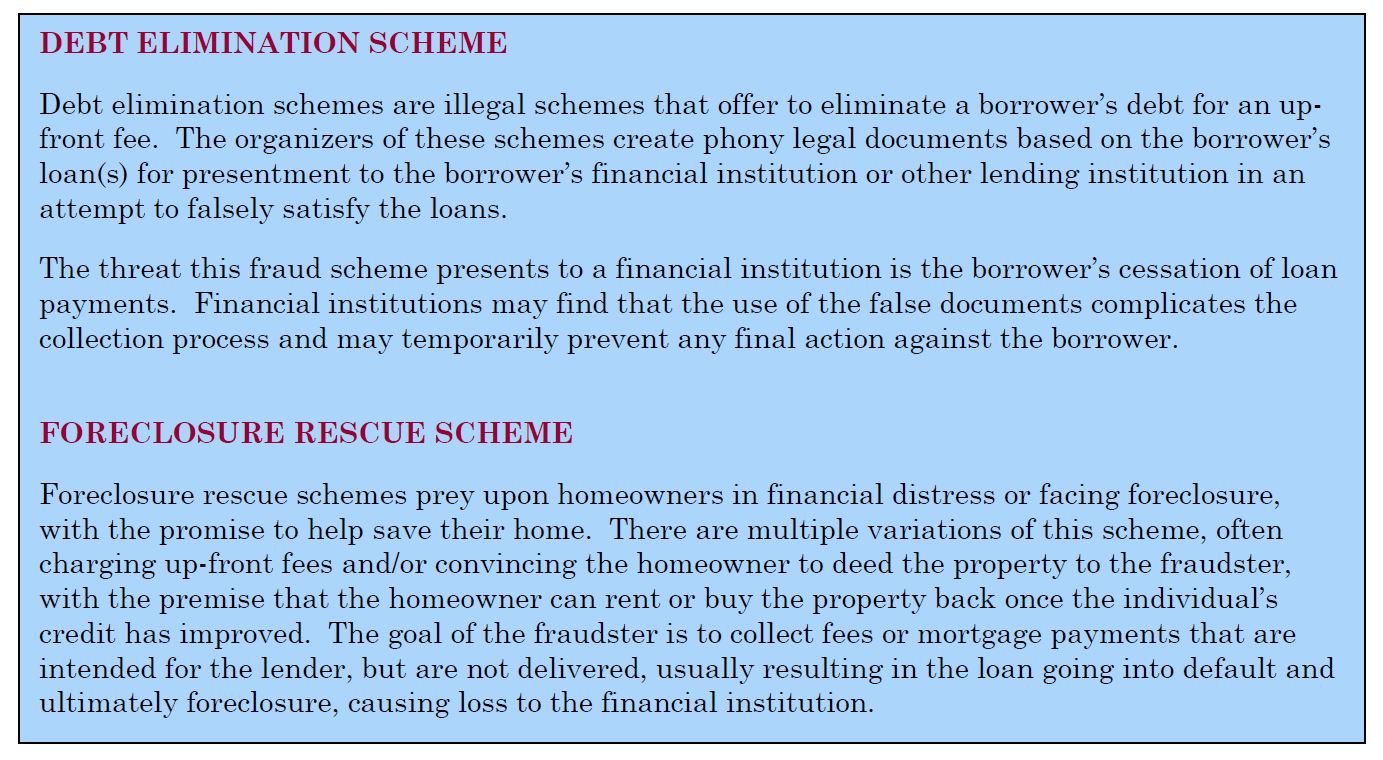
Two additional fraud schemes, which are briefly addressed below, are debt elimination and foreclosure rescue schemes. While these schemes are typically not perpetrated directly on financial institutions, and therefore not expanded upon to the same degree as the above-mentioned schemes, the end result of the scheme can have a negative impact on the financial institution.

COMMON MECHANISMS OF MORTGAGE FRAUD SCHEMES

This Post Paper defines mechanism as the process by which fraud is perpetrated. A single mortgage fraud scheme can often include one or more mechanisms and may involve collusion between two or more individuals working in unison to implement a fraud.

The following is a list of common mechanisms used to perpetrate mortgage fraud schemes:

Asset Rental
Cash or other assets are temporarily placed in the borrower’s account/possession in order to qualify for a mortgage loan. The borrower usually pays a “rental” fee for the temporary “use” of the assets.

Fake Down Payment
In order to meet loan-to-value requirements, a fake down payment through fictitious, forged, falsified, or altered documents is used to mislead the lender.

Fraudulent Appraisal
Appraisal fraud can occur when an appraiser, for various reasons, falsifies information on an appraisal or falsely provides an inaccurate valuation on the appraisal with the intent to mislead a third party.

Fraudulent Documentation
Fraudulent documentation consists of any forged, falsified, incomplete, or altered document that the financial institution relied upon in making a credit decision.

Fraudulent Use of Shell Company
A business entity that typically has no physical presence, has nominal assets, and generates little or no income is a shell company. Shell companies in themselves are not illegal and may be formed by individuals or business for legitimate purposes. However, due to lack of transparency regarding beneficial ownership, ease of formation, and inconsistent reporting requirements from state to state, shell companies have become a preferred vehicle for financial fraud schemes.

Identify Theft
Identity theft can be defined as assuming the use of another person’s personal information (e.g., name, SSN, credit card number, etc.) without the person’s knowledge and the fraudulent use of such knowledge to obtain credit.

Straw/Nominee Borrower
An individual used to serve as a cover for a questionable loan transaction.

COMMON PARTICIPANTS
Various individuals participate in mortgage fraud schemes. The following list consists of common participants in such schemes and each is linked to the glossary:

Appraiser – One who is expected to perform valuation services competently and in a manner that is independent, impartial, and objective.

Processor – The processor is an individual who assembles all the necessary documents to be included in the loan package.

Borrower – One who receives funds in the form of a loan with the obligation of repaying the loan in full with interest. The borrower may be purchasing property, refinancing an existing mortgage loan, or borrowing against the equity of the property for other purposes.

Real Estate Agent – An individual or firm that receives a commission for representing the buyer or seller, in a RE purchase transaction.

Buyer – A buyer is a person who is acquiring property.

Seller – Person offering to sell a piece of real estate.

Closing/Settlement Agent – An individual or company that oversees the consummation of a mortgage transaction at which the note and other legal documents are signed and the loan proceeds are disbursed. Title companies, attorneys, settlement agents, and escrow agents can perform this service. Local RE law may dictate the party conducting the closing.

Title Agent – The title agent is a person or firm that is authorized on behalf of a title insurer to conduct a title search and issue a title insurance report or title insurance policy.

Loan Servicer – A loan servicer is a public or private entity or individual engaged to collect and process payments on mortgage loans.

Underwriter – The credit decision-making process which can be automated, manual or a combination of both. In an automated process, application information is entered into a decision-making model that makes a credit determination based on pre-determined criteria. In a manual process an individual underwriter, usually an employee of the financial institution, makes the credit decision after evaluating all of the information in the loan package, including the credit report, appraisal, and verification of deposit, income, and employment. Financial institutions often use a combination of both, with the automated decision representing one element of the overall credit decision. In each case, the decision may include stipulations or conditions that must be met before the loan can close.

Originator – The individual or entity that gathers application data from the borrower. Alternatively, a person or entity, such as a loan officer, broker, or correspondent, who assists a borrower with the loan application.

Warehouse Lender – A short-term lender for mortgage bankers. Using mortgage loans as collateral, the warehouse lender provides interim financing until the loans are sold to a permanent investor.

CONCLUSION
Mortgage fraud continues to result in significant losses for financial institutions, as well as, the Homeowners. It is imperative that homeowners understand the nature of the various schemes and recognize red flags related to mortgage fraud. This knowledge and use of best practices will help with the prevention of mortgage fraud, and financial losses to the homeowner.

When Homeowner’s good faith attempts to amicably work with the Bank in order to resolve the issue fails;

Home owners should wake up TODAY! before it’s too late by mustering enough courage for “Pro Se” Litigation (Self Representation – Do it Yourself) against the Lender – for Mortgage Fraud and other State and Federal law violations using foreclosure defense package found at https://fightforeclosure.net/foreclosure-defense-package/ “Pro Se” litigation will allow Homeowners to preserved their home equity, saves Attorneys fees by doing it “Pro Se” and pursuing a litigation for Mortgage Fraud, Unjust Enrichment, Quiet Title and Slander of Title; among other causes of action. This option allow the homeowner to stay in their home for 3-5 years for FREE without making a red cent in mortgage payment, until the “Pretender Lender” loses a fortune in litigation costs to high priced Attorneys which will force the “Pretender Lender” to early settlement in order to modify the loan; reducing principal and interest in order to arrive at a decent figure of the monthly amount the struggling homeowner could afford to pay.

If you find yourself in an unfortunate situation of losing or about to lose your home to wrongful fraudulent foreclosure, and need a complete package that will show you step-by-step litigation solutions helping you challenge these fraudsters and ultimately saving your home from foreclosure either through loan modification or “Pro Se” litigation visit: https://fightforeclosure.net/foreclosure-defense-package/


Share this:

  • Click to share on X (Opens in new window) X
  • Click to share on Facebook (Opens in new window) Facebook
Like Loading...

What Homeowners Must Know About Appeal-able Orders and Judgment from the Federal Courts

01 Thursday Mar 2018

Posted by BNG in Appeal, Case Laws, Case Study, Federal Court, Foreclosure Crisis, Foreclosure Defense, Judicial States, Legal Research, Litigation Strategies, Non-Judicial States, Pro Se Litigation, Your Legal Rights

≈ Leave a comment

Tags

Appeal-able Orders, Foreclosure, foreclosure defense, homeowners, Judgment, Orders, Plaintiff, United States

In order to effectively perfect your Appeal case as a Pro Se Litigator, homeowners must familiarize themselves about Appealing unfavorable decisions.

1. Appeal-able Orders: Courts of Appeals have jurisdiction conferred and strictly limited by statute:

(a) Appeals from final orders pursuant to 28 U.S.C. § 1291: Final orders and
judgments of district courts, or final orders of bankruptcy courts which have been appealed to and fully resolved by a district court under 28 U.S.C. § 158, generally are appealable. A final decision is one that “ends the litigation on the merits and leaves nothing for the court to do but execute the judgment.” Pitney Bowes, Inc. v. Mestre, 701 F.2d 1365, 1368 (11th Cir. 1983) (citing Catlin v. United States, 324 U.S. 229, 233, 65 S.Ct. 631, 633, 89 L.Ed. 911 (1945)).

A magistrate judge’s report and recommendation is not final and appealable until judgment thereon is entered by a district court judge. 28 U.S.C. § 636(b); Perez-Priego v. Alachua County Clerk of Court, 148 F.3d 1272 (11th Cir. 1998). However, under 28 U.S.C. § 636(c)(3), the Courts of Appeals have jurisdiction over an appeal from a final judgment entered by a magistrate judge, but only if the parties consented to the magistrate’s jurisdiction. McNab v. J & J Marine, Inc., 240 F.3d 1326, 1327-28 (11th Cir. 2001).

(b) In cases involving multiple parties or multiple claims, a judgment as to fewer than all parties or all claims is not a final, appealable decision unless the district court has certified the judgment for immediate review under Fed.R.Civ.P. 54(b).
Williams v. Bishop, 732 F.2d 885, 885-86 (11th Cir. 1984). A judgment which resolves all issues except matters, such as attorneys’ fees and costs, that are collateral to the merits, is immediately appealable. Budinich v. Becton Dickinson & Co., 486 U.S. 196, 201, 108 S.Ct. 1717, 1721-22, 100 L.Ed.2d 178 (1988); LaChance v. Duffy’s Draft House, Inc., 146 F.3d 832, 837 (11th Cir. 1998).

(c) Appeals pursuant to 28 U.S.C. § 1292(a): Under this section, appeals are permitted from the following types of orders:

i. Orders granting, continuing, modifying, refusing or dissolving injunctions, or refusing to dissolve or modify injunctions; However, interlocutory appeals from orders denying temporary restraining orders are not permitted. McDougald v. Jenson, 786 F.2d 1465, 1472-73 (11th Cir. 1986);

ii. Orders appointing receivers or refusing to wind up receiverships; and

iii. Orders determining the rights and liabilities of parties in admiralty cases.

(d) Appeals pursuant to 28 U.S.C. § 1292(b) and Fed.R.App.P. 5: The certification specified in 28 U.S.C. § 1292(b) must be obtained before a petition for permission to appeal is filed in the Court of Appeals. The district court’s denial of a motion for certification is not itself appealable.

(e) Appeals pursuant to judicially created exceptions to the finality rule: Limited
exceptions are discussed in cases including, but not limited to: Cohen v.
Beneficial Indus. Loan Corp., 337 U.S. 541, 546, 69 S.Ct. 1221, 1225-26, 93
L.Ed. 1528 (1949); Atlantic Fed. Sav. & Loan Ass’n v. Blythe Eastman Paine
Webber, Inc., 890 F.2d 371, 376 (11th Cir. 1989); Gillespie v. United States Steel Corp., 379 U.S. 148, 157, 85 S.Ct. 308, 312, 13 L.Ed.2d 199 (1964).

2. Time for Filing: The timely filing of a notice of appeal is mandatory and jurisdictional.
Rinaldo v. Corbett, 256 F.3d 1276, 1278 (11th Cir. 2001). In civil cases, Fed.R.App.P. 4(a) and (c) set the following time limits:

(a) Fed.R.App.P. 4(a)(1): A notice of appeal in compliance with the requirements set forth in Fed.R.App.P. 3 must be filed in the district court within 30 days after the order or judgment appealed from is entered. However, if the United States or an officer or agency thereof is a party, the notice of appeal must be filed in the district court within 60 days after such entry. THE NOTICE MUST BE RECEIVED AND FILED IN THE DISTRICT COURT NO LATER THAN THE LAST DAY OF THE APPEAL PERIOD – no additional days are provided for mailing. Special filing provisions for inmates are discussed below.

(b) Fed.R.App.P. 4(a)(3): “If one party timely files a notice of appeal, any other party may file a notice of appeal within 14 days after the date when the first notice was filed, or within the time otherwise prescribed by this Rule 4(a), whichever period ends later.”

(c) Fed.R.App.P. 4(a)(4): If any party makes a timely motion in the district court under the Federal Rules of Civil Procedure of a type specified in this rule, the time for appeal for all parties runs from the date of entry of the order disposing of the last such timely filed motion.

(d) Fed.R.App.P. 4(a)(5) and 4(a)(6): Under certain limited circumstances, the district court may extend or reopen the time to file a notice of appeal. Under Rule 4(a)(5), the time may be extended if a motion for an extension is filed within 30 days after expiration of the time otherwise provided to file a notice of appeal, upon a showing of excusable neglect or good cause. Under Rule 4(a)(6), the time to file an appeal may be reopened if the district court finds, upon motion, that the following conditions are satisfied: the moving party did not receive notice of the entry of the judgment or order within 21 days after entry; the motion is filed within 180 days after the judgment or order is entered or within 14 days after the moving party receives notice, whichever is earlier; and no party would be prejudiced by the reopening.

(e) Fed.R.App.P. 4(c): If an inmate confined to an institution files a notice of appeal in either a civil case or a criminal case, the notice of appeal is timely if it is deposited in the institution’s internal mail system on or before the last day for filing. Timely filing may be shown by a declaration in compliance with 28 U.S.C. § 1746 or a notarized statement, either of which must set forth the date of deposit and state that first-class postage has been prepaid.

3. Format of the notice of appeal: Form 1, Appendix of Forms to the Federal Rules of Appellate Procedure, is a suitable format. See also Fed.R.App.P. 3(c). A pro Se notice of
appeal must be signed by the appellant.

4. Effect of a notice of appeal: A district court lacks jurisdiction, i.e., authority, to act after the filing of a timely notice of appeal, except for actions in aid of appellate jurisdiction or to rule on a timely motion of the type specified in Fed.R.App.P. 4(a)(4).

When Homeowner’s good faith attempts to amicably work with the Bank in order to resolve the issue fails;

Home owners should wake up TODAY! before it’s too late by mustering enough courage for “Pro Se” Litigation (Self Representation – Do it Yourself) against the Lender – for Mortgage Fraud and other State and Federal law violations using foreclosure defense package found at https://fightforeclosure.net/foreclosure-defense-package/ “Pro Se” litigation will allow Homeowners to preserved their home equity, saves Attorneys fees by doing it “Pro Se” and pursuing a litigation for Mortgage Fraud, Unjust Enrichment, Quiet Title and Slander of Title; among other causes of action. This option allow the homeowner to stay in their home for 3-5 years for FREE without making a red cent in mortgage payment, until the “Pretender Lender” loses a fortune in litigation costs to high priced Attorneys which will force the “Pretender Lender” to early settlement in order to modify the loan; reducing principal and interest in order to arrive at a decent figure of the monthly amount the struggling homeowner could afford to pay.

If you find yourself in an unfortunate situation of losing or about to lose your home to wrongful fraudulent foreclosure, and need a complete package that will show you step-by-step litigation solutions helping you challenge these fraudsters and ultimately saving your home from foreclosure either through loan modification or “Pro Se” litigation visit: https://fightforeclosure.net/foreclosure-defense-package/

Share this:

  • Click to share on X (Opens in new window) X
  • Click to share on Facebook (Opens in new window) Facebook
Like Loading...

How Homeowners Can Effectively Challenge Bankruptcy on Credit Reports

20 Tuesday Feb 2018

Posted by BNG in Bankruptcy, Judicial States, Non-Judicial States, Your Legal Rights

≈ Leave a comment

Tags

Bankruptcy, bankruptcy court, bankruptcy on credit report, chapter 11, chapter 13, chapter 7, credit disputes, credit report, homeowners, items on credit report, remove bankruptcy, remove bankruptcy on credit report

Removing a bankruptcy from your credit reports is somewhat complicated because bankruptcy is a legal action which dismisses you in part or in whole from your debts.

A Chapter 7 bankruptcy proceeding stays on your credit reports for 10 years. A Chapter 13 bankruptcy proceeding remains on your credit reports for 7 years.

After you file bankruptcy make sure all of your creditors and accounts which were included in the filing are listed on your credit reports as “included in bankruptcy.” If not, the creditors, late accounts, collection accounts and charge-off accounts will continue to be listed as due and owing and will severely lower your credit score.

Disputing a bankruptcy and getting it removed is difficult. It may be a waste of time disputing a bankruptcy as “not mine”, especially when it really is yours and can be easily verified. However, verifying disputes based upon facts is not as easy.

Disputing facts such as filing date, balance of liabilities, type of bankruptcy, social security number, discharge dates on debts, type of accounts and even docket dates are a lot harder to investigate.

There are a few ways to dispute bankruptcy listings that may work. First, remember that credit reporting agencies verify records through a third party database such as PACER or LEXIS NEXIS and some even verify through other creditors.

Even though credit reporting agencies will list the bankruptcy court as the “furnisher” of information, no one at the credit reporting agency actually contacts the bankruptcy courthouse where the proceeding was filed. Below are several strategy options to remove a bankruptcy from credit reports:

1. Inaccurate Reporting
Look for incorrect reporting of facts and dispute the listing. It may get deleted and no further work is necessary. A bankruptcy must be listed accurately in your credit reports.

2. Method of Verification
If the listing gets verified and remains you have the right to request the credit reporting agencies’ method of verification. Request the credit reporting agencies send you the following:

(a) The name of the courthouse;
(b) the person’s name they verified the dispute with;
(c) the address;
(d) the telephone number; and
(e) the documentation used to verify the dispute.

The CRA’s must respond to your request within 15 days and provide the information. Undoubtedly they will only respond with the name and address of the courthouse. But this is good.

3. Follow-up Letter to Credit Reporting Agency
Now you can mail another letter to the credit reporting agency and let them know you contacted the court and were informed they do not furnish records and information to the credit reporting agencies, which they do not.

Can you imagine the time and legal ramifications if court clerks spent the time to personally verify and follow procedures of the Fair Credit Reporting Act. The courts rarely, if ever, verify public records with credit reporting agencies according to the FCRA.

4. Get your Proof in Writing
In order to create your paper trail you may wish to send a letter to the court administrator of the courthouse where the bankruptcy was filed. In your letter request what their procedure is for verifying records with the credit reporting agencies. When sending court clerks any letters ALWAYS INCLUDE A SELF-ADDRESSED STAMPED ENVELOPE if you want a response.

Depending on their response, you will have proof on paper that the actual courts do not verify information directly with the credit reporting agencies. Now take that letter from the court and follow-up with another letter to the credit reporting agency with your proof the courts do not verify bankruptcy filings.

5. Request a Deletion
Should the credit reporting agency respond by telling you they are not required to give you that information, they have violated the FCRA. If the credit reporting agency does not respond within 15 days they have violated the FCRA and the entry must be deleted.

The FCRA, Section 609 a (2) regarding disclosures provides leverage to get the item deleted. You can request to see what they used as proof to verify the bankruptcy and if they are unable to provide it, the bankruptcy must be deleted. The credit reporting agency must disclose the source of the information.

Also, FCRA, Section 611, paragraph (6)(B)(iii) regarding procedures and results of reinvestigation states “…if requested by the consumer, a description of the procedure used to determine the accuracy and completeness of the information shall be provided to the consumer by the agency, including the business name and address of any furnisher of information contacted in connection with such information and the telephone number of such furnisher, if reasonably available…”

Credit reporting agencies are required to conduct investigations of disputed items with the “furnisher” of information. The Bankruptcy Court should be the furnisher of information, not a third party source such as PACER or LEXIS NEXIS.

Vigilant nagging and challenging the credit bureaus on the method of verification process may be the best way to get a bankruptcy removed, but there are no guarantees.

As you have read removing a bankruptcy from your credit report is possible; however it is time consuming and complicated. If you do not have the time to invest in removing a bankruptcy from your credit report or have been unsuccessful in your attempts, consider Lexington Law. In 2011 Lexington Law removed 22,968 from consumer credit reports. Call (877) 587-4574 for a free consultation on bankruptcy removal and credit repair.

Concentrate on Re-establishing Good Credit

Begin re-establishing your credit as soon as possible after a bankruptcy. There will be fewer options and some credit card companies and banks will deny an application when a bankruptcy is listed on your credit report. But start with secured credit cards where you deposit a specific amount in an FDIC-insured account and your credit limit is equal to what you’ve deposited with the card issuer.

If you belong to a credit union ask about a credit builder loan or a loan secured with a savings account. A personal loan is an installment loan and this can really boost credit scores.

Make sure the card reports your payment history to all three major credit bureaus. As you begin to repay on time, your good payment history will be factored into your credit score and the sting of bankruptcy will matter less.

As more time passes the negative effect of bankruptcy will diminish as long as you continually pay all of your bills on time. Bankruptcies on credit reports take on less significance as the filing becomes older. In fact most banks, lender, mortgage companies and auto dealers know consumers with a bankruptcy can some times be a better credit risk because they have less debt and a clean slate.

When Homeowner’s good faith attempts to amicably work with the Bank in order to resolve the issue fails;

Home owners should wake up TODAY! before it’s too late by mustering enough courage for “Pro Se” Litigation (Self Representation – Do it Yourself) against the Lender – for Mortgage Fraud and other State and Federal law violations using foreclosure defense package found at https://fightforeclosure.net/foreclosure-defense-package/ “Pro Se” litigation will allow Homeowners to preserved their home equity, saves Attorneys fees by doing it “Pro Se” and pursuing a litigation for Mortgage Fraud, Unjust Enrichment, Quiet Title and Slander of Title; among other causes of action. This option allow the homeowner to stay in their home for 3-5 years for FREE without making a red cent in mortgage payment, until the “Pretender Lender” loses a fortune in litigation costs to high priced Attorneys which will force the “Pretender Lender” to early settlement in order to modify the loan; reducing principal and interest in order to arrive at a decent figure of the monthly amount the struggling homeowner could afford to pay.

If you find yourself in an unfortunate situation of losing or about to lose your home to wrongful fraudulent foreclosure, and need a complete package that will show you step-by-step litigation solutions helping you challenge these fraudsters and ultimately saving your home from foreclosure either through loan modification or “Pro Se” litigation visit: https://fightforeclosure.net/foreclosure-defense-package/

Share this:

  • Click to share on X (Opens in new window) X
  • Click to share on Facebook (Opens in new window) Facebook
Like Loading...

How Homeowners Can use “Produce the Note” in Judicial & Non-judicial Foreclosure States

24 Wednesday Jan 2018

Posted by BNG in Banks and Lenders, Fed, Federal Court, Foreclosure Crisis, Foreclosure Defense, Fraud, Judicial States, Mortgage mediation, Non-Judicial States, Note - Deed of Trust - Mortgage, Pro Se Litigation, State Court, Your Legal Rights

≈ Leave a comment

Tags

avoid foreclosure, borrowers, foreclose, foreclosing on home, foreclosure defense, foreclosure suit, home, homeowners, Lawsuit, lenders, lending and servicing, mortgages, Non-judicial Foreclosure States, note, Plaintiff, Produce the Note, true owners of the note

In some states, a lender can foreclose on your home without going to court. These are called non-judicial foreclosure states. You can still use the “Produce the Note” strategy in these states, but it takes a few more steps on your part.

First, the concept behind “Produce the Note” is this: When a homeowner is faced with a foreclosure suit, “Produce the Note” requires the lender to prove it has the actual authority to foreclose, by requiring it to officially produce the original promissory note in the lawsuit. But if there is no foreclosure lawsuit, what can homeowners do? In these “nonjudicial foreclosure” states, such as California, Texas, or the thirty or more other states with similar procedures, the homeowner has to file a lawsuit against the party trying to foreclose.

Here’s how it generally works:

In a state with nonjudicial foreclosure procedures, a foreclosure sale can be initiated by the lender without using court proceedings.
Homeowners receive a “Notice of Intent” letter informing them that a foreclosure sale will be scheduled unless the overdue debt is paid within a certain amount of time.
If the debt is not paid accordingly, a “Notice of Sale” is then sent informing the homeowner that a foreclosure sale will take place at a particular time and place.
No lawsuit is ever initiated by the lender and the courts are not involved.

Without a lawsuit, you cannot use judicial procedures to require the lender to “produce the note.”
Merely sending a private letter to the lender “demanding” that it produce the original note to the borrower may be met with utter disregard or outright refusal by the lender.

So, here’s what you can do:
In a nonjudicial foreclosure state, in order to protect yourself by demanding that the lender “produce the note,” it will be necessary for you to first actually file your own lawsuit. Even in such nonjudicial foreclosure states, no law prohibits you from instituting your own lawsuit challenging the right of a lender to foreclose on your property. The lawsuit would allege that:
the lender has sent a Notice of Intent to Foreclose; the homeowner is unsure as to whether the lender still possesses the original debt instrument, upon which the lender claims the right to foreclose; the homeowner wants proof of such authority; and the court should intervene and prevent the foreclosure from taking place unless and until such proof is presented.
Initiating litigation to protect your rights is never a simple process. Requirements as to what must be contained in a pleading, how the facts must be plead, who should be named in the pleading, and how the pleading should be officially “served” on the lender, all differ from state to state.

Once a lawsuit is initiated, however, all states have judicial procedures that allow a party to require the other side to produce relevant documents, and the “produce the note” strategy can be used.

Often times, the best way to protect your rights in these situations is to seek professional help from an attorney licensed to practice in your geographical area. Getting involved in a lawsuit by representing yourself, especially if you file the lawsuit yourself, is not easy, but you can do it. Every citizen is able to represent themselves and file a lawsuit on their own. It’s called pro se, which means “on ones own behalf.”

If you can afford a lawyer, then by all means, hire one. There are attorneys who specialize in real estate matters, and either advertise or can be found in the yellow pages. Most areas have bar associations that maintain lists of attorneys willing to help in specific areas of the law.
Finally, there are usually “legal aid” organizations around set up to assist individuals who may have difficulty paying for the services of an attorney. A good place to begin your search is by going to the Legal Services Corporation website.

So, even if you are in a non-judicial foreclosure state, you can use “Produce the Note.” This is your home, and if you want to fight for it, you do have a way.

If your home is currently in foreclosure, there may still be a chance to save it. As a result of lenders buying and selling mortgages your note could have changed hands several times over the course of the loan. But where is the actual note? In some warehouse somewhere? Make ‘em prove they own the debt they say you owe.

WHO OWNS THE NOTE?
Your goal is to make certain the institution suing you is, in fact, the owner of the note (see steps to follow below). There is only one original note for your mortgage that has your signature on it. This is the document that proves you owe the debt.
During the lending boom, most mortgages were flipped and sold to another lender or servicer or sliced up and sold to investors as securitized packages on Wall Street. In the rush to turn these over as fast as possible to make the most money, many of the new lenders did not get the proper paperwork to show they own the note and mortgage. This is the key to the produce the note strategy. Now, many lenders are moving to foreclose on homeowners, resulting in part from problems they created, and don’t have the proper paperwork to prove they have a right to foreclose.

THE HARM
If you don’t challenge your lender, the court will simply allow the foreclosure to proceed. It’s important to hold lenders accountable for their carelessness. This is the biggest asset in your life. It’s just a piece of paper to them, and one they likely either lost or destroyed.

When you get a copy of the foreclosure suit, many lenders now automatically include a count to re-establish the note. It often reads like this: “…the Mortgage note has either been lost or destroyed and the Plaintiff is unable to state the manner in which this occurred.” In other words, they are admitting they don’t have the note that proves they have a right to foreclose.
If the lender is allowed to proceed without that proof, there is a possibility another institution, which may have bought your note along the way, will also try to collect the same debt from you again.

A Tennessee borrower recently had precisely that happen to her. Her lender, Ameriquest, foreclosed on her in July of 2007. About three months later, another bank sent her a default notice for the mortgage on the house she just lost. She called to find out what was going on. After being transferred from place to place and left on hold for lengthy periods of time, no one could explain what happened. They said they would get back to her, but never did. Now, she faces the risk of having her credit continually damaged for a debt she no longer owes.

FIGHT FOR FAIRNESS
This process is not intended to help you get your house for free. The primary goal is to delay the foreclosure and put pressure on the lender to negotiate. Despite all the hype about lenders wanting to help homeowners avoid foreclosure, most borrowers know that’s not the reality.

Too many homeowners have experienced lender resistance to their efforts to work out a payment structure to keep them in their homes. Many lenders bear responsibility for these defaults, because they put borrowers into unfair loans using deceptive, hard-sell practices and then made the problem worse with predatory servicing.
Most homeowners just want these lenders to give them reasonable terms on their mortgages, many of which were predatory to begin with. With the help of judges who see through these predatory practices, lenders will feel the pressure to work with borrowers to keep them in their homes. Don’t forget lenders made incredible amounts of money by using irresponsible practices to issue and service these loans. That greed led to the foreclosure crisis we’re in today. Allowing lenders to continue foreclosing on home after home, destroying our neighborhoods and our economy hurts us all. So, make it hard for your lender to take your home. Make ‘em produce the note!

STEPS TO FOLLOW – You can either write Qualified Written Request RESPA Letter (QWR), to your lender. Alternatively, you can use the fill in the blank request forms usually available in your local Circuit Courts:

A. If your lender has already filed suit to foreclose on your home:

Use the first form. It’s a fill-in-the-blank legal request to your lender asking that the original note be produced, before it can proceed with the foreclosure. In some jurisdictions, the courts require the original request to be filed with the clerk of court and a copy of the request to be sent to the attorney representing the lender. To find out the rules where you live, call the Clerk of Court in your jurisdiction.

If the lender’s attorney does not respond within 30 days, file a motion to compel with the court and request that the court set a hearing on your motion. That, in effect, asks the judge to order the lender to produce the documents.

The judge will issue a ruling at your hearing. Many judges around the country are becoming more sympathetic to homeowners, because of the prevalence of predatory lending and servicing. In the past, many lenders have relied upon using lost note affidavits, but in many cases, that’s no longer enough to satisfy the judge. They are holding the lender to the letter of the law, requiring them to produce evidence that they are the true owners of the note. For example:

In October 2007, Ohio Federal Court Judge Christopher Boyko dismissed 14 foreclosure cases brought by investors, ruling they failed to prove they owned the properties they were trying to seize.

B. If you are in default, but your lender has not yet filed suit against you:

Use the second form. It’s a fill-in-the-blank letter to your lender which also requests they produce the original note, before taking foreclosure action against you.
If the lender does not respond and files suit against you to foreclose, follow the steps above.
UPDATE: CNN features The Consumer Warning Network and the “Produce The Note” strategy. Borrowers are putting this plan into action and getting results!

Consumer Warning Network Featured on CNN

Borrower wins more time to fight foreclosure! At a court hearing sometime ago, a Pinellas County, Florida Judge denied Wachovia the right to proceed with its foreclosure against borrower Jacqueline O’Brien (profiled in the CNN story). Instead, O’Brien was granted a continuance, as she pursues the produce the note strategy. Wachovia expressed interest in renegotiating the terms of the loan, rather than continuing the court battle.

When Homeowner’s good faith attempts to amicably work with the Bank in order to resolve the issue fails;

Home owners should wake up TODAY! before it’s too late by mustering enough courage for “Pro Se” Litigation (Self Representation – Do it Yourself) against the Lender – for Mortgage Fraud and other State and Federal law violations using foreclosure defense package found at https://fightforeclosure.net/foreclosure-defense-package/ “Pro Se” litigation will allow Homeowners to preserved their home equity, saves Attorneys fees by doing it “Pro Se” and pursuing a litigation for Mortgage Fraud, Unjust Enrichment, Quiet Title and Slander of Title; among other causes of action. This option allow the homeowner to stay in their home for 3-5 years for FREE without making a red cent in mortgage payment, until the “Pretender Lender” loses a fortune in litigation costs to high priced Attorneys which will force the “Pretender Lender” to early settlement in order to modify the loan; reducing principal and interest in order to arrive at a decent figure of the monthly amount the struggling homeowner could afford to pay.

If you find yourself in an unfortunate situation of losing or about to lose your home to wrongful fraudulent foreclosure, and need a complete package that will show you step-by-step litigation solutions helping you challenge these fraudsters and ultimately saving your home from foreclosure either through loan modification or “Pro Se” litigation visit: https://fightforeclosure.net/foreclosure-defense-package/

Share this:

  • Click to share on X (Opens in new window) X
  • Click to share on Facebook (Opens in new window) Facebook
Like Loading...

How Homeowners Can Greatly Improve their Chances of Winning on Appeal

24 Wednesday Jan 2018

Posted by BNG in Appeal, Case Laws, Case Study, Discovery Strategies, Federal Court, Foreclosure Defense, Judicial States, Litigation Strategies, Non-Judicial States, Note - Deed of Trust - Mortgage, Pleadings, Pro Se Litigation, Scam Artists, Title Companies, Trial Strategies, Your Legal Rights

≈ Leave a comment

Tags

Appeal, Court, District Court, Foreclosure, foreclosure defense, homeowners, Plaintiff, pro se, Pro se legal representation in the United States, State Court, United States district court

A seasoned Attorney will tell you that trying cases is one of the most exciting things a litigator does during his or her career but it is also certainly one of the most stressful. While in the trenches during trial, many litigators understandably focus all of their energies on winning the case at hand. But a good litigator knows that trial is often not the last say in the outcome of a case. The final outcome often rests at the appellate level, where a successful trial outcome can be affirmed, reversed, or something in between. The likelihood of success many times hinges on the substance of the record on appeal. The below discusses a variety of issues that trial litigators should keep in mind as they prepare and present their case so they position themselves in the best possible way for any appeals that follow.

Prepare Your Appellate Record From The Moment Your Case Begins

Perhaps one of the biggest misconceptions regarding preserving an adequate record on appeal is when a lawyer should start considering what should be in the record. In short, the answer is from the moment the complaint is filed. At that time, counsel should begin to think carefully about the elements of each asserted cause of action, potential defenses and their required elements, and the burden of proof for each. Every pleading should be drafted carefully to ensure that no arguments are waived in the event they are needed for an appeal. For instance, a complaint should allege with specificity all the factual and legal elements necessary to sustain a claim, while an answer should include any and all applicable affirmative defenses to avoid waiver. See, e.g., Travellers Int’l, A.G. v. Trans World Airlines, 41 F.3d 1570, 1580 (2d Cir. 1994) (“The general rule in federal courts is that a failure to plead an affirmative defense results in a waiver.”). Likewise, if you file a motion to dismiss, ensure that the motion contains all the necessary evidence that both a trial court and appellate court would need to find in your favor. Of particular importance in federal court practice is the pre-trial order. Under Federal

Rule of Civil Procedure 16, the pre-trial order establishes the boundaries of trial. See Elvis Presley Enterprises, Inc. v. Capece, 141 F.3d 188, 206 (5th Cir.1998) (“It is a well-settled rule that a joint pre-trial order signed by both parties supersedes all pleadings and governs the issues and evidence to be presented at trial.”). If the pre-trial order does not contain the pertinent claims, defenses or arguments that you wish to present at trial, you are likely also going to be out of luck on appeal.

Later on in the case, as the factual record becomes more fully developed, consider whether amending or supplementing the pleadings or other court submissions are necessary to make the record as accurate as possible. Most states follow the federal practice of allowing liberal amendments. However, these can be contested, particularly late in the process, closer to trial. While appellate review is often for abuse of discretion, formulating a strong motion in favor of or in opposition to an amendment can preserve the issue.

What to Keep in Mind as Your Case Proceeds

As the case develops, consider whether the elements you need to prove your case are sufficiently reflected in the information you obtain during discovery. If not, determine whether there are ways to obtain the information you need well before trial starts. By the time trial arrives, it may be too late to supplement the record to get before the trial judge and the appellate court what you need to win your case. In that regard, anything you have in writing that gets submitted to the court may very well end up being part of the record on review, so make sure it is accurate and understandable. Incomprehensible or incomplete submissions can muddy your appellate record and damage a successful appellate proceeding. In the same vein, make sure anything presented to the court prior to trial that you want to be part of the record is transcribed. Otherwise, there will be an insufficient record on appeal. This is particularly so when it comes to discovery disputes. Although they are common in present day litigation, judges hate discovery disputes. To preserve discovery issues for appeal, be sure to get a ruling, and make sure it is reflected in writing. Moreover, carefully review every pre-trial court order or other judicial communication, including court minutes, to ensure accuracy. Attempting to make corrections during the appellate process may not be possible.

Another significant area for appellate issues is the failure to timely identify experts. This is subject to an abuse of discretion standard of review, so it is important that one builds a record on the issue, particularly regarding any prejudice suffered by the untimely disclosure.

After Discovery Closes – The Motion in Limine

Once discovery has closed, consider carefully any motions in limine you may want to make. Although motions in limine are not strictly necessary, they are helpful in identifying evidentiary issues for the judge and counsel and increase the chances of a substantive objection, sidebar, and ruling when the issue arises at trial. One potential pitfall – some jurisdictions require a party to renew an objection at trial after a motion in limine has been denied, so make sure to do so if necessary. See, e.g., State ex. Rel Missouri Highway and Transp. Com’n v. Vitt, 785 S.W.2d 708, 711 (Mo. Ct. App. E.D. 1990) (“A motion in limine preserves nothing for review. Following denial of a motion in limine, a party must object at trial to preserve for appellate review the point at issue.”) (internal citation omitted). Also, if the Court delivers its ruling on a motion in limine orally, make sure it is transcribed properly by the court reporter.

Now the Trial – What to Keep in Mind

Above all else, when in doubt, object. Objections should be immediate and specifically describe the basis for the objection so the record is clear. Make the argument to win – every objection should be more than just reciting labels, and should provide sufficient information for the trial judge to decide the issue. The goal is not to be coy with the trial judge and hope for a lucky break, but to be prepared to make an argument to win the issue at trial or, alternatively, on appeal. In addition, if you are the party proffering the evidence, make sure the proffer is on the record and that you expressly state why the evidence is being offered. This may require pressing on the judge to get the full objection on the record. If you fail to do so, you risk the appellate court not reviewing the claim on appeal. See, e.g., National Bank of Andover v. Kansas Bankers Sur. Co., 290 Kan. 247, 274-75 (2010) (observing “purpose of a proffer is to make an adequate record of the evidence to be introduced … [and] preserves the issue for appeal and provides the appellate court an adequate record to review when determining whether the trial court erred in excluding the evidence.”). Also, always be careful of waiving any issues for appeal by agreeing to a judge’s proposed compromise on evidentiary issues.

An important but often overlooked consideration is the courtroom layout and dynamics. Well-thought and timely objections will be for naught if they are not transcribed. Sometimes the courtroom layout can make record preservation difficult. For example, if objections are made at sidebar conferences where the court reporter is not present, those objections may not make their way into the appellate record or be dependent on the after the fact recollections of others. See, e.g., Ohio App. R. 9(c) (describing procedures for preparing statement of evidence where transcript of proceedings is unavailable and providing trial court with final authority for settlement and approval). This should be avoided whenever possible.

Beyond objections, make sure all the evidence you need for your appeal is properly admitted by the trial court before the close of your case. All exhibits that were used at trial should be formally moved into evidence if there is any doubt as to whether they will be needed on appeal. If you had previously moved for summary judgment and lost, make sure you take the necessary steps at trial to preserve those summary judgment issues, especially in jurisdictions that do not allow interlocutory appeals.

Another important aspect of the trial is the jury instructions. Jury instructions should always be complete. Remember that the instructions you propose can be denied without error if any aspect of them is not accurate, so break them into small bites so that the judge can at least accept some parts. Specifically object to any jury instructions as necessary before the jury begins its deliberations. See, e.g., Fed. R. Civ. P. 51(c). Failure to do so will waive the right to have the instruction considered on appeal. See, e.g., ChooseCo, LLC v. Lean Forward Media, LLC, 364 Fed. Appx. 670, 672 (2d Cir. 2010) (finding that defendant’s objection to jury instructions and verdict form during jury deliberations did not comply with Fed. R. Civ. P. 51(c) and noting that the “[f]ailure to object to a jury instruction or the form of an interrogatory prior to the jury retiring results in a waiver of that objection.”).

Additionally, when you lodge your objections, make sure you explain why the jury charge is in error since general objections are insufficient. See, e.g., Victory Outreach Center v. Meslo, 281 Fed. Appx. 136, 139 (3d Cir. 2008) (holding that general objection to the court’s jury instructions and proposed alternative instructions, “were insufficient to preserve on appeal all potential challenges to the instructions” and were not in compliance with Fed. R. Civ. P. 51(c)(1)). If possible, have a set of written objections to the other side’s jury charges, and get the judge to rule on that, since judges like to hold such conferences off the record. Also, do not overlook the verdict form. Know that when you agree to a particular form (general or special), that will mean that you are probably taking certain risks and waiving certain arguments one way or the other. Give this thought, and make sure that you know the rules of your jurisdiction on verdict forms so you can object if necessary. See, e.g., Palm Bay Intern., Inc. v. Marchesi Di Barolo S.P.A., 796 F.Supp. 2d 396, 409 (E.D.N.Y. 2011) (objection to verdict sheet should be made before jury retires); Saridakis v. South Broward Hosp. Dist., 2010 WL 2274955, at *8 (S.D. Fla. 2010) (noting that Federal Rule of Civil Procedure 51(c)(2)(B) states that an objection is timely if “a party objects promptly after learning that the instruction or request will be … given or refused” and that the Eleventh Circuit “require[s] a party to object to a … jury verdict form prior to jury deliberations” or the party “waives its right to raise the issue on appeal.”). (internal quotations and citation omitted).

Finally, pay careful attention to the closing argument. This can be an area where winning at trial by convincing a jury may be at odds with preserving the issue on appeal. On the flip side, many litigators are loath to interrupt a closing argument to object. If you need to object to preserve an issue, do so.

Post-Judgment – Final Things to Consider

First, determine whether certain arguments must be made post-judgment to preserve those arguments for appeal. Some arguments (such as those attacking the sufficiency of the evidence) must be made at that time or they are waived. See, e.g., Webster v. Bass Enterprises Production Co., 114 Fed.Appx. 604, 605 (5th Cir. 2004) (holding that failure to challenge back pay award in post-judgment motion waived the issue on appeal absent exceptional circumstances that did not exist). Written motions post-judgment should include all relevant references to trial transcripts and evidence to make as complete and clean a factual record as possible

Second, when the appellate record is being compiled, carefully double check the record to ensure its accuracy. Many times the trial court clerk or court reporter accidentally omits portions of the record. If this is not caught and corrected in a timely manner, you may be stuck with a bad record. Most jurisdictions have procedures in place for supplementing and correcting the record but understand them well in advance so there is adequate time to address any discrepancies before the appellate briefing is due.

Conclusion

Too often even seasoned trial lawyers get tripped up on appeal by not having an orderly and complete record. A litigator must never lose sight of the factual and legal issues in a case and what an appellate court will need to consider in making the desired determinations. As demonstrated above, a winning record requires thought at all stages of the litigation, not just when the notice of appeal is filed. With proper preparation, attention to detail, and forethought, one can ensure that the proper record on appeal is never in doubt.

When Homeowner’s good faith attempts to amicably work with the Bank in order to resolve the issue fails;

Home owners should wake up TODAY! before it’s too late by mustering enough courage for “Pro Se” Litigation (Self Representation – Do it Yourself) against the Lender – for Mortgage Fraud and other State and Federal law violations using foreclosure defense package found at https://fightforeclosure.net/foreclosure-defense-package/ “Pro Se” litigation will allow Homeowners to preserved their home equity, saves Attorneys fees by doing it “Pro Se” and pursuing a litigation for Mortgage Fraud, Unjust Enrichment, Quiet Title and Slander of Title; among other causes of action. This option allow the homeowner to stay in their home for 3-5 years for FREE without making a red cent in mortgage payment, until the “Pretender Lender” loses a fortune in litigation costs to high priced Attorneys which will force the “Pretender Lender” to early settlement in order to modify the loan; reducing principal and interest in order to arrive at a decent figure of the monthly amount the struggling homeowner could afford to pay.

If you find yourself in an unfortunate situation of losing or about to lose your home to wrongful fraudulent foreclosure, and need a complete package that will show you step-by-step litigation solutions helping you challenge these fraudsters and ultimately saving your home from foreclosure either through loan modification or “Pro Se” litigation visit: https://fightforeclosure.net/foreclosure-defense-package/

Share this:

  • Click to share on X (Opens in new window) X
  • Click to share on Facebook (Opens in new window) Facebook
Like Loading...

Why Do Homeowners Need to File Chapter 7 Bankruptcy

27 Wednesday Dec 2017

Posted by BNG in Bankruptcy, Federal Court, Foreclosure Defense, Judicial States, Non-Judicial States, Pro Se Litigation

≈ Leave a comment

Tags

bankruptcy court, chapter 7 bankruptcy, foreclosure defense, Pro se legal representation in the United States

WHY DO YOU NEED TO FILE “CHAPTER 7” PRO SE BANKRUPTCY?

Bankruptcy laws does not require debtors to have an attorney to file for bankruptcy relief. You are allowed to represent yourself in Chapter 7 or Chapter 13 bankruptcy as a “Pro se” debtor. “Bankruptcy” can be a daunting and even frightening, concept.

A better way to deal with these fears was conceived by the founders of our country when they, purposefully, included in the Constitution the “subject of Bankruptcies throughout the United States.” And so, through several incarnations, the present bankruptcy law remains the surest way to obtain a fresh financial start.

Individuals can file bankruptcy without an attorney, which is called filing Pro se.

One out of every 10 Bankruptcy cases is filed WITHOUT a lawyer.

Once you have filed for bankruptcy, your wage garnishment will cease. Creditors included in the filing must stop all collection activity after a bankruptcy is filed, including garnishment proceedings. Your extra wages should help you catch up on your mortgage payments and assist in solving one of your financial troubles.

SO YOU MAY ASK – WHY DO YOU NEED TO FILE “CHAPTER 7” BANKRUPTCY?

Fresh Start
Chapter 7 bankruptcy is a form of debt relief by which you may eliminate unsecured debts such as credit cards, medical bills and personal loans. In most cases, you can keep your home, car and other personal belongings. In order to be eligible for Chapter 7, your income, usually, can be no greater than the medium income for your State, based on the size of your family.

Stop Garnishments
A Chapter 7 is one of the most effective ways to immediately stop garnishments. Garnishments can take a portion of your hard-earned wages, making it nearly impossible for you to afford basic necessities. By filing a Chapter 7 bankruptcy and stopping the garnishment, you will be able to use your income for more important necessities for your family and possibly start saving for your family’s future.

Stop Creditor Harassment
If creditors are bothering you at work or home, harassing your family, friends and neighbors, call at all hours, you can put an end to it immediately simply using our Bankruptcy package to file your Bankruptcy.

Cosigner Is Not Paying
If you cosigned for a friend or relative, and their failure to pay that debt has resulted in collection activity or a lawsuit against you, Chapter 7 can eliminate your liability for the cosigned debt.

Eliminate Repossession Debt
After your vehicle is repossessed, they auction it off to reduce their loss, usually at a sales price much less than the retail value. You are still responsible for the balance on the car, called a “deficiency balance.” Remove the risk of law suits & garnishments arising from the deficiency balance by filing a Chapter 7.

“Reaffirm” Credit Cards You Want to Keep
The process of “reaffirmation” during the chapter 7 bankruptcy, will allow you to retain credit cards for which you, and the credit card company, want the relationship to continue. When you “reaffirm” the debt, you usually must promise to pay the debt you otherwise would eliminate in the proceedings.

End Law Suits
Lawsuits to collect debts are automatically enjoined upon the filing of a chapter 7 bankruptcy. The worry of a judgment with resultant garnishments and levies will no longer be a concern. The creditor must abide by bankruptcy laws and stop the lawsuit!

Rebuild Your Credit
Chapter 7 is one way for you to begin re-establishing your credit by reducing your debt-to-income ratio. With little or no remaining debt, lenders may see that you will be better able to repay your debts in the future. Many people who file Chapter 7 will finance cars after discharge and may even receive solicitation for unsecured credit within months. With our package, your can also see the estimate of what your credit score will be 1 year after the bankruptcy is completed, if you follow the prescribed plan.

Now What?

Our Pro se Bankruptcy package may be able to provide you with many of the following benefits. BUY NOW
(Forms, Pleadings and Guides, Case Law, References – Including Adversary Proceeding).

Share this:

  • Click to share on X (Opens in new window) X
  • Click to share on Facebook (Opens in new window) Facebook
Like Loading...
← Older posts
Newer posts →

Enter your email address to follow this blog and receive notifications of new posts by email.

Recent Posts

  • Are you facing foreclosure? consider these step
  • San Fernando Valley Con Man Pleads Guilty in Multi-Million Dollar Real Estate Fraud Scheme that Targeted Vulnerable Homeowners
  • Mortgage Application Fraud!
  • What Homeowners Must Know About Mortgage Forbearance
  • Cosigning A Mortgage Loan: What Both Parties Need To Know

Categories

  • Affirmative Defenses
  • Appeal
  • Bankruptcy
  • Banks and Lenders
  • Borrower
  • Case Laws
  • Case Study
  • Credit
  • Discovery Strategies
  • Fed
  • Federal Court
  • Foreclosure
  • Foreclosure Crisis
  • Foreclosure Defense
  • Fraud
  • Judgment
  • Judicial States
  • Landlord and Tenant
  • Legal Research
  • Litigation Strategies
  • Loan Modification
  • MERS
  • Mortgage fraud
  • Mortgage Laws
  • Mortgage loan
  • Mortgage mediation
  • Mortgage Servicing
  • Non-Judicial States
  • Notary
  • Note – Deed of Trust – Mortgage
  • Pleadings
  • Pro Se Litigation
  • Real Estate Liens
  • RESPA
  • Restitution
  • Scam Artists
  • Securitization
  • State Court
  • Title Companies
  • Trial Strategies
  • Your Legal Rights

Archives

  • June 2025
  • February 2022
  • March 2021
  • February 2021
  • September 2020
  • October 2019
  • July 2019
  • May 2019
  • April 2019
  • March 2019
  • January 2019
  • September 2018
  • July 2018
  • June 2018
  • May 2018
  • April 2018
  • March 2018
  • February 2018
  • January 2018
  • December 2017
  • November 2016
  • April 2016
  • March 2016
  • January 2016
  • December 2015
  • September 2015
  • October 2014
  • August 2014
  • July 2014
  • June 2014
  • May 2014
  • April 2014
  • January 2014
  • December 2013
  • November 2013
  • October 2013
  • September 2013
  • August 2013
  • July 2013
  • June 2013
  • May 2013

Recent Posts

  • Are you facing foreclosure? consider these step
  • San Fernando Valley Con Man Pleads Guilty in Multi-Million Dollar Real Estate Fraud Scheme that Targeted Vulnerable Homeowners
  • Mortgage Application Fraud!
  • What Homeowners Must Know About Mortgage Forbearance
  • Cosigning A Mortgage Loan: What Both Parties Need To Know
Follow FightForeclosure.net on WordPress.com

RSS

  • RSS - Posts
  • RSS - Comments

Tags

5th circuit court 9th circuit 9th circuit court 10 years Adam Levitin adding co-borrower Adjustable-rate mortgage adjustable rate mortgage loan administrative office of the courts adversary proceeding affidavits Affirmative defense after foreclosure Alabama Annual percentage rate Appeal Appeal-able Orders Appealable appealable orders Appealing Adverse Decisions Appellate court Appellate Issues appellate proceeding appellate record applying for a mortgage Appraiser Areas of Liability arguments for appeal Arizona Article 9 of the Japanese Constitution Asset Asset Rental Assignment (law) Attorney Fees Attorney general August Aurora Loan Services of Nebraska automatic stay avoid foreclosure Avoid Mistakes During Bankruptcy Avoid Mistakes in Bankruptcy bad credit score bank bank forecloses Bank of America Bank of New York Bankrupcty Bankruptcy bankruptcy adversary proceeding bankruptcy appeal Bankruptcy Appeals Bankruptcy Attorney bankruptcy code bankruptcy court Bankruptcy Filing Fees bankruptcy mistakes bankruptcy on credit report bankruptcy process Bankruptcy Trustee Banks Banks and Lenders Bank statement Barack Obama Berkshire Hathaway Bill Blank endorsement Borrower borrower loan borrowers Borrowers in Bankruptcy Boston Broward County Broward County Florida Builder Bailout Business Buy and Bail Buyer Buyers buying a house buying foreclosed homes California California Court of Appeal California foreclosure California Residents Case in Review Case Trustees Center for Housing Policy CFPB’s Response chapter 7 chapter 7 bankruptcy chapter 11 chapter 11 bankruptcy Chapter 11 Plans chapter 13 chapter 13 bankruptcy Chinese style name Chunking circuit court Citi civil judgments Civil procedure Clerk (municipal official) Closed End Credit Closing/Settlement Agent closing argument collateral order doctrine collection Collier County Florida Colorado Complaint Computer program Consent decrees Consequences of a Foreclosure Consumer Actions Consumer Credit Protection Act Content Contractual Liability Conway Cosigning A Mortgage Loan Counsels Court Court clerk courts Courts of Nevada Courts of New York Credit credit bureaus Credit Counseling and Financial Management Courses credit dispute letter credit disputes Credit history Creditor credit repair credit repair company credit report credit reports Credit Score current balance Debt Debt-to-income ratio debtor Deed in lieu of foreclosure Deed of Trust Deeds of Trust defaulting on a mortgage Default judgment Defendant Deficiency judgment deficiency judgments delinquency delinquency reports Deposition (law) Detroit Free Press Deutsche Bank Dingwall Directed Verdict Discovery dispute letter District Court district court judges dormant judgment Double Selling Due process Encumbered enforceability of judgment lien enforceability of judgments entry of judgment Equifax Equity Skimming Eric Schneiderman Escrow Evans Eviction execution method execution on a judgment Experian Expert witness extinguishment Fair Credit Reporting Act (FCRA) Fake Down Payment False notary signatures Fannie Mae Fannie Mae/Freddie Mac federal bankruptcy laws Federal Bureau of Investigation Federal Court federal courts Federal government of the United States Federal Home Loan Bank Board Federal Housing Administration Federal Judgments Federal Rules of Civil Procedure federal statute Federal tax FHA FICO Fictitious Loan Filing (legal) filing for bankruptcy Finance Finance charge Financial institution Financial reports Financial Services Financial statement Florida Florida Homeowners Florida Supreme Court Fonts Forbearance foreclose foreclosed homes foreclosing on home Foreclosure foreclosure auction Foreclosure Crisis foreclosure defense foreclosure defense strategy Foreclosure in California foreclosure in Florida Foreclosure laws in California Foreclosure Pending Appeal foreclosure process Foreclosure Rescue Fraud foreclosures foreclosure suit Forms Fraud fraud prevention Fraudulent Appraisal Fraudulent Documentation Fraudulent Use of Shell Company Freddie Mac fresh financial start Glaski good credit good credit score Good faith estimate Governmental Liability HAMP HAP hardship home Home Affordable Modification Program home buyer Home insurance homeowner homeowners home ownership Homes Horace housing counselor How Many Bankruptcies Can a Homeowner File How Much Debt Do I Need To File Bankruptcy HSBC Bank USA Ibanez Ibanez Case Identify Theft injunction injunctive injunctive relief installment judgments Internal Revenue Service Interrogatories Investing involuntary liens IOU issuance of the remittitur items on credit report J.P. Morgan Chase Jack Conway Jack McConnell joint borrowers JPMorgan Chase JPMorgan Chase Bank Juarez Judgment judgment creditors judgment expired Judgments after Foreclosure Judicial judicial foreclosures Judicial States July Jury instructions Justice Department Kentucky Kristina Pickering Landlord Language Las Vegas late payment Late Payments Law Lawsuit lawsuits Lawyer Lawyers and Law Firms Lease Leasehold estate Legal Aid Legal Aid by State Legal Assistance Legal burden of proof Legal case Legal Help Legal Information lender lenders Lenders and Vendors lending and servicing liability Lien liens lien stripping lien voidance lifting automatic stay Linguistics Lis pendens List of Latin phrases litigator load modification Loan Loan Modification Loan Modification and Refinance Fraud loan modification specialists Loan origination loans Loan Servicer Loan servicing Los Angeles loses Making Home Affordable Massachusetts Massachusetts Supreme Judicial Court Mastropaolo MBA Letter MBIA McConnell Means Test Forms Mediation mediation program Medical malpractice MER MERS Michigan Monetary Awards Monetary Restitution money Montana mortgage Mortgage-backed security Mortgage Application Fraud Mortgage broker mortgage company Mortgage Coupon Mortgage Electronic Registration System Mortgage fraud Mortgage law mortgage lender Mortgage loan mortgage loan modification mortgage loan modifications mortgage loans Mortgage mediation Mortgage modification Mortgage note mortgages Mortgage servicer Mortgage Servicing Fraud motion Motion (legal) Motion in Limine Motions National Center for State Courts National City Bank National Mortgage Settlement Natural Negotiable instrument Nelva Gonzales Ramos Nevada Nevada Bell Nevada Foreclosure Nevada mortgage loans Nevada Supreme Court New Jersey New Mexico New York New York Stock Exchange New York Times Ninth Circuit non-appealable non-appealable order Non-judicial non-judicial foreclosure non-judicial foreclosures Non-judicial Foreclosure States Non-Judicial States non-recourse nonjudicial foreclosures North Carolina note Notice Notice of default notice of entry of judgment Nueces County Nueces County Texas Objections Official B122C-2 Official Form B122C-1 Ohio Options Oral argument in the United States Orders Originator overture a foreclosure sale Owner-occupier Payment Percentage Perfected periodic payments personal loans Phantom Sale Plaintiff Plan for Bankruptcy Pleading post-judgment pre-trial Pro Bono Process for a Foreclosure Processor Process Service Produce the Note Promissory note pro per Property Property Flip Fraud Property Lien Disputes property liens pro se Pro se legal representation in the United States Pro Se Litigating Pro Se litigator Pro Se trial litigators Protecting Tenant at Foreclosure Act Protecting Tenants PSA PTFA public records purchase a new home Quiet title Real estate Real Estate Agent Real Estate Liens Real Estate Settlement Procedures Act Real property RealtyTrac Record on Appeal refinance a loan Refinance Fraud Refinancing registered judgment Regulatory (CFPB) relief remittance reports remove bankruptcy remove bankruptcy on credit report Remove Late Payments Removing Liens renewal of judgment renewing a judgment Reno Reno Air Request for admissions Rescission Residential mortgage-backed security Residential Mortgage Lending Market RESPA Restitution Reverse Mortgage Fraud Rhode Island robert estes Robert Gaston Robo-signing Sacramento Scam Artists Scope Secondary Mortgage Market Securitization securitized Security interest Se Legal Representation Self-Help Seller servicer servicer reports Services servicing audit setting aside foreclosure sale Settlement (litigation) short sale Short Sale Fraud Social Sciences Social Security South Dakota Special agent standing state State Court State Courts state law Statute of Limitations statute of limitations for judgment renewals statute of repose stay Stay of Proceedings stay pending appeal Straw/Nominee Borrower Subpoena Duces Tecum Summary judgment Supreme Court of United States Tax lien tenant in common Tenants After Foreclosure Tenants Without a Lease Tennessee Texas The Dodd Frank Act and CFPB The TRID Rule Thomas Glaski TILA time-barred judgment Times New Roman Times Roman Timing Title 12 of the United States Code Title Agent Tolerance and Redisclosure Transferring Property TransUnion trial Trial court TRO true owners of the note Trust deed (real estate) Trustee Truth in Lending Act Tuesday Typeface Types of Real Estate Liens U.S. Bancorp U.S. Securities and Exchange Commission UCC Underwriter Uniform Commercial Code United States United States Attorney United States Code United States Congress United States Court of Appeals for the First Circuit United States Department of Housing and Urban Development United States Department of Justice United States district court United States District Court for the Eastern District of California United States federal courts United States federal judge Unperfected Liens US Bank US Securities and Exchange Commission valuation voluntary liens Wall Street Warehouse Lender Warehouseman Washington Washington Mutual Wells Fargo Wells Fargo Bank withdrawal of reference write of execution wrongful foreclosure wrongful foreclosure appeal Wrongful Mortgage Foreclosure Yield spread premium

Fight-Foreclosure.com

Fight-Foreclosure.com

Pages

  • About
  • Buy Bankruptcy Adversary Package
  • Buy Foreclosure Defense Package
  • Contact Us
  • Donation
  • FAQ
  • Services

Archives

  • June 2025
  • February 2022
  • March 2021
  • February 2021
  • September 2020
  • October 2019
  • July 2019
  • May 2019
  • April 2019
  • March 2019
  • January 2019
  • September 2018
  • July 2018
  • June 2018
  • May 2018
  • April 2018
  • March 2018
  • February 2018
  • January 2018
  • December 2017
  • November 2016
  • April 2016
  • March 2016
  • January 2016
  • December 2015
  • September 2015
  • October 2014
  • August 2014
  • July 2014
  • June 2014
  • May 2014
  • April 2014
  • January 2014
  • December 2013
  • November 2013
  • October 2013
  • September 2013
  • August 2013
  • July 2013
  • June 2013
  • May 2013

Website Powered by WordPress.com.

Privacy & Cookies: This site uses cookies. By continuing to use this website, you agree to their use.
To find out more, including how to control cookies, see here: Cookie Policy
  • Subscribe Subscribed
    • FightForeclosure.net
    • Join 349 other subscribers
    • Already have a WordPress.com account? Log in now.
    • FightForeclosure.net
    • Subscribe Subscribed
    • Sign up
    • Log in
    • Report this content
    • View site in Reader
    • Manage subscriptions
    • Collapse this bar
 

Loading Comments...
 

    %d