Why Homeowners Lose on Appeal – A Review of Wrongful Foreclosure Appeal Case

Tags

, , , , , , ,

A CASE IN REVIEW (1)

UNITED STATES COURT OF APPEALS FOR THE NINTH CIRCUIT

No. 09-17364    D.C. No. 2:09-cv-00517-JAT

OLGA CERVANTES, an unmarried
woman; CARLOS ALMENDAREZ, a
married man; ARTURO MAXIMO, a
married man, individually and on
behalf of a class of similarly
situated individuals,
Plaintiffs-Appellants,
v.

OPINION
COUNTRYWIDE HOME LOANS, INC., a
New York corporation; MORTGAGE
ELECTRONIC REGISTRATION SYSTEMS,
INC., a subsidiary of MERSCORP,
INC., a Delaware corporation; ý MERSCORP, INC.; FEDERAL HOME
LOAN MORTGAGE CORPORATION, a
foreign corporation, AKA Freddie
Mac; FEDERAL NATIONAL
MORTGAGE ASSOCIATION, a foreign
corporation; GMAC MORTGAGE,
LLC, a Delaware corporation;
NATIONAL CITY MORTGAGE, a
foreign company and a division of
National City Bank, a foreign
company; J.P. MORGAN CHASE
BANK, N.A., a New York
corporation; CITIMORTGAGE, INC., a
New York corporation;

HSBC MORTGAGE CORPORATION,
U.S.A., a Delaware corporation;
AIG UNITED GUARANTY
CORPORATION, a foreign
corporation; WELLS FARGO BANK,
N.A., a California corporation,
DBA Wells Fargo Home Equity;
BANK OF AMERICA, N.A., a foreign
corporation; GE MONEY BANK, a
foreign company; PNC FINANCIAL
SERVICES GROUP, INC., a
Pennsylvania corporation; No. 09-17364
NATIONAL CITY CORPORATION, a D.C. No. subsidiary of PNC Financial  Services Group; N 2:09-cv-00517-JAT ATIONAL CITY
BANK, a subsidiary of National OPINION
City Corporation; MERRILL LYNCH
& COMPANY, INC., a subsidiary of
Bank of America Corporation;
FIRST FRANKLIN FINANCIAL
CORPORATION, a subsidiary of
Merrill Lynch & Company, Inc.;
LASALLE BANK, N.A., a subsidiary
of Bank of America; TIFFANY &
BOSCO P.A., an Arizona
professional association,
Defendants-Appellees.

Appeal from the United States District Court
for the District of Arizona
James A. Teilborg, District Judge, Presiding
Argued and Submitted
February 16, 2011—San Francisco, California
Filed September 7, 2011

Before: Richard C. Tallman, Johnnie B. Rawlinson,* and
Consuelo M. Callahan, Circuit Judges.
Opinion by Judge Callahan

*Due to the death of the Honorable David R. Thompson, the Honorable
Johnnie B. Rawlinson, United States Circuit Judge for the Ninth Circuit,
has been drawn to replace him on this panel. Judge Rawlinson has read
the briefs, reviewed the record, and listened to the audio recording of oral
argument held on February 16, 2011.

COUNSEL
William A. Nebeker and Valerie R. Edwards, Koeller
Nebeker Carlson & Haluck, LLP, Phoenix, Arizona, and Robert
Hager and Treva Hearne, Hager & Hearne, Reno, Nevada,
for the appellants.
Timothy J. Thomason, Mariscal Weeks McIntyre & Friedlander,
P.A., Phoenix, Arizona, Thomas M. Hefferon, Goodwin
Procter, LLP, Washington, DC, Howard N. Cayne,
Arnold & Porter, LLP, Washington, DC, Stephen E. Hart,
Federal Housing Finance Agency, Washington, DC, Mark S.
Landman, Landman Corsini Ballaine & Ford P.C., New York,
New York, and Robert M. Brochin, Morgan, Lewis & Bockius,
LLP, Miami, Florida, for the appellees.

OPINION

CALLAHAN, Circuit Judge:
This is a putative class action challenging origination and
foreclosure procedures for home loans maintained within the
Mortgage Electronic Registration System (MERS). The plaintiffs
appeal from the dismissal of their First Amended Complaint
for failure to state a claim. In their complaint, the
plaintiffs allege conspiracies by their lenders and others to use
MERS to commit fraud. They also allege that their lenders
violated the Truth in Lending Act (TILA), 15 U.S.C. § 1601
et seq., and the Arizona Consumer Fraud Act, Ariz. Rev. Stat.
§ 44-1522, and committed the tort of intentional infliction of
emotional distress by targeting the plaintiffs for loans they
could not repay. The plaintiffs were denied leave to file their
proposed Second Amended Complaint, and to add a new
claim for wrongful foreclosure based upon the operation of
the MERS system.

On appeal, the plaintiffs stand by the sufficiency of some
of their claims, but primarily contend that they could cure any
pleading deficiencies with a newly amended complaint, which
would include a claim for wrongful foreclosure. We are
unpersuaded that the plaintiffs’ allegations are sufficient to
support their claims. Although the plaintiffs allege that
aspects of the MERS system are fraudulent, they cannot
establish that they were misinformed about the MERS system,
relied on any misinformation in entering into their home
loans, or were injured as a result of the misinformation. If
anything, the allegations suggest that the plaintiffs were
informed of the exact aspects of the MERS system that they
now complain about when they agreed to enter into their
home loans. Further, although the plaintiffs contend that they
can state a claim for wrongful foreclosure, Arizona state law
does not currently recognize this cause of action, and their
claim is, in any case, without a basis. The plaintiffs’ claim
depends upon the conclusion that any home loan within the MERS system is unenforceable through a foreclosure sale, but
that conclusion is unsupported by the facts and law on which
they rely. Because the plaintiffs fail to establish a plausible
basis for relief on these and their other claims raised on
appeal, we affirm the district court’s dismissal of the complaint
without leave to amend.

     I.
The focus of this lawsuit—and many others around the
country—is the MERS system.

1. How MERS works
MERS is a private electronic database, operated by MERSCORP,
Inc., that tracks the transfer of the “beneficial interest”
in home loans, as well as any changes in loan servicers. After
a borrower takes out a home loan, the original lender may sell
all or a portion of its beneficial interest in the loan and change
loan servicers. The owner of the beneficial interest is entitled
to repayment of the loan. For simplicity, we will refer to the
owner of the beneficial interest as the “lender.” The servicer
of the loan collects payments from the borrower, sends payments
to the lender, and handles administrative aspects of the
loan. Many of the companies that participate in the mortgage
industry—by originating loans, buying or investing in the
beneficial interest in loans, or servicing loans—are members
of MERS and pay a fee to use the tracking system. See Jackson
v. Mortg. Elec. Registration Sys., Inc., 770 N.W.2d 487,
490 (Minn. 2009).

When a borrower takes out a home loan, the borrower executes
two documents in favor of the lender: (1) a promissory
note to repay the loan, and (2) a deed of trust, or mortgage,
that transfers legal title in the property as collateral to secure
the loan in the event of default. State laws require the lender
to record the deed in the county in which the property is located. Any subsequent sale or assignment of the deed must
be recorded in the county records, as well.

This recording process became cumbersome to the mortgage
industry, particularly as the trading of loans increased.
See Robert E. Dordan, Mortgage Electronic Registration Systems
(MERS), Its Recent Legal Battles, and the Chance for a
Peaceful Existence, 12 Loy. J. Pub. Int. L. 177, 178 (2010).
It has become common for original lenders to bundle the beneficial
interest in individual loans and sell them to investors
as mortgage-backed securities, which may themselves be
traded. See id. at 180; Jackson, 770 N.W.2d at 490. MERS
was designed to avoid the need to record multiple transfers of
the deed by serving as the nominal record holder of the deed
on behalf of the original lender and any subsequent lender.
Jackson, 770 N.W.2d at 490.

At the origination of the loan, MERS is designated in the
deed of trust as a nominee for the lender and the lender’s
“successors and assigns,” and as the deed’s “beneficiary”
which holds legal title to the security interest conveyed. If the
lender sells or assigns the beneficial interest in the loan to
another MERS member, the change is recorded only in the
MERS database, not in county records, because MERS continues
to hold the deed on the new lender’s behalf. If the beneficial
interest in the loan is sold to a non-MERS member, the
transfer of the deed from MERS to the new lender is recorded
in county records and the loan is no longer tracked in the
MERS system.
In the event of a default on the loan, the lender may initiate
foreclosure in its own name, or may appoint a trustee to initiate
foreclosure on the lender’s behalf. However, to have the
legal power to foreclose, the trustee must have authority to act
as the holder, or agent of the holder, of both the deed and the
note together. See Landmark Nat’l Bank v. Kesler, 216 P.3d
158, 167 (Kan. 2009). The deed and note must be held
together because the holder of the note is only entitled to repayment, and does not have the right under the deed to use
the property as a means of satisfying repayment. Id. Conversely,
the holder of the deed alone does not have a right to
repayment and, thus, does not have an interest in foreclosing
on the property to satisfy repayment. Id. One of the main
premises of the plaintiffs’ lawsuit here is that the MERS system
impermissibly “splits” the note and deed by facilitating
the transfer of the beneficial interest in the loan among lenders
while maintaining MERS as the nominal holder of the
deed.
The plaintiffs’ lawsuit is also premised on the fact that
MERS does not have a financial interest in the loans, which,
according to the plaintiffs, renders MERS’s status as a beneficiary
a sham. MERS is not involved in originating the loan,
does not have any right to payments on the loan, and does not
service the loan. MERS relies on its members to have someone
on their own staff become a MERS officer with the
authority to sign documents on behalf of MERS. See Dordan,
12 Loy. J. Pub. Int. L. at 182; Jackson, 770 N.W.2d at 491.
As a result, most of the actions taken in MERS’s own name
are carried out by staff at the companies that sell and buy the
beneficial interest in the loans. Id.

2. The named plaintiffs
The three named plaintiffs in this case, Olga Cervantes,
Carlos Almendarez, and Arturo Maximo, obtained home
loans or refinanced existing loans in 2006. All three signed
promissory notes with their lenders—Cervantes with Countrywide
Home Loans, and Almendarez and Maximo with First
Franklin. Each executed a deed of trust in favor of his or her
lender, naming MERS as the “beneficiary” and as the “nominee”
for the lender and lender’s “successors and assigns.”
All three plaintiffs are Hispanic, and Almendarez and Maximo
do not speak or read English. Almendarez and Maximo
negotiated the mortgage loans with their lenders in Spanish, but were provided with, and signed, copies of their loan documents
written in English.
The plaintiffs subsequently defaulted on their loans. Following
Cervantes’s default, trustee Recontrust Company initiated
non-judicial foreclosure proceedings by recording a
notice of a trustee’s sale in the county records. The parties
have not addressed the status of the noticed sale. Following
defaults by Almendarez and Maximo, their lender, First
Franklin, appointed LaSalle Bank as its trustee to initiate nonjudicial
foreclosure proceedings. MERS recorded documents
with the county assigning its beneficial interest in the deeds
of trust to La Salle Bank. Later, Michael Bosco of Tiffany &
Bosco was substituted in as First Franklin’s trustee. Michael
Bosco sold Almendarez’s house at public auction in February
2009. The sale of Maximo’s property was cancelled in April
2009.

3. Procedural history
Cervantes filed suit in March 2009. Almendarez and Maximo
joined the lawsuit, and the plaintiffs filed their First
Amended Complaint a few days later. The First Amended
Complaint names several defendants, including the plaintiffs’
lenders, the trustees for the lenders, MERS, and MERS members
who are named only as co-conspirators based on their
role in using the MERS system. The defendants filed several
motions to dismiss, prompting the plaintiffs to file a motion
for leave to amend, along with a proposed Second Amended
Complaint. The district court held a hearing on the various
motions, at which the plaintiffs orally proposed to amend their
complaint with a wrongful foreclosure claim. The district
court granted the motions to dismiss the First Amended Complaint,
and denied the motion for leave to amend on the
ground that amendment would be futile. The plaintiffs appeal.

    II.
We have jurisdiction under 28 U.S.C. § 1291. We review
de novo the district court’s dismissal for failure to state a claim pursuant to Federal Rule of Civil Procedure 12(b)(6).
Mendiondo v. Centinela Hosp. Med. Ctr., 521 F.3d 1097,
1102 (9th Cir. 2008). “To survive a motion to dismiss, a complaint
must contain sufficient factual matter, accepted as true,
to state a claim to relief that is plausible on its face.” Ashcroft
v. Iqbal, 129 S. Ct. 1937, 1949 (2009) (internal quotation
marks omitted). Dismissal is proper when the complaint does
not make out a cognizable legal theory or does not allege sufficient
facts to support a cognizable legal theory. Mendiondo,
521 F.3d at 1104. A complaint that alleges only “labels and
conclusions” or a “formulaic recitation of the elements of the
cause of action” will not survive dismissal. Bell Atl. Corp. v.
Twombly, 550 U.S. 544, 555 (2007).

The district court’s denial of leave to amend the complaint
is reviewed for an abuse of discretion. Gompper v. VISX, Inc.,
298 F.3d 893, 898 (9th Cir. 2002). Although leave to amend
should be given freely, a district court may dismiss without
leave where a plaintiff ’s proposed amendments would fail to
cure the pleading deficiencies and amendment would be
futile. See Cook, Perkiss & Liehe, Inc. v. N. Cal. Collection
Serv. Inc., 911 F.2d 242, 247 (9th Cir. 1990) (per curiam).1

1The plaintiffs have requested that we take judicial notice of orders of
the United States District Court for the District of Arizona dismissing
complaints without prejudice in pending multidistrict litigation concerning
MERS. The plaintiffs imply that it was inconsistent for the same district
court to deny leave to amend here. We deny the requests because the
orders are not relevant.

                               III.
The plaintiffs challenge the dismissal of their complaint
without leave to amend but, on appeal, only address the district
court’s: (1) dismissal of their claim for conspiracy to
commit fraud through the MERS system; (2) failure to
address their oral request for leave to add a wrongful foreclosure
claim; (3) dismissal of trustee Tiffany & Bosco from the suit; (4) denial of leave to amend their pleadings regarding equitable tolling of their TILA and Arizona Consumer Fraud Act claims; and (5) dismissal of their claim for intentional infliction of emotional distress. We address these claims in
turn, and do not consider the dismissed claims that are not
raised on appeal. Entm’t Research Group v. Genesis Creative
Group, 122 F.3d 1211, 1217 (9th Cir. 1997) (“We will not
consider any claims that were not actually argued in [appellant’s]
opening brief.”).

1. Conspiracy to commit fraud through the MERS
system
On appeal, the plaintiffs contend that they sufficiently
alleged a conspiracy among MERS members to commit fraud.
In count seven of the First Amended Complaint, they allege
that MERS members conspired to commit fraud by using
MERS as a sham beneficiary, promoting and facilitating predatory
lending practices through the use of MERS, and making
it impossible for borrowers or regulators to track the changes
in lenders.

[1] Under Arizona law, a claim of civil conspiracy must be
based on an underlying tort, such as fraud in this instance.
Baker ex rel. Hall Brake Supply, Inc. v. Stewart Title & Trust
of Phoenix, Inc., 5 P.3d 249, 256 (Ariz. Ct. App. 2000). To
show fraud, a plaintiff must identify “(1) a representation; (2)
its falsity; (3) its materiality; (4) the speaker’s knowledge of
its falsity or ignorance of its truth; (5) the speaker’s intent that
it be acted upon by the recipient in the manner reasonably
contemplated; (6) the hearer’s ignorance of its falsity; (7) the
hearer’s reliance on its truth; (8) the right to rely on it; [and]
(9) his consequent and proximate injury.” Echols v. Beauty
Built Homes, Inc., 647 P.2d 629, 631 (Ariz. 1982).

[2] The plaintiffs’ allegations fail to address several of
these necessary elements for a fraud claim. The plaintiffs have
not identified any representations made to them about the MERS system and its role in their home loans that were false
and material. None of their allegations indicate that the plaintiffs
were misinformed about MERS’s role as a beneficiary,
or the possibility that their loans would be resold and tracked
through the MERS system. Similarly, the plaintiffs have not
alleged that they relied on any misrepresentations about
MERS in deciding to enter into their home loans, or that they
would not have entered into the loans if they had more information
about how MERS worked. Finally, the plaintiffs have
failed to show that the designation of MERS as a beneficiary
caused them any injury by, for example, affecting the terms
of their loans, their ability to repay the loans, or their obligations
as borrowers. Although the plaintiffs allege that they
were “deprived of the right to attempt to modify their toxic
loans, as the true identity of the actual beneficial owner was
intentionally hidden” from them, they do not support this bare
assertion with any explanation as to how the operation of the
MERS system actually stymied their efforts to identify and
contact the relevant party to modify their loans. Thus, the
plaintiffs fail to state a claim for conspiracy to commit fraud
through the MERS system, and dismissal of the claim was
proper.

[3] While the plaintiffs’ allegations alone fail to raise a
plausible fraud claim, we also note that their claim is undercut
by the terms in Cervantes’s standard deed of trust, which
describe MERS’s role in the home loan.2 For example, the
plaintiffs allege they were defrauded because MERS is a
“sham” beneficiary without a financial interest in the loan, yet
the disclosures in the deed indicate that MERS is acting
“solely as a nominee for Lender and Lender’s successors and
assigns” and holds “only legal title to the interest granted by Borrower in this Security Instrument.” Further, while the
plaintiffs indicate that MERS was used to hide who owned the
loan, the deed states that the loan or a partial interest in it “can
be sold one or more times without prior notice to Borrower,”
but that “[i]f there is a change in Loan Servicer, Borrower will
be given written notice of the change” as required by consumer
protection laws. Finally, the deed indicates that MERS
has “the right to foreclose and sell the property.” By signing
the deeds of trust, the plaintiffs agreed to the terms and were
on notice of the contents. See Kenly v. Miracle Props., 412 F.
Supp. 1072, 1075 (D. Ariz. 1976) (explaining that a deed of
trust is “an essentially private contractual arrangement”). In
light of the explicit terms of the standard deed signed by Cervantes,
it does not appear that the plaintiffs were misinformed
about MERS’s role in their home loans.

2Cervantes’s deed of trust, attached to MERSCORP’s reply in support
of its motion to dismiss, may be considered at the pleadings stage because the complaint references and relies on the deed, and its authenticity is unquestioned. See Swartz v. KPMG LLP, 476 F.3d 756, 763 (9th Cir. 2007) (per curiam).

[4] Moreover, amendment would be futile. In their proposed
Second Amended Complaint, the plaintiffs seek to add
further detail concerning how MERS works in general and
how it has facilitated the trade in mortgage-backed securities.
But none of the new allegations cure the First Amended Complaint’s
deficiencies: the plaintiffs have not shown that they
received material misrepresentations about MERS that they
detrimentally relied upon. Accordingly, we affirm the district
court’s dismissal, without leave to amend, of the claim for
conspiracy to commit fraud through the MERS system.

2. Wrongful foreclosure
The plaintiffs contend that the district court abused its discretion
by dismissing their complaint without leave to add a
wrongful foreclosure claim. The only mention of a wrongful
foreclosure claim was during the hearing on the plaintiffs’
motion for leave to amend and the defendants’ motions to dismiss.
Although the plaintiffs expressed their intention to add
a wrongful foreclosure claim, they failed to include it in their
proposed Second Amended Complaint. Moreover, during the
hearing, the plaintiffs stated only a general theory of the claim: they posited that any foreclosure on a home loan tracked in the MERS system is “wrongful” because MERS is not a true beneficiary. As the plaintiffs describe it on appeal, their claim is that “the MERS system was used to facilitate wrongful foreclosure based on the naming of MERS as the
beneficiary on the deed of trust, which results in the note and
deed of trust being split and unenforceable.”

[5] The plaintiffs’ oral request to add a wrongful foreclosure
claim was procedurally improper and substantively
unsupported. The district court’s local rules require the plaintiffs
to submit a copy of the proposed amended pleadings
along with a motion for leave to amend. See D. Ariz. Civ. L.
R. 15.1. The plaintiffs failed to do so. Further, they failed to
provide the district court with an explanation of the legal and
factual grounds for adding the claim. It is particularly notable
here that Arizona state courts have not yet recognized a
wrongful foreclosure cause of action. Although a federal court
exercising diversity jurisdiction is “at liberty to predict the
future course of [a state’s] law,” plaintiffs choosing “the federal
forum . . . [are] not entitled to trailblazing initiatives
under [state law].” Ed Peters Jewelry Co. v. C & J Jewelry
Co., Inc., 124 F.3d 252, 262- 63 (1st Cir. 1997) (affirming
dismissal of a wrongful foreclosure claim when no such
action existed under state law). Under the circumstances, we
conclude that it was not an abuse of discretion for the district
court to deny leave to amend without addressing the plaintiffs’
proposed claim for wrongful foreclosure. See Gardner
v. Martino (In re Gardner), 563 F.3d 981, 991 (9th Cir. 2009)
(concluding that the district court did not abuse its discretion
by denying leave to amend where the party seeking leave
failed to attach a proposed amended complaint in violation of
local rules and failed to articulate a factual and legal basis for
amendment).

[6] In any event, leave to amend would be futile because
the plaintiffs cannot state a plausible basis for relief. Looking
to states that have recognized substantive wrongful foreclosure claims, we note that such claims typically are available
after foreclosure and are premised on allegations that the borrower
was not in default, or on procedural issues that resulted
in damages to the borrower. See, e.g., Ed Peters Jewelry Co.,
124 F.3d at 263 n.8 (noting that the Massachusetts Supreme
Court recognized a claim for wrongful foreclosure where no
default had occurred in Mechanics Nat’l Bank of Worcester v.
Killeen, 384 N.E.2d 1231, 1236 (Mass. 1979)); Fields v. Millsap
& Singer, P.C., 295 S.W.3d 567, 571 (Mo. Ct. App.
2009) (stating that “a plaintiff seeking damages in a wrongful
foreclosure action must plead and prove that when the foreclosure
proceeding was begun, there was no default on its part
that would give rise to a right to foreclose” (internal alteration
and citation omitted)); Gregorakos v. Wells Fargo Nat’l
Ass’n, 647 S.E.2d 289, 292 (Ga. App. 2007) (“In Georgia, a
plaintiff asserting a claim of wrongful foreclosure must establish
a legal duty owed to it by the foreclosing party, a breach
of that duty, a causal connection between the breach of that
duty and the injury it sustained, and damages.” (internal quotation
marks and alteration omitted)); Collins v. Union Fed.
Sav. & Loan Ass’n, 662 P.2d 610, 623 (Nev. 1983) (“[T]he
material issue of fact in a wrongful foreclosure claim is
whether the trustor was in default when the power of sale was
exercised.”). Similarly, the case that the plaintiffs cite for the
availability of a wrongful foreclosure claim under Arizona
law, Herring v. Countrywide Home Loans, Inc., No. 06-2622,
2007 WL 2051394, at *6 (D. Ariz. July 13, 2007), recognized
such a claim where the borrower was not in default at the time
of foreclosure. The plaintiffs have not alleged that Cervantes’s
or Maximo’s homes were sold and, in any event, all are
in default and have not identified damages. Thus, under the
established theories of wrongful foreclosure, the plaintiffs
have failed to state a claim.

Instead, the plaintiffs advance a novel theory of wrongful
foreclosure. They contend that all transfers of the interests in
the home loans within the MERS system are invalid because
the designation of MERS as a beneficiary is a sham and the system splits the deed from the note, and, thus, no party is in
a position to foreclose.

[7] Even if we were to accept the plaintiffs’ premises that
MERS is a sham beneficiary and the note is split from the
deed, we would reject the plaintiffs’ conclusion that, as a necessary
consequence, no party has the power to foreclose. The
legality of MERS’s role as a beneficiary may be at issue
where MERS initiates foreclosure in its own name, or where
the plaintiffs allege a violation of state recording and foreclosure
statutes based on the designation. See, e.g., Mortgage
Elec. Registration Sys. v. Saunders, 2 A.3d 289, 294-97 (Me.
2010) (concluding that MERS cannot foreclose because it
does not have an independent interest in the loan because it
functions solely as a nominee); Landmark Nat’l Bank, 216
P.3d at 165-69 (same); Hooker v. Northwest Tr. Servs., No.
10-3111, 2011 WL 2119103, at *4 (D. Or. May 25, 2011)
(concluding that the defendants’ failure to register all assignments
of the deed of trust violated the Oregon recording laws
so as to prevent non-judicial foreclosure). But see Jackson,
770 N.W.2d at 501 (concluding that defendants’ failure to
register assignments of the beneficial interest in the mortgage
loan did not violate Minnesota recording laws so as to prevent
non-judicial foreclosure). This case does not present either of
these circumstances and, thus, we do not consider them.

[8] Here, MERS did not initiate foreclosure: the trustees
initiated foreclosure in the name of the lenders. Even if
MERS were a sham beneficiary, the lenders would still be
entitled to repayment of the loans and would be the proper
parties to initiate foreclosure after the plaintiffs defaulted on
their loans. The plaintiffs’ allegations do not call into question
whether the trustees were agents of the lenders. Rather, the
foreclosures against Almendarez and Maximo were initiated
by the trustee Tiffany & Bosco on behalf of First Franklin,
who is the original lender and holder of Almendarez’s and
Maximo’s promissory notes. Although it is unclear from the
pleadings who the current lender is on plaintiff Cervantes’s loan, the allegations do not raise any inference that the trustee
Recontrust Company lacks the authority to act on behalf of
the lender.

Further, the notes and deeds are not irreparably split: the
split only renders the mortgage unenforceable if MERS or the
trustee, as nominal holders of the deeds, are not agents of the
lenders. See Landmark Nat’l Bank, 216 P.3d at 167. Moreover,
the plaintiffs have not alleged violations of Arizona
recording and foreclosure statutes related to the purported
splitting of the notes and deeds.

[9] Accordingly, the plaintiffs have not raised a plausible
claim for wrongful foreclosure, and we conclude that dismissal
of the complaint without leave to add such a claim was
not an abuse of discretion.

3. Injunctive relief against Tiffany & Bosco
[10] The plaintiffs contend that the district court improperly
dismissed the trustee Tiffany & Bosco from this suit
under Arizona Revised Statute 33-807(E). Section 33-807(E)
provides that a “trustee is entitled to be immediately dismissed”
from any action other than one “pertaining to a
breach of the trustee’s obligations,” because the trustee is otherwise
bound by an order entered against a beneficiary for
actions that the trustee took on its behalf. The only breach that
the plaintiffs allege against Tiffany & Bosco is that it failed
to recognize that its appointment was invalid. According to
the plaintiffs, the appointment was invalid because MERS is
a sham beneficiary and lacks power to “appoint” a trustee.
However, a trustee such as Tiffany & Bosco has the “absolute
right” under Arizona law “to rely upon any written direction
or information furnished to him by the beneficiary.” Ariz.
Rev. Stat. § 33-820(A). Thus, Tiffany & Bosco did not have
an obligation to consider whether its presumptively legal
appointment as trustee, which was recorded in the county
records, was invalid based on the original designation of MERS as a beneficiary. Accordingly, Tiffany & Bosco was
properly dismissed.

4. Equitable Tolling and Estoppel
The plaintiffs contend that the district court failed to
address the equitable tolling of their claims under TILA and
the Arizona Consumer Fraud Act and, in any event, abused its
discretion by denying the plaintiffs leave to amend their allegations
in support of equitable tolling and estoppel. A district
court may dismiss a claim “[i]f the running of the statute is
apparent on the face of the complaint.” Jablon v. Dean Witter
& Co., 614 F.2d 677, 682 (9th Cir. 1980). However, a district
court may do so “only if the assertions of the complaint, read
with the required liberality, would not permit the plaintiff to
prove that the statute was tolled.” Id.

[11] The plaintiffs’ claims under TILA and the Arizona
Consumer Fraud Act are subject to one-year statutes of limitations.
15 U.S.C. § 1640(e); Ariz. Rev. Stat. § 12-541(5). Both
limitations periods began to run when the plaintiffs executed
their loan documents, because they could have discovered the
alleged disclosure violations and discrepancies at that time.
See 15 U.S.C. § 1640(e) (the one-year limitations period for
a TILA claim begins when the violation occurred); Alaface v.
Nat’l Inv. Co., 892 P.2d 1375, 1379 (Ariz. Ct. App. 1994) (a
cause of action for consumer fraud under Arizona law accrues
“ ‘when the defrauded party discovers or with reasonable diligence
could have discovered the fraud’ ”). The running of the
limitations periods on both claims is apparent on the face of
the complaint because the plaintiffs obtained their loans in
2006, but commenced their action in 2009.

[12] The plaintiffs have not demonstrated a basis for equitable
tolling of their claims. “We will apply equitable tolling
in situations where, despite all due diligence, the party invoking
equitable tolling is unable to obtain vital information bearing
on the existence of the claim.” Socop-Gonzalez v. I.N.S., 272 F.3d 1176, 1193 (9th Cir. 2001) (internal quotation marks
and alterations omitted). The plaintiffs suggest that their
TILA claim should have been tolled because Almendarez and
Maximo speak only Spanish, but received loan documents
written in English. However, the plaintiffs have not alleged
circumstances beyond their control that prevented them from
seeking a translation of the loan documents that they signed
and received. Thus, the plaintiffs have not stated a basis for
equitable tolling. See Hubbard v. Fidelity Fed. Bank, 91 F.3d
75, 79 (9th Cir. 1996) (per curiam) (declining to toll TILA’s
statute of limitations when “nothing prevented [the mortgagor]
from comparing the loan contract, [the lender’s] initial
disclosures, and TILA’s statutory and regulatory requirements”).

[13] In addition, the plaintiffs have not demonstrated a
basis for equitable estoppel. Equitable estoppel “halts the statute
of limitations when there is active conduct by a defendant,
above and beyond the wrongdoing upon which the plaintiff ’s
claim is filed, to prevent the plaintiff from suing in time.” See
Guerrero v. Gates, 442 F.3d 697, 706 (9th Cir. 2006) (internal
quotation marks omitted). The First Amended Complaint
alleges only that the defendants “fraudulently misrepresented
and concealed the true facts related to the items subject to disclosure.”
The plaintiffs, however, have failed to specify what
true facts are at issue, or to establish that the alleged misrepresentation
and concealment of facts is “above and beyond the
wrongdoing” that forms the basis for their TILA and Arizona
Consumer Fraud Act claims. Guerrero, 442 F.3d at 706.

[14] The district court therefore properly dismissed the
plaintiffs’ claims under both TILA and the Arizona Consumer
Fraud Act as barred by a one-year statute of limitations. The
plaintiffs did not add any new facts to the proposed Second
Amended Complaint, and do not suggest any on appeal, that
would support applying either equitable tolling or equitable
estoppel to their claims. Thus, the district court also did not
abuse its discretion by denying leave to amend.

5. Intentional Infliction of Emotional Distress
The plaintiffs contend that they sufficiently stated a claim
for intentional infliction of emotional distress. When ruling on
a motion to dismiss such a claim under Arizona law, a district
court may determine whether the alleged conduct rises to the
level of “extreme and outrageous.” See Cluff v. Farmers Ins.
Exch., 460 P.2d 666, 668 (Ariz. Ct. App. 1969), overruled on
other grounds by Godbehere v. Phoenix Newspapers, Inc.,
783 P.2d 781 (Ariz. 1989).

[15] Here, the plaintiffs fail to meet that threshold. They
allege that the lenders’ “actions in targeting Plaintiffs for a
loan, misrepresenting the terms and conditions of the loan,
negotiating the loan, and closing the loan” were “extreme and
outrageous because of the Plaintiffs’ vulnerability” and “because
the subject of the loan was each Plaintiff ’s primary residence.”
This conduct, though arguably offensive if true, is
not so outrageous as to go “beyond all possible bounds of
decency.” Lucchesi v. Frederic N. Stimmell, M.D., Ltd., 716
P.2d 1013, 1015 (Ariz. 1986) (en banc). The plaintiffs essentially
allege that the lenders offered them loans that the lenders
knew they could not repay; this is not inherently “extreme
and outrageous.” Moreover, the plaintiffs do not allege any
additional support for their claim in their proposed Second
Amended Complaint. Accordingly, the district court properly
dismissed, without leave to amend, the plaintiffs’ claim for
intentional infliction of emotional distress.

IV.
The district court properly dismissed the plaintiffs’ First
Amended Complaint without leave to amend. The plaintiffs’
claims that focus on the operation of the MERS system ultimately
fail because the plaintiffs have not shown that the
alleged illegalities associated with the MERS system injured
them or violated state law. As part of their fraud claim, the
plaintiffs have not shown that they detrimentally relied upon any misrepresentations about MERS’s role in their loans. Further,
even if we were to accept the plaintiffs’ contention that
MERS is a sham beneficiary and the note is split from the
deed in the MERS system, it does not follow that any attempt
to foreclose after the plaintiffs defaulted on their loans is necessarily
“wrongful.” The plaintiffs’ claims against their original
lenders fail because they have not stated a basis for
equitable tolling or estoppel of the statutes of limitations on
their TILA and Arizona Consumer Fraud Act claims, and
have not identified extreme and outrageous conduct in support
of their claim for intentional infliction of emotional distress.

Thus, we AFFIRM the decision of the district court.

If you have been a victim of wrongful foreclosure and need help in saving your home from fraudulent foreclosure, you need to know the Foreclosure Fundamentals that will ensure that you stick it to these illegal entities rather than having your case thrown out by the courts that favors the deep pockets. To get the real arsenals that will blow the lids off of these crime pots – visit: http://www.fightforeclosure.net
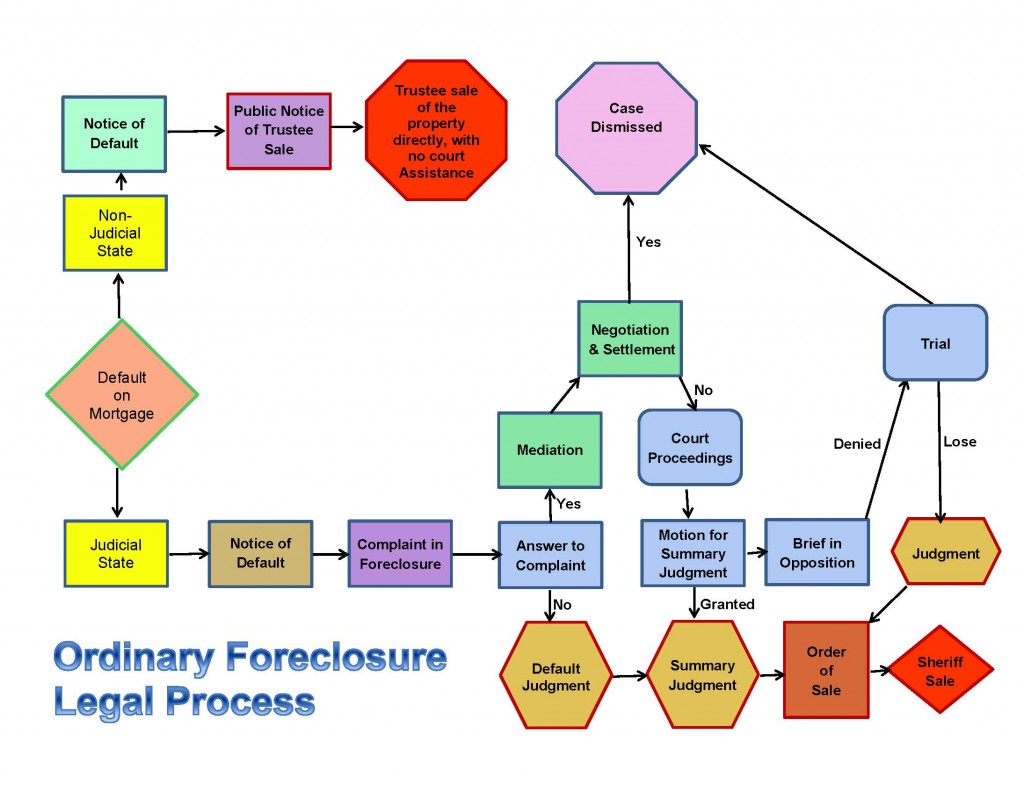
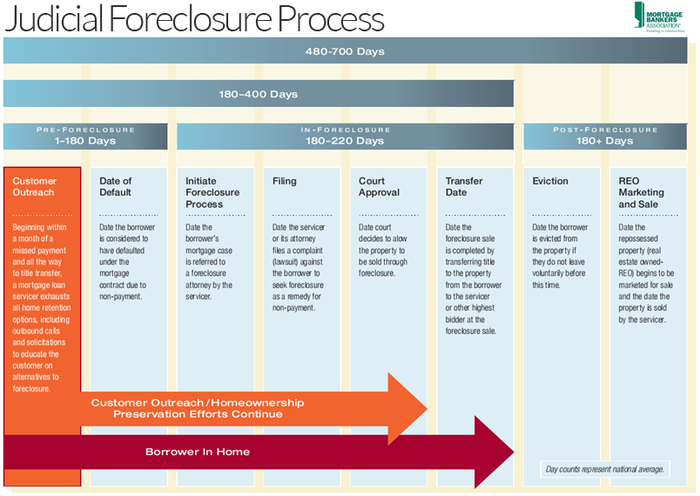
Florida Homeowner’s Guide to a Civil Lawsuit

Tags

, , , , , , ,

This post is intended to offer a general introduction to, and overview of, the course of a “typical” civil lawsuit for homeowners wishing to fight their foreclosure in other to save their homes. Because of the vast array of actions that may be pursued in Florida courts, an exhaustive discussion of the rights, remedies, and procedures available is beyond the scope of this post.

Moreover, this post will focus mainly on the pretrial proceedings, which tend to be more “mysterious” and less publicized than the actual trial. Indeed, pretrial proceedings can be a valuable way of savings your home as many banks and lenders who were in the business of illegal wrongful foreclosure with fraudulently manufactured sets of mortgage documents never take homeowners serious until it gets to that stage. The reason why they take a homeowner serious from that point on is that Banks and lenders will then start making major expenses on legal fees to attorneys retained to respond to the wrongful foreclosure complaints filed by homeowners. With an average wrongful foreclosure litigation lasting between 2 to 5 years, and many homeowners living in their homes mortgage free throughout the litigation period without making a dime in mortgage payments, most smart Lenders and Banks try to cut their loses by quickly modifying mortgage loans with terms most favorable to homeowners in order for homeowners to remain in their rightfully owned dream homes. This fit would not have been accomplished by simply asking the banks to modify a mortgage loan as most loans have been securitized to investors. Lenders and banks from that point on serves only as “servicers” (Not Owners) to the securitized investment trusts From that point after the securitization, they are no longer owners of the mortgage loans, but simply servicers of the trust, unless they later repurchase it after default. They may try to trick homeowners into thinking that they still own their mortgage loans, absolutely not! That’s why they are giving homeowners run around in order to foreclose and steal the home right behind your nose. Folks! they can’t modify mortgage loans for the simple fact that “they cannot modify what they don’t own” period! There are thousands of investors that own the mortgage pools.  Mortgage pools are controlled by PSA (Pooling and Servicing Agreement) and they must obtain consent authorizations from all investors (Real Owners), in order to modify any loans in the securitized pools that is why it is nearly impossible to modify most loans unless you take them to Court to prove their ownership, which they cannot do. Then and only then will the Lenders and Banks get those consent from investors as investors do not want to lose assets and in most times the loans will simply be repurchased from the trust by your lender after default before modification. Once repurchased, your loan is ‘get this’, “no longer a secured debt” but an unsecured debt and your “home” is no longer used as a collateral to your mortgage loan debt. Your mortgage loan may also have been paid off by forced place insurance your lender placed on your loan when you took out your loan, as that is taken out to cover their loses in the event of your default on the mortgage loan. That this why they are charging you the forced placed insurance premium when you took out your mortgage loan, in order to collect large sums of money that reduces your mortgage debt and in most cases, “pays off your entire mortgage loan” when you default. But they will still try to foreclose on you as if your loan is still a secured debt which it is not. They perpetrate those fraud due to your ignorance. That’s of course if you keep quite and let them steal your home right under your nose.

While many homeowners are familiar with the general procedures applicable in criminal cases, they may be less familiar with civil proceedings. For example, unlike criminal defendants, civil litigants enjoy no constitutional speedy trial rights. As a result, civil proceedings may seem unduly lengthy, particularly in counties where the court dockets are especially congested. Courts try to speed up the process and encourage extra-judicial resolution of disputed claims, for example, through court-annexed mediation or arbitration.

I. The Pleadings

A. The Complaint
B. Answer
C. Responsive Motions
D. Counterclaims
E. Crossclaims and Third-Party Claims
F. Amendment

II. Pretrial Procedure

A. Discovery
B. Discovery Methods
C. Protective Orders
D. Sanctions

III. Dismissal

A. Voluntary Dismissal
B. Involuntary Dismissal
C. Summary Judgment

IV. Non-Judicial Methods of Resolution

A. Mediation
B. Arbitration
C. Offers of Judgment

V. Trial

A. Demand for Jury
B. Jury Selection
C. Opening Statements
D. Motion for Directed Verdict
E. Closing Argument
F. Jury Instructions
G. Verdict

VI. Conclusion
————————–

I. The Pleadings.

The term “pleadings” often is used synonymously (and incorrectly) to refer to any documents filed with the court. However, this term has a more limited and technical meaning. The “pleadings” in a lawsuit are simply those filings that set forth either (a) the complaining party’s allegations and causes of action; or (b) the defending party’s responses to those allegations along with any defenses or causes of action the defending party may assert. This becomes significant only when the Florida Rules of Civil Procedure distinguish between “pleadings” and other documents. For example, a motion to dismiss for failure to state a cause of action is directed solely to the “pleadings” and the court may not consider any other filings, such as exhibits, deposition testimony, interrogatory answers, etc.

A. The Complaint.

A civil action is commenced by filing a complaint or petition. Fla. R. Civ. P. 1.050. This initial pleading filed by the complaining party generally consists of factual allegations, a description of the legal claims based on those allegations, and a request for relief. Fla. R. Civ. P. 1.110(b). Some pleadings are subject to special rules. For example, in actions alleging injury or death arising out of medical malpractice, the pleadings are required to include a certificate that counsel has conducted “a reasonable investigation as permitted by the circumstances to determine that there are grounds for a good faith belief that there has been negligence in the care or treatment of the claimant.” Fla. Stat. Sec. 766.104(1) (2003). “Good faith” may be demonstrated by a written expert opinion that there is evidence of medical negligence. Id. Failure to comply with this section may subject the party to an award of fees and costs. Id. These special pleading rules are in addition to the pre-suit notice requirements applicable to medical malpractice claims. See Fla. Stat. Sec. 766.106 (2003). A lawsuit may involve one defendant, multiple defendants, or even a class of defendants. The procedures and requirements for certifying a class of plaintiffs or defendants are found in Fla. R. Civ. P. 1.220. Similarly, the lawsuit may involve multiple plaintiffs or a class of plaintiffs.

A complaint may assert more than one count. It may state different causes of action, even if they are inconsistent. This common practice is called pleading “in the alternative.” Sometimes the conduct complained about may support more than one cause of action, depending on what discovery reveals. For example, Adam contracts to sell a piece of commercial real estate to Bob. Adam decides to accept a better offer from Charles. Bob brings a lawsuit against Adam after Adam reneges on their agreement. Bob may seek monetary damages because he will have to incur additional expenses in finding another suitable property. However, Bob also may sue in the alternative, for “specific performance,” which simply means that the original contract between Bob and Adam would be enforced and Adam would be required to sell the property to Bob, instead of paying Bob money damages.

Therefore, a party often does not have to choose initially which theory it will proceed on; however, the party ultimately can recover only once. Therefore, Bob cannot have both remedies and will have to choose which one he wants.

A party also may plead claims that are inconsistent with each other. As one court has noted, this is because “the pleadings in a cause are merely a tentative outline of the position which the pleader takes before the case is fully developed on the facts.” Hines v. Trager Constr. Co., 188 So. 2d 826, 831 (Fla. 1st DCA), cert. denied, 194 So. 2d 618 (Fla. 1966). This rule applies equally to defendants. Therefore, a defendant may raise defenses that are inconsistent with each other.

The relief most commonly sought is money damages. Compensatory damages are intended to compensate the injured party for its loss. Punitive or exemplary damages are awarded beyond the actual loss and are intended to punish the wrongdoer and to deter similar conduct by others. The availability of punitive damages is limited by statute and court rule. See Fla. Stat. Sec. 768.72 (2003). This statute prevents a party from even including a claim for punitive damages in the complaint until that party has presented record evidence sufficient to support a jury verdict for punitive damages. This is important because the party seeking punitive damage is not entitled to the discovery of information concerning the other party’s financial net worth until the court is satisfied that a triable claim for punitive damages has been established. Id. In 2003, these requirements were incorporated into Fla. R. Civ. P. 1.190(f).

A party also may seek injunctive relief, i.e., an order by the court directing a party to do some act (positive) or to refrain from doing some act (negative). Once such an order is entered by a court, noncompliance with that order may be punishable as contempt of court.

One form of injunctive relief frequently requested is “specific performance,” which is essentially a direction to a party to perform its contract. Specific performance may be requested in land sales contracts and non-compete agreements. However, this remedy is not available to enforce certain types of contracts, such as personal service contracts.

A party also may seek declaratory relief. The trial courts have jurisdiction “to declare rights, status, and other equitable or legal relations whether or not further relief is or could be claimed.” Fla. Stat. Sec. 86.011 (2003). This may include the interpretation and declaration of rights under “a statute, regulation, municipal ordinance, contract, deed, will, franchise, or other article, memorandum, or instrument in writing.” Fla. Stat. Sec. 86.021 (2003). The declaration may be affirmative or negative and “has the force and effect of a final judgment.” Fla. Stat. Sec. 86.011 (2003). For example, declaratory judgment proceedings frequently are initiated by insurance companies seeking a determination of their obligation to defend against another action.

B. Answer.

After being served with the initial pleading, the defendant (or respondent) must respond to it. A defendant has a couple of options at this stage.

Typically the defendant files an answer, which responds to each allegation of the complaint and which may set forth one or more defenses. Fla. R. Civ. P. 1.110(c). Under the rules of civil procedure, “affirmative defenses” must be asserted in a responsive pleading or motion to dismiss or they will be waived. Fla. R. Civ. P. 1.110(d). Affirmative defenses are those defenses that “avoid” rather than deny. For example, the statute of limitations is an affirmative defense. By raising this defense, the defendant asserts that even if the defendant committed all of the horrible acts alleged by the plaintiff, the plaintiff has no cause of action because the action was not filed in a timely fashion. In that respect the claim is “avoided,” rather than denied.

C. Responsive Motions.

In lieu of, or in addition to, filing an answer, the defendant may move to challenge the legal sufficiency of the claims raised by the plaintiff. Fla. R. Civ. P. 1.140. These rules apply equally to counterclaims, crossclaims, and third-party claims. This motion is not a “pleading.” The defendant may argue that the complaint “fails to state a claim,” that is, even assuming that the facts alleged in the complaint are true, the law does not recognize a cause of action. Fla. R. Civ. P. 1.140(b)(6). For example, a store patron sues the grocery store for damages after he is assaulted by a third person in the vacant lot next door. The grocery store will move to dismiss, claiming that the store patron has failed to state a cause of action because it has no duty to protect customers off the premises. An out-of-state defendant might argue that the court lacks “personal jurisdiction” over him or her Fla. R. Civ. P. 1.140(b)(2). because he or she lacks sufficient “contacts” with the state, such as an office or business transactions in the state. This is based on the federal due process clause. Before a court may exercise personal jurisdiction over a nonresident defendant, that defendant must possess “certain minimum contacts with the state” so that “maintenance of the suit does not offend ‘traditional notions of fair play and substantial justice’.” Walt Disney Co. v. Nelson, 677 So. 2d 400, 402 (Fla. 5th DCA 1996) (quoting International Shoe Co. v. Washington, 326 U.S. 310, 316 (1945)).

Other defenses that might be raised at this stage include failure to join an indispensable party, Fla. R. Civ. P. 1.140(b)(7). lack of subject matter jurisdiction, Fla. R. Civ. P. 1.140(b)(1). Subject matter jurisdiction refers to the court’s authority or competence to preside over certain matters. For example, by statute, circuit courts lack subject matter jurisdiction to hear matters involving amounts less than $15,000.00. The subject matter for such actions is vested in the county courts. See Fla. Stat. Sec. 34.01(1)(c) (2003). improper venue, Fla. R. Civ. P. 1.140(b)(3). Venue is governed by Fla. Stat. Ch. 47 (2003), except where the Legislature has provided for special venue rules. See, e.g., Fla. Stat. Sec. 770.05 (2003) (limiting choice of venue in actions involving “libel or slander, invasion of privacy, or any other tort founded upon any single publication, exhibition, or utterance”). and insufficiency of process Fla. R. Civ. P. 1.140(b)(4). “Insufficiency of process” refers to the actual document which is served. To determine if the process is adequate, one should examine it to determine that it is signed by a clerk of court or the clerk’s deputy, it bears the clerk’s seal, a correct caption, the defendant’s correct name, the name of the appropriate state, the return date, the name and address of the party or lawyer causing process to be issued, and the name of any defendant organization. If it is not a summons, it should comply with the statute or rule that authorizes its issuance. See H.

Trawick, Florida Practice & Procedure Sec. 8-22, at 170-72 (1999). or service of process. Fla. R. Civ. P. 1.140(b)(5). A defect in the “service of process” claims that the defendant was not served appropriately: for example, he or she was not served personally, when required. Service of process is governed by Fla. R. Civ. P. 1.070 and by Fla. Stat. Chs. 48, 49 (2003). Certain defenses are waived if not raised either by an answer (or other responsive pleading) or by motion to dismiss, such as personal jurisdiction, improper venue, and insufficiency of process or service of process. Fla. R. Civ. P. 1.140(h)(1).

A defendant also may move for “a more definite statement” if the pleading is so vague or ambiguous that the defendant cannot frame a sufficient response to it Fla. R. Civ. P. 1.140(e). or it may move to “strike” portions as “redundant, immaterial, impertinent or scandalous.” Fla. R. Civ. P. 1.140(f).

D. Counterclaims.

In addition to its responsive pleading, a defendant may file a counterclaim, which operates like a complaint, except that the defendant is now the counterclaim plaintiff. Fla. R. Civ. P. 1.170. Thus, a counterclaim sets out factual allegations, legal claims, and a request for relief, just like a complaint. Id. A counterclaim requires a response by the “counterclaim defendant,” who was the plaintiff in the initial complaint. See Fla. R. Civ. P. 1.100(a) and 1.110(c).

Counterclaims may be “permissive” or “compulsory.” Fla. R. Civ. P. 1.170(a), (b). A counterclaim is “compulsory” and, therefore, must be raised in he current action if it “arises out of the transaction or occurrence that is the subject matter of the opposing party’s claim and does not require for its adjudication the presence of third parties over whom the court cannot acquire jurisdiction.” Fla. R. Civ. P. 1.170(a). On the other hand, a counterclaim is “permissive” if it does not arise out of the transaction or occurrence that is the subject matter of the opposing party’s claim. Fla. R. Civ. P. 1.170(b). This designation determines whether the counterclaim must be raised at this time or whether the defendant/counterclaim plaintiff can bring a separate action on the counterclaim. Fla. R. Civ. P. 1.170(a), (b).

E. Crossclaims and Third-Party Claims.

A defendant may file a crossclaim against another defendant Fla. R. Civ. P. 1.170(g). or may file a third-party complaint against a nonparty. Fla. R. Civ. P. 1.170(h). Crossclaims and third-party claims include factual allegations, legal claims, and requests for relief. They also require a response by the crossclaim or third-party defendants. Fla. R. Civ. P. 1.100(a). In practice, the pleadings can become quite complicated because of the number of possible claims which may be asserted. For example, a crossclaim defendant can assert a counterclaim against the crossclaim plaintiff and can assert a third-party claim against other nonparties. Multiple plaintiffs who are subject to a counterclaim can assert cross-claims against each other or third-party claims against other nonparties. There may be fourth party complaints. Understanding the availability of crossclaims, counterclaims and third-party claims by various parties aids in comprehension when one is faced with a lengthy caption identifying one party as a defendant, a counterclaim plaintiff, a crossclaim defendant, and a third-party plaintiff, all at the same time.

F. Amendment.

A party may amend the pleading once as a matter of right if there has been no responsive pleading. Otherwise, leave of court or written consent of the other side is required. Fla. R. Civ. P. 1.190(a). Leave of court is “given freely when justice so requires.” Id. Frequently a party will amend the pleading to cure any deficiencies addressed by a motion to dismiss. Amendments may be allowed even after trial under certain circumstances. Fla. R. Civ. P. 1.190(b).

II. Pretrial Procedure.

After responsive pleadings or motions are due, the court may schedule a case management conference to try to expedite and streamline litigation, for example, by scheduling service of papers, coordinating complex litigation, addressing discovery issues, pretrial motions and settlement issues, requiring the parties to file stipulations, etc. Fla. R. Civ. P. 1.200(a).
Later, the court may schedule a pretrial conference to address simplification of issues, amendments, admissions by one party, experts, etc. The failure of a party or its attorney to cooperate in these conferences may result in sanctions. Fla. R. Civ. P. 1.200(b), (c); Fla. Stat. Sec. 768.75(1) (2003).

A. Discovery.

Discovery occupies a large part of most civil lawsuits because Florida courts do not favor trial “by ambush.” Therefore, the rules of civil procedure encourage, indeed mandate, complete discovery. In practice, however, discovery disputes occupy a large amount of attorney and judge time.

Generally, discovery is allowed of “any matter, not privileged, that is relevant to the subject matter of the pending action.” Fla. R. Civ. P. 1.280(b)(1). In this context, “relevance” has a very broad meaning. Information is discoverable if it “appears reasonably calculated to lead to the discovery of admissible evidence.” Id.

The goals of discovery are several. Each party desires to know what the other party intends to present at trial so as to avoid any nasty surprises. Each party also seeks to obtain evidence either to support its claims and/or defenses or rebut the opposing party’s claims and/or defenses, whether directly or through impeachment. Discovery permits a party to obtain information concerning what documents the other side intends to introduce, what that party’s experts and other witnesses will say and how that party intends to prove its claims and/or defenses. In cases in which punitive damages legitimately have been sought, the plaintiff may obtain financial worth information from the alleged wrongdoer. However, keep in mind that punitive damages only may be requested with prior permission of the court. See Fla. Stat. Sec. 768.72 (2003).

While discovery is very broad, it is not without limitation. For example, the other side generally cannot discover privileged information. Fla. R. Civ. P. 1.280(b)(1). Examples of evidentiary privileges recognized by statute are: journalist’s privilege, Fla. Stat. Sec. 90.5015 (2003); attorney-client communications, Fla. Stat. Sec. 90.502 (2003); psychotherapist-patient communications, Fla. Stat. Sec. 90.503 (2003); sexual assault counselor-victim communications, Fla. Stat. Sec. 90.5035 (2003); domestic violence advocate-victim communications, Fla. Stat. Sec. 90.5036 (2003); husband-wife communications, Fla. Stat. Sec. 90.504 (2003); communications to clergy, Fla. Stat. Sec. 90.505 (2003); accountant-client communications, Fla. Stat. Sec. 90.5055 (2003); and trade secrets, Fla. Stat. Sec. 90.506 (2003). The rules also restrict a party’s ability to obtain documents and tangible things prepared “in anticipation of litigation” by the other side. Fla. R. Civ. P. 1.280(b)(3). This is also known as the “work-product” privilege. The rules severely limit a party’s ability to discover information concerning experts who have been retained by the other side in anticipation of litigation but who are not expected to testify at trial. Fla. R. Civ. P. 1.280(b)(4)(B).

B. Discovery Methods.

There are several mechanisms for obtaining discovery. To a large extent, the type of discovery method employed and its timing depend on the information desired and the particular style of the legal practitioner.

1. Depositions.

A “deposition” is an oral examination of a person under oath that is recorded by a stenographer and may be videotaped or audiotaped. Fla. R. Civ. P. 1.310. A party deponent may be required to produce documents during the examination. Fla. R. Civ. P. 1.310(b)(5). Depositions of parties may be used by the other side for any purpose. Fla. R. Civ. P. 1.330(a)(2). Depositions may be taken by telephone. Fla. R. Civ. P. 1.310(b)(7). Depositions frequently are used to impeach subsequent testimony. Sometimes, depositions may be taken prior to the filing of a civil action or during appeal to preserve testimony. Fla. R. Civ. P. 1.290. Depositions may or may not be transcribed, depending upon the wishes of the parties. Depositions also may be conducted on written questions. See Fla. R. Civ. P. 1.320. This method is not used frequently.

2. Interrogatories.

“Interrogatories,” another common discovery method, are written questions that are served on a party Although the rules allow for any person to be deposed, interrogatories and requests for admission may be directed only to parties. See Fla. R. Civ. P. 1.340(a) (“a party may serve upon any other party written interrogatories”) and 1.370(a) (“[A] party may serve upon any other party a written request for the admission of the truth of any matters within the scope of rule 1.280(b)”). and that require written responses within thirty (30) days. Fla. R. Civ. P. 1.340(a). The rules limit the number of questions to thirty (30) without court approval. Id. Form interrogatories pre-approved by the Florida Supreme Court must be used if applicable. Id. Interrogatories must be answered separately, fully, in writing, and under oath unless objections are made. Id. Like deposition testimony, interrogatory answers frequently are used to impeach subsequent testimony.

A party may produce records in lieu of answering an interrogatory if the answer may be derived from those records and if it is equally burdensome for the party to determine the answer as it is for the party seeking the information. Fla. R. Civ. P. 1.340(c).

3. Production of Documents and Things by Parties.

A party may be required to produce documents or other tangible things for inspection and/or copying by the other side. Fla. R. Civ. P. 1.350(a). “Documents” are defined broadly to include writings, drawings, graphs, charts, photographs, phono-records and other “data compilations” from which information may be obtained or translated. See Fla. R. Civ. P. 1.350. The party seeking the information may test and sample the tangible items. Fla. R. Civ. P. 1.350(a)(2). A party may request to enter upon designated land or property to inspect some object or operation. Fla. R. Civ. P. 1.350(a)(3).

4. Production of Documents and Things by Nonparties.

A party also may obtain documents from nonparties by issuing a subpoena directing production of documents or things without deposition. See Fla. R. Civ. P. 1.351(a). Other parties must be notified at least ten (10) days before the subpoena issues so that they may object. Fla. R. Civ. P. 1.351(b). If another party objects, this method of nonparty discovery becomes unavailable. Fla. R. Civ. P. 1.351(c). If there is no objection, the nonparty may comply with the subpoena by providing copies of the documents or things sought. Fla. R. Civ. P. 1.351(e).

5. Mental and Physical Examinations.

In certain circumstances, a party may request that a qualified expert conduct a physical or mental examination of a party, or a person in that party’s control or custody. Fla. R. Civ. P. 1.360(a). This discovery method is utilized most often in personal injury cases and otherwise when a person’s physical or mental condition is in controversy. The party requesting the examination must demonstrate good cause. Fla. R. Civ. P. 1.360(a)(2).

6. Request for Admissions.

An important, but often under-utilized, form of discovery is the “request for admissions.” Fla. R. Civ. P. 1.370. One party serves upon another party a written request that the party admit to the truth of certain matters, including statements or opinions of fact or the application of law to fact, or the genuineness of documents. Fla. R. Civ. P. 1.370(a). If the other side fails to respond or object within thirty (30) days, the facts are considered admitted, which means that they are conclusively established. Fla. R. Civ. P. 1.370(b). The requesting party also may move to determine the sufficiency of the responses. Fla. R. Civ. P. 1.370(a). If the court decides that a response does not comply with the rule, the matter may be deemed admitted or an amended answer required. Id. If a party fails to admit a matter and the other side later proves that matter, the party may have to pay the costs incurred by the other side in making that proof. Id. Recently, the Florida Supreme Court revised the rules of civil procedure to limit the number of requests for admissions to thirty (30).Fla. R. Civ. P. 1.370(a).

C. Protective Orders.

At any time, a party or nonparty from whom discovery is sought may ask the court to enter a protective order to protect that person from “annoyance, embarrassment, oppression, or undue burden or expense.” Fla. R. Civ. P. 1.280(c). Such a protective order may prohibit discovery, limit its scope, or effectuate other protective measures. Id.

D. Sanctions.

A party who is dissatisfied with the other side’s cooperation in discovery may seek an order compelling discovery. Fla. R. Civ. P. 1.380(a). If a motion to compel is granted, the opposing party shall pay the moving party’s expenses incurred in obtaining the order, which may include attorney’s fees, unless the opposition to the motion was justified or other circumstances make an award of expenses unjust. Fla. R. Civ. P. 1.380(a)(4). Similarly, if the motion is denied, the moving party shall pay the nonmoving party’s expenses unless the motion was substantially justified or other circumstances make an award of expenses unjust. Id.

If the court orders discovery, failure to obey that order may be punishable as contempt. Fla. R. Civ. P. 1.380(b). The court has many available sanctions for discovery violations, particularly when the recalcitrant person is a party. Certain matters may be deemed established or a party may be prevented from opposing or supporting claims or defenses or from introducing evidence. Fla. R. Civ. P. 1.380(b)(2). The court may strike pleadings, dismiss the action, or enter a default judgment. Id. However, the failure to submit to a physical or mental examination is not punishable by contempt. Fla. R. Civ. P. 1.380(b)(2)(E).

III. Dismissal.

Frequently, civil actions are dismissed before a trial on the merits of the underlying claims. In addition to settlement, dismissal of a civil action may come about under a number of circumstances.

A. Voluntary Dismissal.

A party’s ability to dismiss its own action is limited by the rules of civil procedure. Fla. R. Civ. P. 1.420. The dismissal rules also apply to counterclaims, crossclaims, and third-party claims. A party may dismiss its lawsuit voluntarily without a court order prior to trial, as long as no motion for summary judgment has been heard or one has been denied and the case has not been submitted to the fact-finder. Fla. R. Civ. P. 1.420(a)(1)(A). An action may be dismissed by stipulation of the parties. Fla. R. Civ. P. 1.420(a)(1)(B). If the plaintiff previously has dismissed a similar case, this second dismissal will operate as an adjudication on the merits and the plaintiff will not be permitted to refile the action. Fla. R. Civ. P. 1.420(a)(1). Otherwise, the plaintiff may be able to refile the action. However, the plaintiff may be required to pay costs before bringing a similar action against the same party. Fla. R. Civ. P. 1.420(d).

B. Involuntary Dismissal.

The court may enter an order of dismissal as a sanction for failure to comply with court rules or orders. Fla. R. Civ. P. 1.420(b). In evaluating whether the compliance merits this drastic sanction, the court considers the intent of the noncompliant party, the existence of previous sanctions, the involvement of the client, the degree of prejudice to the other side, and any justification for noncompliance. See H. Trawick, Florida Practice & Procedure Sec. 21-5, at 335-37 (1999).

If a case is tried to the court (i.e., without a jury), a party may seek involuntary dismissal if the other side, after completing its presentation of evidence, has failed to show a right to relief. Fla. R. Civ. P. 1.420(b).
Unless the order states that the dismissal is without prejudice, an involuntary dismissal under this rule is an adjudication on the merits and precludes the plaintiff from refiling the action. See, e.g., Drady v. Hillsborough County Aviation Auth., 193 So. 2d 201 (Fla. 2d DCA 1967), cert. denied, 210 So. 2d 223 (Fla. 1968).

An action shall be dismissed by the court for failure to prosecute if there has been no record activity for one year unless the court has stayed the action or a party shows good cause prior to the hearing. Fla. R. Civ. P. 1.420(e). In practice, this rule is strictly enforced.

C. Summary Judgment.

After the lawsuit has been filed, either party may move for summary judgment, subject to certain time restrictions. Fla. R. Civ. P. 1.510. Unlike a motion to dismiss, a motion for summary judgment does more than challenge the legal sufficiency of the complaint. Of course, a summary judgment motion may be directed to a counterclaim, crossclaim, or third-party claim in the same manner. In moving for a summary judgment, one argues that the opposing party cannot present evidence that would be sufficient to demonstrate a “genuine issue as to any material fact” and that the moving party is entitled to judgment as a matter of law. Fla. R. Civ. P. 1.510(c). Orders granting summary judgment are scrutinized closely on appeal.

The motion for summary judgment may be supported or opposed by competent affidavits made on personal knowledge that set forth admissible facts. Fla. R. Civ. P. 1.510(a), (b), (e). The parties also may rely upon depositions and answers to interrogatories. Fla. R. Civ. P. 1.510(e). However, in evaluating a motion for summary judgment, a trial judge may not weigh evidence or assess credibility. If the material facts are in dispute, summary judgment may not be entered and the litigation continues.

IV. Non-Judicial Methods of Resolution.

There are several ways in which a case may be resolved by the parties before trial, with the assistance of “alternative dispute resolution” techniques.

A. Mediation.

Mediation is “a process whereby a neutral third person called a mediator acts to encourage and facilitate the resolution of a dispute between two or more parties. It is an informal and nonadversarial process with the objective of helping the disputing parties reach a mutually acceptable and voluntary agreement.” Fla. Stat. Sec. 44.1011(2) (2003). The parties also may stipulate to mediation. Fla. R. Civ. P. 1.710(b). Mediation does not suspend the discovery process. Fla. R. Civ. P. 1.710(c).

Some civil actions are never ordered to mediation, including bond estreatures, habeas corpus and extraordinary writs, bond validations, criminal or civil contempt proceedings, or any other matters specified by the chief judge of that court. Fla. R. Civ. P. 1.710(b).

The mediator may be chosen by the parties or may be appointed by the court. The chief judge maintains a list of mediators who have been certified by the Florida Supreme Court. Fla. Stat. Sec. 44.102(5) (2003). When possible, qualified individuals who have volunteered their time to serve as mediators shall be appointed. Fla. Stat. Sec. 44.102(5)(a) (2003). Often parties agree on a particular mediator in order to select someone with specialized knowledge or expertise in the area under consideration.

Parties who fail to appear at mediation without good cause are subject to sanctions. Fla. R. Civ. P. 1.720(b). The mediator controls the mediation process. Fla. R. Civ. P. 1.720(d). Counsel are permitted to communicate privately with their clients. Id. If the parties and mediator agree, mediation can proceed without counsel. Id. The mediator can meet privately with the parties or their counsel. Fla. R. Civ. P. 1.720(e).

If the mediation results in no agreement, the mediator reports this to the court without comment or recommendation. Fla. R. Civ. P. 1.730(a). The mediator also may identify pending motions or outstanding legal issues, discovery process or other actions whose resolution could facilitate the possibility of a settlement. Id. If an agreement is reached, it is reduced to writing and signed by the parties and their counsel. Fla. R. Civ. P. 1.730(b). Mediation proceedings are privileged, subject to limited exceptions. Fla. Stat. Sec. 44.102(3) (2003). Written communications in mediation are also exempt from Florida’s Public Records Act.Fla. Stat. Sec. 44.102(3) (2003).

B. Arbitration.

There are generally two types of court-ordered arbitration: mandatory non-binding arbitration and voluntary binding arbitration. In addition, arbitration often is ordered when the parties previously have agreed contractually to submit their claims to arbitration. See Fla. Stat. Sec. 682.02 (2003).

1. Mandatory (Non-Binding) Arbitration.

The court may direct the parties to participate in mandatory, non-binding arbitration. See Fla. Stat. Sec. 44.103(2) (2003). Unlike mediation, which is relatively informal, arbitration is similar to a mini-trial because arbitrators may administer oaths, take testimony, issue subpoenas and apply to the court for orders compelling attendance and production. Fla. Stat. Sec. 44.103(4) (2003). The arbitrator (or arbitration panel) renders a written decision that will become final if the parties do not submit a timely request for a trial de novo. Fla. Stat. Sec. 44.103(5) (2003). If a party requests a trial de novo and does not achieve a result that is more favorable than the arbitration award, that party may be assessed costs, including fees. Fla. Stat. Sec. 44.103(6) (2003).

2. Voluntary (Binding) Arbitration.

The parties also may agree in writing to submit their action to binding arbitration, except when constitutional issues are involved. Fla. Stat. Sec. 44.104(1) (2003). The parties may agree on the selection of one or more arbitrators; otherwise, they will be appointed by the court. Fla. Stat. Sec. 44.104(2) (2003). As in mandatory non-binding arbitration, the arbitrator has the power to administer oaths, issue subpoenas, etc. Fla. Stat. Sec. 44.104(7) (2003). A majority of the arbitrators may render a decision. Fla. Stat. Sec. 44.104(8) (2003). The Florida Rules of Evidence apply to voluntary binding arbitration proceedings. Fla. Stat. Sec. 44.104(9) (2003). Appeals to the circuit court are limited to statutorily defined issues, such as failure of the arbitrators to comply with procedural or evidentiary rules, misconduct, etc. Fla. Stat. Sec. 44.104(10) (2003). Disputes involving child custody, visitation, or child support, or the rights of a nonparty to the arbitration are non-arbitrable. Fla. Stat. Sec. 44.104(14) (2003). In addition, the court may require the parties in a medical malpractice action to submit to non-binding arbitration before a panel of arbitrators consisting of a plaintiff’s attorney, a health care practitioner or defense attorney, and a trial attorney. See Fla. Stat. Sec. 766.107(1) (2003). The panel considers the evidence and decides the issues of liability, amount of damages, and apportionment of responsibility among the parties, but may not award punitive damages. Fla. Stat. Sec. 766.107(3)(b) (2003). Voluntary binding arbitration is also available in medical malpractice actions. See Fla Stat. Sec. 766.207 (2003).

C. Offers of Judgment.

Before trial, a party may submit a written “offer of judgment” that offers to settle a claim on specified terms, e.g., for a specified amount, etc. Fla. Stat. Sec. 768.79(1) (2003). The other side has thirty (30) days to accept the offer in writing. If the plaintiff rejects an offer by a defendant under this section and ultimately obtains a judgment of no liability or at least twenty-five percent (25%) less than the offer, the plaintiff will be responsible for costs and fees from the date of the filing of the offer. Id. Likewise, if the defendant rejects a demand for judgment by the plaintiff under this section, and the plaintiff subsequently obtains a judgment that is at least twenty-five percent (25%) greater than the offer, the defendant will be responsible for plaintiff’s fees and costs incurred after the date of the filing of the demand. Id. An offer or demand may be withdrawn in writing at any time prior to its acceptance. Fla. Stat. Sec. 768.79(5) (2003). Another statute provides for the assessment of costs and fees against a party whose rejection of an offer of settlement subsequently is determined by the court to have been “unreasonable.” Unlike Fla. Stat. Sec. 768.79 an award of fees and costs under this section is not mandatory. However, this section does not apply to causes of action which accrue after October 1, 1990 and, therefore, the statute is all but obsolete. See Fla. Stat. Sec. 45.061 (2003). Given the availability of fees and costs under this section, it is a powerful mechanism for encouraging parties to consider settlement offers seriously.

V. Trial.

Although the majority of civil cases are resolved without a trial, many still proceed to trial. Once all motions directed to the last “pleading” Recall that “pleading” has a specialized meaning and refers to complaint and answer, counterclaim and response to counterclaim, crossclaim and response to crossclaim, etc.have been resolved of or, if no such motions were served, within twenty (20) days of the service of the last pleading, an action is “at issue,” and a party may notify the court that it is ready to be set for trial. Fla. R. Civ. P. 1.440(b). Typically, the court directs the parties to mediation if mediation already has not occurred. Otherwise, a trial date may be scheduled.

A. Demand for Jury.

The right to a jury trial in a civil case is not absolute and, in fact, may be waived if it is not demanded in a timely fashion. Fla. R. Civ. P. 1.430(d).

Typically, the demand for a jury trial is appended to the plaintiff’s complaint. A plaintiff may choose, however, for strategic purposes or otherwise, not to assert its jury trial right. However, both parties enjoy the right to a jury trial Fla. R. Civ. P. 1.430(a); Art. I, Sec. 22, Fla. Const. and a defendant who desires a jury trial typically will demand one in its answer or other responsive pleading. If a jury trial is not demanded within the time limits imposed by the rules of civil procedure, it is deemed waived. Fla. R. Civ. P. 1.430(d). If a jury trial is demanded, the demand thereafter may not be withdrawn without consent of the parties. Id.

A matter may be tried completely or partially to a jury. Fla. R. Civ. P. 1.430(c). However, parties are not entitled automatically to a jury trial in all cases because some matters, such as injunction proceedings, are not triable to a jury.

B. Jury Selection.

Assuming that a jury trial has been demanded, the first step in the trial process is jury selection. Prospective jurors may be provided with a questionnaire to determine any legal disqualifications (e.g., felony conviction). Fla. R. Civ. P. 1.431(a)(1). Fla. Stat. Sec. 40.013 (2003), disqualifies from jury service (1) those individuals who have been convicted of a felony and (2) the Governor, Lieutenant Governor, Cabinet officers, clerk of court, and judges. Fla. Stat. Sec. 40.013(1), (2)(a) (2003). This chapter also permits other individuals to be excused upon request, including law enforcement officers and their investigative personnel, expectant mothers and non-full-time employed single parents of children under six years old, practicing attorneys and physicians, the physically infirm, individuals over seventy (70) years old, individuals who demonstrate hardship, extreme inconvenience, or public necessity, and persons who care for certain incapacitated individuals. Id. Jurors also may be provided with questionnaires to assist in voir dire, or the oral examination of prospective jurors. Fla. R. Civ. P. 1.431(a)(2). The parties have the right to examine jurors orally on voir dire. Fla. R. Civ. P. 1.431(b). The court also may question prospective jurors. Id.

The parties may challenge any prospective juror “for cause,” i.e., if the juror is biased, incompetent, or related to a party or attorney for a party or has some interest in the action. Fla. R. Civ. P. 1.431(c)(1). There is no limit to the number of “for cause” challenges that may be raised. On the other hand, a party generally is limited to three (3) “peremptory” challenges, which do not require that the party establish cause, or any other reason for that matter. Fla. R. Civ. P. 1.431(d). However, there are constitutional limitations on peremptory challenges. For example, a party may not utilize its peremptory challenges to exclude prospective jurors in a racially discriminatory manner. See, e.g., State v. Johans, 613 So. 2d 1319, 1321 (Fla. 1993); State v. Neil, 457 So. 2d 481 (Fla. 1984); Laidler v. State, 627 So. 2d 1263 (Fla. 4th DCA 1993).

After the trial jury is selected, the court may provide for the selection of alternate jurors, and the parties generally are allowed one peremptory challenge for this process. Fla. R. Civ. P. 1.431(g). Alternate jurors are selected in the same manner as trial jurors, and are in all respects identical except that they are discharged if they are not needed when the jury retires to deliberate. Fla. R. Civ. P. 1.431(g)(1).

C. Opening Statements.

After a jury is selected, the parties present opening statements. Opening statements are not supposed to be arguments; rather, the parties should advise the jury of what the evidence will prove. After opening statements, the parties or the court may “invoke the rule,” which simply means that nonparty witnesses are excluded from the courtroom while others are testifying. Fla. Stat. Sec. 90.616 (2003). In addition, the witnesses are directed not to discuss the case with anyone other than the attorneys. H. Trawick, Florida Practice & Procedure Sec. 22-7, at 356 (1999).

D. Motion for Directed Verdict.

After the plaintiff presents its case-in-chief, the defendant may move for a directed verdict on the grounds that the plaintiff has failed to present sufficient evidence to justify submission of the case to the jury. Fla. R. Civ. P. 1.480(a). If the action is being tried to the court without a jury, the proper motion is a motion for involuntary dismissal under Fla. R. Civ. P. 1.420(b), as discussed earlier. If the motion is denied or reserved, the case proceeds, subject to the defendant’s ability to renew the motion at the close of the evidence. However, in a nonjury trial, renewal of the motion for involuntary dismissal at the close of the evidence is not authorized.

Orders granting directed verdict are unusual and scrutinized closely on appeal. Courts commonly “reserve ruling” on a motion for directed verdict and allow the case to proceed to the jury. This is a preferred approach because if the trial court grants a directed verdict and does not submit the case to the jury, and the directed verdict is overturned on appeal, the entire case must be retried. On the other hand, if the judge reserves ruling on the motion for directed verdict, the judge may override a subsequent plaintiff’s verdict and if that decision is overturned on appeal, the verdict may simply be reinstated without the necessity of a new trial.

After the plaintiff presents its case and any motions for directed verdict by either side are addressed, the defendant presents its case-in-chief. At the close of the defendant’s case, either party may move for a directed verdict. The plaintiff may present rebuttal evidence.

E. Closing Argument.

After the close of all the evidence, each side has an opportunity to present closing arguments. Because the plaintiff bears the burden of proof, the plaintiff is permitted to argue first and last (i.e., in rebuttal to defendant’s argument). The attorneys are required to confine their closing arguments to the evidence presented, along with its reasonable inferences. Alford v. Barnett Nat’l Bank, 137 Fla. 564, 188 So. 322 (1939). Case law restricts the types of arguments that may be presented in closing argument. For example, an attorney may not express a personal belief in his client or his client’s case. Miami Coin-O-Wash, Inc. v. McGough, 195 So. 2d 227 (Fla. 3d DCA 1967). He may not request that the jury place itself in his client’s shoes, i.e., the so-called “Golden Rule” argument. Bullock v. Branch, 130 So. 2d 74 (Fla. 1st DCA 1961).

F. Jury Instructions.

If the judge does not direct a verdict following the parties’ respective presentations, the case is submitted to a jury. Prior to the close of evidence, the parties must submit requested jury instructions. Fla. R. Civ. P. 1.470(b). These may include numerous form instructions pre-approved by the Florida Supreme Court. Additional instructions may need to be drafted and often there will be great debate between the parties on their wording.

The judge instructs the jurors on the manner in which they are expected to deliberate and the law that they must follow. Finally, the jurors retire to deliberate. Id. Frequently, the jury has questions during the deliberation process. The parties and their attorneys are notified of such questions. There may be some discussion or debate on how such questions are to be answered and the attorneys may object on the record to the answers ultimately provided to the jury.

G. Verdict.

Once the jury’s deliberations are complete, the verdict is announced in open court. A verdict may be either a “general” verdict or a “special” verdict. A general verdict “finds for a party in general terms on all issues within the province of the jury to determine.” H. Trawick, Florida Practice & Procedure Sec. 24-2, at 399 (1999). On the other hand, the court might employ a “special verdict,” which asks the jury to answer specific questions that determine the disputed facts. H. Trawick, Florida Practice & Procedure Sec. 24-3, at 400 (1999). For example, a special verdict form in a negligence action might require the jury to determine whether the defendant owed a duty to the plaintiff. If the answer to this question were negative, the court would enter judgment for the defendant because duty is an essential element of a negligence claim. A general verdict, on the other hand, might simply ask whether the jury’s verdict was for the plaintiff and, if so, for how much. Regardless of the form of verdict that is used, a separate verdict on each count must be required if requested by either party. H. Trawick, Florida Practice & Procedure Sec. 24-2, at 399 (1999). The verdict form is written and signed by the foreperson.

In negligence actions, the verdict is required to be itemized according to economic loss, noneconomic loss, and punitive damages (if awarded). Fla. Stat. Sec. 768.77(1) (2003). “Economic damages” refers to “past lost income and future lost income reduced to present value; medical and funeral expenses; lost support and services; replacement value of lost personal property; loss of appraised fair market value of real property; costs of construction repairs, including labor, overhead, and profit; and any other economic loss which would not have occurred but for the injury giving rise to the cause of action.” Fla. Stat. Sec. 768.81(1) (2003). In addition, damages must be itemized further into past and future damages. Fla. Stat. Sec. 768.77(2) (2003). Economic damages are computed before and after reduction to present value, but no other damages are reduced to present value. Id. After the verdict is read, either party may request that the individual jurors be polled. Each juror is asked then to confirm that the verdict read is his or her verdict. Once the requested polling is complete, the jury is discharged.

VI. Conclusion.

This post provides a general overview of the route of a civil lawsuit. Every lawsuit is different and the steps often vary dramatically. Pretrial proceedings frequently are overlooked as a valuable source of information. Although access to various components of the pretrial process is beyond the scope of this post, homeowners should view this post as a guide for successful wrongful foreclosure defense. Hopefully, this post will serve to “demystify” the pretrial process and assist homeowners gearing up to fight the wrongful foreclosure shops that are illegally snatching away their dream homes.

If you find yourself in an unfortunate situation of losing or about to lose your home to wrongful fraudulent foreclosure, and needed solutions to defend or reclaim your home please visit: http://www.fightforeclosure.net
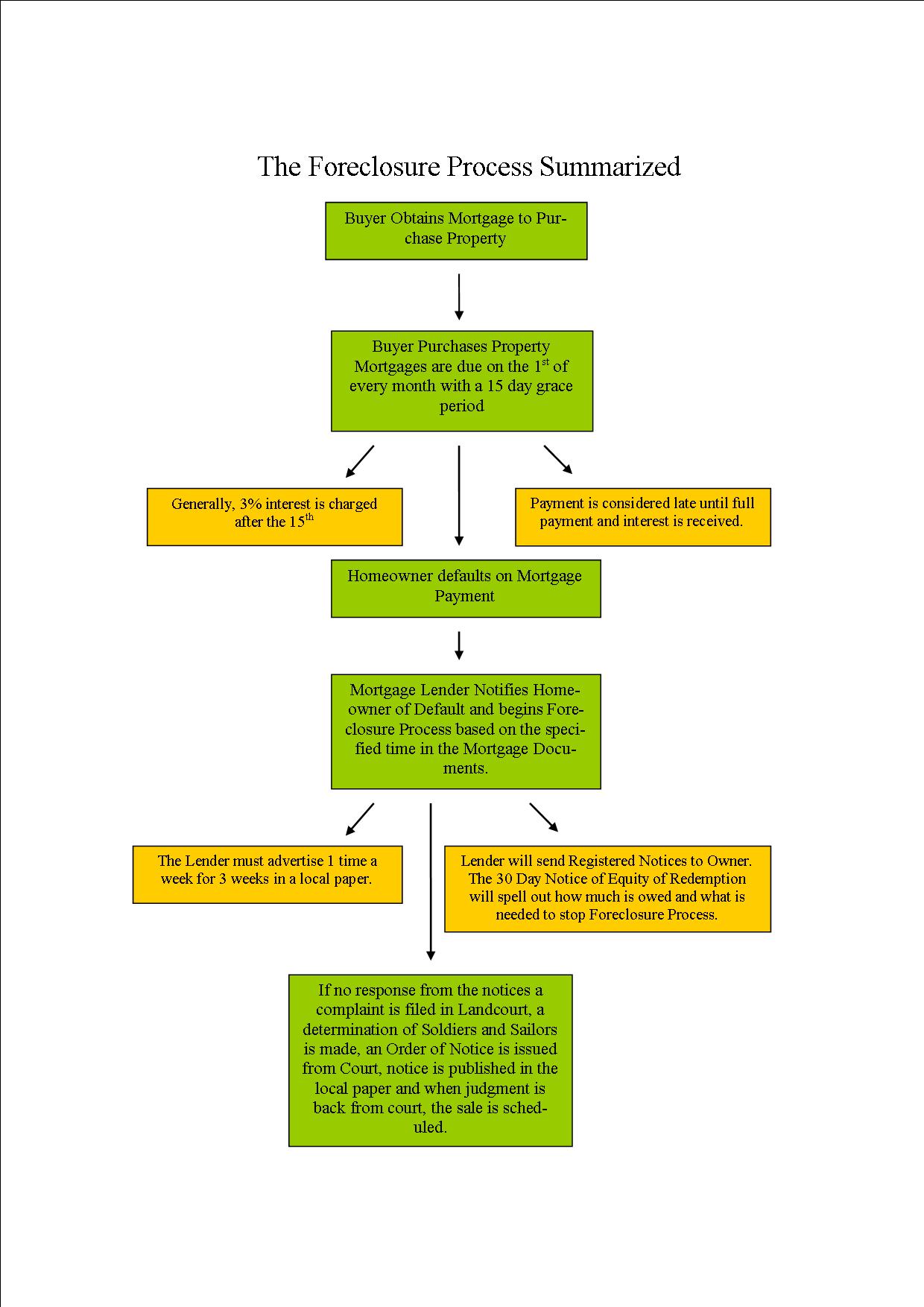
Judicial Versus Non-Judicial Foreclosure

Tags

, , , , , , ,

Foreclosure-Process2-1024x791

In many discussions about mortgage foreclosures the terms
judicial and non-judicial foreclosure are used. They involve very different processes. These terms refer to how individual states handle real estate foreclosure. Under both systems, time frames and terms vary widely from state to state. The following is a brief, general description of both
processes. The accompanying chart (see last page) depicts the varying time frames involved in the judicial foreclosure process.

foreclosure-stockdenslowfigure-1image-6922538539_image-69225_38539
Judicial Foreclosures

A judicial foreclosure is a court proceeding that begins when the lender files a complaint and records a notice in the public land records announcing a claim on the property to potential buyers, creditors and other interested parties. The complaint describes the debt, the borrower’s default and the amount owed. The complaint asks the court to allow the lender to foreclose its lien and take possession of the property as a remedy for non-payment.

foreclosureexplained

The homeowner is served notice of the complaint, either by mail, direct service or publication of the notice. The defendant (borrower) is permitted to dispute the facts (such as show that payments were made), offer defenses or present counterclaims by answering the complaint, filing a separate suit, and/or by attending a hearing arranged by the court. If the defendant shows there are differences of material facts, a trial will be held by the court to determine if foreclosure should occur. In the vast
majority of cases, however, the foreclosure action is undisputed because the borrower is in default and cannot offer facts to the contrary. If the court determines the homeowner did default and that the debt is valid, it will issue a judgment in favor of the servicer for the total amount owed, including costs for the foreclosure process. In order for the judge to determine the amount of the judgment, the servicer submits paperwork through an affidavit that itemizes the amounts due.

Twenty two states use judicial procedures as the primary way to foreclose.
These include: Connecticut, Delaware, Florida, Hawaii, Illinois, Indiana, Iowa, Kansas, Kentucky, Louisiana, Maine, New Jersey, New Mexico, New York, North Dakota, Ohio, Oklahoma, Pennsylvania, South Carolina, South Dakota, Vermont and Wisconsin.

In all other states, foreclosure is usually handled by attorneys who follow a state-provided process. In the mortgage documents, borrowers give lenders the “power of sale” outside of judicial process in the event of an uncured default. Documentation or affidavit issues are not common in these states because of the non-judicial nature of the process.

ar131472849801331
Next, the court will authorize a sheriff’s sale. The sale is an auction of the property open to anyone, and must be held in a public place. Procedures for a sheriff’s sale in each locality differ, but the individual with the highest bid is granted the property. After the sale is confirmed by the court, the deed, which transfers ownership, is prepared, recorded and the highest bidder becomes the owner of the property.

In most cases, the highest bidder is the servicer, who takes title of the property. The servicer then can sell the property. At this point, it is called
real estate owned (REO).

Visio-foreclosure timeline.vsd
Non-Judicial Foreclosures

The requirements for non-judicial foreclosure are established by state statute; there is no court intervention. When the default occurs, the homeowner is mailed a default letter and in many states a
Notice of Default is recorded, at or about the same time. The homeowner may cure the debt during a prescribed period; if not, a Notice of Sale is mailed to the homeowner, posted in public places, recorded
at the county’s recorder’s office, and published in area newspapers
/legal publications. When the legally required notice period (determined by each state) has expired, a public auction is held and the highest
bidder becomes the owner of the property, subject to recordation of the deed. Prior to the sale, if the borrower disagrees with the facts of the case, he or she can try to file a lawsuit to enjoin the trustee’s sale.

short_sale_table_2

If you find yourself in an unfortunate situation of losing or about to lose your home to wrongful fraudulent foreclosure, and needed solutions to defend or reclaim your home please visit: http://www.fightforeclosure.net
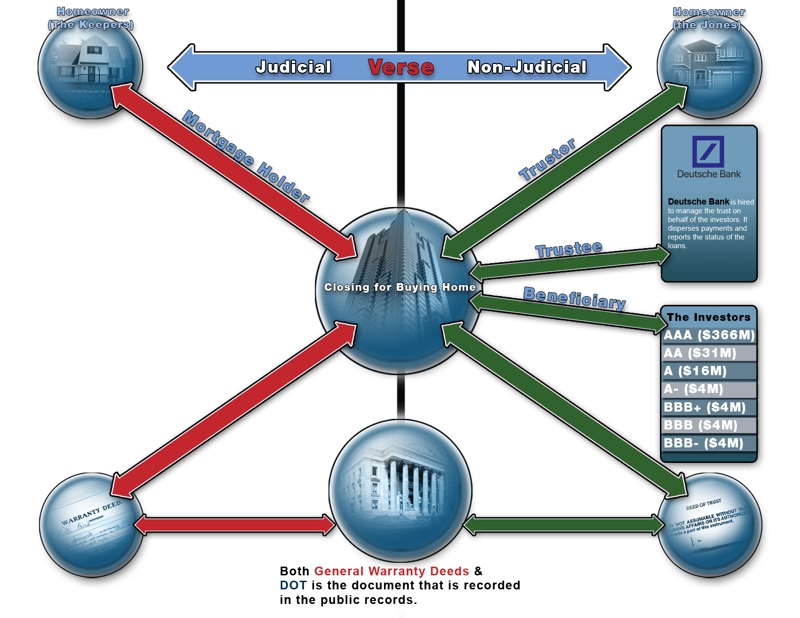
Why Michigan Packaged Foreclosure Laws Were Designed to Harm Home Owners

Tags

, , , , , , ,

The package of bills (HB 4765, HB4766, SB 380 and SB383) which has since been signed into Law on July 3rd by Michigan‘s Governor is designed to harm homeowners on both the front end and the back end of the foreclosure process by repealing Michigan’s pre-foreclosure negotiation law and by making it possible for banks to eliminate Michigan’s longstanding 6-month redemption period.

By repealing Michigan’s pre-foreclosure negotiation law, homeowners are forced into an increasingly vulnerable position of falling victim to widespread foreclosure scams.  Under the new policy, lender-designated agents are no longer required to meet with homeowners to avoid a foreclosure, and any person regardless of their qualifications can perform the role of a certified foreclosure counselor or legal aid attorney.

According to Detroit Free Press, by eliminating Michigan’s longstanding 6-month redemption period, at-risk homeowners could lose their homes immediately if the bank chooses to evict them.

“This means if a homeowner facing foreclosure has a leaky roof and the bank determines that it has the potential to do ‘imminent’ damage, the homeowner loses the redemption period and along with it, the chance to challenge an illegal or fraudulent foreclosure, come up with the money to save the home, sell it on a short sale or find a safe affordable new place to live. Instead they face immediate eviction.”

Because the laws definition of ‘damage’ is both broad and ambiguous, if the bank finds so much as a broken hinge or a closed off window, they could immediately move to evict the homeowner.  As outlined in SB 383, a bank representative has the authority to stop by a home unannounced to inspect both the exterior and interior of the home for any possible damages, and if denied access by the homeowner, the bank has license to disregard the redemption period and repossess the property immediately.

SEE DETAILS OF THE NEW LAW

NEWS ALERT: Michigan Governor Signs Foreclosure Bills HB 4765, HB 4766, SB 380, and SB 383

The following four Bills affecting Michigan’s non-judicial foreclosure process were signed into law by the Governor on July 3rd.

HB 4765

House Bill 4765 extends the sunset date for MCL §§ 600.3205a-3205d of the Michigan non-judicial foreclosure statute to January 9, 2014. Previously set to expire on June 30, 2013, these sections of the statute include the mandatory 90-day hold requiring loan modification mediations to occur prior to the commencement of non-judicial foreclosure actions of homestead properties where mortgagors “opt-in”. The requirements set forth in MCL §§ 600.3205a-3205d will have to be complied with through June 30, 2014, in regard to any non-judicial foreclosures for which the notice was published prior to January 10, 2014.

SB 380 and HB 4766

Senate Bill 380 and House Bill 4766 create MCL § 600.3206, which was designed to replace the current sections of the Michigan non-judicial foreclosure statute that dictate when mandatory mediations aimed at modifying loans are to occur. Effective January 10, 2014, if the servicer has signed a consent judgment in United States of America, et al. v. Bank of America Corp., et al., then that servicer will be required to send notice (similar to Michigan’s current pre-foreclosure mediation notice) to the mortgagor, allowing the mortgagor the opportunity to “opt-in” to a loan workout meeting prior to commencement of foreclosure proceedings.  Servicers that are not parties to the consent judgment will no longer be required to postpone commencement of non-judicial foreclosures to allow for mediations to occur on homestead properties where mortgagors “opt-in.”

SB 383

Senate Bill 383 adds a provision to MCL § 600.3240, which is the section of Michigan’s non-judicial foreclosure statute dictating post-sale redemption periods. This new provision grants the foreclosure sale purchaser the right to inspect the exterior and interior of the structures after the foreclosure sale as well as periodically during the redemption period. If inspection is unreasonably refused or property damage has occurred or is believed to be imminent, the purchaser may immediately commence summary proceedings to obtain possession of the property. The statute provides examples of what would be considered damage, which include failure to comply with local property maintenance ordinances, broken doors and windows, accumulated trash, stripped plumbing, etc. If a judgment for possession is granted in favor of the purchaser, the redemption period will be extinguished. These changes become effective January 10, 2014.

If you find yourself in an unfortunate situation of losing or about to your home to wrongful fraudulent foreclosure, visit: http://www.fightforeclosure.net

Constitutional Rights of Florida Citizens Violated By Florida House Bill 87

Tags

, , , , , , ,

Representatives Kathleen Passidomo (District 106, Collier County) and George Moraitis, Jr. (District 93, Broward County) have supported the passing of House Bill 87, which denies residents the right to take their homes back after a wrongful foreclose.

According to House Bill 87, if a bank forecloses on a property, and if it is later discovered that the bank did not have standing to foreclose or that it was the incorrect bank with no beneficial interest in the loan, then the only available option to the homeowner is to sue for damages. The homeowner will no longer be afforded the opportunity to get his or her home back from the bank once the foreclosure has been finalized.

The people of Florida are demanding that proposed House Bill 87 not be allowed to pass into law in any form. The Bill is deemed unconstitutional because it violates Article 1, Sections 9 and 10 of Florida’s Constitution, which states that it is unlawful to pass any law or any Judicial and/or Executive Branch process which deprives any person of life, liberty or property without due process of law, and it prohibits the passing of any law that impairs the obligations of contracts.

If House Bill 87 is not killed, constituents and citizens of Florida, and any Florida property owner, will lose their individual property and due process rights. The “Kill House Bill 87” petition states:

“The people demand that House Bill 87 be voted down and not passed into law, as the proposed Bill is no more than another brazen attempt to further deprive U.S. citizens of their constitutional rights to due process of law in Florida’s courts, and will be used as a stepping stone to change the State of Florida into a non-judicial foreclosure state.”

The petition’s current goal is to gather 2,000 signatures. If you would like to support the voting down of the unconstitutional House Bill 87, then please sign the petition below.

To sign the petition please click here: http://petitions.moveon.org/sign/kill-house-bill-87?source=s.icn.em.mt&r_by=7041070

Fightforeclosure.net supports the people’s petition to eradicate House Bill 87. If you have been a victim of wrongful foreclosure and need help in saving your home from fraudulent foreclosure visit: http://www.fightforeclosure.net

Homeowner Wins $3.5 Million in Foreclosure Fraud Punitive Damages

Quicken Loans received a judgment from the state Supreme Court of West Virginia that it must pay $3.5 million in punitive damages to Lourie Jefferson.

Jefferson filed a lawsuit against Quicken Loans under allegations that they had, “committed fraud and violated various provisions of the West Virginia Consumer Credit and Protection act in a mortgage loan,” reports John O’Brien of The West Virginia Record.

Jefferson filed the lawsuit in 2007 after responding to a pop-up advertisement from Quicken Loans and was directed to speak to one of their mortgage bankers. After inquiring about her refinancing needs the company ordered and appraisal of the property to deduce an estimated value for refinancing. O’Brien states that Quicken estimated the value of the property to be $262,500 however, the trail court later found it to be valued only $46,000. Another appraiser valued the property at $181,700 and after deliberation Jefferson’s Quicken mortgage banker secured a loan at $144,800.

Jefferson initially received a written Good Faith Estimate that differed greatly from the much larger loan she agreed to with her mortgage banker that included very different terms and undisclosed balloon payments from the original estimate given. After finalizing the loan and making payments Jefferson contacted Quicken to, “begin the refinancing process” as she had understood in the terms of her contracted loan with them but Quicken refused.

Early in 2007, Jefferson was unable to work after undergoing multiple surgeries and was unable, “to workout a payment arrangement with Quicken”. She defaulted on her loan after Quicken failed to cure a statutory notice of a claim and Quicken began the foreclosure process.

Quicken Loans is the largest online retail mortgage lender and the third largest overall retailer lender in the United States. They have brought the case up for appeal and Jefferson’s award only seems to grow each time they return for review in higher courts. In November the Supreme Court sent the case to the Ohio County Circuit Court to adjust the award to $2.8 million dollars. On July 17th, Quicken appealed the case, citing the punitive damages to be “grossly excessive”, even stating that Jefferson’s evidence was, “weak, and that Quicken Loans was […] right in this matter and that therefore, a punitive damages award against it is not warranted,” noted Ohio Circuit Judge David J. Sims. Upon reviewing the case Sims replied to Quicken’s argument saying,

“It is apparent that Quicken Loans did not accurately evaluate the egregiousness of its conduct, its potential liability, and the potential for a large damages award against it.”

The State Supreme Court of West Virginia has ruled that Quicken pay $3.5 million in punitive damages for its actions. Quicken’s blatant disregard for the refinancing of this woman’s home demonstrates a greater problem in the loan industry and the possibility for the abuse of a system that is meant to assist consumers.

For More information How You can Effectively Defend Your Home From Wrongful Foreclosure Fraud Visit: http://www.fightforeclosure.net
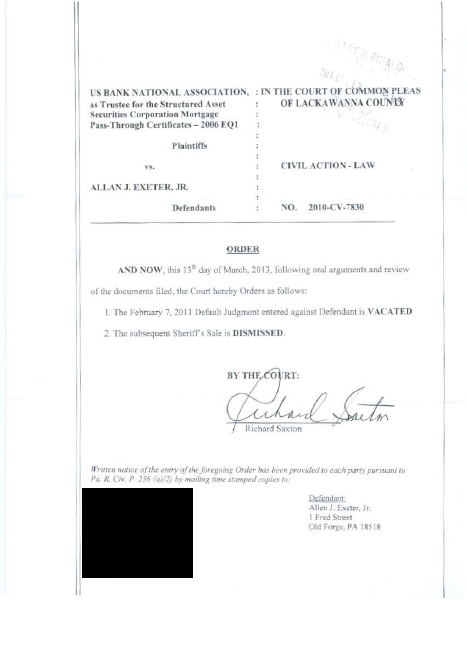
Foreclosure Injunction Lifted in Rhode Island For Lenders to Continue Foreclosures

Tags

, , , , , , ,

A couple of weeks ago, a federal judge lifted a blanket order that had prevented over 800 of Rhode Island foreclosures from moving forward and had sent the cases to mediation where both homeowners and financial institutions were required to first engage in settlement discussions.

In a 2011 order, amid America’s housing crisis, U.S. District Judge Jack McConnell instituted an order to halt all foreclosure cases before the court, suspend all deadlines and mandated that all homeowners and financial institutions take part in ‘‘directed and serious settlement discussions’’ before he would allow any foreclosure case to proceed. However, earlier this week, McConnell was forced to lift his injunction on grounds that he failed to follow the proper procedures in his order.

Although the 1st Circuit Court of Appeals demanded that McConnell’s order be lifted, the District Judge still believes it is imperative that both homeowners and financial institutions find solutions without homeowners being threatened with eviction.

‘‘It is in all parties’ and the court’s best interest to have the parties talk to each other in a meaningful way and to attempt to amicably resolve these matters,’’ he wrote.

McConnell asserted he would closely examine a number of individual cases before moving forward with the other 800-plus cases. Additionally, McConnell said he would take meetings with lawyers for both parties to discuss how to continue the mediation program.

Corey Allard, an attorney representing many homeowners suing financial institutions, said his clients are disappointed.

“The banks are going to be allowed to foreclose on our clients. We’re hopeful that the defendants are going to be reasonable and work with our clients towards loan modifications,’’ he said.

At press time three lawyers representing financial institutions were unavailable for comment.

If foreclosure proceeding has started on your home and you wish to save your home, Visit: http://www.fightforeclosure.net

Nevada Foreclosure Rate Tops U.S. Again

Tags

, , , , , , , ,

Last month Nevada once again secured the top spot as the state with the nation’s highest foreclosure rate due to spikes in default notices and scheduled foreclosure auctions.

According to a report by the Irvine-based real estate analytics company, RealtyTrac, in August one out of every 359 Nevada housing units was the subject of a new foreclosure filing.  This number reflects more than two-and-a-half times the national average.

RealtyTrac defines foreclosure filings as:

“Including notices of default, notices of pending trustee sales and repossessions by banks.”

Additionally, RealityTrac stated that last month with one filing for every 323 housing units, Las Vegas was ranked third for the nation’s highest foreclosure rate among large metropolitan areas. Nevada’s foreclosure filings have increased over 100 percent compared to the previous month and nearly 11 percent percent over August 2012, due to the 226 percent increase in default notices and a 96 percent jump in scheduled foreclosure auctions compared with July.

RealtyTrac Vice President Daren Blomquist attempts to explain the recent jump in Nevada foreclosures saying:

“The foreclosure floodwaters have receded in most parts of the country, but lenders and communities continue to clean up the damage left behind, which means the recent uptick in bank repossessions is a trend that will likely continue into next year,” he said. “Meanwhile foreclosure flash floods will continue to hit some markets over the next few months as delayed foreclosure starts are quickly pushed into the pipeline.

Another explanation for Nevada’s increase in foreclosures is due to the possibility that bankers have identified how to operate under the new Assembly Bill 300 law that is supposed to make it easier for banks to seize homes from delinquent borrowers.

Under AB300, a bank’s affidavit no longer has to be based on personal knowledge of a home’s mortgage-document history before they foreclose. Instead, the bank’s affidavit can be founded on an assessment of internal lending records and either title paperwork or filings with the local county recorder.

For More Information on How To Effectively Challenge Your Lender/Bank In Order to Save Your Home Even If Foreclosure has taken place, Visit: http://www.fightforeclosure.net

A Guide to California Homeowners Defending Post-Foreclosure Evictions

Tags

, , , , , , ,

Elements of a Post-foreclosure Eviction
– Notice Requirements
– Compliance with CC 2924
– Present Right to Possession
Unlawful Detainer Litigation

Notice Requirements

Former Borrowers v. Tenants

– Former borrowers
3 days’ notice
– Tenants
90 days’ notice (in most cases)

Protecting Tenants at Foreclosure Act (Section 702)

– All bona fide tenants
Must be given at least 90 days’ notice
– Bona fide tenants with more than 90 days remaining on lease
Entitled to stay until the end of the lease, if lease entered into before “notice of foreclosure”

– EXCEPTION: lease may be terminated with a 90-day notice if purchaser will occupy unit as primary residence or if lease terminable at will under state law

Bona Fide Tenancy (PTFA)

A lease or tenancy is bona fide only if:
– Tenant is not the mortgagor or the mortgagor’s child, spouse, or parent; and
– Lease was the result of an arms length transaction; and
– Rent is not substantially less than fair market rent (unless the reduction is due to governmental subsidy)

HCV (Section 8) Tenants

– Section 8 tenants are deemed to be bona fide tenants. 74 Fed. Reg. 30108
– New owner takes title subject to both the Section 8 lease and the HAP contract

– EXCEPTION: Lease may be terminated with a 90 day notice if new owner will occupy unit as primary residence
– Any eviction notices must also be sent to the Housing Authority. 24 CFR 982.310(e)(2)(ii).

State Law Notice Requirements

CCP 1161b
– 60-day notice requirement for all tenants
– AB 2610 (effective 1/1/13):
– 90-day notice requirement for all tenants
– lease protections
– CCP 1161c
– Cover sheet requirement for post-foreclosure eviction notices

Service of Notice

Cal. law (CCP 1162):
– Personal service;
– Substitute service; or
– Posting and mail
– Does actual receipt cure service defects?
– Compare Valov v. Tank (1985) 168 CA3d 867 with Culver Ctr. Partners E #1 LP v. Baja Fresh Westlake Village, Inc. (2010) 185 CA4th 744

3/60/90 Day Notices

Invalid? Alta Cmty. Invs. III v. Ottoboni, No. 1370195 (Cal. Super. Ct. July 29, 2010) (holding that 3/30/60/90 day notice is fatally ambiguous)

Post-FC Evictions in Just-Cause Jurisdictions

Just cause for eviction required
– Nonpayment of Rent
– 90-day notice required? PNMAC Mortg. v. Stanko, No. 11U04495, 2012 WL 845508 (Los Angeles, Cal. Super. Ct. Mar. 7, 2012) (yes)
– AB 1953 (effective 1/1/13):
– Cannot demand rent accrued before compliance with CC 1962
– Breach of Lease
– 90-day notice required?

Compliance with CC 2924

CCP 1161a

A person who holds over . . . may be removed therefrom as prescribed in this chapter:
– (3) Where the property has been sold in accordance with Section 2924 of the Civil Code, under a power of sale contained in a deed of trust executed by such person, or a person under whom such person claims, and the title under the sale has been duly perfected.
“Title” issues may be litigated in post-foreclosure UDs
– Malkoskie v. Option One Mortg. Corp., 188 Cal. App. 4th 968 (2010)

Properly Conducted Sale

Trustee must have authority to conduct sale
Wells Fargo Bank, N.A. v. Detelder-Collins, No. APP10000325 (Riverside Super. Ct. App. Div. Mar. 28, 2012) (UD judgment reversed because plaintiff failed to provide substitution of trustee to show that trustee had authority to conduct sale)
Sale void if conducted in breach of loan mod.
– Barroso v. Ocwen Loan Servicing, LLC, 208 Cal. App. 4th 1001 (2012) (permanent modification)

Failure to provide proper foreclosure notices
– JP Morgan Chase v. Callandra, No. 1371026 (Cal. Super. Ct., Santa Barbara Co. Oct. 21, 2010) (tenant may challenge foreclosure based on failure to post NTS)
– But tender/prejudice requirement for former homeowners

Right to Possession – Present Right to Possession

Expiration of Notice Period?
Expiration of Bona Fide Lease?
Must still satisfy 90-day notice requirement

UD Litigation – Unlawful Detainer Process

Service of Summons and Complaint
– Personal;
– Substitute; or
– Nail and mail with court approval (after reasonable diligence)
– Five days to answer
– Pre-answer motions:
– Delta motion to quash (prejudgment claimant?)
– Demurrer (defect must appear on face of complaint)
– Answer
– Summary Judgment
– Trial

60-Day “Curtain” (CCP 1161.2)

Limited civil UDs are masked for the first 60 days
– Unmasked after 60 days unless tenant prevails within the 60 days

Except for post-foreclosure cases
– Permanently masked unless plaintiff prevails against all defendants after trial within 60 days

Unnamed Occupants

“Doe” occupants
– Must intervene in case by filing prejudgment claim of right to possession within 10 days of service
– BUT see AB 2610 (effective 1/1/13):
– PJCRTP form may be filled out and presented at any time, even after judgment

Appeal

Notice of appeal – 30 days after notice of entry of judgment
– No automatic stay of the writ of possession
– Ask for stay
– Trial court
– Writ proceeding in appellate division
– Appeal bond
– Little case law for post-foreclosure UD issues
21

Hypo

Tom Tenant’s 3-BR home in Sacramento, CA was sold at foreclosure sale on October 1. Tom’s existing lease expires on November 1, 2013. Under this lease, he pays $1,600 in rent each month under the lease, but the surrounding homes rent for about $2,300 per month. On October 5, Ivan Investor, who purchased the property at the trustee sale, served Tom with a 60-day notice to quit. Is the notice correct?

– What if Tom was a Section 8 HCV tenant?
– Or if Tom lived in Oakland instead of Sacramento?

Homeowners who finds themselves in a situation where their lender is fraudulently trying to use cooked up documents to steal their most prized possessions “their homes”, needs to do whatever is necessary to stop these interlopers from stealing their homes. To do this, homeowners need to fight them to the finish in order to avoid the situation of change of status from “borrowers to tenants” as described above. Homeowners in wrongful foreclosures should do their best to reclaim what is rightfully theirs even if the lenders initially succeeded in foreclosing using fraudulent documents. It can reversed and dismissed by the courts through vigorous litigation, that’s where http://www.fightforeclosure.net comes in.

foreclosure_dismissal_Proof

To learn how you can effectively use well structured (Pro Se “Self Representation”) litigation pleadings to effectively challenge and reclaim your status as a homeowner instead of a tenant, visit http://www.fightforeclosure.net

How Attorney Mistakes Can Result to Homeowners Losing their Homes in Wrongful Foreclosure Litigation.

Tags

, , , , , , ,

One of the biggest mistakes we see in various court cases especially in wrongful foreclosure cases where homeowners who are represented by counsel is the failure by plaintiffs’ attorneys to file the complaint within the statutes of limitation period. Attorneys fail to file a claim within the appropriate statutes of limitation for numerous reasons. For example, lawyers often fail to determine the correct statute of limitation applicable to the claim. For instance to effectively bring a TILA lawsuit against your lender, it must be filed within “One Year”, of your mortgage closing otherwise the courts can only allow the cause of action based on whether your motion for equitable tolling is granted or not.

For wrongful foreclosure homeowners who hired Attorneys to represent them, do not assume that your Attorney knows the statutes of limitation period for every cause of action you intend to bring against your lender to save your home, because if your Attorney miss all major causes of action that would have disqualified your lender from stealing your home as a result of fraud, you may end up losing your home even if your lender is liable for other violations which may entitle you to a couple of thousands of dollars in compensation. Your goal is to save your home, so it is not a matter to be taken for granted because you paid your Attorneys big bucks to represent you.

Litigation attorneys are at a greater risk of malpractice claims than all other types of attorneys. Typically, errors arising out of litigation accounted for 35% to 40% of all claims reported. Clients who lose suits often point to a
perceived error by their attorney as the reason their suit was unsuccessful and seek a remedy against the attorney. The main causes of malpractice stem from missing deadlines, failing to calendar, failing to file, failing to
meet discovery obligations, inadequate trial preparation, inappropriate post-trial actions and improper withdrawal. The use of good docketing and tickler systems and the development of good client relations can significantly reduce malpractice risk

While Attorneys obviously need to be knowledgeable about the substantive issues in any lawsuit, some Attorneys does not take care to learn and follow the procedural rules of court.

Even experienced Attorneys do not know every procedural rule for every court in which they practice. Rather, they know where to find the particular procedural rules governing the litigation and make sure they follow them,
thereby reducing their exposure to malpractice actions.

This post, while not exhaustive, provides important tips to help homeowners who are being represented by Attorneys ensure that they are getting their money’s worth thereby avoid common pitfalls that usually
result in malpractice liability when Attorneys fails their clients. After all when you pay someone $5000-$10000 to save your home, you expect them to put their best foot forward. However, always remember that (YOU ARE YOUR OWN BEST ADVOCATED), as a Pro Se Litigant with http://www.fightforeclosure.net

The post highlights ten prominent points during the course of litigation where attorneys are prone to make mistakes, emphasizing specific
types of rules and procedures that are often overlooked. Armed with the information contained in this post, homeowners can help reduce the possibility of losing the homes as a result of negligence conduct of their hired lawyers which could possibly exposure the lawyers to malpractice liability.

THESE FOLLOWING AREAS ARE WHERE THE HOMEOWNERS SHOULD PAY CLOSE ATTENTION TO – THESE ARE WHERE ATTORNEYS USUALLY MAKE MISTAKES.

A GOOD DOCKETING SYSTEM

Attorneys risk malpractice claims when they correctly identify the expiration date of a claim but fail to file the complaint in a timely manner, allowing the claim to expire. One common pitfall is that the attorney or staff person
calendars the deadline in the attorney’s calendar, but the attorney fails to check the calendar, thus missing the date.

Homeowners should ensure that their lawyers can reduce their malpractice risk by diligently calendaring statutes of limitation deadlines and other deadlines that arise within their case. Everything that involves a time limit should be entered into the docket system and the system should generate several advance warnings of each deadline to be given to the attorney and support persons involved.

Although it is ultimately the lawyer’s responsibility to meet deadlines, unforeseen circumstances may prevent the lawyer from meeting a deadline. Homeowners should ensure that their case is assigned a backup lawyer or staff member who is responsible for bringing the deadline to the attention of the main attorney on the matter; or who is able to meet a filing deadline in the lawyer’s absence.

AVOID FILING AT THE LAST MINUTE

Malpractice suits for missing the statutes of limitation also arise when the lawyer and/or his office staff simply neglect to follow through and make sure the complaint is filed with the proper court on or before the deadline. A
variety of unforeseen problems may delay filings. For example, lawyers may sometimes assume that complaints sent by overnight mail will arrive in time and be processed by the court the next day. Similarly, office staff or third
parties hired to assist with the filing may make errors, such as filing the complaint with the wrong court, or missing a last minute deadline.

Such errors can be avoided by routinely filing complaints, motions and other documents in advance of the deadline. Filing at the last minute is a risky practice. Unexpected glitches are bound to occur from time to time. Filing ahead of time will give you breathing room to resolve the unforeseeable problems that might get in the way of filing before the limitation period expires.

KNOWING THE APPLICABLE LAW

DETERMINE THE CORRECT STATUTES OF LIMITATION FOR YOUR JURISDICTION

Attorneys often miss statutes of limitation deadlines when they incorrectly assume that the statutes of limitation runs after the same amount of time in different jurisdictions. For example, the statutes of limitation for a wrongful death claim in Tennessee runs in one-year.  However, a North Carolina plaintiff ’s attorney handling a wrongful death suit arising in Tennessee might assume that North Carolina’s two-year statutes of limitation for a wrongful death claim applies in the situation. If the attorney files a claim after Tennessee’s expiration date but before North Carolina’s expiration date, the attorney missed the appropriate state’s deadline and could face a claim for malpractice.

PERFORM ADEQUATE RESEARCH AND INVESTIGATION

Nearly half of all malpractice claims arise from substantive errors. Examples include failure to learn or properly apply the law, and inadequate discovery or investigation. In addition to ascertaining all relevant statutes of limitation deadlines, it is important that homeowners ensure that their attorneys are  familiar and comply with the law and standards of care in each applicable state.

One common type of malpractice claim resulting from inadequate knowledge of substantive law is in the area of personal injury claims arising out of automobile accidents. Such a claim arises, for example, where the client suffers personal injury in a wreck and there is a $25,000 limit on the defendant’s auto insurance. Since the client has $100,000 worth of damages, the defendant’s carrier readily issues a check for the policy limit of $25,000. The lawyer neglects to investigate whether any other coverage
exists. The client later learns he could have recovered an additional $75,000 from his own insurance policy that included uninsured/underinsured “UM/UIM” coverage. By then, however, it is too late because the client has
already signed a release of all claims against the tortfeasor. Since “[a]n underinsured [UIM] motorist carrier’s liability is derivative of the tortfeasor’s liability,” the UIM carrier may decline to provide any coverage. Liberty Mut. Ins. Co. v. Pennington, 141 N.C. App. 495, 499, 541 S.E.2d 503, 506
(2000), cert. granted, 353 N.C. 451, 548 S.E.2d 526 (2001); see also Spivey v. Lowery, 116 N.C. App. 124, 446 S.E.2d 835 (1994) (UIM carrier was not liable after plaintiff executed general release).

Experience lawyers in these areas and situations usually require have the client execute a limited release that protects the client’s right to recover UIM or UM benefi ts. For an example of a limited release that was upheld by the courts, review North Carolina Farm Bureau, Mut. Ins. Co. v. Bost, 126 N.C. App. 42, 483 S.E.2d 452, review denied, 347 N.C. 138, 492 S.E.2d 25 (1997). In other cases, the lawyer may fail to notify the UIM carrier of the
claim in a timely manner. If the client is unable to recover from his UIM carrier because of his lawyer’s neglect, he may have a claim for damages against the attorney.

In these cases that pertains to personal injury, the law requires the plaintiff to timely serve the summons and complaint on both the tortfeasor and the UM carrier prior to the expiration of the statutes of limitation. See N.C. Gen. Stat. § 20-279.21(b)(3); Thomas v. Washington, 136 N.C. App. 750, 525 S.E.2d 839, review denied, 352 N.C. 598, 545 S.E.2d 223 (2000). Failure to properly serve either the tortfeasor or the UM carrier may result in lost benefi ts for the client and a malpractice claim against the attorney.

These types of errors usually can be prevented through careful research and methodical procedures.

When dealing with wrongful foreclosure case, homeowners should stay abreast of new legal developments. Experts should be consulted, where needed.

PROVIDE ADEQUATE SUPERVISION OVER ASSIGNED TASKS

Malpractice concerns arise when lawyers fail to adequately supervise non-lawyers or junior associates. Lawyers can be held responsible for mistakes made by their employees. See e.g., Pincay v. Andrews, 367 F.3d 1087 (9th Cir. 2004) (Judge Kozinski’s dissent; holding attorney liable for a paralegal’s miscalculation). Such malpractice risk can be minimized
by providing adequate supervision and fostering an environment where questions and concerns can be freely raised. Staff should be carefully supervised as the attorney is ultimately the responsible party.

FILING THE COMPLAINT AND SERVICE OF PROCESS

After the proper statutes of limitation period has been properly identified and the complaint properly filed, other pitfalls await the unwary attorney. Attorneys commonly make mistakes in naming and serving the proper parties. Such defects can often be corrected. However, when a lawsuit is commenced at the eleventh hour (just before the statutes of limitation expires), as in most wrongful foreclosure cases, the attorney may not
have time to correct such flaws, and the client may suffer prejudicial harm as a result.

IDENTIFY AND NAME THE PROPER DEFENDANT

One of the most common mistakes attorneys make is that they fail to discover and identify the proper name of the corporate defendant whom the plaintiff seeks to sue. In a wrongful foreclosure case that involved securitization of mortgage loans, sometimes defendants mights be more than one. To avoid such errors, homeowners should ensure that their attorneys should make every effort to ascertain the defendant’s proper
corporate name either before filing the complaint or as soon as possible thereafter through discovery. A diligent effort should be made to determine all possible entities and persons who should be named as parties in the lawsuit. If situation involves foreign defendants, take special care in correctly naming and serving foreign defendants. Foreign service requirements, including Hague Convention requirements, may need to be followed.

SERVE ALL DEFENDANTS WITHIN STATUTORILY PRESCRIBED TIME LIMITATIONS.

Attorneys who commit errors in timely serving a complaint and summons on a defendant may also face malpractice liability.

Attorneys must serve a defendant with a complaint and summons within the statutorily required time limitations. These limitations vary according
to jurisdiction. For instance, an attorney must serve a defendant to a lawsuit in federal court within 120 days of the fi ling of the complaint. Fed. R. Civ. P. 4(m). However, a defendant in a lawsuit in North Carolina State court must be served in most cases within 60 days after the date of the
issuance of the summons. N.C. Gen. Stat. § 1A-1, Rule 4(c).

Attorneys who fail to perfect service upon a defendant within the statutory expiration period may request an extension of time for service of process. A federal court will grant an extension only if the attorney provides good
cause for the delay in service. Fed. R. Civ. P. 4(m). On the other hand, a North Carolina court will issue an alias or pluries summons to extend the time period for service upon request, provided certain guidelines are met. N.C. Gen. Stat. § 1A-1, Rule 4(d)(2). Thus, an attorney may be vulnerable to malpractice claims for failing to follow the rules of the particular court in which the case is being litigated. For instance, attorneys may request an alias or pluries summons “at any time within 90 days after the date of issue of the last preceding summons in the chain of summonses.” Id. Provided that the request is not made in “violations of the letter or spirit of the rules for the purpose of delay or obtaining an unfair advantage,” an attorney may request numerous alias or pluries summonses and extend the service deadline for a lengthy period of time without committing malpractice. Smith v. Quinn, 324 N.C. 316, 319, 378 S.E.2d 28 (1989). However, an attorney who does not request an alias or pluries summons within the 90 day time period invalidates the old summons and begins a new action. See CBP Resources v. Ingredient Resource Corp., 954 F. Supp. 1106, 1110 (M.D.N.C. 1996). An attorney risks malpractice liability if the statutes of limitation runs before the alias or pluries summons is issued in such a situation.

In addition, an attorney must refer to the original summons in an alias or pluries summons or else the alias or pluries summons is invalid. Integon Gen. Ins. Co. v. Martin, 127 N.C. App. 440, 441, 490 S.E.2d 242 (1997).

In addition, the attorney may encounter the situation where he is unable to serve the defendant with the summons and complaint because the defendant has died. To complicate matters further, the statutes of limitation
has expired. Homeowners should ensure that their Attorneys consult the statutes for their respective Jurisdictions. This statute will help the lawyer resolve the issue and save the homeowners cause of action.

KEEP THE SUMMONS ALIVE OR ENTER INTO ENFORCEABLE TOLLING AGREEMENTS WITHIN THE STATUTES OF LIMITATION WHILE ENGAGING IN SETTLEMENT DISCUSSIONS.

It is often in the client’s best interest to pursue settlement before spending the time and money involved to file or serve a complaint. However, in the instants where the Banks are not willing to work with homeowners, but where rather interested in stealing the homes through wrongful foreclosure, homeowners are left with little options but to pursue the litigation with their Attorneys or Pro Se, in order to save their homes.

In such cases, it is important that the homeowner let their Counsels know that  it is crucial to keep the required summons alive and/or enter into an enforceable tolling agreement with the opposing party. Such tolling agreements must be executed before the statutes of limitation passes. Regardless of how close the parties may be to settlement, the Attorneys should not let the statutes of limitation pass without invoking proper protections for the homeowners.

For More Information How You Can Aggressively Defend Your Wrongful Foreclosure on Your Own “Pro Se”, thereby Avoiding These Costly Attorney Mistakes That Can Potentially Cost You the Most Valuable Investment You Have Ever Made which is “Your Home – The American Dream” Visit http://www.fightforeclosure.net (You Are Your Own Best Advocate!)