• About
  • Buy Bankruptcy Adversary Package
  • Buy Foreclosure Defense Package
  • Contact Us
  • Donation
  • FAQ
  • Services

FightForeclosure.net

~ Your "Pro Se" Foreclosure Fight Solution!

FightForeclosure.net

Tag Archives: Foreclosure

What Homeowners Must Know About Reinstating their Mortgage Loan

18 Monday Jun 2018

Posted by BNG in Banks and Lenders, Foreclosure Crisis, Foreclosure Defense, Judicial States, Loan Modification, Mortgage mediation, Mortgage Servicing, Non-Judicial States, Pro Se Litigation, Your Legal Rights

≈ Leave a comment

Tags

avoid foreclosure, Deed in lieu of foreclosure, foreclose, foreclosing on home, Foreclosure, Foreclosure Crisis, foreclosure defense, foreclosures, homeowners, mortgage lender, Mortgage loan, mortgage loan modification, mortgage loan modifications, mortgage loans, Mortgage modification, Mortgage servicer, Pro se legal representation in the United States, short sale, United States

Once you fall behind on your mortgage, the amount you’re behind is called the arrears.

In the past, we have discussed how you may have loan modification options available to you that let you stay in your home and resume making mortgage payments without having to pay your arrears all at once.

But sometimes homeowners would rather pay their arrears, get current on their mortgage loan and resume making their regular mortgage payments.

This is called reinstating your loan. Reinstating your loan means you pay the entire amount you’re behind (arrears) plus all related fees (such as interest and late fees) to bring your loan current. After you reinstate, your loan will appear as paid to date in the lender’s records and you will resume making your original mortgage payments.

If you have fallen behind on your mortgage payments and want to reinstate your loan, your first step is to determine whether the lender has initiated the foreclosure process.

Reinstating before the foreclosure process has started

If you’re not in the foreclosure process yet, you want to cure the default on the loan. You need to ask your lender to give you a reinstatement quote. This document can be issued 30 days in advance of your payment date. For example, on May 1 you can order a reinstatement quote good through June 1 so you know how much will be due in 30 days.

If you pay the amount listed on the reinstatement quote, the default will be cured and you can resume making regular mortgage payments. The lender will then be unable to start foreclosure.

Make sure you pay the full amount listed on the reinstatement quote

Simply adding up missed mortgage payments and sending that amount may not be the actual amount due. Based on the terms you signed in your original note, the lender may add late fees for missed payments. If you don’t pull a reinstatement quote and send only what you believe is owed, the lender may deem this a partial payment. They will likely keep the partial payment but refuse to show the loan as fully up to date. This could lead to foreclosure.

Don’t accept any verbal reinstatement payoff amount, whether on the phone or in person. Make the lender give you the quote in writing. Verbal reinstatement amounts may be inaccurate and they may change. They are also impossible to verify later. If you send payment based on a verbal quote, the lender could change their mind and you would have no way to prove what they originally told you.

Reinstating after the foreclosure process has started

If you have fallen behind on your mortgage payments and want to pay your arrears but your loan has entered the foreclosure process, rather than talk to your lender, work with the Trustee. The Trustee is the party who issued your Notice of Trustee’s Sale (NOTS). Their contact information should be listed in the NOTS.

Once a lender starts foreclosure and hires a Trustee, the Trustee is in charge of the foreclosure. They are responsible for documenting and holding all reinstatement amounts and quotes.

Things to know and things you should do:

  • Legal fees paid to the Trustee by the lender may be added to your total reinstatement amount. So, if you decide to reinstate the loan you may see additional legal fees added to the total amount due.
  • Make sure you receive your reinstatement quote directly from the Trustee, not the lender. At this point in the process, to ensure that you’re making a full payment, the Trustee is the only one who has that number.
  • Make the request in writing. Include your name, loan number, and Trustee Sale number found on your NOTS. Write “Please send me a reinstatement quote good through (Date) at (my contact information).”
  • Fax the request to the fax number provided on the NOTS and to your lender. Call the Trustee to make sure they received the fax and continue to follow up until they send you the quote.
  • In the state of Washington, you’re allowed to reinstate your loan up to 11 days before your foreclosure sale date. If you believe reinstatement is the right move for you, make sure you request the quote and gather the funds so you can send payment before that 11-day mark.
  • Ask your Trustee how they would like to receive payment. Most Trustees want a cashier’s check made out to the Trustee but payment processes are different for each Trustee. Have this conversation with them before you make payment.

How does reinstatement affect foreclosure?

If you fully reinstate before the 11-day deadline, the Trustee will cancel the foreclosure of your home and withdraw from the case.

You will resume making monthly mortgage payments outlined in your original loan.

You have to track your foreclosure date to make sure the sale actually is canceled. Get written confirmation from the Trustee that they have canceled the sale.

Are the fees attached to the reinstatement quotes negotiable?

Sometimes. It is important to review all late fees and attorney’s fees attached to the reinstatement quote. Some Trustees and Lenders will take advantage of a reinstatement situation by tacking on fees in excess of work performed. There is little regulation on these fees, so it is important to review the fees carefully.

If you see something that looks excessive, request a full accounting of each fee. The Trustee should be able to provide you a breakdown of how they arrived at the reported fees. Request a breakdown for excessive late fees sent by the lender to make sure they only reflect legal late fees for missed mortgage payments.

Are there any exceptions to the 11-day requirement to reinstate?

If you believe that you may be able to reinstate your loan, but not before the 11-day deadline, reach out to the Trustee and tell them your situation.

If you can prove that you fully intend to reinstate and have the ability to do so, the Trustee or lender may provide you more time in order to reinstate the loan. Reinstatement is generally good for lenders. They want you to pay them back and get current. Many times, lenders agree to postpone foreclosure in order to allow you to reinstate, but you have to demonstrate your ability to reinstate in a persuasive way.

We recommend putting together a package including:

  1. A signed and dated letter stating that you intend to reinstate the loan
    • Include how you plan to come up with the funds
    • Give a date for when you’ll have the funds
    • Ask for a foreclosure postponement of a certain time (e.g. 15 days, 30 days, etc.). Asking for a general, indefinite postponement likely won’t work.
    • Do everything you can to indicate that you are serious about wanting to reinstate
  2. Proof of funding: Demonstrate how you will come up with the funds. For example, if the funds are in a retirement account, send the retirement fund statement showing that the money is there. If you are borrowing the money, have the people you’re borrowing from sign and notarize a letter stating that they will be lending you money. Include the amount borrowed and the source.

Fax the package to the lender and the Trustee. Call to make sure they received the fax. While you’re on the phone, find out who is looking at your request and see if you can email them directly. It is not enough to simply fax the package, you have to push both the lender and the Trustee to pay attention to your request.

Is a partial payment ever acceptable?

It may be an option for you to offer a partial payment of the full reinstatement amount in order to get a postponement that will give you time to gather the full funds. Lenders may agree to take a portion of money in exchange for foreclosure postponement.

Be careful with this option. Unless you are absolutely, 100% certain you will be able to fully reinstate, you shouldn’t send money or you may lose it. Never send money without an agreement in writing that the lender will postpone in exchange for a lump sum received.

Because you’re in default, the lender will keep the money you paid regardless of whether you’re able to fully reinstate. Don’t do this unless you know will be able to come up with the rest of the money.

Modification options instead of reinstatement

If you’re barely making it through the month in your current financial situation, reinstating the loan may not be the best solution for you. If the reasons why you defaulted are still part of your life, it may be better for you to pursue an alternative like a loan modification or a short sale so you can get to a more affordable housing situation.

Some homeowners think reinstatement is the only way to stay in their home. That’s not always true.

Don’t spend thousands of dollars to get current on a loan you may not be able to maintain. Call us to learn about all your options to tailor the best plan to fit your situation.

If you think you want to reinstate, keep it as your last option. After all, you can reinstate all the way up until 11 days before the foreclosure sale. Other options may allow you to stay in your home and avoid having to pay a large lump sum.

When Homeowner’s good faith attempts to amicably work with the Bank in order to resolve the issue fails;

Home owners should wake up TODAY! before it’s too late by mustering enough courage for “Pro Se” Litigation (Self Representation – Do it Yourself) against the Lender – for Mortgage Fraud and other State and Federal law violations using foreclosure defense package found at https://fightforeclosure.net/foreclosure-defense-package/ “Pro Se” litigation will allow Homeowners to preserved their home equity, saves Attorneys fees by doing it “Pro Se” and pursuing a litigation for Mortgage Fraud, Unjust Enrichment, Quiet Title and Slander of Title; among other causes of action. This option allow the homeowner to stay in their home for 3-5 years for FREE without making a red cent in mortgage payment, until the “Pretender Lender” loses a fortune in litigation costs to high priced Attorneys which will force the “Pretender Lender” to early settlement in order to modify the loan; reducing principal and interest in order to arrive at a decent figure of the monthly amount the struggling homeowner could afford to pay.

If you find yourself in an unfortunate situation of losing or about to lose your home to wrongful fraudulent foreclosure, and need a complete package that will show you step-by-step litigation solutions helping you challenge these fraudsters and ultimately saving your home from foreclosure either through loan modification or “Pro Se” litigation visit: https://fightforeclosure.net/foreclosure-defense-package/


Share this:

  • Click to share on X (Opens in new window) X
  • Click to share on Facebook (Opens in new window) Facebook
Like Loading...

What Homeowners Must Know After they Have Been Sued in a Bankruptcy Adversary Proceeding

18 Monday Jun 2018

Posted by BNG in Bankruptcy, Federal Court, Foreclosure Defense, Judicial States, Litigation Strategies, Non-Judicial States, Pleadings, Pro Se Litigation, Trial Strategies, Your Legal Rights

≈ Leave a comment

Tags

adversary proceeding, automatic stay, Bankruptcy, bankruptcy adversary proceeding, bankruptcy court, Foreclosure, foreclosure defense, homeowners, Law, Lawsuit, Mortgage Electronic Registration System, Mortgage loan, Plaintiff, Pro se legal representation in the United States, United States

This post will be helpful to the Debtor when defending against a creditor’s/trustee’s objection to your discharge or the filing of a Complaint for Nondischargeability based upon fraud/conversion; however, this post may also assist the Debtor in bringing an adversary proceeding should one be necessary.

Introduction

An adversary proceeding is a lawsuit brought within your bankruptcy. This lawsuit normally centers around whether a particular debt or all of your debts are dischargeable (or forgiven) through the act of your filing bankruptcy. These lawsuits usually focus around some alleged improper act on your part, including fraud, misrepresentation, or your failure to abide by the Bankruptcy Code and accompanying Rules.

You are now at the point of the adversary process where you have received, by mail or by personal service, the complaint filed by your creditor which asks the Court to decide whether or not that particular obligation should be part of your bankruptcy discharge or an objection to your overall discharge should be granted.

This section of the adversary proceeding packet is to inform you of what your obligations are in order to prepare for a trial. Note that there are references to the bankruptcy rules: Local Rules of Bankruptcy Practice = LR; Federal Rules of Bankruptcy Procedure = Fed.R.Bankr.P. You may also find both types of Rules at the county law library or you may access the Local Rules at the court’s website http://www.uscourts.gov. You should take a look at these rules if you have any questions about the information given in this section.

Step 1: Answer

After you receive a complaint, you must file an answer with the clerk of the Bankruptcy Court within 30 days after issuance of the summons. (Fed.R.Bankr.P. 7012) You must provide a copy of that answer to the creditor’s attorney.

Step 2: Pre-Trial Conference

Note that the cover sheet you receive from the Court will set forth a pre-trial conference date in the lower right-hand corner of the Summons. You must attend that hearing. At that time, the Court will set parameters for trial. The Court may also discuss with the parties whether or not any settlement is possible. Prior to this pre-trial conference with the Court, and within thirty (30) days after you have answered the complaint, you are required to meet with the attorney for the creditor to discuss how discovery will be conducted in the case. After you have had this discussion and no later than fourteen (14) days after the meeting with the attorney, the parties are required to submit a discovery plan. (Fed.R.Bankr.P. 7016 and LR 7016) This plan is a form which the creditor’s counsel will have and will be filled out by both parties. The form will then be submitted to the Court and the Court will then approve, disapprove or modify the discovery plan and enter any other orders that may be appropriate.

Step 3: Discovery

After you have gone through the preparation of the discovery plan and have had it approved by the Court, you will then conduct your discovery. Local Rule 7026 will provide you with information as to what the parties may or may not do during the discovery process. You may also want to look at Local Rules 7026 through and including 7036 and Fed.R.Bankr.P. 7026 through and including 7036 which gives further information regarding some of the discovery tools or requirements.

Step 4: Motions

You may find that throughout the time frame prior to trial that motions are being filed. Motions may be filed by either party. If you are served with a motion in your adversary proceeding, please be advised that you are required to file your opposition or response with the Court and serve your response to the creditor’s attorney not more than fifteen (15) days after you have received the motion and, in no event, not later than five (5) business days prior to the date set for the hearing on the motion. (Fed.R.Bankr.P. 9013 and Local Rule 9014) Make sure that you provide counsel with a copy of your response.

When you get to Court, you are basically going to supplement what is in your opposition or your motion so the Court can make a well-informed analysis of the situation and then deliver an appropriate decision. Please note that when you are in front of the Court, your time is limited. Generally, a motion is limited to approximately five minutes for both sides. It is the feeling of all judges in our district that if all motions and oppositions are well-drafted and timely filed, there is no reason to spend lengthy periods with oral argument. Therefore, you will be expected to come in to court, make a brief presentation and then sit down.

Step 5: Trial

After you have completed all discovery and all motions, you will then be at the point where the parties are ready to proceed with trial. Your trial date will be assigned to you at the pre-trial conference and the Court will generally schedule the trial within 60 and 120 days depending upon the nature of the matter being tried.

Approximately two weeks prior to the trial, you are required to file with the Court a trial statement, a list of witnesses, and a list of exhibits. You must also exchange these documents with the attorney for the creditor. If you and the attorney for the creditor can agree on what the basic issues in trial are going to be, the trial statement may be filed jointly. In other words, one statement will represent the facts and information for both sides to the Court.

The day before the trial, the parties will mark all the exhibits and any supplemental information that needs to be added to the trial statements. Although you are not required to agree with the attorney for the creditor as to what exhibits may be introduced into evidence, it is strongly encouraged that the parties try to agree to all exhibits to be placed before the Court in an effort to have an economical and efficient adjudication of the case.

Certain documents have been included in this packet so that you will have the ability to understand what needs to be filed with the Court prior to trial. However, it is strongly recommended that you access the court’s website at http://www.uscourts.gov and download a copy of the Local Rules. These will prove very useful to you through the course of the adversary proceeding. You may also wish to check with the county law library for a copy of the Local Rules.

All bankruptcy judges are willing to set up a time to discuss whether or not the case may be settled. Many times, having an impartial third party listening to the problems will allow negotiations to flow freely and hopefully obviate the need for the trial. If a settlement conference is set up, it will not be the judge in front of whom this matter will be heard, so you need not fear that you will be prejudiced in any way if this matter is not settled.

COURTROOM ETIQUETTE BETWEEN THE COURT AND THE PARTIES

1.  Don’t take the argument personally (no personal slurs against the other party.)

2. Advocacy does not mean we cannot be civil and communicate with the other side.

3. Adversary proceedings are intended to be negotiated if possible.

4. If you cannot resolve the matter and proceed to trial, remember the following:

a. Dress Appropriately- Nice attire such as a suit or slacks is acceptable. Please no hats, shorts, thongs, tank tops, etc.

b. Your statements should be addressed to the court and not to the other side- The only time you should speak to opposing counsel is during breaks or with the Court’s permission after requesting a break.

a. Do not interrupt the other side or the judge when they are speaking.

b. Remember to follow the rules as explained in the attached documents regarding the filing of your trial statement, list of exhibits, witnesses, etc.

DEALING WITH THE LAW

1. Understand your responsibilities and respond accordingly. You are held to the same standard as an attorney when presenting your case and arguing the legal issues. You may need to educate yourself on the law at issue by visiting the law library and reading the Bankruptcy Code and cases dealing with those sections of the code involving your case.

2. Sanctions – Remember that if you act disrespectful to the Court or opposing attorney, or if you lie in your court pleadings or under oath at trial, the Court has the power to sanction you by either assessing a fee or ruling for the opposing party.

3. If you have any questions regarding your responsibilities, call the other side’s attorney they will answer procedural questions, but cannot assist you with your legal argument.

4. Know the Local Rules – you can obtain a copy by accessing the court’s website at http://www.uscourts.gov You may also be able to obtain the rules from the county law library or from opposing counsel.

 When Homeowner’s good faith attempts to amicably work with the Bank in order to resolve the issue fails;

Home owners should wake up TODAY! before it’s too late by mustering enough courage for “Pro Se” Litigation (Self Representation – Do it Yourself) against the Lender – for Mortgage Fraud and other State and Federal law violations using foreclosure defense package found at https://fightforeclosure.net/foreclosure-defense-package/ “Pro Se” litigation will allow Homeowners to preserved their home equity, saves Attorneys fees by doing it “Pro Se” and pursuing a litigation for Mortgage Fraud, Unjust Enrichment, Quiet Title and Slander of Title; among other causes of action. This option allow the homeowner to stay in their home for 3-5 years for FREE without making a red cent in mortgage payment, until the “Pretender Lender” loses a fortune in litigation costs to high priced Attorneys which will force the “Pretender Lender” to early settlement in order to modify the loan; reducing principal and interest in order to arrive at a decent figure of the monthly amount the struggling homeowner could afford to pay.

If you find yourself in an unfortunate situation of losing or about to lose your home to wrongful fraudulent foreclosure, and need a complete package that will show you step-by-step litigation solutions helping you challenge these fraudsters and ultimately saving your home from foreclosure either through loan modification or “Pro Se” litigation visit: https://fightforeclosure.net/foreclosure-defense-package/

Share this:

  • Click to share on X (Opens in new window) X
  • Click to share on Facebook (Opens in new window) Facebook
Like Loading...

What Homeowners in Foreclosure Must Know About TRO and Injunction

06 Sunday May 2018

Posted by BNG in Federal Court, Foreclosure Defense, Judicial States, Litigation Strategies, Non-Judicial States, Pleadings, Pro Se Litigation, Restitution, State Court, Your Legal Rights

≈ Leave a comment

Tags

Appeal, Foreclosure, foreclosure defense, homeowners, injunction, Law, Pro se legal representation in the United States, TRO

Very few people fully appreciate the powerful and flexible remedy offered by an injunction. Injunctions are extraordinary, both in terms of their timing and their effectiveness. Certain injunctions are issued with a rapidity otherwise unknown in the American legal system. Injunctions frequently have consequences so sweeping that they effectively shut down operating businesses or otherwise affect dramatically the rights of the parties involved in an irreversible manner – even when the requested injunction is refused. Two illustrative examples of the power of injunctions which have recently been seared into the American consciousness are the injunction against further ballot counting in Florida following the 2001 presidential election and the injunction ordering Napster, the Internet music swapping service, to cease and desist from operating.

Simply put, injunction proceedings are high stakes poker. If a party plays its first hand wrong, the game may be over before another hand is dealt. This article will explore the remedies available in an injunction proceeding, the timing implications involved in either seeking or defending an injunction, and the particular hallmarks incident to various kinds of injunctions.

The Remedies Available Through An Injunction

The only limitation on remedies available through an injunction is the creativity of counsel or of the judge hearing the case. Generally speaking, there are two kinds of relief available through an injunction: prohibitory and mandatory. A prohibitory injunction is the most common form of injunction, and directs a party to refrain from acting in a certain manner. Examples of a prohibitory injunction are cease and desist orders (entered against Napster), or an order stopping a bulldozer prior to the razing of an historic building. Injunctions can also be mandatory, however, in which case the court directs a party to take affirmative action. Examples of this kind of injunction were seen in the school integration and busing cases prevalent several decades ago. Whether prohibitory or mandatory, the only limit on the power of the trial judge (other than the role of appeals courts) is that the remedy selected be reasonably suited to abate the threatened harm and that the court be in a position to enforce its own order and assess a party’s compliance.

The Timing Implications Involved In Seeking Or Defending An Injunction

Similar to the type of remedy, courts and parties have significant flexibility regarding timing, so long as the party seeking an injunction is not guilty of unreasonable delay in requesting the court’s assistance. What constitutes “unreasonable” delay will vary from case to case. There are three kinds of injunction requests, which vary by the timing of the request. The first is called an ex parte injunction (also sometimes popularly known as a temporary restraining order, or TRO. The technical name for such an injunction in the Pennsylvania Rules of Civil Procedure is “special relief”). The other two kinds of injunctions are preliminary injunctions and permanent injunctions.

Ex Parte Injunctions

Ex parte injunctions are appropriate only when the threatened harm is so immediate and so severe that even giving the other party notice of the application for the injunction and an opportunity to be heard in opposition is not practical. Ex parte literally means one-sided. A party seeking the entry of an ex parte order (without the involvement of or even notification to the other party most directly affected) has an exceedingly heavy burden in convincing a judge the emergency warrants such extreme action. By definition, there will not be even minimal due process afforded to the affected party; therefore, the courts’ rules require certain safeguards to protect it. For example, in state court in Pennsylvania, an interim order granted on an ex parte basis may not remain in effect for more than five days without the commencement of a hearing. Furthermore, the party seeking such an injunction also has the obligation to post a monetary bond which the judge deems sufficient to compensate the affected party if it is later determined that the ex parte injunction should not have been granted.

During an ex parte injunction hearing, there is frequently no actual hearing. Although a judge is free to insist upon a full evidentiary presentation, he or she usually permits these applications to be presented in chambers. The presentation of such an application represents one of the only instances in our legal system where one party’s attorney has the opportunity to sit down with the judge and render an entirely one-sided version of the matter before the court. Although the lawyer is acting as an advocate for his client, he or she must be scrupulously honest and avoid exaggerating the circumstances. Engaging in any form of overreach throughout this onesided process can have disastrous effects on both counsel and client, once the adversely-affected party is represented and has an opportunity to tell its side of the story. For obvious reasons, judges react very poorly to being sandbagged.

There is no requirement that a party seeking injunctive relief make a request for ex parte relief. Instead, because judges are very reluctant to grant such requests, and given the heavy burden involved in all actions for injunctions, it’s wise for a client not to risk its credibility before the court by asking for ex parte injunctive relief unless it is truly necessary. Counsel will advise requesting ex parte relief only where circumstances are very favorable.

Preliminary Injunctions

A preliminary injunction represents the most common form of injunctive relief requested. A preliminary injunction differs from an ex parte injunction in that the affected party is given notice that the application has been filed and has an opportunity to appear and be heard at a formal hearing where both parties may present evidence. Unlike ex parte injunction practice, a preliminary injunction almost always involves an evidentiary presentation in open court. Although not a full-blown trial, these hearings are critically important and set the stage for any litigation to come. In many cases, these hearings – and the judge’s reaction to them – constitute the entirety of the litigation.

More often than not, preliminary injunction hearings are conducted without the benefit of a significant amount of time to prepare and without the benefit of discovery, through which documents and testimony from the other side and its witnesses can be obtained prior to the hearing. Therefore, unless the party seeking the injunction is certain it fully understands the case and is completely prepared to present its case at hearing, it is a good idea to attempt to secure a court order to allow for limited discovery in preparation for the hearing to be conducted on an expedited basis, sometimes the very day before the hearing.

At the hearing, the party seeking the injunction has the burden of convincing the judge of a number of things. (Injunction requests are presented to a judge sitting without a jury. Therefore, the more counsel knows about the judge, including his or her political and ideological leanings, the better). Among the elements which must be proven by the party seeking the injunction are: (1) it has no adequate remedy other than an injunction (such as money damages); (2) truly irreparable harm will occur in the absence of an injunction; (3) it is more likely than not that the moving party will prevail on the underlying merits when the matter ultimately goes to trial; (4) the benefit to the party seeking the injunction outweighs the burden of the party opposed to the injunction; and (5) the moving party’s right to the relief sought is clear.

Although these are somewhat flexible – even vague – standards, the judge must be satisfied that all of these elements have been satisfactorily proven prior to granting an injunction. Needless to say, it is easier for the defendant to argue that one or more of these five elements has not been satisfactorily proven than it is for the moving party’s lawyer to argue that all five have been proven. The law sets such exacting standards because the consequences of an injunction can be so dramatic.

The Role of the Injunction Bond

The purpose of the injunction bond is to protect the party against whom the injunction has been entered in the event it is later determined that the injunction should not have been granted. Assuming the judge is persuaded by the proof at the hearing and is willing to grant an injunction, a determination as to the appropriate amount for the injunction bond must be made. The party seeking the injunction will predictably argue that its proof has been so strong that only a nominal bond should be required. Conversely, the adversary will argue that only a significant bond will be adequate to protect his or her client. The judge must balance these competing arguments. Particularly in the event that the judge had any reservation regarding the strength of the moving party’s case, the setting of the bond is another manner in which he or she may protect the interests of the party to be enjoined. There are circumstances where the bond is so sizable that the moving party, which has successfully demonstrated its entitlement to an injunction, will not or cannot satisfy the bonding requirement. In such a case the injunction will not become effective: No bond, no injunction. Thus, it is possible that a party can lose on the merits at the hearing, but never actually be enjoined due to its adversary’s failure to post the required bond.

The Role of the Appellate Court

Most court orders are not subject to an appeal until the case is over in all respects. Orders affecting injunctions, however, are exceptions to this rule. A party dissatisfied with a judge’s decision regarding an injunction – whether that decision grants, denies, modifies, dissolves or otherwise affects an injunction – has an immediate right to appeal that judge’s ruling in both the state or the federal court systems. However, although an appeal is available, it will usually prove extremely difficult to overturn the trial judge’s decision because of the manner in which appellate courts review decisions concerning injunctions. Furthermore, in all but the rarest of occasions, the injunction will remain in place throughout the appeal process, which can itself be lengthy.

Essentially, the court system recognizes that decisions involving injunctions are necessarily made in a somewhat subjective manner and are also made under sometimes severe time constraints. Appellate courts therefore defer to trial judges’ findings and generally believe that the judge who heard the evidence first-hand is in the best position to evaluate the case. As a result, the standard on appeal is very narrow: The trial judge’s decision will be upheld if there is any evidence in the record to support the decision. It doesn’t matter whether the appellate judges would have reached the same decision or not. The thinking is that the trial court should exercise its discretion in the first instance and, if there is more than one plausible interpretation of the evidence, the trial court’s acceptance of any particular interpretation cannot be an abuse of that discretion.

Permanent Injunctions

There is no requirement that a party seeking permanent injunctive relief first request either ex parte or preliminary relief. A permanent injunction may be sought as part of the full trial on the merits in an action, regardless of the outcome of prior proceedings in the case. In reality, however, many injunction cases do not proceed this far because, as previously indicated, the earlier proceedings (the granting or refusal of an ex parte or preliminary injunction) frequently alter the landscape so significantly that further proceedings are never pursued.

Sometimes, however, a permanent injunction is sought following previous proceedings. A permanent injunction may be sought, for example, where a party has been dissatisfied with the outcome of a preliminary injunction proceeding, but remains adamant about securing its rights. With the chances of a successful appeal so low, either the winner or the loser at the preliminary injunction level may elect to press on with discovery and attempt to convince the trial judge to change his or her decision after hearing all of the evidence. (Naturally, the judge’s first impression is always hard to overcome.) As with any order affecting an injunction, a dissatisfied party may appeal from any order entered in consideration of a request for permanent injunction. With a fully developed trial record, the appellate court will be somewhat less deferential to the trial court’s conclusion, yet a successful appeal remains difficult.

Injunctions are particularly powerful and flexible tools, which can have dramatic consequences to the parties involved. Homeowners can use injunction to delay moving out of the property while wrongful foreclosure Appeal is pending. A Homeowner seeking an injunction or attempting to defend against one should be well versed how these procedures works, if you are litigating Pro Se, or Secure counsel familiar with the intricacies of injunction practice.

When Homeowner’s good faith attempts to amicably work with the Bank in order to resolve the issue fails;

Home owners should wake up TODAY! before it’s too late by mustering enough courage for “Pro Se” Litigation (Self Representation – Do it Yourself) against the Lender – for Mortgage Fraud and other State and Federal law violations using foreclosure defense package found at https://fightforeclosure.net/foreclosure-defense-package/ “Pro Se” litigation will allow Homeowners to preserved their home equity, saves Attorneys fees by doing it “Pro Se” and pursuing a litigation for Mortgage Fraud, Unjust Enrichment, Quiet Title and Slander of Title; among other causes of action. This option allow the homeowner to stay in their home for 3-5 years for FREE without making a red cent in mortgage payment, until the “Pretender Lender” loses a fortune in litigation costs to high priced Attorneys which will force the “Pretender Lender” to early settlement in order to modify the loan; reducing principal and interest in order to arrive at a decent figure of the monthly amount the struggling homeowner could afford to pay.

If you find yourself in an unfortunate situation of losing or about to lose your home to wrongful fraudulent foreclosure, and need a complete package that will show you step-by-step litigation solutions helping you challenge these fraudsters and ultimately saving your home from foreclosure either through loan modification or “Pro Se” litigation visit: https://fightforeclosure.net/foreclosure-defense-package/

Share this:

  • Click to share on X (Opens in new window) X
  • Click to share on Facebook (Opens in new window) Facebook
Like Loading...

How Homeowners Can Avoid Foreclosure Rescue Fraud Scams

25 Wednesday Apr 2018

Posted by BNG in Foreclosure Crisis, Foreclosure Defense, Fraud, Judicial States, Loan Modification, Mortgage fraud, Mortgage mediation, Non-Judicial States, Scam Artists, Your Legal Rights

≈ Leave a comment

Tags

avoid foreclosure, Foreclosure, Foreclosure Crisis, foreclosure defense, Foreclosure Rescue Fraud, fraud prevention, HAMP, homeowners, Loan Modification, loan modification specialists, Making Home Affordable, Mortgage Coupon, Scam Artists

The most devastating foreclosure rescue fraud scams are those that not only promise a modification, but also trick homeowners into believing the lender has agreed to the terms. The party then instructs the homeowner to pay the “new” modified mortgage payments to them, and they will forward the payment to the lender. In reality, the third party takes the payments and the money never reaches the lender. Homeowners are often blindsided by foreclosure notices after many months of believing they are paying the “new” payments to the lender. The scammers often use copies of government logos and have names that are similar to real government programs.

“Your modification is approved! Send us your new payments”
Operation asserts the homeowner has been approved for a modification then steals the homeowner’s “new” mortgage payments.

In one heartbreaking example, a woman from Lindenhurst, New York, received a flyer in the mail in early 2013 with the header “NOTICE OF HUD RELIEF.” Believing the flyer came from the government, she called the number on the flyer, and explained that she had tried working with her lender, but had no success. The third party told her that the lender was not being cooperative because they really just wanted to foreclose on her.

After sending the third party personal financial information, the homeowner quickly received a call back with some good news: they told her she was qualified for “HAMP through Making Home Affordable.” The homeowner was told she now had a mortgage that was a thousand dollars less than her current one, but this was a lie. Then the party told her there was one other thing she had to do before paying the new mortgage payment – pay a “reinstatement fee” of $6,000 that her lender required. Believing it was the final hurdle to reach relief, she sent in the $6,000. Then in March, April and May 2013, she made her new “trial payments” to the third party. They encouraged the homeowner to let them know when she sent the check so they could contact her lender with a tracking number.

Each month the homeowner received a “Mortgage Coupon” with what appeared to be various government logos on it, including the Making Home Affordable and Treasury logos. The homeowner stayed in close contact with the third party, diligently sending the checks.

In May 2013, the homeowner received a call from her lender, telling her she owed almost $30,000. She explained that she had received a loan modification and had already paid the reinstatement fee along with three mortgage payments. The lender representative told the homeowner that she may have gotten caught in a scam. Frantically, the homeowner called her main contact at the operation to which she had been sending her checks. The phone number was disconnected.
After losing almost $12,000, the homeowner is now facing foreclosure.

STATE LAWS

Ensure that Homeowners Are Covered Under State Laws Targeting Foreclosure Rescue Fraud: Many states have passed new laws to address foreclosure rescue scamming. However, some of these laws defined “homeowners” that the law was designed to protect too narrowly. For example, some state laws limit coverage to homeowners who are in default or foreclosure, and fail to reach many homeowners who are defrauded seeking to refinance their mortgage or are seeking mortgage relief because loss of job or unexpected medical costs. It is therefore important that state laws targeting foreclosure rescue fraud define homeowners broadly to cover fraud at any stage of the process.

As the foreclosure crisis grew, foreclosure rescue fraud – scams designed to capitalize on homeowners facing foreclosure by extracting thousands of dollars in exchange for empty promises of assistance – exploded and increased the pain of these homeowners. The proliferation of this type of fraud is not surprising. Homeowners with financial difficulties desperately need to find help to keep their homes and are vulnerable to scam artists posing as loan modification specialists, for example. Scam operators blanket television, radio, newspapers, and the internet with advertisements in English and Spanish, and also rely on street flyers, signs, billboards, and direct mail solicitation.

This saturation marketing, often filled with lies and exaggerations, plays on the trust of distressed homeowners. Scammers use high-pressure sales tactics and false guarantees of success to attract homeowners and to extract large upfront cash payments from homeowners, and then typically do little or no work to obtain the relief promised, essentially abandoning these homeowners. The homeowners not only lose the money they paid to the scam operation, but fall deeper into default and lose valuable time that could have been spent negotiating directly with their mortgage servicer or by going to free a HUD-approved housing counseling agency with true expertise in assisting homeowners in trying to save their homes.

As the foreclosure crisis was peaking, these scams replaced predatory lending as a major problem in the housing finance industry and scams resulted in what was known as the “second wave” of the foreclosure crisis. Indeed, many predatory lending operations morphed into foreclosure rescue scam entities.

“We volunteer all our hours with no payment.”

Alleged “Non-profits” Referring Homeowners to “Law Groups”

Attorney involvement in scams is growing and appears to be an effective means of ensnaring victims, but some homeowners still approach attorneys with skepticism. Attorneys, or someone pretending to be affiliated with an attorney, attempt to ease this skepticism by involving a “non-profit.” Anyone involved in preventing foreclosure or foreclosure rescue fraud knows the best resource for homeowners is a FREE, HUD – approved housing counseling agency.

The problem is that not every organization who claims to fit that description actually does. Some “non-profits” operate as lead generation agencies, gaining the trust of vulnerable homeowners. A search for “.org” in the Database produces over 1400 complaint hits. Homeowners meet with these “non-profits” and things appear to be in order. They aren’t asking for any money, the people seem very nice, and they begin to look over various mortgage documents, free of charge. Providing what appears to be a free service, the “non-profit” can make the homeowner feel at ease and also invested in the process. Once the homeowner is invested, the next level of the scam begins.

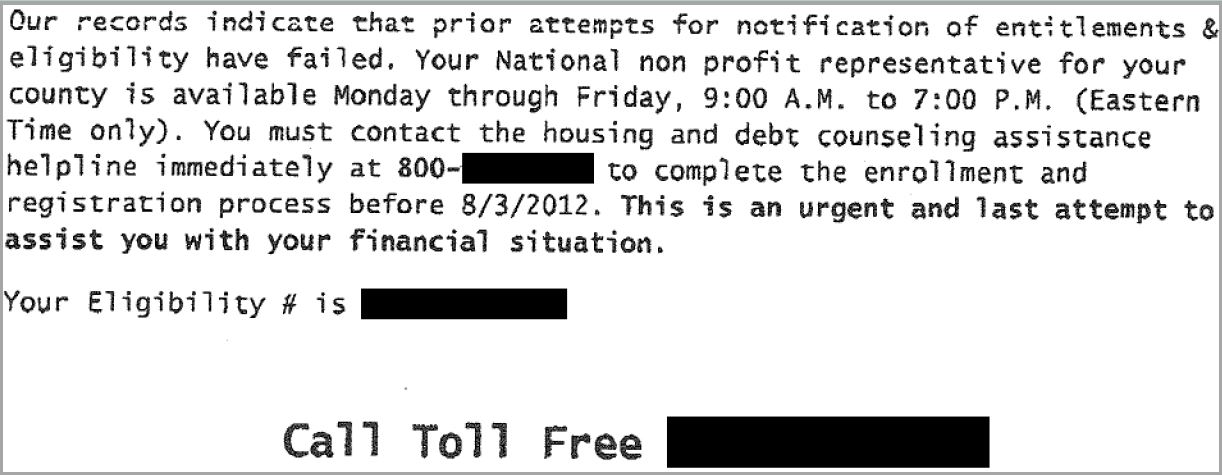
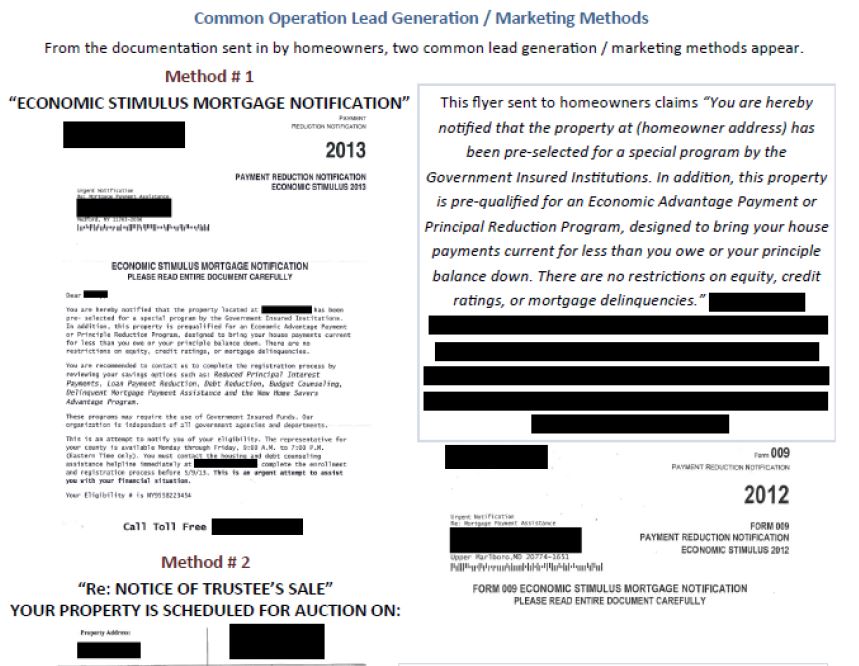
One homeowner from Rosedale, New York, began working with one of these “non-profits” in early 2013. She had received a flyer in the mail with the headline, “Economic Stimulus Mortgage Notification” that read, in part: “You are hereby notified that the property at (her address) has been pre-selected for a special program by the Government Insured Institutions. In addition, this property is pre-qualified for an Economic Advantage Payment or Principal Reduction Program, designed to bring your house payments current for less than you owe or your principle balance down. There are no restrictions on equity, credit ratings, or mortgage delinquencies.” The flyer said to contact “Your National non-profit representative” because this is the “last attempt to assist you with your financial situation.”

The homeowner was in need of a modification, so she called the “non-profit” listed on the top of the flyer. After working with the “non-profit” for a while, they told her that they did “all that they could,” and she needed to talk to “(Name withheld) Law Group.” This “Law Group” advertised that they “fight the bank.” They assured her that nothing could happen to her home as long as they were defending her, saying “(her lender) will not take her case until 2016,” giving her some much needed breathing room. After paying four thousand dollars to the “Law Group” and following weeks of empty promises, she was blindsided by a letter telling her that her mortgage was put into foreclosure just a few months after she began working with the “non-profit.”

To keep skeptical homeowners on the hook, the “non-profit” will stay involved throughout the process, assuring the vulnerable homeowner everything is fine. The “Law Group” extracts numerous fees from the homeowner, often saying, “the bank can’t do anything as long as we represent you.” Often in the end, the “non-profit” was started by the same attorney (or non-attorney) who started the “Law Group.” The homeowner loses thousands of dollars and is left wondering, if a “non-profit” will scam them, is there anyone they can trust?

“You’re eligible to join our lawsuit”
Fake Mass Joinder & Other Lawsuits

On average, complaints that allege some type of attorney involvement have produced greater losses per homeowner than all other complaints. While attorneys can be involved in any type of foreclosure rescue fraud, they are uniquely capable of tricking homeowners into believing they can get involved in fake mass joinder or other lawsuit against a lender. The lawsuit schemes can prove to be even more painful for homeowners because they often involve two parts: first a fee for a “forensic audit” to see if the homeowner is eligible to join the suit, then another fee to join the suit. Most promise very impressive results, like the homeowner who was told she could “join a class action lawsuit against her lender. Once this was settled she was guaranteed $75,000.”

The final selling point for many of these lawsuits is the assurances made to homeowners that nothing can happen to their homes as long as they are part of the suit. Some attorneys advise homeowners to stop paying their mortgage and instead pay monthly retainer fees to them. Month after month, homeowners pay the fee, believing the attorney is fighting for them. In the worst cases, the homeowner doesn’t realize the attorney is actually providing no service at all until a foreclosure notice arrives.

One senior citizen from Williamstown, New Jersey, was contacted by a group of attorneys who guaranteed him a loan modification for just over four thousand dollars. After they allegedly reviewed his documents and made “headway” with the bank regarding a loan modification, they informed him that he was eligible to join a lawsuit against his lender. The suit included over twenty thousand homeowners and they assured him that the lender would settle. At that point the homeowner began making monthly retainer payments of just over a thousand dollars, for eleven months, for a suit that never happened. On top of all of that, the attorneys advised him to stop making his mortgage payments.

Attorneys Engaged in Foreclosure Rescue Fraud
Results in Higher Homeowner Losses

These “Law Groups” or “Law Networks” claim to include hundreds of lawyers from around the country and claim that they will connect homeowners to lawyers in their home state.

The Domino Effect of Foreclosure Rescue Fraud

The average dollar figure a homeowner loses in Attorney involved Scam is around $3600, and $2850 on non-Attorney Scams. This dollar figure does not take into account the potential domino effect of foreclosure and homelessness these foreclosure rescue scams can have.

Homeowners may lose over $3,200 in cash payments to a scammer, but then can end up losing hundreds of thousands of dollars more because their homes fall into foreclosure as a direct result of the scam.

At Reno Nevada Foreclosure Prevention Event: One story was particularly memorable.

It involved a homeowner named Bill, and his Dad. After the Lawyers’ Committee’s presentation, Bill’s father, who is in his 80’s, came to the Lawyers’ Committee’s table and asked that we speak to his son, who has medical issues and has difficulty walking. Bill opened his rolling filing cabinet, where he kept his mortgage documents meticulously categorized, and pulled out a large stack of papers from the section labeled “Name Withheld Law Center.”

Bill described his experience as follows: Towards the end of 2009, he received a flyer in the mail with the subject line, “RE: Obama Administration’s Homeowner Affordability and Stability Plan.” This “Modification PROGRAM” said he may be eligible for the “Governmental Economic Stimulus Act of 2009.” The flyer contained Bill’s name, address, and exact loan amount. There was a place for him provide his email address and phone number so the group responsible for the flyer could contact him.

After receiving the flyer, Bill began talking to the “Name Withheld Law Center” associated with it. He pulled out the contract that was sent to him, which contained a recognized attorney’s name because several state Attorneys General had obtained cease and desist orders against that attorney. The attorney doesn’t appear to have ever been licensed in Nevada, and while he had been licensed in California, his license was suspended in early 2013 for misconduct in three loan modification cases.

Bill paid just under two thousand dollars for a loan modification that he never received.

Bill’s Dad sat behind him and watched closely as Bill spoke about his experience with the “Name Withheld Law Group,” and about his life in general. Bill’s Dad’s eyes would well up from time to time.

This story is so moving because it accurately describes the effects of the foreclosure crisis and foreclosure rescue frauds on struggling homeowners. The vast majority of people looking for help to modify their mortgages don’t have an exploding rate mortgage. They, like Bill, have a normal 30 year fixed mortgage that they could afford pre-recession. Bill bought his home for around $280,000 in 2005, putting down a full 20%, which now is worth somewhere between $130,000 and $160,000. When he bought the home, like many Americans, he couldn’t foresee the worst recession since the Great Depression and the simultaneous housing collapse.

These homeowners became prime targets for foreclosure rescue scammers, having been blindsided by the recession and believing the guarantees of success by those who promised to save their homes.

Military Scams

Fake Military Discounts in Foreclosure Rescue Fraud

“We have a discount for military members & their families”

With more than three years of data in the Database – including over thirty-eight thousand complaints and over eighty-four million dollars in total reported losses – sadly there is no shortage of disturbing stories. From the dying cancer patient who was scammed out of thousands of dollars while he was trying to make sure his widow could afford the mortgage when he was gone, to the single woman who took in her sister’s four children after she passed away who was scammed into believing she was part of a fake lawsuit, then threatened by the same attorneys who scammed her after she complained. One type of troubling scam appearing over the past few years is the “Military Discount” targeted to active military service members and their families.

One man, a senior citizen from Fort Worth, Texas, had hit a rough patch when he was solicited by a third party. At that point, he was one month behind on his mortgage payments and was working hard to keep up. The company guaranteed him a loan modification for $1,600. He was hesitant to pay so much money when he was already struggling to stay current on his mortgage. Sensing his hesitation with the original price, the third party asked if he, or anyone in his family, was currently serving the country. After he explained that his daughter was currently serving the country in Iraq, the third party thanked him for his daughter’s service and told him that he was eligible for a military discount of $300. Lowering the price just enough to make it bearable for him, he paid the fee. Months went by with no results and no refund. The damage was not done there. The company advised him that he needed to stop making his mortgage payments in order to get the loan modification, so he did. He went from being just one month behind on his mortgage when he started working with this operation, to his home being sold in foreclosure.

State laws targeting foreclosure rescue fraud should define covered homeowners broadly, as those who seek foreclosure relief services can easily be defrauded before an actual foreclosure or mortgage payment default, thereby excluding them from the coverage of otherwise applicable consumer protection laws. Homeowners who are not yet in foreclosure and who have not fallen behind on mortgage payments should be encompassed in laws regulating third-party services in this area.

Some state and federal laws prohibiting foreclosure rescue fraud directly or indirectly (including through prohibitions on deceptive business practices) are only enforceable by government entities.

When Homeowner’s good faith attempts to amicably work with the Bank in order to resolve the issue fails;

Home owners should wake up TODAY! before it’s too late by mustering enough courage for “Pro Se” Litigation (Self Representation – Do it Yourself) against the Lender – for Mortgage Fraud and other State and Federal law violations using foreclosure defense package found at https://fightforeclosure.net/foreclosure-defense-package/ “Pro Se” litigation will allow Homeowners to preserved their home equity, saves Attorneys fees by doing it “Pro Se” and pursuing a litigation for Mortgage Fraud, Unjust Enrichment, Quiet Title and Slander of Title; among other causes of action. This option allow the homeowner to stay in their home for 3-5 years for FREE without making a red cent in mortgage payment, until the “Pretender Lender” loses a fortune in litigation costs to high priced Attorneys which will force the “Pretender Lender” to early settlement in order to modify the loan; reducing principal and interest in order to arrive at a decent figure of the monthly amount the struggling homeowner could afford to pay.

If you find yourself in an unfortunate situation of losing or about to lose your home to wrongful fraudulent foreclosure, and need a complete package that will show you step-by-step litigation solutions helping you challenge these fraudsters and ultimately saving your home from foreclosure either through loan modification or “Pro Se” litigation visit: https://fightforeclosure.net/foreclosure-defense-package/


Share this:

  • Click to share on X (Opens in new window) X
  • Click to share on Facebook (Opens in new window) Facebook
Like Loading...

How Homeowners in Foreclosure Can Quickly Improve their Credit Score

25 Wednesday Apr 2018

Posted by BNG in Credit, Your Legal Rights

≈ Leave a comment

Tags

bad credit score, credit repair, credit repair company, Credit Score, Equifax, Experian, FICO, Foreclosure, good credit score, homeowners, personal loans, TransUnion

When homeowners find themselves in an unfortunate situations like recent foreclosures, there are few things that can help a homeowner get back on track to purchase a New Home, and one of those things is Improved Credit Score.

A good credit score can give you a lot of freedom. A bad credit score can be prohibitive in more ways than one, making it harder to get loans with reasonable interest rates, or even to get a loan to begin with.

So, what is a good credit score?

According to Value Penguin, a credit score of 720 or more is considered excellent, 660 to 719 is good, 620 to 659 is poor, and anything under 620 is bad. In 2015, the average FICO credit score in America reached an all-time high of 695.

There are several different scoring models out there, and the average FICO score will vary based on age and location, but most will fall between 660 and 720.

So this article is going to discuss why your credit score is important, and give you eight ways you can improve your credit score quickly (potentially within 30 days).

Why is Your Credit Score So Important?

There are many reasons why your credit score is important.

Many landlords will check your credit report before renting to you. They want to make sure you can and will pay your bills on time, so a poor credit score could influence your ability to find a place to live.

Your credit score also affects how much you pay in home and auto insurance, and even whether or not you are approved for a cell phone plan.

Most importantly, your credit score determines the cost of your future purchases. A good credit score gets lower rates on loans and credit cards, resulting in lower overall costs.

To put this into perspective, someone who has a credit score of 650 and gets a 30-year $400,000 mortgage loan is likely to pay over $70,000 more in interest than someone who gets the same loan, but has a credit score of 750.

As you can see, you can save A LOT of money by maintaining a good credit score.

Top 8 Ways: How to Improve Your Credit Score

1. Pay your bills on time.

This may seem like a no-brainer, but 35% of your credit score is determined by your ability to pay your bills on time. Even a payment that is a few days late can significantly impact your credit score.

If you have missed one or more payments, that’s OK. By consistently paying your bills on time after your late or missed payments your score should start to improve, but it may take a few months before you see results.

2. Raise your credit limit.

By raising your credit limit you are decreasing your credit utilization rate. That is, as long as you don’t adjust you’re spending habits accordingly.

Then you would just end up at the same credit utilization rate and owing more.

To put this into perspective, if you have maxed out a $2000 credit card, and you call the creditor and get approved for a credit limit increase to $4000, you instantly cut your credit utilization rate in half.

You should see results in an improved FICO score within a month or two with this method.

3. Use different types of credit.

Using different types of credit like personal loans from credit unions and installment loans for things like furniture, in addition to maintaining a credit card or two, shows your ability to pay your bills and manage the different types of credit.

Once you successfully pay these loans off, making all the payments on time, the credit reporting agencies will see you as a good borrower and your score will increase.

4. Dispute discrepancies and errors.

You should examine everything in your credit report, particularly focusing on accounts that show late payments or unpaid bills. If you find any information to be inaccurate, you can report the inaccuracies on line through Experian, TransUnion, and Equifax.

Additionally, you may consider contacting a credit repair company like Lexington Law for their assistance in repairing your credit.

The reporting agency will open an investigation if they find your claims to be substantiated, and things should be resolved in one or two months.

You are entitled by law to one free credit report each year. You can request your free annual credit report from the major reporting agencies at AnnualCreditReport.com.

5. Strategically open credit accounts.

Opening too many accounts in a short amount of time can have a negative impact on your credit score.

When you apply for credit, a hard inquiry is made on your credit report, which will dock your credit score a few points. So, the more times you apply for credit the more points that will be docked from your credit score.

If you have one or two accounts with low credit limits and haven’t opened any new accounts within the last six months, opening a new credit card account can improve your score.

This works because by opening a new credit account you are increasing your overall credit limit, which if you don’t increase your spending habits, decreases your credit utilization rate. You could also achieve this by contacting your current credit providers and requesting a credit increase.

It cannot be stressed enough to spend only what you can afford to pay every month.

6. Pay your bills twice a month.

Most creditors only report balances to credit bureaus once a month. Even if you pay your card off each month, if you are running up large balances, it could appear like your overusing your credit.

For example, if you use a rewards card to pay for everything and max it out or close too every month. Even though you pay your bill in full, when the credit reporting agency sends in their monthly report it will look like your utilizing most of your credit, which will decrease your score.

You can counter this glitch in the system by splitting up your credit card payments, and paying on your balances at least twice per month to keep your running balance down. If you make a large purchase and have the cash, you should pay it off immediately.

7. Become an authorized user.

In order to become and authorized user, you need to have someone who manages their money very well and is willing to add you onto their credit account and issue a card in your name.

Obviously this person will need to care about you and trust you a whole lot to add you to their credit account. You should have no intention of using this credit card and should be asking this favor of someone only to improve your credit score.

Once you are an authorized user, the account will show up on your credit report as well as the credit utilization rate and all the on-time payments associated with the account. As a result your credit score will increase.

8. Reduce the amount you owe.

Ultimately the best thing you can do to increase your credit score is to reduce the amount you owe.

The amount you owe determines 30% of your credit score, but with financial discipline it can be easier to reduce the amount you owe than clean up a late and missed payment history.

By paying on time, twice per month, and decreasing the amount you owe, you can control the factors that collectively make up 65% of your score.

So by diligently focusing and committing to reducing the amount you owe and paying bills on time, you will dramatically improve your score.

Conclusion

It is important to understand that the quickest you will see an increase in your credit score may be a few months.

You can easily ruin your credit score within a year’s period, and it will take even longer than that to repair the damages of irresponsible credit usage. It is a lot easier and less stressful to maintain a good credit score, than it is to fix one.

The best advice is to not spend more than you can afford and to pay all of your bills on time. In the event that you lose employment and cannot pay, many creditors will work with you until you find new employment.

You have choices and the ability to improve your credit score, no matter how bad your score is. All you have to do is take action.

Do you have any tips on how to improve your credit score quickly? If so, please leave them in the comment section below.

When Homeowner’s good faith attempts to amicably work with the Bank in order to resolve the issue fails;

Home owners should wake up TODAY! before it’s too late by mustering enough courage for “Pro Se” Litigation (Self Representation – Do it Yourself) against the Lender – for Mortgage Fraud and other State and Federal law violations using foreclosure defense package found at https://fightforeclosure.net/foreclosure-defense-package/ “Pro Se” litigation will allow Homeowners to preserved their home equity, saves Attorneys fees by doing it “Pro Se” and pursuing a litigation for Mortgage Fraud, Unjust Enrichment, Quiet Title and Slander of Title; among other causes of action. This option allow the homeowner to stay in their home for 3-5 years for FREE without making a red cent in mortgage payment, until the “Pretender Lender” loses a fortune in litigation costs to high priced Attorneys which will force the “Pretender Lender” to early settlement in order to modify the loan; reducing principal and interest in order to arrive at a decent figure of the monthly amount the struggling homeowner could afford to pay.

If you find yourself in an unfortunate situation of losing or about to lose your home to wrongful fraudulent foreclosure, and need a complete package that will show you step-by-step litigation solutions helping you challenge these fraudsters and ultimately saving your home from foreclosure either through loan modification or “Pro Se” litigation visit: https://fightforeclosure.net/foreclosure-defense-package/

Share this:

  • Click to share on X (Opens in new window) X
  • Click to share on Facebook (Opens in new window) Facebook
Like Loading...

What Homeowners Must Know About Mortgage Fraud & Restitution

10 Tuesday Apr 2018

Posted by BNG in Banks and Lenders, Case Laws, Case Study, Foreclosure Crisis, Foreclosure Defense, Fraud, Judicial States, Legal Research, Litigation Strategies, Mortgage fraud, Mortgage Laws, Non-Judicial States, Pro Se Litigation, Restitution, State Court, Your Legal Rights

≈ Leave a comment

Tags

Foreclosure, homeowners, Law, Lawsuit, Loan, Monetary Restitution, Mortgage fraud, Nevada, Ninth Circuit, Pro se legal representation in the United States, Restitution

During the peak of the housing boom in Las Vegas, Russell, a mortgage loan processor for a large bank, reviewed a mortgage application. Everything appeared to be in order: this particular type of mortgage loan required no income verification because the buyer had excellent credit and the home would be an owner-occupied property. Russell approved the loan for the bank.

Unbeknownst to Russell and the bank, the applicant was actually a “straw buyer,” using his name and credit to buy the house at the insistence of his business partner, but not actually intending to live in the house. All the applicant had to do was sign a few documents and both the applicant and his business partner would profit from exploding housing prices. The applicant’s credit would allow the pair to purchase a single-family residence for $295,000, and then, before the first mortgage payment came due, they would flip the property, that is, immediately sell the home, and profit from the home’s extraordinary short-term appreciation. The applicant never planned on living in the house nor making any mortgage payments, despite his execution of loan documents to the contrary.

Unfortunately, housing prices did not continue their fantastic escalation and the pair were unable to sell the home. Not surprisingly, neither the applicant nor his business partner made any mortgage payments and the home went into foreclosure. At the time of the home’s foreclosure, the house had a fair market value of $265,000. However, the bank that relied on the applicant’s information had too many similarly situated properties at the time of the foreclosure and decided to keep the home in inventory until it could sell the home at a later date.

Meanwhile, the financial institution became suspicious of the applicant and realized he never even moved into the house, despite claiming on his Uniform Residential Loan Application that this would be an “owner-occupied” property.

Concerned with an increase in mortgage fraud, the lender tipped off authorities, who subsequently investigated and arrested the straw buyer and his business partner. Almost a year later, the partners pled guilty and were sentenced, inter alia, to pay restitution to the financial institution. At the time of sentencing, the home had a fair market value of $145,000.

The court ordered restitution based on the Mandatory Victims Restitution Act (MVRA) concerning fraud and property. The victim, in this case the bank, argued its amount of loss equaled $295,000 (the amount originally borrowed) less the current fair market value of the property returned, $145,000; thus, the court should order the defendants to pay restitution of $150,000. On the other hand, the defendants argued that at the time the property was returned to the financial institution, the value of the home was $265,000. And because the bank had control over the property since that point in time, and had the ability to sell it any time, the defendants should not be liable for the further declining
market conditions. Thus, the defendants argued they only owed restitution of $30,000. Alternatively, the judge could consider a third possibility: recent  recommendations from US Sentencing Guidelines. Under these new guidelines,
the court determines the fair market value of the home on the defendants’ sentencing
date.

But, if the bank had not sold the home by that date, that fair market value would be based on the county’s assessed value of the property. In Clark County, where Las Vegas is situated, the Assessor’s Office updates property values annually and, depending on the specific time frame in this hypothetical, the assessment value can range from a lagging property assessment valuing the home at $280,000 to a more current assessment valuing the home at $125,000.

Which measure of restitution and subsequent calculation is best? That is, which value most adequately compensates the injured victim without unfairly burdening the defendants? The Ninth Circuit would side with the defendants in this case, having previously held that the value of the home on the date the bank gains control is the proper measure of restitution. Accordingly, the defendants in this case would be ordered to pay only $30,000 in restitution. On the other hand, the Seventh Circuit would hold that the “property” stolen was the money used to finance the home purchase, and not the actual home.

Subsequently, the “property” is not returned to the victim until the bank sells the
house and gets the entire amount it loaned to the defendants back. For that reason, if the bank sold the home by the sentencing date for $145,000, the defendants would be ordered to pay $150,000 in restitution. And if a judge considered the US Sentencing Guidelines, she would look to the local assessor’s office to determine the correct value. Thus, the amount of restitution a defendant pays depends on where the mortgage fraud takes place and whether the presiding judge considers the US Sentencing Guidelines. Accordingly, mortgage fraud restitution is not uniform throughout the United States.

This note discusses the circuit split in applying the Mandatory Victims Restitution Act of 1996 to mortgage fraud crimes—specifically, the difference in the mortgage fraud restitution formula. In Part I, I provide an introduction to mortgage fraud. In Part II, I provide background on the Mandatory Victims Restitution Act of 1996, which established a directive to courts to order restitution to identifiable victims. Further, the Act indicated, albeit imprecisely, that the restitution amount is based on the property’s value on the sentencing date, less the property’s “value” on the date the property is returned. Regrettably, the Act does not provide a definition of the word property,” which has resulted in a circuit split. Three circuit courts calculate the mandatory restitution as the property’s “value” based on the date the property is returned—that is, the property’s fair market value on that date. On the other hand, four circuits insist that the “value” of the property can only be determined when the bank actually sells that property. In Part III, I will discuss the circuit split where courts disagree on the “appropriate” restitution calculation.

In an effort to provide a uniform calculation, last year the US Sentencing Commission proposed changes to the US Sentencing Guidelines. While the Guidelines are only advisory and not mandatory, these recent amendments result in a third possible calculation that I discuss in Part IV.

Finally, in Part V, I critique each of the three imperfect approaches. In addition, I provide comparisons to various state foreclosure deficiency statutes as an illustration of alternative calculations. I conclude by proposing an amendment to the Mandatory Victim Restitution Act that, in the cases of collateralized loans obtained by fraud, defines “property” as the actual property fraudulently obtained: cash. In addition, I propose an additional “good faith” clause to the amendment to prevent banks from holding onto a foreclosed property longer than necessary. The sooner a property is sold, the sooner the bank recuperates some of its lost funds and the sooner a defendant knows the restitution
amount he must pay.

A. What is Mortgage Fraud?

In the hypothetical above, the partners executed mortgage fraud by using the applicant’s name and credit as a “straw buyer.” That is, a person who allows his name to be used in the loan process but has no intention of actually making any mortgage loan payments. Mortgage fraud comes in a variety of forms. For example, a person commits loan origination fraud when he misrepresents or omits information on a loan application upon which an underwriter ultimately relies to write a loan. Mortgage fraud can also occur with illicit programs aimed at current homeowners who are having trouble with their payments. Lately, this type of foreclosure rescue fraud is increasing. These types of scams focus on homeowners on the verge of foreclosure. Criminals promise to “stop or delay the foreclosure process,” and, in return, homeowners sign over their property to the criminals.

Mortgage fraud can also include “flopping.” Flopping occurs when a bank agrees to a short sale with the homeowner who then attempts to get the lowest price possible by purposefully damaging the soon-to-be-sold house. The house is then bought by an accomplice, cleaned up, and immediately flipped for a profit of upwards of 30 percent. In 2011, Nevada ranked second to Florida in the Mortgage Fraud Index (MFI), a ranking of states based on reported fraud and misrepresentation investigations. The FBI investigates mortgage fraud through Suspicious Activity Reports (SARs) filed by financial institutions.

The number of mortgage fraud SARs filed in 2011 was 93,508. To put this in perspective, in 2003 the number of reports filed was less than 7,000. However, mortgage fraud may be decreasing: 2012 SARs are down 25 percent compared to the previous year.

B. Why Does Mortgage Fraud Matter?

Mortgage fraud is a “significant contributor” to our economic crisis. Mortgage fraud has contributed to an increasing number of home foreclosures, decreasing home prices, and tightening of credit because of investor losses attributable to mortgage-backed securities. Further, “[t]he discovery of mortgage fraud via the mortgage industry loan review processes, quality control measures, regulatory and industry referrals, and consumer complaints lags behind economic indicators—often up to two years or more, with the impacts [of the fraud] felt far beyond these years.” Undeniably, reports of mortgage fraud persist and are continually emphasized in the news.

Lenient underwriting standards and a booming housing market have shaped a perfect backdrop for fraud to thrive. However, “[b]y 2007, real estate values began to fall and mortgage lenders began experiencing large losses due to fraud, reducing their ability to fund new mortgage loans.” The economic implications of mortgage fraud are staggering. The actual dollar amount attributed to mortgage fraud is unknown, however in 2010 alone “more than $10 billion in loans originated with fraudulent application data.”

Moreover, in fiscal year 2012, 70,291 SARs were filed with losses of $2.69 billion. And while the number of mortgage fraud instances has decreased, the dollar amounts involved in instances of fraud has increased.

C. Why Restitution?

Until the early 1980s, courts did not habitually consider restitution as part of sentencing guidelines. In fact, if a court ordered restitution, it was usually based on the defendant’s ability to pay. The passage of the Victim and Witness Protection Act (VWPA) in 1982, its subsequent revision in 1986, and later the Mandatory Victims Restitution Act (MVRA) in 1996 empowered federal judges to order restitution to victims of certain crimes without consideration of the defendant’s ability to pay. Unfortunately, victims receive only a fraction of the costs from crimes through restitution, as not all defendants have the resources to pay the restitution and their income potential diminishes significantly once they are in jail. However, as courts consider both the MVRA and the frequently cited public policy argument for restitution (making the victim whole), courts consequently order restitution awards to mortgage fraud victims. Indeed, “[v]ictims in mortgage fraud cases are statutorily entitled to restitution.

D. The Split

When a court convicts a defendant of mortgage fraud, and the defendant’s return of the property alone is not enough to fully restore the identified victim, the court will try to offset this deficiency in one of two ways. The Second, Fifth, and Ninth Circuits determine restitution based on the property’s fair market value the day the victim receives title to the property. The Third, Eighth, Tenth, and, most recently, Seventh Circuits hold the shortage is calculated based on the actual sale of the collateral real estate. Thus, the value of the property is unknown until the property has been sold and the lender receives the net proceeds. Consequently, this split “sets up a potential case for the U.S.
Supreme Court to decide whether the MVRA requires a court to determine restitution based on the fair market value of collateral real estate on the date it is returned to a victim . . . or the cash value upon foreclosure sale.”

II. THE MANDATORY VICTIMS RESTITUTION ACT OF 1996

Congress first enacted legislation in support of victims’ rights with the Victim and Witness Protection Act of 1982 (VWPA). The act included a broad provision for victim restitution. In considering the bill, the Committee on the Judiciary indicated that [t]he principle of restitution is an integral part of virtually every formal system of criminal justice, of every culture and every time. It holds that, whatever else the sanctioning power of society does to punish its wrongdoers, it should also insure that the wrongdoer is required to the degree possible to restore the victim to his or her prior state of well-being.

However, while this report indicated the importance of requiring restitution,
the Act only provided that a Court may order the defendant to pay restitution. Congress expanded and amended legislation for victims in future legislation, most notably in the Mandatory Victims Restitution Act of 1996. Congress identified one of the primary purposes of the Act as “requiring Federal criminal defendants to pay full restitution to the identifiable victims of their crimes.” In addition, Congress specifically made mandatory restitution applicable to fraudulent crimes against property. Moreover, Congress explicitly identified the legislation’s purpose:

This legislation is needed to ensure that the loss to crime victims is recognized, and
that they receive the restitution that they are due. It is also necessary to ensure that
the offender realizes the damage caused by the offense and pays the debt owed to the
victim as well as to society. Finally, this legislation is needed to replace an existing
patchwork of different rules governing orders of restitution under various Federal
criminal statutes with one consistent procedure.

If restitution is appropriate, a court may only award it to identifiable victims. A
federal crime victim is defined as “a person directly and proximately harmed as
a result of the commission of a Federal offense or an offense in the District of Columbia.” Further, restitution is only applicable to crime victims when the
defendant is actually convicted. In addition, “[a] ‘victim’s’ participation in a
fraudulent mortgage scheme . . . will generally exclude the victim from
restitution.”

It should also be remembered that restitution, “like all criminal sanctions . . . is a sanction of limited application.” Restitution is only complete, then, when payment of the obligation is complete. In jurisdictions that allow “extended or nominal payment mechanisms,” which can prolong the repayment, the variable time value of money may cause any restitution to be technically incomplete, even once the balance is repaid in full. Unfortunately, only 17.4 percent of measured property offenses resulted in criminal charges. Where convictions of mortgage fraud do result, however, courts consider the language of the MVRA in awarding restitution:

The court may also order restitution . . . . The order may require that such defendant
. . . return the property to the owner of the property . . . or . . . if return of the property . . . is impossible, impractical, or inadequate, pay an amount equal to the greater of . . . the value of the property on the date of the damage, loss, or destruction, or . . . the value of the property on the date of sentencing, less the value (as of the date the property is returned) of any part of the property that is returned . . . .

Accordingly, when the return of the property is inadequate restitution, the MVRA states that the offset value must be determined as of the date the property is returned. However, the statute is silent as exactly how to measure the value of the property on that date. Consequently, in the absence of clear guidelines, three possible formulas have arisen.

III. THE CIRCUIT SPLIT

With a lack of clarity in defining “property” in the MVRA, the circuit courts have split in their interpretations of restitution. Two circuits have followed the Ninth Circuit in determining that the value of the property is the fair market value on the date of the property’s return, arguing that once the property is returned to the victim, the victim has control over the property and may dispose of the property whenever it chooses. Accordingly, these courts calculate the fair market value of the property based on the date the property is returned rather than waiting for a later sale. Conversely, four circuits hold that the “property” can only be valued when the house is eventually sold and the proceeds are provided to the victim because cash, not real estate, was the actual
property the defendants took from the victim.

A. The Ninth Circuit Method

A bank would say a restitution calculation can only be determined when the property is sold, but a defendant would argue that if a bank holds on to the property in a declining market, it is unfair for the defendant to pay more in restitution than what the property was worth when the victim regained control of it. The Ninth Circuit method considers the fairness of a bank refraining from selling a property immediately, and ultimately agrees with the defendant’s argument.

After the passage of the Victim and Witness Protection Act in 1982, the Ninth Circuit became the first circuit court to consider mortgage fraud restitution. The court turned to an earlier decision in a timber theft case for property valuation guidance. In United States v. Tyler, the defendant was ordered to pay restitution for his theft of timber from a national forest. However, the victim, the federal government, did not sell the timber upon its seizure and in fact purposefully held onto the timber, claiming it needed the timber for evidentiary purposes in its case against Tyler. During the period between the
arrest and sentencing, timber prices declined. The district court found that the
amount of restitution equaled the difference of the timber’s value from sentencing
date and the higher value when defendant actually stole the timber. The Ninth Circuit disagreed with the District Court and held that the defendant should not have an increased restitution when the victim decides to retain the property. The court reasoned that the defendant’s conduct did not cause the subsequent loss the government experienced and therefore restitution was properly calculated as the property’s value on the date the victim regained control of the timber.

The Ninth Circuit subsequently applied this logic to a mortgage fraud context in United States v. Smith, where the defendant obtained loans secured by speculative real estate. The court determined that the credit against restitution should be based on the value of the property on the date title is transferred to the victim. The court noted, “[a]s of that date, the new owner had the power to dispose of the property and receive compensation.” Because the victim has control over the property’s sale once the property is returned, “[v]alue should therefore be measured by what the financial institution would have received in a sale as of that date.”

The Smith decision served as the “keystone for all of the subsequent decisions.”
The Ninth Circuit reinforced this valuation method in later cases. Further, in United States v. Gossi, the court elaborated on its prior decisions that value should be based on the date the victim has control over the property. Specifically, the court noted that what comes with control of the property is the power to dispose, which allows the victim to sell the property anytime and provides no immediate calculation of restitution. Subsequently, the court cited Smith, stating the “[v]alue should therefore be measured by what the financial institution would have received in a sale as of that date.” Finally, this past year, the Ninth Circuit upheld its mortgage fraud restitution calculation in United States v. Yeung. In Yeung, the defendant enlisted five people in a scheme involving false information on straw buyers’ loan applications in order to purchase and refinance homes in Northern California during the booming housing market. The district court considered a sentencing memo indicating that Yeung should pay restitution in the amount of the “outstanding principal balance on the defaulted loans less any money recovered from a sale of the properties used as collateral for the loans.”

Applying the US Sentencing Guidelines, rather than the MVRA, the district court ordered a restitution award in excess of $1.3 million. The Court of Appeals, however,
indicated that a financial institution has control of the property either when the
property is sold or when, citing Smith, the lender “had the power to dispose of
the property and receive compensation,” and therefore restitution should be
based on the fair market value on the date the property is returned. One distinction in Yeung, however, involved a loan purchased on the secondary market. One of the loans had been sold from the originating lender to a loan purchaser at a discount. The court indicated that the “property” in such circumstances is the actual loan, and not the original real property. The court determined that the restitution calculation in this type of circumstance must consider how much the loan purchaser paid for the loan, “less the value of the real property collateral as of the date the victim took control of the collateral property.”

Further, the court disagreed with the district court’s calculation of one property’s value. The district court determined the value of one of the properties as $363,863—the amount the victim received from the property’s sale. However, this sale did not occur until sixteen months after the victim took control of the property. Accordingly, the court found the actual value should be determined from the date the victim took control of the property. Two circuits follow the Ninth Circuit’s restitution calculation. In both United States v. Reese and United States v. Holley, the Fifth Circuit maintained that a property’s value is determined based on the date the collateral property is returned to the lender. Further, in Holley, the Fifth Circuit specifically analogized the facts of Holley to the Smith case in subscribing to the Ninth Circuit calculation

Relatedly, in United States v. Boccagna, the Second Circuit performed an extensive analysis of how property value should be measured, ultimately agreeing with the Ninth and Fifth Circuits. The Boccagna court noted that the MVRA does not define how to determine the value of property. Instead, the court stated, the “law appears to contemplate the exercise of discretion by sentencing courts in determining the measure of value appropriate to restitution calculation in a given case.” The court found the property’s sale price was lower than the fair market value and remanded the case to determine this value as part of the restitution calculation.

B. The Seventh Circuit Method

In contrast, four circuit courts presume the fair market value is determined only by the actual sale of the property. I have referred to this calculation as the Seventh Circuit method because of that court’s recent decision in which it analyzed all circuit holdings to date. However, these decisions begin outside of that circuit. The Third Circuit, in United States v. Himler, observed that the return of the property would be inadequate to compensate the victim, and explicitly disagreed with the Ninth Circuit’s view that value of the property is “as of the date the victim took control of [it].” The court noted instead that real estate is an illiquid asset, and “is only worth what you can get for it.” Thus, the court held that restitution would equal the original loan amount, less the eventual amount recovered from a sale. Surprisingly in this case, waiting until the sale actually
occurred resulted in the defendant paying less restitution than he would have if the fair market value had been used. The condominium in Himler sold for significantly more than its presumed value when title was transferred, due to favorable market conditions.

The Tenth Circuit, in United States v. James, also concluded that value is based on the actual foreclosure sales price and not an appraised value when the property is returned to the mortgage holder. The court noted that the MVRA “generally uses the term ‘value,’ and does not limit calculation of ‘value’ only to the use of the ‘fair market value’ of the property at issue.” Further, because the statute does not specifically mention value as being fair market value, there are other examples of value that may be appropriate, such as foreclosure sales price and replacement price. The court subsequently noted that
value can be a flexible concept, and a court with discretionary powers should keep in mind the purpose of restitution—to make the victim whole. The court concluded, therefore, that the foreclosure sale price in that case reflected a more accurate measure of the victim’s loss. Similarly, the Eighth Circuit, in United States v. Statman, used the foreclosure sale price of a fraudulently purchased bakery business in calculating the restitution award to a state’s small business-funding agency. While the defendant wanted the court to consider the appraised value of the bakery, the court cited James and determined that a foreclosure sale price was a permissible calculation method. The court also agreed with the Tenth Circuit; its decision aligns with the public policy concerns, which justify the existence of restitution in the first place—the need to make victims whole for the actual loss. While this case involved financial fraud, and not mortgage fraud per se, the chosen calculation method aligns this circuit with the sale-price camp.

Most recently, in United States v. Robers, the Seventh Circuit joined the Third, Eighth, and Tenth Circuits concluding “it is proper to determine the offset value [of property that is returned] based on the eventual amount recouped by the victim following sale of the collateral real estate.” The court observed that because the victim loaned cash to the defendants to purchase the property, the cash was therefore the “property” taken, not a home. Basing its opinion on the plain language of the MVRA, the Seventh Circuit decided that “ ‘property’ must mean the property originally taken from the victim,” the value can only be determined by the amount of cash returned to the victim from a sale.

IV. YET ANOTHER PERSPECTIVE—US SENTENCING GUIDELINES

The US Sentencing Guidelines are advisory rules that set out uniform sentencing guidelines for various offenses. The Guidelines are not mandatory,
and while judges have discretion in sentencing, courts must consider the Guidelines
in determining a defendant’s sentence. Moreover, a court of appeals reviewing a sentence that follows the Guidelines will consider the sentencing reasonable per se. Under these Guidelines, the factors considered when imposing a sentence include restitution to the victim. Further, the Guidelines state that, “[i]n the case of an identifiable victim, the court shall . . . enter a restitution order for the full amount of the victim’s loss, if such order is authorized under 18 U.S.C. . . . § 3663.”

The US Sentencing Commission annually reviews the current Guidelines and proposes amendments to reflect inadequacies in recent sentences. Recent revisions to the Guidelines, however, are not consistent with the latest Seventh Circuit decision in Robers. In the Dodd-Frank Wall Street Reform and Consumer Protection Act, Congress issued a directive to the US Sentencing Guideline Commission to review and amend federal sentencing guidelines related to “persons convicted of fraud offenses relating to financial institutions or federally related mortgage loans and any other similar provisions of law.” The amendment subsequently attempts to address the inconsistencies with Application Note 3(E) and “credits against loss rule,” which offsets a victim’s
loss by any credit the victim has already received. In general, the rule deducts the fair market value of the property returned to the victim from the amount of restitution the defendant is required to pay. In other words, the restitution is offset by the collateral’s fair market value. The Commission specifically addressed the situation that the circuit courts have wrestled with—when the victim gets the collateral back but has not disposed of the property, resulting in a problematic value calculation. The Commission noted this and, in an attempt to provide uniform guidelines, it proposed two changes. The first change established a specific date of the fair. market value determination: “the date on which the guilt of the defendant has been established.” The second change “establishes a rebuttable presumption that the most recent tax assessment value of the collateral is a reasonable estimate of the fair market value.” The Commission suggests that a court may consider the accuracy of this measure by examining factors such as how current the assessment is and the jurisdiction’s calculation process. In sum, a court ordering restitution following these Guidelines would establish the value of the property based on the official date of the defendant’s guilt. In addition, if the property has been returned to the victim but remains unsold, a court will use the local tax assessor’s value of the property to determine the property’s value.

V. CRITIQUE OF THE THREE CALCULATIONS

The absence of a definition for the term “property” in the MVRA is the root of the different applications of the statute throughout the country. “When the court defines ‘property,’ the question is whether the statute refers to the property stolen or the property returned. They are not necessarily equivalent, particularly in the context of complex financial instruments . . . .” However, as stated previously, the Act’s purpose is to make the victim whole, and no matter which formula is used, each calculation has the potential to not achieve this goal.

A. The Ninth Circuit Method: Control as the Impetus

There are several advantages to the Ninth Circuit mortgage fraud restitution calculation method, which holds that the fair market value should be calculated based on the date the property is returned to the financial institution victim. First, the date reflects the date that control over the property has been returned to the victims. Accordingly, the bank then has the power to dispose of the property at its discretion without additionally penalizing the defendant if the victim refrains from selling the property on that date. For example, a victim may decide to hold on to the property, as in United States v. Tyler or United States v. Smith, coincidental with a declining market. A victim may have too
many properties in inventory to immediately put a particular property up for sale. Or a victim may be making a calculated business decision to retain the property for a certain period of time for accounting purposes. No matter the purpose behind the retention, it is unfair to place the additional penalty that coincides with declining real estate prices on the defendant who had no control or even influence over the property’s sale.

Second, this specific date requires no guesswork when attempting to calculate the amount of restitution, which results in better efficiency. On the date the bank gets the property back, an appraisal can determine the property’s fair market value. The court can immediately calculate the restitution amount with this figure. Waiting until the property actually sells could result in a delay of months or years to determine how much the actual proceeds from the sale are. As a result, the court has an almost immediate figure to apply to the calculation and can order the restitution award right away. On the other hand, the Ninth Circuit calculation method has some considerable weaknesses. First, real estate is an illiquid asset, and determining fair market value of an illiquid asset is difficult. An appraisal only suggests what the house could sell for, not what the house actually will sell for. In addition, appraisals are based on historical data of home sales, and during sharp market increases or decreases an appraisal will not reflect the most up-to-date real estate prices.

Second, the recent housing bubble created an economic environment where home prices decreased at a radical rate. Traditionally, such sharp declines are not a concern with real estate over the long run because, while real estate prices fluctuate, they eventually trend upward. However, in situations like the recent drops in home values, the victim-lender can be punished for the market decline, despite the fact the victim was actively trying to sell the property. In addition, amidst tightening credit conditions, fewer buyers may qualify to purchase a home. This results in too much supply, not enough demand, and
consequently puts further downward pressure on home prices. The victimlender
is therefore penalized for market conditions beyond its control and consequently
does not receive complete restitution. Further, a victim financial institution is not in the business of selling homes; it is in the business of making collateralized mortgage loans for qualified buyers. Not only will the lender have costs associated with selling the
home (for example, carrying costs or realtor commissions), the lender cannot make a sale magically happen, especially if the home is situated in a market flooded with other foreclosure sales. Thus, when the lender eventually sells the home, it can potentially face a greater loss, an inequity beyond its control.

B. The Seventh Circuit Method: Cash Proceeds are the “Property”

As discussed in Part II, the Seventh Circuit, along with three other circuits, requires a sale of the property in order to establish the net proceeds offsetting a restitution award. These circuits distinguish that the property fraudulently obtained was the cash proceeds to finance a real estate purchase, not the actual home. Thus, this method recognizes the illiquidity of real estate and instead requires cash proceeds from a property’s sale; therefore, no return of the property for restitution purposes occurs with just the transfer of title or “control” over the property.

In addition, this method provides a more exact amount to the restitution calculation. With an appraisal, a court only has an approximation of what the house is worth. With an actual sale, the court knows specifically what the home sold for, and also has information on the true net proceeds to the lender.

Finally, this method also provides a buffer of protection for a victim trying to sell a property in a declining housing market. If the victim is unable to sell the property immediately, and home prices continue to plummet, the victim will not be financially punished by an ensuing lower sales price of the property. Thus, by treating the property as cash proceeds and not calculating the restitution award until there is a sale of the property, this allows the victim to come closer to achieving full restitution because the funds returned are the original amount that was taken.

This calculation method, however, has some distinct disadvantages. First, calculating the amount of time a home will be on the market is a challenge. For example, in a downturn economy, is it appropriate for the defendants to wait for the home to sell for months or years? At what point should the restitution award sentence be official? Without an established time period for a requisite sale, there will be a decrease of both efficiency and certainty as the defendant will have to wait longer to find out what the value of the property is and therefore how much restitution is necessary. In addition, what if the lender purposely holds on to the property longer than necessary? Indeed, victim banks could make a “business decision” to hold onto a property for years before attempting to sell. This type of allowance does not encourage an efficient method of asset redistribution, which can delay economic recovery in a down economy. Further, what if the victim holds an improper foreclosure auction—for example, by failing to advertise the foreclosure sale—and subsequently purchases the home itself for an amount far lower than fair market value because of a (not surprising) lack of buyers? Should the
lender be rewarded for its misbehavior? On the other hand, some would argue
that between the two parties—a convicted criminal who attempted to defraud a
financial institution and a more innocent lender who trusted the criminal borrower—
the defendant should absorb the risk.

Further, it is possible in a booming housing market that a defendant will owe no restitution. For example, if the defendant fraudulently obtained a home loan for $200,000 and the victim lender subsequently sold the property for $205,000, the defendant will be absolved from restitution. However, if part of the goal of restitution is to make the victim whole, the victim is more than compensated in a booming housing market.

Moreover, this type of calculation can have an adverse effect on other types of property. Knowing that the value of the property is not calculated until the item is actually sold, a criminal has little incentive to actually return the property. This would not be a concern for real property, but the same legal framework could be applied to other forms of collateral that can be moved and hidden, like cars. Thus, a thief can choose to hold on to the property or never return the property because of a lack of incentive to return it immediately. Accordingly, “[t]he decision is focused on the statute’s goal of making victims whole but potentially interferes with the statute’s goal of returning property to
victims.” Consequently, “[i]f a defendant is going to be on the hook for the offset amount regardless of when the property is sold, then why return the property? Also, the decision may have the unintended consequence of interfering with the marketplace . . . .”

Finally, the loan in question in these circumstances is for a collateralized asset. The actual home provided security to the lender. As such, the lender bore the risk when it made the loan; however, the lender also understood it could foreclose on the home in case of default. Thus, this cost of doing business is already accounted for and a victim lender understands this type of risk when providing mortgage loans.

C. US Sentencing Guidelines: Local Property Assessment is the Real
“Value”

As discussed in Part IV, the US Sentencing Guidelines establish the date of valuation as the conviction date of the defendant. In addition, if the property has not sold by that date, the local property tax assessor’s value of the home is the value of the property for restitution calculation purposes. There are several advantages to this approach. First, if every circuit applied this approach, these guidelines would result in a uniform application throughout the country and would eliminate the conflicting restitution awards. In addition, this approach sets a number that can be calculated and independently verified. An individual could easily confirm the tax assessor’s value of the property and calculate the restitution.

Moreover, the Guidelines allow flexibility. For example, if a court determines that an assessed value is too divergent from a property’s fair market value, the court has discretion to address these differences and assign a fair market value.

The Guideline method, however, has potential disadvantages. First, as previously
noted, the assessed value may not be near the fair market value of the property, and a battle of experts may ensue as both the defendant and the victim claim otherwise. In addition, this discrepancy may afford too much discretion to judges when the goal of the Guidelines is to set a uniform policy.

In addition, this approach disregards the Seventh Circuit method recognizing that the property taken was the actual cash for the home loan. Instead, by relying on a tax assessor’s value if the home remains unsold, the Commission determined that the “property” is the tangible real estate, and not the cash that was lent. Again, if the victim were unable to sell the home in a declining housing market, the restitution award would fail to compensate the victim for its true loss.

D. Alternative Methods of Calculation – State Deficiency Statutes

The problematic issue of fair market assessment is not unique to restitution.
Every state and the District of Columbia have a deficiency statute, whereby a lender can obtain a deficiency judgment to recover the difference between a foreclosure sale price and the current outstanding balance owed on the mortgage loan. Not every jurisdiction, however, calculates this deficiency in the same way. For example, Nevada calculates the home value based on the actual sale price, not the fair market value when the property is returned to the lender. However, the court may also consider the home’s appraised
value in its determination.

Some states maintain that a foreclosure sale price determines the value of the home when calculating a deficiency judgment. In other words, these states determine that a property’s value is only determined at the time of the property’s sale. Therefore, this calculation is similar to the Seventh Circuit method whereby a property’s value can only be determined following a sale of the real estate.

Other states consider the fair market value of the property when considering a deficiency judgment. States that consider the fair market value at the time the property is returned coincide with the Ninth Circuit calculation method. Notably, some of these states are states that have had a high number of foreclosures and are within the Ninth Circuit: for example, Arizona and California. Other states provide that the courts have discretion to determine the appropriate value of the property. This discretion is analogous to the alternative offered by US Sentencing Guidelines. This alternative is available when a court deems the property’s assessed value is inappropriate and provides that a court has authority to consider other evidence in its determination of a property’s value.

Thus, just as there is a lack of uniformity in the restitution calculation depending on which state you live in, there is a corresponding lack of uniformity regarding deficiency judgments. While most states follow the foreclosure sale approach recognizing the property’s value can only be determined with an actual sale, this approach does not account for the amount of time a financial institution can choose to hold onto the property. It further fails to account for the lack of control a mortgagor has over the sale process. On the other hand, while the fair market approach recognizes the importance of the control aspect, this approach does not consider a mortgagee’s potential inability to sell in a down economy.

E. Analysis

Restitution is founded primarily on the idea that the victim should be made whole for his property loss. The actual property that was defrauded from a victim in mortgage fraud is the money lent as part of the real estate transaction.
Therefore, until the actual money is returned, equity has not been restored to the victim. However, equity also demands that a victim not take advantage of the criminal defendant and hold on to the returned real estate property longer than necessary to sell the real estate property. Therefore, there should be a limitation to ensure a victim does not unreasonably allow the property to languish. Accordingly, a “good faith” requirement should be included in any amendment to the MVRA, requiring a victim to sell the property to recoup funds with good faith. Thus, a defendant who believes a victim unfairly held onto a property for too long may petition the court to reduce the amount of restitution owed if the victim did not commence the sales process with good
faith.

If Congress were to amend MVRA, it should provide a definition of the term “property” to help distinguish between properties at the different phases of a financial transaction. Because of the diverse types of financial fraud—e.g. mortgage fraud compared with securities fraud—the term “property” may have more than one meaning within these contexts, and may also change throughout the transaction. For instance, consider a scheming debtor who fraudulently obtained a margin loan to purchase both mortgage backed securities and corporate bonds. The property “stolen” initially in this case is the fraudulently obtained cash used to purchase the assets. However, after the margin loan is received, the property now consists of two types of financial instruments within
the debtor’s portfolio. Indeed, the property in its current form (financial assets)
can be converted back to the form of the original property (cash). However, with the current definition of property, it is unclear if that conversion is even required.

The definition of property should state that “property” is defined as the specific or particular type of asset (such as cash) that the defendant secured from the victim. This way, the “property” returned to the victim (money) will be the same type of property stolen (money used to purchase the home). In addition, similar to many state statutes prohibiting insurance companies from operating in bad faith, the Act should prohibit victim-lenders from operating in bad faith.

VI. CONCLUSION

Defendants, like the partners in the fictional story in the introduction, could face varied restitution awards depending on which state they commit the mortgage fraud in. This lack of a uniform approach results in inadequate restitution to victims. If the goal of the MVRA is to make victims whole, a more standardized and consistent calculation of restitution is required. Providing a definition of property in the MVRA would provide this uniformity. Further, requiring victims to act in good faith as they attempt to convert property back to the type of asset they were deprived of will help ensure defendants aren’t unfairly punished.

When Homeowner’s good faith attempts to amicably work with the Bank in order to resolve the issue fails;

Home owners should wake up TODAY! before it’s too late by mustering enough courage for “Pro Se” Litigation (Self Representation – Do it Yourself) against the Lender – for Mortgage Fraud and other State and Federal law violations using foreclosure defense package found at https://fightforeclosure.net/foreclosure-defense-package/ “Pro Se” litigation will allow Homeowners to preserved their home equity, saves Attorneys fees by doing it “Pro Se” and pursuing a litigation for Mortgage Fraud, Unjust Enrichment, Quiet Title and Slander of Title; among other causes of action. This option allow the homeowner to stay in their home for 3-5 years for FREE without making a red cent in mortgage payment, until the “Pretender Lender” loses a fortune in litigation costs to high priced Attorneys which will force the “Pretender Lender” to early settlement in order to modify the loan; reducing principal and interest in order to arrive at a decent figure of the monthly amount the struggling homeowner could afford to pay.

If you find yourself in an unfortunate situation of losing or about to lose your home to wrongful fraudulent foreclosure, and need a complete package that will show you step-by-step litigation solutions helping you challenge these fraudsters and ultimately saving your home from foreclosure either through loan modification or “Pro Se” litigation visit: https://fightforeclosure.net/foreclosure-defense-package/

Share this:

  • Click to share on X (Opens in new window) X
  • Click to share on Facebook (Opens in new window) Facebook
Like Loading...

How Homeowners Can Use Ibanez Case to Fight a Wrongful Foreclosure

26 Monday Mar 2018

Posted by BNG in Bankruptcy, Banks and Lenders, Case Laws, Case Study, Federal Court, Foreclosure Crisis, Foreclosure Defense, Fraud, Judicial States, Legal Research, Litigation Strategies, Loan Modification, MERS, Mortgage Laws, Mortgage mediation, Mortgage Servicing, Non-Judicial States, Pro Se Litigation, Securitization, State Court, Your Legal Rights

≈ Leave a comment

Tags

bank forecloses, bankruptcy court, Foreclosure, homeowners, Ibanez Case, Loan, Massachusetts, MERS, Mortgage Electronic Registration System, Pro se legal representation in the United States, US Bank, wrongful foreclosure

Many homeowners who found themselves in wrongful foreclosure situation may have a valid defense, against the perpetrators of these crimes.

How much does it cost to get justice, when a bank forecloses on your house illegally? Thousands of ex-homeowners don’t pursue their rights to a financial settlement because they assume they couldn’t pay the legal fees.

In fact, it costs less than you fear. Consumer lawyers take a few cases at no charge. More likely, you’ll pay fees — upfront or on a monthly plan — tied to the lawyer’s estimate of the time it will take and your ability to pay. If they win your case, they’ll collect from the financial institution, too.

Before readers attack the “greedy lawyers” for defending “deadbeat” clients who couldn’t repay their mortgage loans, let me quote from a groundbreaking decision of 2011 by the Massachusetts Supreme Court. The court reversed two foreclosures because the banks — Wells Fargo and U.S. Bancorp, acting as trustees for investors — couldn’t prove that they actually owned the mortgages. Judge Robert J. Cordy excoriated them for their “utter carelessness.” The fact that the borrowers owed the money was “not the point,” he wrote. The right to deprive people of their property is a powerful one and banks have to prove they have the legal standing to do so.

American law cannot allow property seizures based on backdated, incomplete, or fraudulent documentation, no matter what the circumstances are. Otherwise, no one’s home is safe. Courts enforce private property rights through the cases brought before them. In other words, lawyers.

The Massachusetts case began not with consumers, but with the banks themselves. They asked the courts to affirm that the foreclosures were valid so they could get title insurance. That pulled the borrowers — Antonio Ibanez and Mark and Tammy LaRace — into the fray. When the horrified courts looked at how the foreclosures had gone down, they said, “no way,” and gave the former owners their property back.

Ibanez, a special ed teacher, bought the home for investment in 2005 and defaulted in 2007 on a $103,500 loan, according to the court papers. Even since, the house has been boarded up. Ibanez filed a Chapter 7 bankruptcy, so he now has title to the home and no obligation on the debt. The mortgage investors will take the loss.

The LaRaces borrowed $103,200 to buy their home in 2005 and also defaulted in 2007. They had an offer on their home, but the servicer foreclosed anyway. (During the trial, the foreclosing law firm admitted that servicers are graded on how quickly they can liquidate a mortgage.)

The LaRaces have moved back into their long-unattended home, but first they had to clean up mold, fix plumbing, and make other repairs. They would gladly resume payments on the mortgage, their lawyer Glenn Russell says. But the trustee bank doesn’t own the loan. The investors don’t own it because the mortgage was never transferred properly. The original lender, Option One, no longer exists. So whom do they pay?

This important case opens the door to thousands of foreclosure do-overs in Massachusetts at the time, and continuing and equally influenced courts in other states, as well. But there hasn’t been a rush by lawyers to get involved, probably because the field is complex and not especially remunerative. No class actions have been certified, as at that time or shortly thereafter, so the cases proceeded one by one. The financial trail can be hard to track (the Massachusetts documents were unwound by mortgage-fraud specialist Marie McDonnell).  The lawyer — often, a sole practitioner — is up against the awesome resources of major financial institutions.

Neither Ibanez nor the LaRaces were charged for their lawyer’s services. Collier had file a claim for wrongful foreclosure and was paid from any settlement. Russell did the same. At the time, Russell also thinks the LaRaces are owed something for the cost of repairing their home.

Very few cases start as pro bono, however. Lawyers who defend consumers have bills to pay, just as the banks’ corporate attorneys do. You may opt to fight it Pro Se using the package from our website, or if you want to fight an unfair foreclosure, you might be offered one of several arrangements:

An upfront fee. “Many of my clients were formerly very successful individuals,” Russell says. On average, the value of the homes of the people who contact him is “somewhat north of $500,000.” He suggests a fee based on their means.

Monthly payments. If you’re not making monthly mortgage payments, some portion of that money could be applied to legal expenses. Collier says he puts the payments into escrow and retains them if he gets the house back (he says he always does, in predatory lending cases).

Bankruptcy payment plans. The clients of North Carolina bankruptcy attorney Max Gardner are usually in a Chapter 13 monthly repayment plan. Each state sets the maximum attorney’s fee, payable as part of the plan.

Mostly, the attorneys get paid by suing the financial institutions, who settle claims or suffer court judgements due to their own illegal activity. People who beat up on consumer lawyers scream that they bring frivolous cases just for the fees. But consumer lawyers only get paid if their case is good, so they’re pretty rigorous about whom they choose to represent. “I was called crazy for practicing in this area of law, as in ‘I would be broke’ by not getting enough fees,” Russell says. “Three years later, I am still here and still living my motto of helping people first.”

Most homeowners are successful fighting there case Pro Se using the package we offer for fighting Foreclosure, as your interest is at stake, and you have the most to lose, not Attorneys. They gets paid whether you win or lose. However, homeowners equally have options when fighting wrongful foreclosure.

If you think you have a case, your toughest challenge isn’t fees, it’s finding a lawyer with the expertise to press your claim successfully, Gardner says. If you don’t have a personal reference for a qualified lawyer, the best place to look is the website of  the National Association of Consumer Advocates. Next best: the National Association of Consumer Bankruptcy Attorneys. In either case, ask if the lawyer has won other securitization, mortgage servicing, and foreclosure cases. “They have to know what documents to ask for,” Gardner says. That’s what wins.

When Homeowner’s good faith attempts to amicably work with the Bank in order to resolve the issue fails;

Home owners should wake up TODAY! before it’s too late by mustering enough courage for “Pro Se” Litigation (Self Representation – Do it Yourself) against the Lender – for Mortgage Fraud and other State and Federal law violations using foreclosure defense package found at https://fightforeclosure.net/foreclosure-defense-package/ “Pro Se” litigation will allow Homeowners to preserved their home equity, saves Attorneys fees by doing it “Pro Se” and pursuing a litigation for Mortgage Fraud, Unjust Enrichment, Quiet Title and Slander of Title; among other causes of action. This option allow the homeowner to stay in their home for 3-5 years for FREE without making a red cent in mortgage payment, until the “Pretender Lender” loses a fortune in litigation costs to high priced Attorneys which will force the “Pretender Lender” to early settlement in order to modify the loan; reducing principal and interest in order to arrive at a decent figure of the monthly amount the struggling homeowner could afford to pay.

If you find yourself in an unfortunate situation of losing or about to lose your home to wrongful fraudulent foreclosure, and need a complete package that will show you step-by-step litigation solutions helping you challenge these fraudsters and ultimately saving your home from foreclosure either through loan modification or “Pro Se” litigation visit: https://fightforeclosure.net/foreclosure-defense-package/


Share this:

  • Click to share on X (Opens in new window) X
  • Click to share on Facebook (Opens in new window) Facebook
Like Loading...

What Homeowners Must Know About Appeal-able Orders and Judgment from the Federal Courts

01 Thursday Mar 2018

Posted by BNG in Appeal, Case Laws, Case Study, Federal Court, Foreclosure Crisis, Foreclosure Defense, Judicial States, Legal Research, Litigation Strategies, Non-Judicial States, Pro Se Litigation, Your Legal Rights

≈ Leave a comment

Tags

Appeal-able Orders, Foreclosure, foreclosure defense, homeowners, Judgment, Orders, Plaintiff, United States

In order to effectively perfect your Appeal case as a Pro Se Litigator, homeowners must familiarize themselves about Appealing unfavorable decisions.

1. Appeal-able Orders: Courts of Appeals have jurisdiction conferred and strictly limited by statute:

(a) Appeals from final orders pursuant to 28 U.S.C. § 1291: Final orders and
judgments of district courts, or final orders of bankruptcy courts which have been appealed to and fully resolved by a district court under 28 U.S.C. § 158, generally are appealable. A final decision is one that “ends the litigation on the merits and leaves nothing for the court to do but execute the judgment.” Pitney Bowes, Inc. v. Mestre, 701 F.2d 1365, 1368 (11th Cir. 1983) (citing Catlin v. United States, 324 U.S. 229, 233, 65 S.Ct. 631, 633, 89 L.Ed. 911 (1945)).

A magistrate judge’s report and recommendation is not final and appealable until judgment thereon is entered by a district court judge. 28 U.S.C. § 636(b); Perez-Priego v. Alachua County Clerk of Court, 148 F.3d 1272 (11th Cir. 1998). However, under 28 U.S.C. § 636(c)(3), the Courts of Appeals have jurisdiction over an appeal from a final judgment entered by a magistrate judge, but only if the parties consented to the magistrate’s jurisdiction. McNab v. J & J Marine, Inc., 240 F.3d 1326, 1327-28 (11th Cir. 2001).

(b) In cases involving multiple parties or multiple claims, a judgment as to fewer than all parties or all claims is not a final, appealable decision unless the district court has certified the judgment for immediate review under Fed.R.Civ.P. 54(b).
Williams v. Bishop, 732 F.2d 885, 885-86 (11th Cir. 1984). A judgment which resolves all issues except matters, such as attorneys’ fees and costs, that are collateral to the merits, is immediately appealable. Budinich v. Becton Dickinson & Co., 486 U.S. 196, 201, 108 S.Ct. 1717, 1721-22, 100 L.Ed.2d 178 (1988); LaChance v. Duffy’s Draft House, Inc., 146 F.3d 832, 837 (11th Cir. 1998).

(c) Appeals pursuant to 28 U.S.C. § 1292(a): Under this section, appeals are permitted from the following types of orders:

i. Orders granting, continuing, modifying, refusing or dissolving injunctions, or refusing to dissolve or modify injunctions; However, interlocutory appeals from orders denying temporary restraining orders are not permitted. McDougald v. Jenson, 786 F.2d 1465, 1472-73 (11th Cir. 1986);

ii. Orders appointing receivers or refusing to wind up receiverships; and

iii. Orders determining the rights and liabilities of parties in admiralty cases.

(d) Appeals pursuant to 28 U.S.C. § 1292(b) and Fed.R.App.P. 5: The certification specified in 28 U.S.C. § 1292(b) must be obtained before a petition for permission to appeal is filed in the Court of Appeals. The district court’s denial of a motion for certification is not itself appealable.

(e) Appeals pursuant to judicially created exceptions to the finality rule: Limited
exceptions are discussed in cases including, but not limited to: Cohen v.
Beneficial Indus. Loan Corp., 337 U.S. 541, 546, 69 S.Ct. 1221, 1225-26, 93
L.Ed. 1528 (1949); Atlantic Fed. Sav. & Loan Ass’n v. Blythe Eastman Paine
Webber, Inc., 890 F.2d 371, 376 (11th Cir. 1989); Gillespie v. United States Steel Corp., 379 U.S. 148, 157, 85 S.Ct. 308, 312, 13 L.Ed.2d 199 (1964).

2. Time for Filing: The timely filing of a notice of appeal is mandatory and jurisdictional.
Rinaldo v. Corbett, 256 F.3d 1276, 1278 (11th Cir. 2001). In civil cases, Fed.R.App.P. 4(a) and (c) set the following time limits:

(a) Fed.R.App.P. 4(a)(1): A notice of appeal in compliance with the requirements set forth in Fed.R.App.P. 3 must be filed in the district court within 30 days after the order or judgment appealed from is entered. However, if the United States or an officer or agency thereof is a party, the notice of appeal must be filed in the district court within 60 days after such entry. THE NOTICE MUST BE RECEIVED AND FILED IN THE DISTRICT COURT NO LATER THAN THE LAST DAY OF THE APPEAL PERIOD – no additional days are provided for mailing. Special filing provisions for inmates are discussed below.

(b) Fed.R.App.P. 4(a)(3): “If one party timely files a notice of appeal, any other party may file a notice of appeal within 14 days after the date when the first notice was filed, or within the time otherwise prescribed by this Rule 4(a), whichever period ends later.”

(c) Fed.R.App.P. 4(a)(4): If any party makes a timely motion in the district court under the Federal Rules of Civil Procedure of a type specified in this rule, the time for appeal for all parties runs from the date of entry of the order disposing of the last such timely filed motion.

(d) Fed.R.App.P. 4(a)(5) and 4(a)(6): Under certain limited circumstances, the district court may extend or reopen the time to file a notice of appeal. Under Rule 4(a)(5), the time may be extended if a motion for an extension is filed within 30 days after expiration of the time otherwise provided to file a notice of appeal, upon a showing of excusable neglect or good cause. Under Rule 4(a)(6), the time to file an appeal may be reopened if the district court finds, upon motion, that the following conditions are satisfied: the moving party did not receive notice of the entry of the judgment or order within 21 days after entry; the motion is filed within 180 days after the judgment or order is entered or within 14 days after the moving party receives notice, whichever is earlier; and no party would be prejudiced by the reopening.

(e) Fed.R.App.P. 4(c): If an inmate confined to an institution files a notice of appeal in either a civil case or a criminal case, the notice of appeal is timely if it is deposited in the institution’s internal mail system on or before the last day for filing. Timely filing may be shown by a declaration in compliance with 28 U.S.C. § 1746 or a notarized statement, either of which must set forth the date of deposit and state that first-class postage has been prepaid.

3. Format of the notice of appeal: Form 1, Appendix of Forms to the Federal Rules of Appellate Procedure, is a suitable format. See also Fed.R.App.P. 3(c). A pro Se notice of
appeal must be signed by the appellant.

4. Effect of a notice of appeal: A district court lacks jurisdiction, i.e., authority, to act after the filing of a timely notice of appeal, except for actions in aid of appellate jurisdiction or to rule on a timely motion of the type specified in Fed.R.App.P. 4(a)(4).

When Homeowner’s good faith attempts to amicably work with the Bank in order to resolve the issue fails;

Home owners should wake up TODAY! before it’s too late by mustering enough courage for “Pro Se” Litigation (Self Representation – Do it Yourself) against the Lender – for Mortgage Fraud and other State and Federal law violations using foreclosure defense package found at https://fightforeclosure.net/foreclosure-defense-package/ “Pro Se” litigation will allow Homeowners to preserved their home equity, saves Attorneys fees by doing it “Pro Se” and pursuing a litigation for Mortgage Fraud, Unjust Enrichment, Quiet Title and Slander of Title; among other causes of action. This option allow the homeowner to stay in their home for 3-5 years for FREE without making a red cent in mortgage payment, until the “Pretender Lender” loses a fortune in litigation costs to high priced Attorneys which will force the “Pretender Lender” to early settlement in order to modify the loan; reducing principal and interest in order to arrive at a decent figure of the monthly amount the struggling homeowner could afford to pay.

If you find yourself in an unfortunate situation of losing or about to lose your home to wrongful fraudulent foreclosure, and need a complete package that will show you step-by-step litigation solutions helping you challenge these fraudsters and ultimately saving your home from foreclosure either through loan modification or “Pro Se” litigation visit: https://fightforeclosure.net/foreclosure-defense-package/

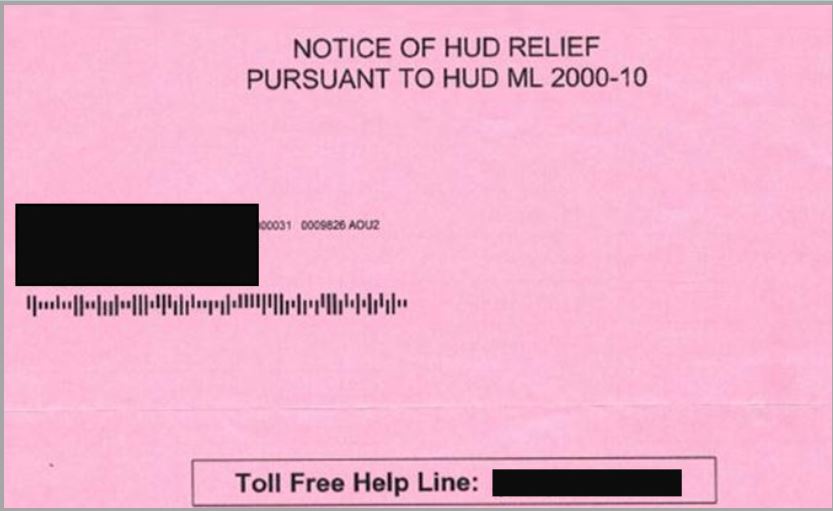
Share this:

  • Click to share on X (Opens in new window) X
  • Click to share on Facebook (Opens in new window) Facebook
Like Loading...

How Homeowners Can Greatly Improve their Chances of Winning on Appeal

24 Wednesday Jan 2018

Posted by BNG in Appeal, Case Laws, Case Study, Discovery Strategies, Federal Court, Foreclosure Defense, Judicial States, Litigation Strategies, Non-Judicial States, Note - Deed of Trust - Mortgage, Pleadings, Pro Se Litigation, Scam Artists, Title Companies, Trial Strategies, Your Legal Rights

≈ Leave a comment

Tags

Appeal, Court, District Court, Foreclosure, foreclosure defense, homeowners, Plaintiff, pro se, Pro se legal representation in the United States, State Court, United States district court

A seasoned Attorney will tell you that trying cases is one of the most exciting things a litigator does during his or her career but it is also certainly one of the most stressful. While in the trenches during trial, many litigators understandably focus all of their energies on winning the case at hand. But a good litigator knows that trial is often not the last say in the outcome of a case. The final outcome often rests at the appellate level, where a successful trial outcome can be affirmed, reversed, or something in between. The likelihood of success many times hinges on the substance of the record on appeal. The below discusses a variety of issues that trial litigators should keep in mind as they prepare and present their case so they position themselves in the best possible way for any appeals that follow.

Prepare Your Appellate Record From The Moment Your Case Begins

Perhaps one of the biggest misconceptions regarding preserving an adequate record on appeal is when a lawyer should start considering what should be in the record. In short, the answer is from the moment the complaint is filed. At that time, counsel should begin to think carefully about the elements of each asserted cause of action, potential defenses and their required elements, and the burden of proof for each. Every pleading should be drafted carefully to ensure that no arguments are waived in the event they are needed for an appeal. For instance, a complaint should allege with specificity all the factual and legal elements necessary to sustain a claim, while an answer should include any and all applicable affirmative defenses to avoid waiver. See, e.g., Travellers Int’l, A.G. v. Trans World Airlines, 41 F.3d 1570, 1580 (2d Cir. 1994) (“The general rule in federal courts is that a failure to plead an affirmative defense results in a waiver.”). Likewise, if you file a motion to dismiss, ensure that the motion contains all the necessary evidence that both a trial court and appellate court would need to find in your favor. Of particular importance in federal court practice is the pre-trial order. Under Federal

Rule of Civil Procedure 16, the pre-trial order establishes the boundaries of trial. See Elvis Presley Enterprises, Inc. v. Capece, 141 F.3d 188, 206 (5th Cir.1998) (“It is a well-settled rule that a joint pre-trial order signed by both parties supersedes all pleadings and governs the issues and evidence to be presented at trial.”). If the pre-trial order does not contain the pertinent claims, defenses or arguments that you wish to present at trial, you are likely also going to be out of luck on appeal.

Later on in the case, as the factual record becomes more fully developed, consider whether amending or supplementing the pleadings or other court submissions are necessary to make the record as accurate as possible. Most states follow the federal practice of allowing liberal amendments. However, these can be contested, particularly late in the process, closer to trial. While appellate review is often for abuse of discretion, formulating a strong motion in favor of or in opposition to an amendment can preserve the issue.

What to Keep in Mind as Your Case Proceeds

As the case develops, consider whether the elements you need to prove your case are sufficiently reflected in the information you obtain during discovery. If not, determine whether there are ways to obtain the information you need well before trial starts. By the time trial arrives, it may be too late to supplement the record to get before the trial judge and the appellate court what you need to win your case. In that regard, anything you have in writing that gets submitted to the court may very well end up being part of the record on review, so make sure it is accurate and understandable. Incomprehensible or incomplete submissions can muddy your appellate record and damage a successful appellate proceeding. In the same vein, make sure anything presented to the court prior to trial that you want to be part of the record is transcribed. Otherwise, there will be an insufficient record on appeal. This is particularly so when it comes to discovery disputes. Although they are common in present day litigation, judges hate discovery disputes. To preserve discovery issues for appeal, be sure to get a ruling, and make sure it is reflected in writing. Moreover, carefully review every pre-trial court order or other judicial communication, including court minutes, to ensure accuracy. Attempting to make corrections during the appellate process may not be possible.

Another significant area for appellate issues is the failure to timely identify experts. This is subject to an abuse of discretion standard of review, so it is important that one builds a record on the issue, particularly regarding any prejudice suffered by the untimely disclosure.

After Discovery Closes – The Motion in Limine

Once discovery has closed, consider carefully any motions in limine you may want to make. Although motions in limine are not strictly necessary, they are helpful in identifying evidentiary issues for the judge and counsel and increase the chances of a substantive objection, sidebar, and ruling when the issue arises at trial. One potential pitfall – some jurisdictions require a party to renew an objection at trial after a motion in limine has been denied, so make sure to do so if necessary. See, e.g., State ex. Rel Missouri Highway and Transp. Com’n v. Vitt, 785 S.W.2d 708, 711 (Mo. Ct. App. E.D. 1990) (“A motion in limine preserves nothing for review. Following denial of a motion in limine, a party must object at trial to preserve for appellate review the point at issue.”) (internal citation omitted). Also, if the Court delivers its ruling on a motion in limine orally, make sure it is transcribed properly by the court reporter.

Now the Trial – What to Keep in Mind

Above all else, when in doubt, object. Objections should be immediate and specifically describe the basis for the objection so the record is clear. Make the argument to win – every objection should be more than just reciting labels, and should provide sufficient information for the trial judge to decide the issue. The goal is not to be coy with the trial judge and hope for a lucky break, but to be prepared to make an argument to win the issue at trial or, alternatively, on appeal. In addition, if you are the party proffering the evidence, make sure the proffer is on the record and that you expressly state why the evidence is being offered. This may require pressing on the judge to get the full objection on the record. If you fail to do so, you risk the appellate court not reviewing the claim on appeal. See, e.g., National Bank of Andover v. Kansas Bankers Sur. Co., 290 Kan. 247, 274-75 (2010) (observing “purpose of a proffer is to make an adequate record of the evidence to be introduced … [and] preserves the issue for appeal and provides the appellate court an adequate record to review when determining whether the trial court erred in excluding the evidence.”). Also, always be careful of waiving any issues for appeal by agreeing to a judge’s proposed compromise on evidentiary issues.

An important but often overlooked consideration is the courtroom layout and dynamics. Well-thought and timely objections will be for naught if they are not transcribed. Sometimes the courtroom layout can make record preservation difficult. For example, if objections are made at sidebar conferences where the court reporter is not present, those objections may not make their way into the appellate record or be dependent on the after the fact recollections of others. See, e.g., Ohio App. R. 9(c) (describing procedures for preparing statement of evidence where transcript of proceedings is unavailable and providing trial court with final authority for settlement and approval). This should be avoided whenever possible.

Beyond objections, make sure all the evidence you need for your appeal is properly admitted by the trial court before the close of your case. All exhibits that were used at trial should be formally moved into evidence if there is any doubt as to whether they will be needed on appeal. If you had previously moved for summary judgment and lost, make sure you take the necessary steps at trial to preserve those summary judgment issues, especially in jurisdictions that do not allow interlocutory appeals.

Another important aspect of the trial is the jury instructions. Jury instructions should always be complete. Remember that the instructions you propose can be denied without error if any aspect of them is not accurate, so break them into small bites so that the judge can at least accept some parts. Specifically object to any jury instructions as necessary before the jury begins its deliberations. See, e.g., Fed. R. Civ. P. 51(c). Failure to do so will waive the right to have the instruction considered on appeal. See, e.g., ChooseCo, LLC v. Lean Forward Media, LLC, 364 Fed. Appx. 670, 672 (2d Cir. 2010) (finding that defendant’s objection to jury instructions and verdict form during jury deliberations did not comply with Fed. R. Civ. P. 51(c) and noting that the “[f]ailure to object to a jury instruction or the form of an interrogatory prior to the jury retiring results in a waiver of that objection.”).

Additionally, when you lodge your objections, make sure you explain why the jury charge is in error since general objections are insufficient. See, e.g., Victory Outreach Center v. Meslo, 281 Fed. Appx. 136, 139 (3d Cir. 2008) (holding that general objection to the court’s jury instructions and proposed alternative instructions, “were insufficient to preserve on appeal all potential challenges to the instructions” and were not in compliance with Fed. R. Civ. P. 51(c)(1)). If possible, have a set of written objections to the other side’s jury charges, and get the judge to rule on that, since judges like to hold such conferences off the record. Also, do not overlook the verdict form. Know that when you agree to a particular form (general or special), that will mean that you are probably taking certain risks and waiving certain arguments one way or the other. Give this thought, and make sure that you know the rules of your jurisdiction on verdict forms so you can object if necessary. See, e.g., Palm Bay Intern., Inc. v. Marchesi Di Barolo S.P.A., 796 F.Supp. 2d 396, 409 (E.D.N.Y. 2011) (objection to verdict sheet should be made before jury retires); Saridakis v. South Broward Hosp. Dist., 2010 WL 2274955, at *8 (S.D. Fla. 2010) (noting that Federal Rule of Civil Procedure 51(c)(2)(B) states that an objection is timely if “a party objects promptly after learning that the instruction or request will be … given or refused” and that the Eleventh Circuit “require[s] a party to object to a … jury verdict form prior to jury deliberations” or the party “waives its right to raise the issue on appeal.”). (internal quotations and citation omitted).

Finally, pay careful attention to the closing argument. This can be an area where winning at trial by convincing a jury may be at odds with preserving the issue on appeal. On the flip side, many litigators are loath to interrupt a closing argument to object. If you need to object to preserve an issue, do so.

Post-Judgment – Final Things to Consider

First, determine whether certain arguments must be made post-judgment to preserve those arguments for appeal. Some arguments (such as those attacking the sufficiency of the evidence) must be made at that time or they are waived. See, e.g., Webster v. Bass Enterprises Production Co., 114 Fed.Appx. 604, 605 (5th Cir. 2004) (holding that failure to challenge back pay award in post-judgment motion waived the issue on appeal absent exceptional circumstances that did not exist). Written motions post-judgment should include all relevant references to trial transcripts and evidence to make as complete and clean a factual record as possible

Second, when the appellate record is being compiled, carefully double check the record to ensure its accuracy. Many times the trial court clerk or court reporter accidentally omits portions of the record. If this is not caught and corrected in a timely manner, you may be stuck with a bad record. Most jurisdictions have procedures in place for supplementing and correcting the record but understand them well in advance so there is adequate time to address any discrepancies before the appellate briefing is due.

Conclusion

Too often even seasoned trial lawyers get tripped up on appeal by not having an orderly and complete record. A litigator must never lose sight of the factual and legal issues in a case and what an appellate court will need to consider in making the desired determinations. As demonstrated above, a winning record requires thought at all stages of the litigation, not just when the notice of appeal is filed. With proper preparation, attention to detail, and forethought, one can ensure that the proper record on appeal is never in doubt.

When Homeowner’s good faith attempts to amicably work with the Bank in order to resolve the issue fails;

Home owners should wake up TODAY! before it’s too late by mustering enough courage for “Pro Se” Litigation (Self Representation – Do it Yourself) against the Lender – for Mortgage Fraud and other State and Federal law violations using foreclosure defense package found at https://fightforeclosure.net/foreclosure-defense-package/ “Pro Se” litigation will allow Homeowners to preserved their home equity, saves Attorneys fees by doing it “Pro Se” and pursuing a litigation for Mortgage Fraud, Unjust Enrichment, Quiet Title and Slander of Title; among other causes of action. This option allow the homeowner to stay in their home for 3-5 years for FREE without making a red cent in mortgage payment, until the “Pretender Lender” loses a fortune in litigation costs to high priced Attorneys which will force the “Pretender Lender” to early settlement in order to modify the loan; reducing principal and interest in order to arrive at a decent figure of the monthly amount the struggling homeowner could afford to pay.

If you find yourself in an unfortunate situation of losing or about to lose your home to wrongful fraudulent foreclosure, and need a complete package that will show you step-by-step litigation solutions helping you challenge these fraudsters and ultimately saving your home from foreclosure either through loan modification or “Pro Se” litigation visit: https://fightforeclosure.net/foreclosure-defense-package/
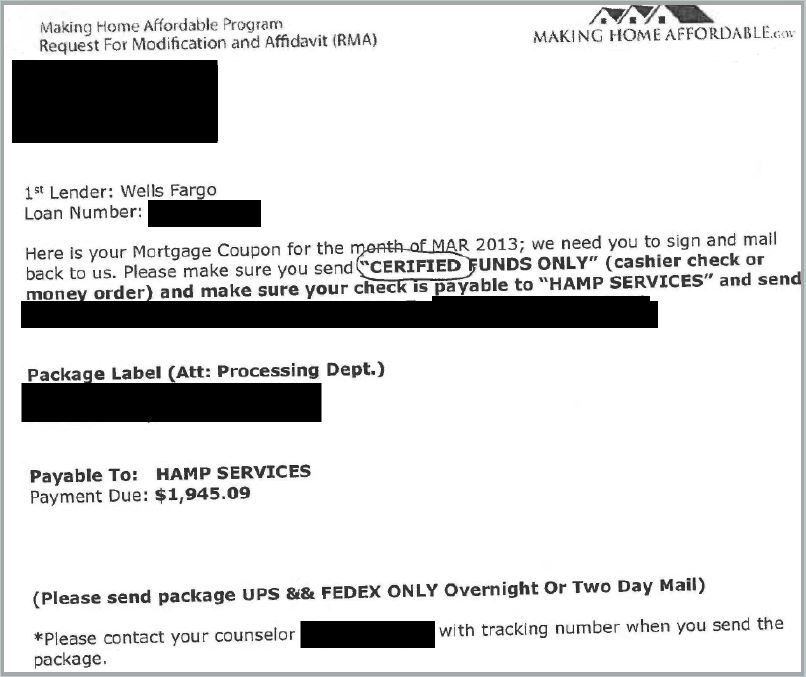
Share this:

  • Click to share on X (Opens in new window) X
  • Click to share on Facebook (Opens in new window) Facebook
Like Loading...

How Can Nevada Homeowners Effectively Handle Foreclosure Matters

08 Friday Apr 2016

Posted by BNG in Affirmative Defenses, Appeal, Federal Court, Foreclosure Defense, Pro Se Litigation

≈ Leave a comment

Tags

Foreclosure, foreclosure defense, Mortgage loan, Nevada, Nevada Foreclosure, Nevada mortgage loans, Pro se legal representation in the United States

Why Is It Impportant For Nevada Homeowners to Protect their Homes?

In Nevada, homeowners must be aware of mortgage loans and foreclosure laws inorder to be few steps aheads of unscrupulous elements that would do whatever it takes to snatch away your home right under your nose.

Why You Need to Know About Nevada Mortgage Loans

When you take out a loan to purchase residential property in Nevada, you typically sign a promissory note and a deed of trust. A promissory note is basically an IOU that contains the promise to repay the loan, as well as the terms for repayment. The deed of trust provides security for the loan that is evidenced by a promissory note.

How Can you Handle the Issues of Missed Payments

If you miss a payment, most loans include a grace period of ten or fifteen days after which time the loan servicer will assess a late fee. (Loan servicers collect and process payments from homeowners, as well as handle loss mitigation applications and foreclosures for defaulted loans.)

The late fee is generally 5% of the overdue payment of principal and interest based on the terms of the note. To find out the late charge amount and grace period for your loan, look at the promissory note that you signed. This information can also be found on your monthly mortgage statement.

What Are Your Option About Missing Quite a Few Payments

If you miss a few mortgage payments, your mortgage servicer will probably send a letter or two reminding you to get caught up, as well as call you to try to collect the payments. Don’t ignore the phone calls and letters. This is a good opportunity to discuss loss mitigation options and attempt to work out an agreement (such as a loan modification, forbearance, or payment plan) so you can avoid foreclosure.

How Can You Handle Pre-Foreclosure Loss Mitigation Review Period

Under the federal Consumer Financial Protection Bureau servicing rules that went into effect January 10, 2014, the mortgage servicer must wait until you are 120 days delinquent on payments before making the first official notice or filing for any nonjudicial or judicial foreclosure. This is to give you sufficient time to explore loss mitigation opportunities. (If a servicer’s sole purpose of providing a notice is to inform you that you are late on your payments and/or explain what your loss mitigation options are, the servicer can deliver the notice within this pre-foreclosure period.)

What About Deed of Trust, What You Need to Know

Nevada deeds of trust often contain a clause that requires the lender to send a notice, commonly called a breach letter or demand letter, informing you that your loan is in default before it can accelerate the loan and proceed with foreclosure. (The acceleration clause in the mortgage permits the lender to demand that the entire balance of the loan be repaid if the borrower defaults on the loan.)

The letter must specify:

  • the default
  • the action required to cure the default
  • a date (usually not less than 30 days from the date the notice is given to the borrower) by which the default must be cured, and
  • that failure to cure the default on or before the date specified in the notice may result in acceleration of the debt and sale of the property.

What Types of Foreclosure Procedures Is there In Nevada

In Nevada, most residential foreclosures are nonjudicial. This means the lender can foreclose without going to court as long as the deed of trust contains a power of sale clause.

What is Notice of Default and Election to Sell

In Nevada, Non-judicial proceedings is used to foreclose most home. The Nevada nonjudicial foreclosure process formally begins when the trustee, a third-party, records a Notice of Default and Election to Sell (NOD) in the office of the recorder in the county where the property is located, providing three months to cure the default.

A copy of the NOD must be sent to each person who has a recorded request for a copy and each person with an interest or claimed interest in the property by registered or certified mail within ten days after the NOD is recorded recordation.

What Are the Requirements for Posting NOD?

If a residential foreclosure, a copy of the NOD must be posted in a conspicuous place on the property 100 days before the date of sale.

Are there Any Affidavit Required

The trustee or beneficiary (lender) must record a notarized affidavit along with the NOD that states, based on a review of business records, including all of the following information.

  • The full name and business address of the current trustee or the current trustee’s personal representative or assignee, the current holder of the note secured by the deed of trust, the current beneficiary of record and the current servicer of the obligation or debt secured by the deed of trust.
  • That the beneficiary under the deed of trust, the successor in interest of the beneficiary or the trustee is in actual or constructive possession of the note secured by the deed of trust; or that the beneficiary or its successor in interest or the trustee is entitled to enforce the obligation or debt secured by the deed of trust.
  • That the beneficiary or its successor in interest, the servicer of the obligation or debt secured by the deed of trust or the trustee, or an attorney representing any of those persons, has sent to the borrower a written statement including the amount needed to cure the default, the principal amount of the debt, the accrued interest and late charges, a good faith estimate of all fees, contact information for obtaining the most current amounts due, and each assignee of the deed of trust.

What Other Alternatives Do I Have to Stop the Foreclosure?

You have 3 alternatives, sometimes 4.

Your alternatives are:

1). Try to call your alleged lender to see if you can get a reasonable person on the phone. Don’t panic, just be prepared as over 90% of the people you speak to on the phone are programmed to act certain way.i.e, if you are lucky as 99.9% you’ll get a recording and will have to leave a message, unfortunately, you have less that 20% of getting a call back response. You’ll know very early that the alleged lender, definitely not with your best interest at heart.

2). Nevada law requires that borrowers who are in foreclosure be given the option to participate in mediation if the property is owner-occupied.

The trustee must mail to the borrower (by registered or certified mail, return receipt requested) an Election to Mediate Form no later than ten days after recording the NOD. If the borrower wants to elect mediation, the form must be completed and returned within 30 days.

3). You can commence litigation to immediately stop the foreclosure, but you have to be prepared to whether the stop as you’ll experience various emotions during the litigation proceedings, but with time, you’ll get used to it.

3) Bamkruptcy is another method to stop foreclosure, but it will not be in your best interest if you just found yourself in foreclosure situation. We recommend Bankruptcy as the last resort and this is why?

If you are a homeowner with a mortgage payment, say like $1000/mth. If you have missed payment that is 1 year or more. Your Chapter 13 bankrupcty payments will be difficult for you to make once in bankrupcty because you will still make the Normal monthly payment and then some portion of the missed payments, which is sometimes, nealy half of the monthly payment. So if you make a payment of $1000 before the foreclosure began, you’ll now have to make ($1500 (Regular + Potion Payments) to catch up. So you ask yourself, if you can’t afford the original payment of $1000, before you went into foreclosure, how can you afford the higher payments.

In Nevada, You Have What is called Danger Notice

At least 60 days prior to the date of the sale, the trustee must provide the borrower(s) with a separate “Danger Notice” stating that they are in danger of losing their home to foreclosure, along with a copy of the original promissory note.

The notice must be:

  • personally served to the borrower
  • left with a person of suitable age and discretion (if the borrower is not available) and a copy mailed, or
  • if a person of suitable age and discretion is not available, then the notice may be posted in a conspicuous place on the property, left with a person residing in the property, and then mailed to the borrower.

What do you need to know about Notice of Sale

After expiration of the three-month period following the recording of the NOD, the trustee must give notice of the time and place of the sale by recording the notice of sale and by:

  • Providing the notice of sale to each required party by personal service or by mailing the notice by registered or certified mail to the last known address 20 days before sale.
  • Posting the notice of sale on the property 15 days before the sale.
  • Posting the notice of sale for 20 days successively in a public place in the county where the property is situated and on the property 15 days before sale.
  • Publishing a copy of the notice of sale three times, once each week for three consecutive weeks, in a newspaper of general circulation in the county where the property is situated.

Notice to Tenants

If the property is tenant occupied, a separate notice must be posted in a conspicuous place on the property and mailed to the tenant no later than three business days after the notice of sale is given.

Reinstatement Before Sale

In the case of owner-occupied housing, the borrower gets a right to reinstate by paying the arrearage, costs, and fees. This right expires 5 days prior to the date of the foreclosure sale.

The Foreclosure Sale

The foreclosure sale must be between the hours of 9:00 a.m. and 5:00 p.m. All sales of real property must be made:

  • at the courthouse in the county in which the property or some part thereof is situated (in counties with a population of less than 100,000), or
  • at the public location in the county designated by the governing body of the county for that purpose (in counties with a population of 100,000 or more).

The property will be:

  • sold to the highest third-party bidder or
  • revert to the foreclosing lender and become REO

Deficiency Judgment Following Sale

When a lender forecloses on a mortgage, the total debt owed by the borrower to the lender frequently exceeds the foreclosure sale price. The difference between the sale price and the total debt is called a “deficiency.” In some states, the lender can seek a personal judgment against the debtor to recover the deficiency. Generally, once the lender gets a deficiency judgment, the lender may collect this amount from the borrower.

In Nevada, a lender may obtain a deficiency judgment following foreclosure, but the amount of the judgment is limited to the lesser of:

  • the difference between the total debt and fair market value of the home, or
  • the difference between the total debt and foreclosure sale price.

For loans taken out after October 1, 2009, deficiencies are prohibited for purchase money loans (that have not been refinanced) held by a bank or other financial institution for single-family residences occupied continuously by the borrowers.

Redemption Period

A redemption period is the legal right of any mortgage borrower in foreclosure to pay off the total debt, including the principal balance, plus certain additional costs and interest, in order to reclaim the property. In Nevada, there is no redemption period following a nonjudicial foreclosure sale.

Eviction Following Foreclosure

If you don’t vacate the property following the foreclosure sale, the new owner will likely:

  • offer you a cash-for-keys deal (where the new owner offers you money in exchange for you agreeing to move out), or
  • give you a three-day notice to quit (leave) before filing an eviction lawsuit.

To learn more about foreclosure in general, ways to defend against foreclosure, and programs to help struggling homeowners avoid foreclosure

When Homeowner’s good faith attempts to amicably work with the Bank in order to resolve the issue fails;

Home owners should wake up TODAY! before it’s too late by mustering enough courage for “Pro Se” Litigation (Self Representation – Do it Yourself) against the Lender – for Mortgage Fraud and other State and Federal law violations using foreclosure defense package found at http://www.fightforeclosure.net “Pro Se” litigation will allow Homeowners to preserved their home equity, saves Attorneys fees by doing it “Pro Se” and pursuing a litigation for Mortgage Fraud, Unjust Enrichment, Quiet Title and Slander of Title; among other causes of action. This option allow the homeowner to stay in their home for 3-5 years for FREE without making a red cent in mortgage payment, until the “Pretender Lender” loses a fortune in litigation costs to high priced Attorneys which will force the “Pretender Lender” to early settlement in order to modify the loan; reducing principal and interest in order to arrive at a decent figure of the monthly amount the struggling homeowner could afford to pay.

If you find yourself in an unfortunate situation of losing or about to lose your home to wrongful fraudulent foreclosure, and need a complete package that will show you step-by-step litigation solutions helping you challenge these fraudsters and ultimately saving your home from foreclosure either through loan modification or “Pro Se” litigation visit: http://www.fightforeclosure.net

Share this:

  • Click to share on X (Opens in new window) X
  • Click to share on Facebook (Opens in new window) Facebook
Like Loading...
← Older posts
Newer posts →

Enter your email address to follow this blog and receive notifications of new posts by email.

Recent Posts

  • Are you facing foreclosure? consider these step
  • San Fernando Valley Con Man Pleads Guilty in Multi-Million Dollar Real Estate Fraud Scheme that Targeted Vulnerable Homeowners
  • Mortgage Application Fraud!
  • What Homeowners Must Know About Mortgage Forbearance
  • Cosigning A Mortgage Loan: What Both Parties Need To Know

Categories

  • Affirmative Defenses
  • Appeal
  • Bankruptcy
  • Banks and Lenders
  • Borrower
  • Case Laws
  • Case Study
  • Credit
  • Discovery Strategies
  • Fed
  • Federal Court
  • Foreclosure
  • Foreclosure Crisis
  • Foreclosure Defense
  • Fraud
  • Judgment
  • Judicial States
  • Landlord and Tenant
  • Legal Research
  • Litigation Strategies
  • Loan Modification
  • MERS
  • Mortgage fraud
  • Mortgage Laws
  • Mortgage loan
  • Mortgage mediation
  • Mortgage Servicing
  • Non-Judicial States
  • Notary
  • Note – Deed of Trust – Mortgage
  • Pleadings
  • Pro Se Litigation
  • Real Estate Liens
  • RESPA
  • Restitution
  • Scam Artists
  • Securitization
  • State Court
  • Title Companies
  • Trial Strategies
  • Your Legal Rights

Archives

  • June 2025
  • February 2022
  • March 2021
  • February 2021
  • September 2020
  • October 2019
  • July 2019
  • May 2019
  • April 2019
  • March 2019
  • January 2019
  • September 2018
  • July 2018
  • June 2018
  • May 2018
  • April 2018
  • March 2018
  • February 2018
  • January 2018
  • December 2017
  • November 2016
  • April 2016
  • March 2016
  • January 2016
  • December 2015
  • September 2015
  • October 2014
  • August 2014
  • July 2014
  • June 2014
  • May 2014
  • April 2014
  • January 2014
  • December 2013
  • November 2013
  • October 2013
  • September 2013
  • August 2013
  • July 2013
  • June 2013
  • May 2013

Recent Posts

  • Are you facing foreclosure? consider these step
  • San Fernando Valley Con Man Pleads Guilty in Multi-Million Dollar Real Estate Fraud Scheme that Targeted Vulnerable Homeowners
  • Mortgage Application Fraud!
  • What Homeowners Must Know About Mortgage Forbearance
  • Cosigning A Mortgage Loan: What Both Parties Need To Know
Follow FightForeclosure.net on WordPress.com

RSS

  • RSS - Posts
  • RSS - Comments

Tags

5th circuit court 9th circuit 9th circuit court 10 years Adam Levitin adding co-borrower Adjustable-rate mortgage adjustable rate mortgage loan administrative office of the courts adversary proceeding affidavits Affirmative defense after foreclosure Alabama Annual percentage rate Appeal Appeal-able Orders Appealable appealable orders Appealing Adverse Decisions Appellate court Appellate Issues appellate proceeding appellate record applying for a mortgage Appraiser Areas of Liability arguments for appeal Arizona Article 9 of the Japanese Constitution Asset Asset Rental Assignment (law) Attorney Fees Attorney general August Aurora Loan Services of Nebraska automatic stay avoid foreclosure Avoid Mistakes During Bankruptcy Avoid Mistakes in Bankruptcy bad credit score bank bank forecloses Bank of America Bank of New York Bankrupcty Bankruptcy bankruptcy adversary proceeding bankruptcy appeal Bankruptcy Appeals Bankruptcy Attorney bankruptcy code bankruptcy court Bankruptcy Filing Fees bankruptcy mistakes bankruptcy on credit report bankruptcy process Bankruptcy Trustee Banks Banks and Lenders Bank statement Barack Obama Berkshire Hathaway Bill Blank endorsement Borrower borrower loan borrowers Borrowers in Bankruptcy Boston Broward County Broward County Florida Builder Bailout Business Buy and Bail Buyer Buyers buying a house buying foreclosed homes California California Court of Appeal California foreclosure California Residents Case in Review Case Trustees Center for Housing Policy CFPB’s Response chapter 7 chapter 7 bankruptcy chapter 11 chapter 11 bankruptcy Chapter 11 Plans chapter 13 chapter 13 bankruptcy Chinese style name Chunking circuit court Citi civil judgments Civil procedure Clerk (municipal official) Closed End Credit Closing/Settlement Agent closing argument collateral order doctrine collection Collier County Florida Colorado Complaint Computer program Consent decrees Consequences of a Foreclosure Consumer Actions Consumer Credit Protection Act Content Contractual Liability Conway Cosigning A Mortgage Loan Counsels Court Court clerk courts Courts of Nevada Courts of New York Credit credit bureaus Credit Counseling and Financial Management Courses credit dispute letter credit disputes Credit history Creditor credit repair credit repair company credit report credit reports Credit Score current balance Debt Debt-to-income ratio debtor Deed in lieu of foreclosure Deed of Trust Deeds of Trust defaulting on a mortgage Default judgment Defendant Deficiency judgment deficiency judgments delinquency delinquency reports Deposition (law) Detroit Free Press Deutsche Bank Dingwall Directed Verdict Discovery dispute letter District Court district court judges dormant judgment Double Selling Due process Encumbered enforceability of judgment lien enforceability of judgments entry of judgment Equifax Equity Skimming Eric Schneiderman Escrow Evans Eviction execution method execution on a judgment Experian Expert witness extinguishment Fair Credit Reporting Act (FCRA) Fake Down Payment False notary signatures Fannie Mae Fannie Mae/Freddie Mac federal bankruptcy laws Federal Bureau of Investigation Federal Court federal courts Federal government of the United States Federal Home Loan Bank Board Federal Housing Administration Federal Judgments Federal Rules of Civil Procedure federal statute Federal tax FHA FICO Fictitious Loan Filing (legal) filing for bankruptcy Finance Finance charge Financial institution Financial reports Financial Services Financial statement Florida Florida Homeowners Florida Supreme Court Fonts Forbearance foreclose foreclosed homes foreclosing on home Foreclosure foreclosure auction Foreclosure Crisis foreclosure defense foreclosure defense strategy Foreclosure in California foreclosure in Florida Foreclosure laws in California Foreclosure Pending Appeal foreclosure process Foreclosure Rescue Fraud foreclosures foreclosure suit Forms Fraud fraud prevention Fraudulent Appraisal Fraudulent Documentation Fraudulent Use of Shell Company Freddie Mac fresh financial start Glaski good credit good credit score Good faith estimate Governmental Liability HAMP HAP hardship home Home Affordable Modification Program home buyer Home insurance homeowner homeowners home ownership Homes Horace housing counselor How Many Bankruptcies Can a Homeowner File How Much Debt Do I Need To File Bankruptcy HSBC Bank USA Ibanez Ibanez Case Identify Theft injunction injunctive injunctive relief installment judgments Internal Revenue Service Interrogatories Investing involuntary liens IOU issuance of the remittitur items on credit report J.P. Morgan Chase Jack Conway Jack McConnell joint borrowers JPMorgan Chase JPMorgan Chase Bank Juarez Judgment judgment creditors judgment expired Judgments after Foreclosure Judicial judicial foreclosures Judicial States July Jury instructions Justice Department Kentucky Kristina Pickering Landlord Language Las Vegas late payment Late Payments Law Lawsuit lawsuits Lawyer Lawyers and Law Firms Lease Leasehold estate Legal Aid Legal Aid by State Legal Assistance Legal burden of proof Legal case Legal Help Legal Information lender lenders Lenders and Vendors lending and servicing liability Lien liens lien stripping lien voidance lifting automatic stay Linguistics Lis pendens List of Latin phrases litigator load modification Loan Loan Modification Loan Modification and Refinance Fraud loan modification specialists Loan origination loans Loan Servicer Loan servicing Los Angeles loses Making Home Affordable Massachusetts Massachusetts Supreme Judicial Court Mastropaolo MBA Letter MBIA McConnell Means Test Forms Mediation mediation program Medical malpractice MER MERS Michigan Monetary Awards Monetary Restitution money Montana mortgage Mortgage-backed security Mortgage Application Fraud Mortgage broker mortgage company Mortgage Coupon Mortgage Electronic Registration System Mortgage fraud Mortgage law mortgage lender Mortgage loan mortgage loan modification mortgage loan modifications mortgage loans Mortgage mediation Mortgage modification Mortgage note mortgages Mortgage servicer Mortgage Servicing Fraud motion Motion (legal) Motion in Limine Motions National Center for State Courts National City Bank National Mortgage Settlement Natural Negotiable instrument Nelva Gonzales Ramos Nevada Nevada Bell Nevada Foreclosure Nevada mortgage loans Nevada Supreme Court New Jersey New Mexico New York New York Stock Exchange New York Times Ninth Circuit non-appealable non-appealable order Non-judicial non-judicial foreclosure non-judicial foreclosures Non-judicial Foreclosure States Non-Judicial States non-recourse nonjudicial foreclosures North Carolina note Notice Notice of default notice of entry of judgment Nueces County Nueces County Texas Objections Official B122C-2 Official Form B122C-1 Ohio Options Oral argument in the United States Orders Originator overture a foreclosure sale Owner-occupier Payment Percentage Perfected periodic payments personal loans Phantom Sale Plaintiff Plan for Bankruptcy Pleading post-judgment pre-trial Pro Bono Process for a Foreclosure Processor Process Service Produce the Note Promissory note pro per Property Property Flip Fraud Property Lien Disputes property liens pro se Pro se legal representation in the United States Pro Se Litigating Pro Se litigator Pro Se trial litigators Protecting Tenant at Foreclosure Act Protecting Tenants PSA PTFA public records purchase a new home Quiet title Real estate Real Estate Agent Real Estate Liens Real Estate Settlement Procedures Act Real property RealtyTrac Record on Appeal refinance a loan Refinance Fraud Refinancing registered judgment Regulatory (CFPB) relief remittance reports remove bankruptcy remove bankruptcy on credit report Remove Late Payments Removing Liens renewal of judgment renewing a judgment Reno Reno Air Request for admissions Rescission Residential mortgage-backed security Residential Mortgage Lending Market RESPA Restitution Reverse Mortgage Fraud Rhode Island robert estes Robert Gaston Robo-signing Sacramento Scam Artists Scope Secondary Mortgage Market Securitization securitized Security interest Se Legal Representation Self-Help Seller servicer servicer reports Services servicing audit setting aside foreclosure sale Settlement (litigation) short sale Short Sale Fraud Social Sciences Social Security South Dakota Special agent standing state State Court State Courts state law Statute of Limitations statute of limitations for judgment renewals statute of repose stay Stay of Proceedings stay pending appeal Straw/Nominee Borrower Subpoena Duces Tecum Summary judgment Supreme Court of United States Tax lien tenant in common Tenants After Foreclosure Tenants Without a Lease Tennessee Texas The Dodd Frank Act and CFPB The TRID Rule Thomas Glaski TILA time-barred judgment Times New Roman Times Roman Timing Title 12 of the United States Code Title Agent Tolerance and Redisclosure Transferring Property TransUnion trial Trial court TRO true owners of the note Trust deed (real estate) Trustee Truth in Lending Act Tuesday Typeface Types of Real Estate Liens U.S. Bancorp U.S. Securities and Exchange Commission UCC Underwriter Uniform Commercial Code United States United States Attorney United States Code United States Congress United States Court of Appeals for the First Circuit United States Department of Housing and Urban Development United States Department of Justice United States district court United States District Court for the Eastern District of California United States federal courts United States federal judge Unperfected Liens US Bank US Securities and Exchange Commission valuation voluntary liens Wall Street Warehouse Lender Warehouseman Washington Washington Mutual Wells Fargo Wells Fargo Bank withdrawal of reference write of execution wrongful foreclosure wrongful foreclosure appeal Wrongful Mortgage Foreclosure Yield spread premium

Fight-Foreclosure.com

Fight-Foreclosure.com

Pages

  • About
  • Buy Bankruptcy Adversary Package
  • Buy Foreclosure Defense Package
  • Contact Us
  • Donation
  • FAQ
  • Services

Archives

  • June 2025
  • February 2022
  • March 2021
  • February 2021
  • September 2020
  • October 2019
  • July 2019
  • May 2019
  • April 2019
  • March 2019
  • January 2019
  • September 2018
  • July 2018
  • June 2018
  • May 2018
  • April 2018
  • March 2018
  • February 2018
  • January 2018
  • December 2017
  • November 2016
  • April 2016
  • March 2016
  • January 2016
  • December 2015
  • September 2015
  • October 2014
  • August 2014
  • July 2014
  • June 2014
  • May 2014
  • April 2014
  • January 2014
  • December 2013
  • November 2013
  • October 2013
  • September 2013
  • August 2013
  • July 2013
  • June 2013
  • May 2013

Website Powered by WordPress.com.

Privacy & Cookies: This site uses cookies. By continuing to use this website, you agree to their use.
To find out more, including how to control cookies, see here: Cookie Policy
  • Subscribe Subscribed
    • FightForeclosure.net
    • Join 349 other subscribers
    • Already have a WordPress.com account? Log in now.
    • FightForeclosure.net
    • Subscribe Subscribed
    • Sign up
    • Log in
    • Report this content
    • View site in Reader
    • Manage subscriptions
    • Collapse this bar
 

Loading Comments...
 

    %d